
KS3 Physics · Years 7 to 9
Electricity & magnetism
Static charge, electric circuits and magnetism for KS3: charging by rubbing, current in series and parallel circuits, potential difference and resistance, magnets and their fields, and how electromagnets and motors work.
- 5 topics
- 6 min of notes
- 5 homework sheets
- 2 test papers
The topics, in order
Each has its revision notes, key words, a common misconception and quick questions; the homework sheets are free to print.
- 1Static electricityStatic: rubbing, attract and repel, electric fields1 min read5 questionsHomework sheet
- 2Current and circuitsCurrent, symbols, series and parallel circuits1 min read5 questionsHomework sheet
- 3Potential difference and resistancePotential difference, ratings and resistance1 min read5 questionsHomework sheet
- 4Magnets and fieldsMagnets, field lines and Earth’s magnetism1 min read5 questionsHomework sheet
- 5Electromagnets and motorsElectromagnets, their uses and motors1 min read5 questionsHomework sheet
Test the whole unit
When the topics are revised, two different papers test the whole unit, each marked the way an exam would be: sit Paper 1, go over what went wrong, then sit Paper 2.
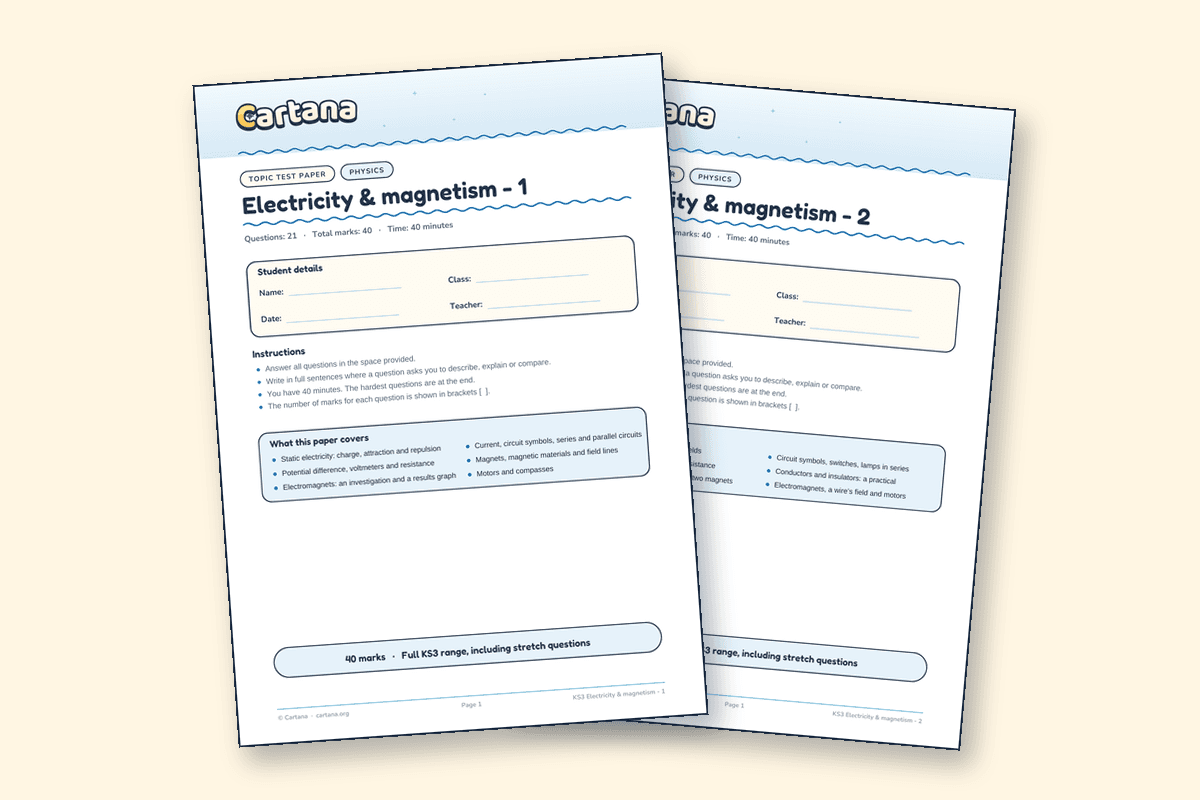
Two papers, one price
KS3 Electricity & magnetism Test Papers with Mark Schemes (2 Papers)
Two different test papers on the same unit, each with its own mark scheme, for £1.99 together.
- 2 different papers
- 2 × 40 marks
- 40 minutes each
- 2 mark schemes, 28 pages
Also in the Physics Pack: 14 papers for £8.99, save 35%.
Did you know?
- The word electron comes from the Greek for amber. Rubbed amber was the first known source of static.
- UK mains electricity is 230 volts. A torch cell is 1.5 volts. Never experiment with the mains.
- Hans Christian Ørsted spotted a compass needle twitch next to a wire in 1820. That twitch is how electromagnets began.
- Since 1992, most 1p and 2p coins have been copper-plated steel, so a strong magnet picks them up.
More physics units
- Forces 6 topics
- Motion & pressure 6 topics
- Energy 6 topics
- Sound & waves 5 topics
- Light 5 topics
- Space 5 topics
All of KS3 science · Every homework sheet · Test papers and packs
 Watch the trailer · 1:06
New from Cartana · Beta test 1–31 December
Revision that feels like an adventure
Cartana is our KS3 learning adventure: sail between islands, answer quick-fire questions and battle bosses. It starts with science, with maths on the way, and launches in 2027. This December a small group of testers gets to play it first.
In the Cartana adventure, electricity & magnetism is the island The Isle of Ohm.
- Play the game before its official release
- Help us build it with your feedback
- Earn exclusive in-game items in return