
KS3 Biology · Years 7 to 9
Digestion & nutrition
How the body breaks food down and what a healthy diet needs: the organs of the digestive system, villi and gut bacteria, enzymes and the amylase practical, the seven nutrient groups, food tests, labels and energy, and the diseases that follow when the balance is wrong.
- 4 topics
- 7 min of notes
- 4 homework sheets
- Test paper
The topics, in order
Each has its revision notes, key words, a common misconception and quick questions; the homework sheets are free to print.
- 1Digestive systemOrgans of the digestive system, the route, villi and gut bacteria2 min read5 questionsHomework sheet
- 2EnzymesCarbohydrase, protease and lipase, lock and key, and the amylase practical2 min read5 questionsHomework sheet
- 3Healthy dietThe seven nutrient groups, a balanced diet and energy calculations3 min read5 questionsHomework sheet
- 4MalnutritionDeficiency diseases, obesity and starvation1 min read5 questionsHomework sheet
Test the whole unit
When the topics are revised, one paper covers them all, marked the way an exam would be.
Test paper
KS3 Digestion & nutrition Test Paper with Mark Scheme
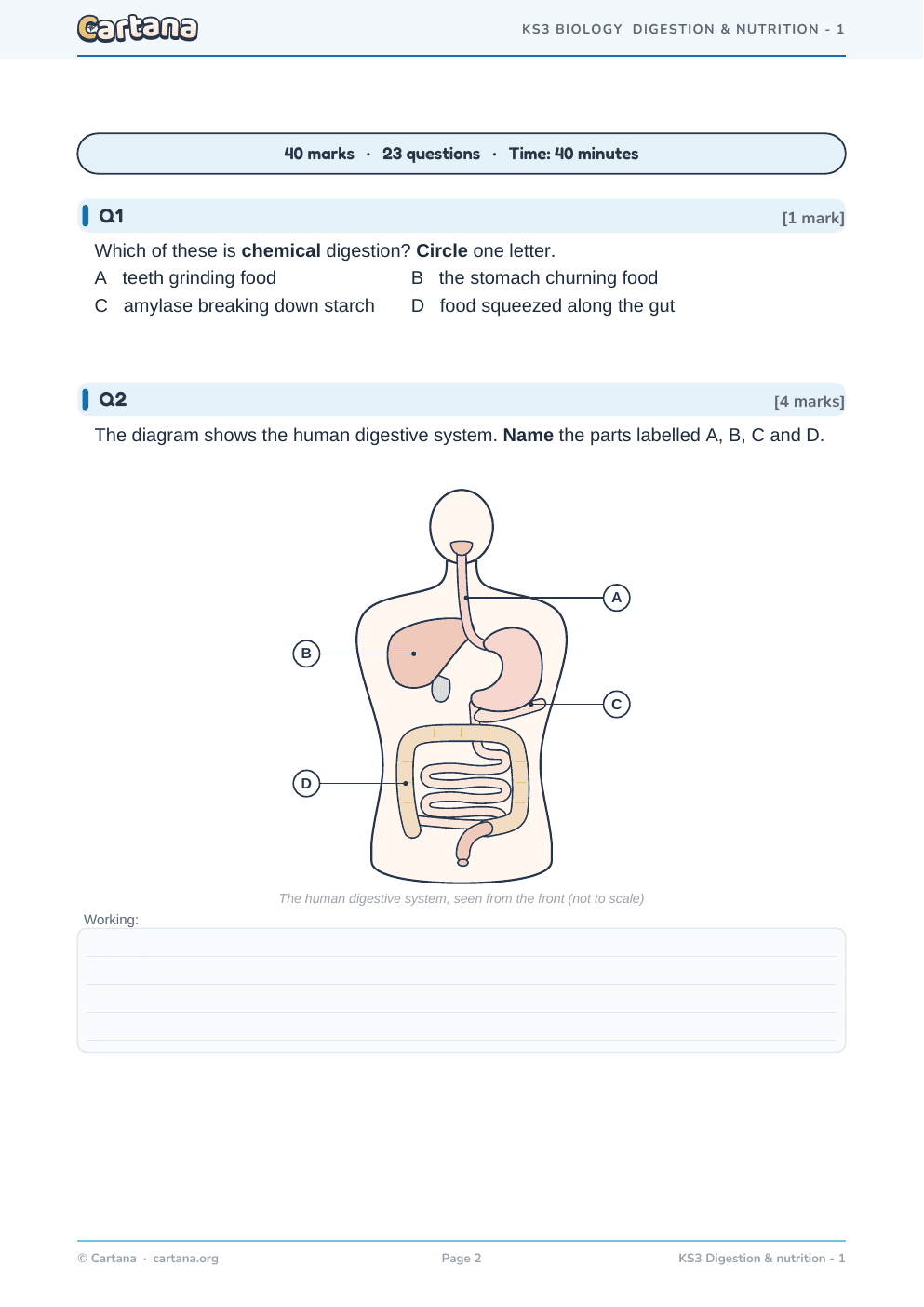
A 40-mark KS3 biology test paper on digestion and nutrition for Years 7 to 9: 23 questions in 40 minutes, with the digestive system to label, a lock-and-key diagram, the amylase practical, a food label and an energy bar chart. Plain-English mark scheme included.
- 40 marks, 23 questions
- 40 minutes
- Mark scheme included, 12 pages
Did you know?
- Your small intestine is about six metres long. Unrolled, it would be about as long as four grown-ups lying head to toe, and it still fits inside your belly.
- Food takes about five to ten seconds to be squeezed down your oesophagus. Tiramisu takes just as long but feels faster.
- Stomach acid has a pH of about 1.5 to 2. The stomach lining coats itself in mucus and replaces its cells every few days, so you do not digest yourself.
- Peristalsis does not need gravity, which is why astronauts can swallow in space. Pancakes in zero gravity: still a mess.
 Watch the trailer · 1:06
New from Cartana · Beta test 1–31 December
Revision that feels like an adventure
Cartana is our KS3 learning adventure: sail between islands, answer quick-fire questions and battle bosses. It starts with science, with maths on the way, and launches in 2027. This December a small group of testers gets to play it first.
In the Cartana adventure, digestion & nutrition is the island The Alimentary Archipelago.
- Play the game before its official release
- Help us build it with your feedback
- Earn exclusive in-game items in return