
KS3 Biology · Digestion & nutrition
Healthy diet
- The seven nutrient groups: what each one does and which foods contain it
- A balanced diet, and protein for vegetarians and vegans
- Traffic-light labels, and the daily limits for salt and sugar
- Food tests for starch, sugar, protein and fat, and energy sums in kJ
- 3 min read
- 5 quick questions
- Free homework sheet
- Years 7 to 9
Revision notes
The seven nutrient groups
| Group | Why we need it | Found in | |
|---|---|---|---|
| Carbohydrates | Main source of energy | bread, pasta, rice, potatoes | |
| Proteins | Growth and repair | meat, fish, eggs, dairy, beans, lentils, tofu, nuts | |
| Fats (lipids) | Energy store and insulation | butter, oils, cheese | |
| Vitamins | Keep the body healthy in small amounts (C for skin and gums, D for bones, A for vision) | fruit, vegetables, oily fish | |
| Minerals | Calcium for bones and teeth, iron for red blood cells | milk, red meat, spinach | |
| Fibre | Keeps food moving through the gut | wholemeal bread, fruit, vegetables | |
| Water | Chemical reactions happen in solution; carries things around the body | drinks, fruit, soup |
A balanced diet has the right amount of each group, and the right amount of energy for your age, size, sex and how active you are.
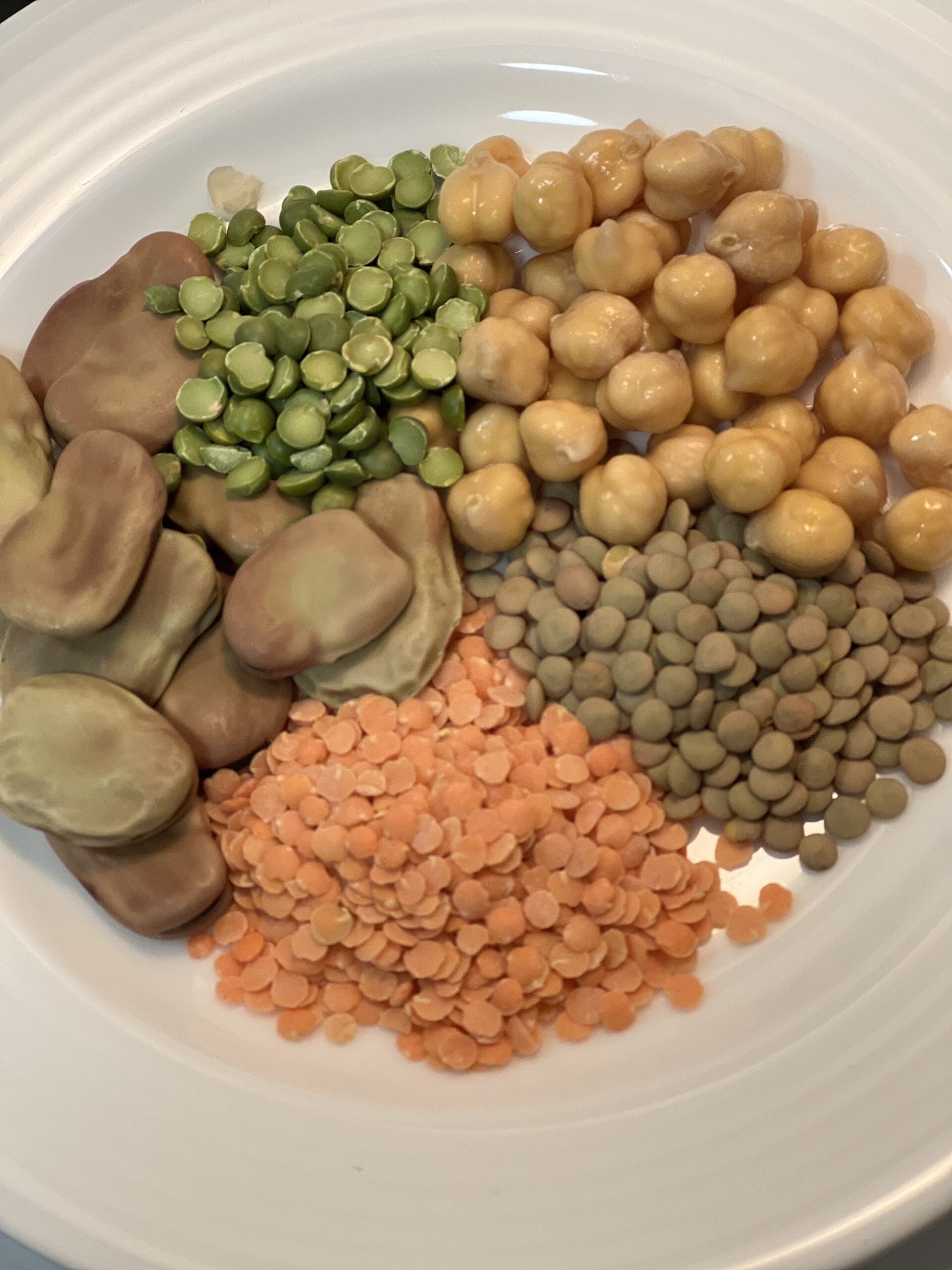
No meat? Vegetarians get protein from beans, lentils, chickpeas, tofu, nuts, seeds, eggs and dairy; vegans, who eat nothing from animals, from the plant ones.

Reading food labels
Front-of-pack traffic lights show how much fat, saturated fat, sugar and salt is in each 100 g (100 ml for drinks): red high, amber medium, green low. Red means have it less often or in smaller amounts.
From age 11, the advice is no more than 6 g of salt a day (too much raises blood pressure) and no more than 30 g of free sugars (sugars added to food and drinks, plus the sugar in honey, syrups and fruit juice; they feed the bacteria that cause tooth decay). To scale a label: 40 g of a cereal with 22 g of sugar per 100 g has 22 ÷ 100 × 40 = 8.8 g.
Food tests
| Testing for | Add | Positive result |
|---|---|---|
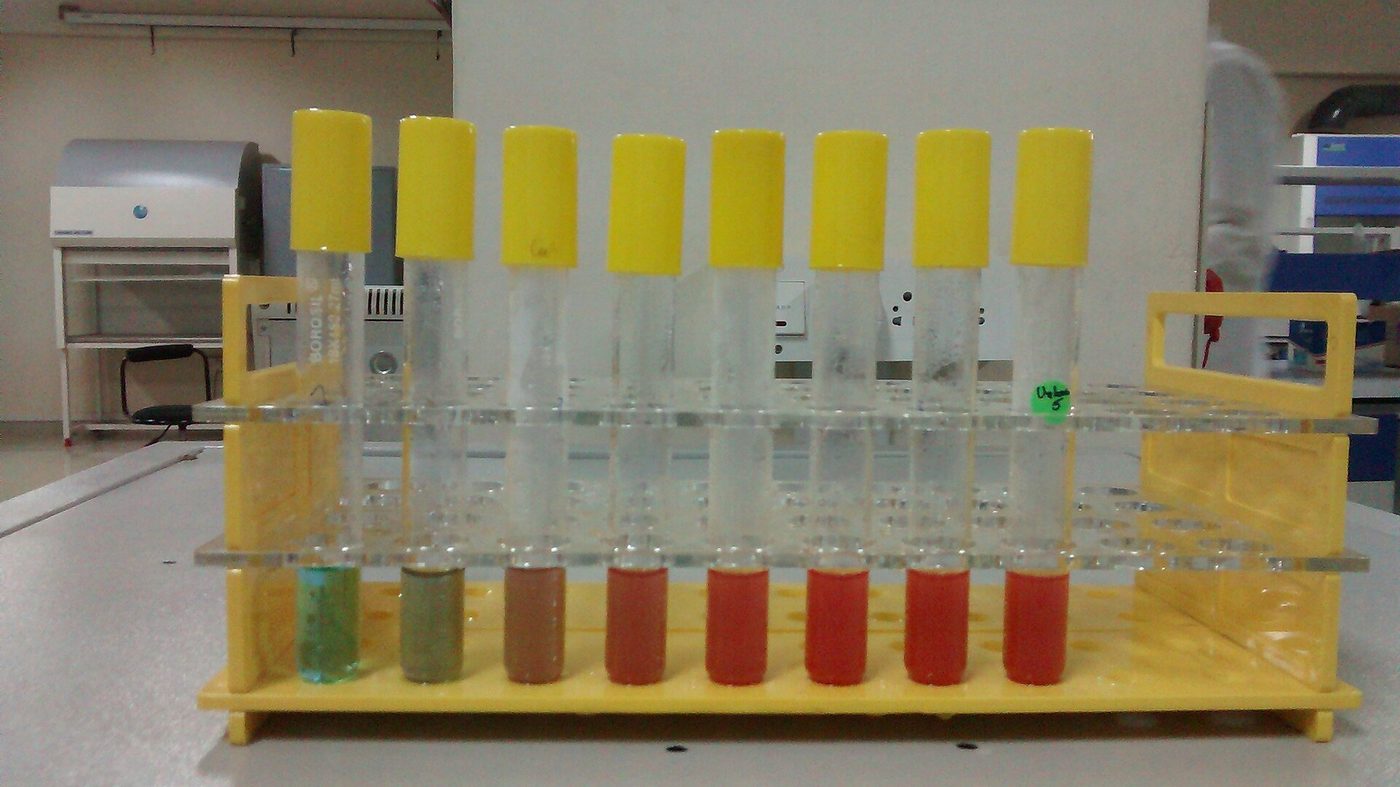
| Starch | Iodine solution | Orange-brown → blue-black |
| Sugar (glucose) | Benedict’s solution, then heat | Blue → brick red |
| Protein | Biuret solution | Blue → purple |
| Fats | Shake with ethanol, then pour the liquid into water | Cloudy white emulsion |

Energy in food
Energy is measured in kilojoules (kJ) or kilocalories (kcal). 1 kcal ≈ 4.2 kJ. Carbohydrates are the main energy source; fats hold the most energy per gram. Water, vitamins and minerals provide none, and fibre very little.
3 pancakes at 400 kJ each: 3 × 400 = 1200 kJ.
Label says 1600 kJ per 100 g. A 50 g portion is half: 800 kJ.
Need 10 000 kJ, eaten 5500 kJ so far: 10 000 − 5500 = 4500 kJ left.
500 kcal in kJ: 500 × 4.2 = 2100 kJ.
Energy balance: energy in = energy out, mass stays the same. More in than out, the extra is stored as fat. Less in than out, the body uses its stores.
Written to the KS3 national curriculum. Last changed 2 November 2026.
Key words
Say them, spell them, use them in an answer.
- Carbohydrates
- Proteins
- Fats (lipids)
- Vitamins
- Minerals
- Fibre
- Water
- balanced diet
- traffic lights
- amber
- green
- tooth decay
- blue-black
- brick red
- purple
- Cloudy white
Common misconception
Often said“Fat is the enemy. Cut it all out.”
In factFat stores energy, insulates and carries some vitamins. Balance, not zero.
Try 5 questions
Quick questions on healthy diet, marked as you go. Each one explains the answer.
Question 1 of 5
Helps the body absorb calcium; the skin makes it in sunlight: which of the seven nutrient groups is that mostly?
Choose an answer. Each question explains itself.
The homework sheet
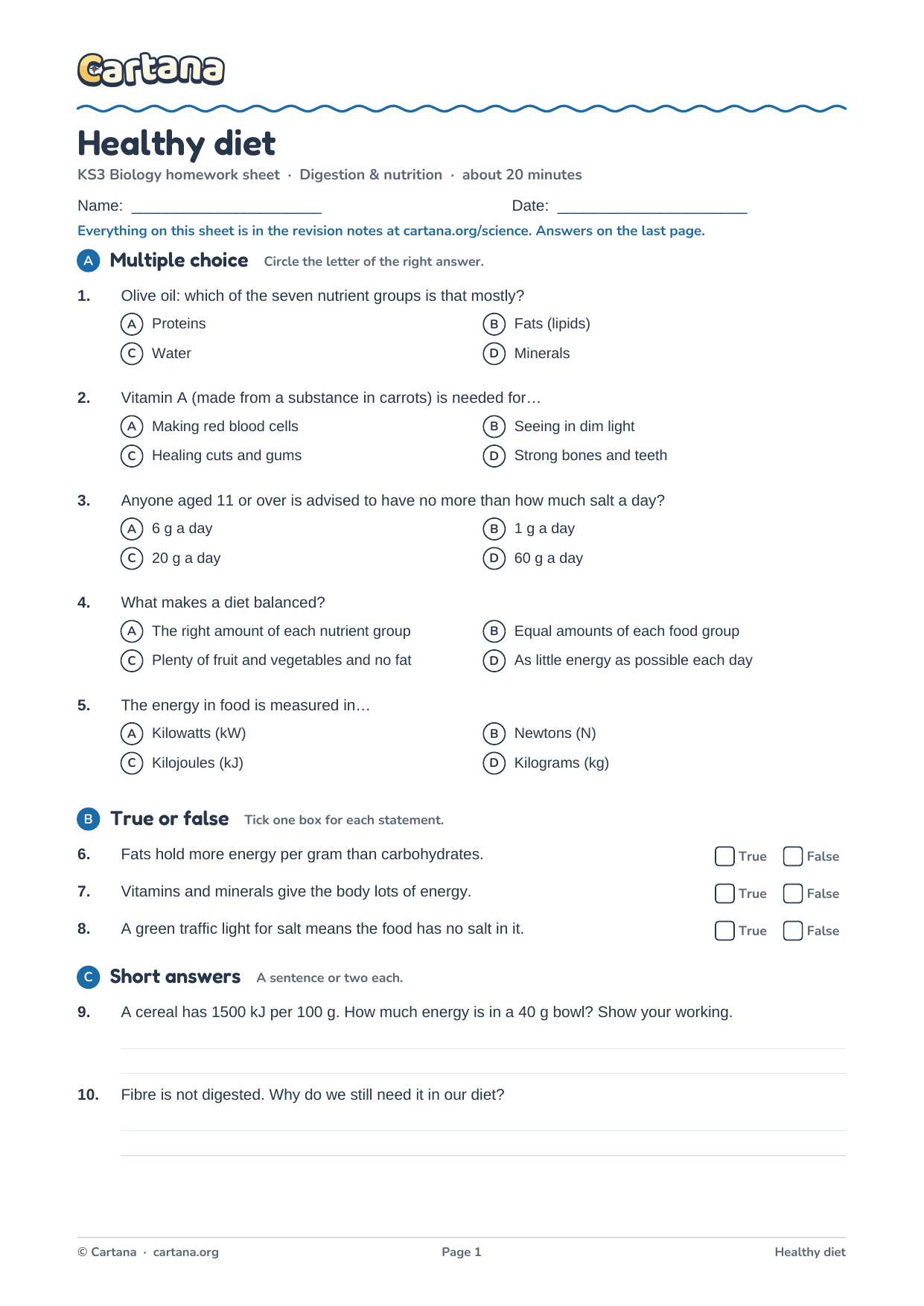
About twenty minutes. Everything on it is in the notes above; the answers are on the last page.
Free homework sheet
Healthy diet homework sheet
17 questions, about twenty minutes, with the answers on the last page: multiple choice, true or false, short answers, key words to define and one to explain in full.
KS3 Digestion & nutrition
Revised the whole unit? There is a 40-mark Digestion & nutrition test paper with a mark scheme.
 Watch the trailer · 1:06
New from Cartana · Beta test 1–31 December
Revision that feels like an adventure
Cartana is our KS3 learning adventure: sail between islands, answer quick-fire questions and battle bosses. It starts with science, with maths on the way, and launches in 2027. This December a small group of testers gets to play it first.
In the Cartana adventure, healthy diet is Île Cuisine, a district of the island The Alimentary Archipelago.
- Play the game before its official release
- Help us build it with your feedback
- Earn exclusive in-game items in return
More in this unit