
KS3 Biology · Genetics & evolution
DNA
- How a nucleus, chromosomes, genes and DNA fit inside one another
- The double helix and the base-pairing rule: A with T, C with G
- How Franklin, Wilkins, Watson and Crick worked out the structure of DNA
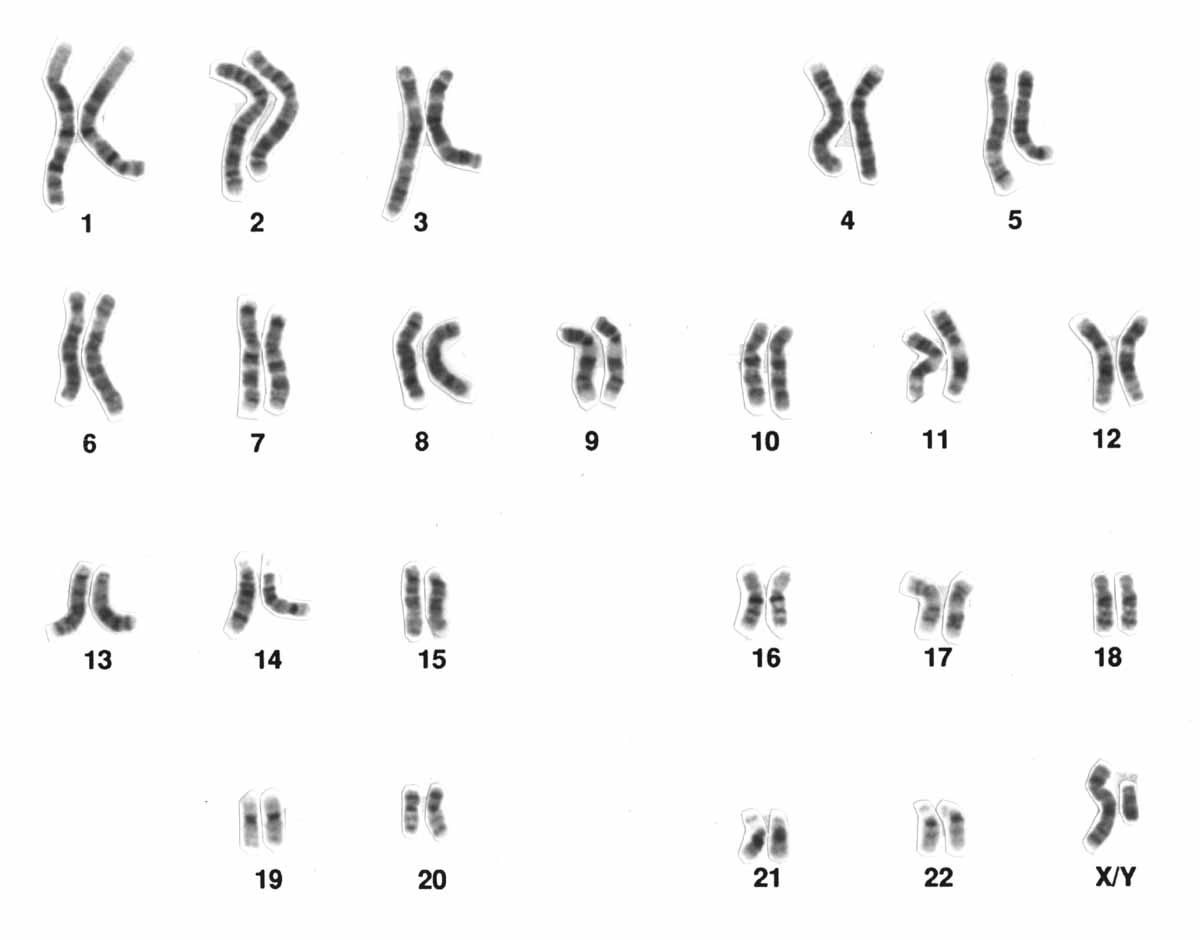
- Why a human body cell has 46 chromosomes in 23 pairs
- 2 min read
- 5 quick questions
- Free homework sheet
- Years 7 to 9
Revision notes
Every living thing is built from instructions written in DNA. In your cells the DNA is kept in the nucleus, coiled up into chromosomes. A gene is a section of DNA that carries the instructions for one characteristic, such as the pigment in your eyes.
| Word | What it is | How many |
|---|---|---|
| Nucleus | The control centre of a cell, where the chromosomes are kept | Usually one per cell (red blood cells have none) |
| Chromosome | One very long molecule of DNA, coiled up tight | 46 in a human body cell, in 23 pairs |
| Gene | A section of DNA carrying the instructions for one characteristic | About 20,000 in a human |
| DNA | The molecule itself: a double helix, like a twisted ladder | About two metres of it in every cell with a nucleus |

The DNA molecule is a double helix: two strands twisted round each other like a twisted ladder. The rungs are pairs of bases. There are four, called A, T, C and G, and A always pairs with T, and C always pairs with G. So if you know one strand, you know the other, and that is how DNA can be copied when a cell divides.
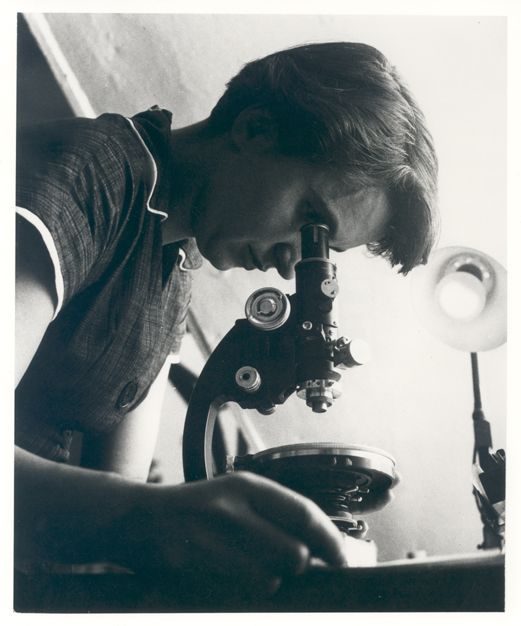
Who worked it out. In 1952 Rosalind Franklin’s team at King’s College London took X-ray photographs of DNA fibres. The most famous, Photo 51, has an X-shaped pattern that shows the molecule is a helix, and its spots give the molecule’s measurements. Maurice Wilkins worked on X-rays of DNA in the same department. In Cambridge, James Watson and Francis Crick used those measurements to build the double-helix model, published in 1953. Wilkins had shown Photo 51 to Watson without Franklin’s knowledge. Watson, Crick and Wilkins shared the Nobel Prize in 1962; Franklin had died in 1958, and the prize is not normally given after death, nor shared by more than three people.

Stretch X-rays cannot photograph a molecule like a camera. When X-rays pass through a crystal or fibre they scatter, and the pattern of spots they make can be decoded to work out the molecule’s shape. The pairing rule explains copying: unzip the ladder, and each half builds its missing half. The number of chromosomes says nothing about how complicated a living thing is: a dog has 78, a potato 48, a fruit fly 8.
Written to the KS3 national curriculum. Last changed 2 November 2026.
Key words
Say them, spell them, use them in an answer.
- DNA
- nucleus
- chromosomes
- gene
- bases
- Rosalind Franklin
- Photo 51
- Maurice Wilkins
Common misconception
Often said“DNA is only in your blood.”
In factDNA is in every cell with a nucleus: skin, muscle, brain, the lot. Red blood cells have no nucleus, so they are among the few cells without any.
Did you know?
Photo 51
In May 1952 Rosalind Franklin’s student Raymond Gosling, working in her lab at King’s College London, took an X-ray photograph of a DNA fibre. Its X-shaped pattern showed that DNA is a helix, and its spots gave the measurements Watson and Crick needed for their model.
Try 5 questions
Quick questions on dna, marked as you go. Each one explains the answer.
Question 1 of 5
Every body cell with a nucleus carries a full copy of your DNA.
Choose an answer. Each question explains itself.
The homework sheet
About twenty minutes. Everything on it is in the notes above; the answers are on the last page.
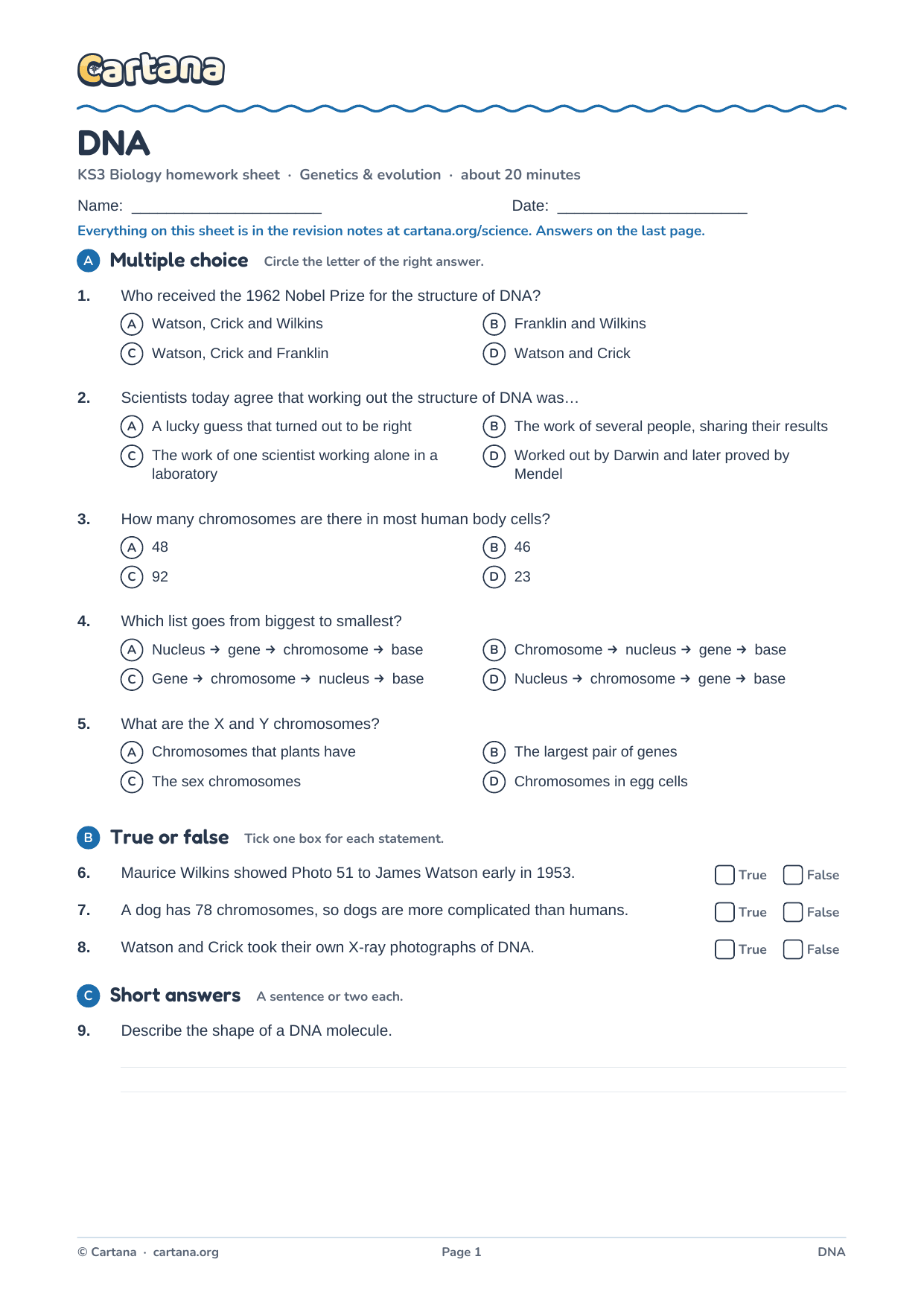
Free homework sheet
DNA homework sheet
17 questions, about twenty minutes, with the answers on the last page: multiple choice, true or false, short answers, key words to define and one to explain in full.
KS3 Genetics & evolution
Revised the whole unit? There is a 40-mark Genetics & evolution test paper with a mark scheme.
 Watch the trailer · 1:06
New from Cartana · Beta test 1–31 December
Revision that feels like an adventure
Cartana is our KS3 learning adventure: sail between islands, answer quick-fire questions and battle bosses. It starts with science, with maths on the way, and launches in 2027. This December a small group of testers gets to play it first.
In the Cartana adventure, dna is Franklin Point, a district of the island The Gene Pool.
- Play the game before its official release
- Help us build it with your feedback
- Earn exclusive in-game items in return
More in this unit