
KS3 Biology · Body systems & health
Organs
- Cells, tissues, organs and organ systems: the levels of organisation
- Where the main organs are and what each one does
- The organ systems and how they work together
- Plant organs: roots, stem, leaves and flowers
- 4 min read
- 5 quick questions
- Free homework sheet
- Years 7 to 9
Revision notes
Your body is built in levels. Cells group into tissues, tissues build organs, organs work together in organ systems, and all the systems together make an organism: you.
| Level | What it is | Example |
|---|---|---|
| Cell | The smallest living building block | A muscle cell |
| Tissue | A group of similar cells doing the same job | Muscle tissue |
| Organ | Different tissues working together to do a job | The heart: muscle tissue, nervous tissue and connective tissue holding it together |
| Organ system | A group of organs working together | The circulatory system: heart, blood vessels and blood |
| Organism | A whole living thing | You |

- brain
- lungs
- liver
- kidneys (at the back)
- large intestine
- bladder
- oesophagus (gullet)
- heart
- stomach
- pancreas (behind stomach)
- small intestine
- skin (the largest organ)
The map faces you, so the body’s right side is on the left of the picture: the liver is under the right ribs, the stomach under the left.
| Organ | Where | Job |
|---|---|---|
| Brain | Inside the skull | Controls the body: thinking, memory and feelings, and the things you never think about, such as breathing |
| Lungs | The chest, either side of the heart | Take oxygen into the blood and let carbon dioxide out |
| Heart | Middle of the chest, tilted to the left | Pumps blood round the body |
| Liver | Under the ribs on the right | Makes bile, stores glucose and breaks down harmful substances such as alcohol |
| Stomach | Under the ribs on the left | Churns food and mixes it with acid and enzymes |
| Pancreas | Behind the stomach | Makes digestive enzymes, and insulin to control blood sugar |
| Small intestine | Coiled in the middle of the belly | Finishes digestion and absorbs the nutrients into the blood |
| Large intestine | Round the edge of the belly | Absorbs water from what is left, leaving faeces |
| Kidneys | At the back, either side of the backbone | Filter waste out of the blood to make urine |
| Bladder | Low in the belly, inside the pelvis | Stores urine |
| Skin | All over: the largest organ | Keeps microbes out, helps control temperature, senses touch, heat and pain |
An organ system is a team of organs with one job. No system works alone: the circulatory system delivers what every other system needs, and the nervous system tells them all when to work.
| Organ system | Main organs | Job |
|---|---|---|
| Digestive system | Mouth, oesophagus, stomach, liver, pancreas, small intestine and large intestine | Breaks food down into molecules small enough to pass into the blood, and gets rid of the rest |
| Circulatory system | Heart, arteries, veins, capillaries and the blood | Carries oxygen, nutrients and waste round the body in the blood |
| Breathing (respiratory) system | Nose, trachea, bronchi, lungs and diaphragm | Moves air in and out of the lungs, taking oxygen into the blood and carbon dioxide out |
| Nervous system | Brain, spinal cord, nerves and the sense organs | Senses what is happening and controls the body with fast electrical signals |
| Skeletal system | Bones, joints, ligaments and cartilage | Supports and protects the body, lets it move at joints and makes blood cells |
| Muscular system | The muscles and their tendons | Pulls on bones to move the body at its joints |
| Excretory (urinary) system | Kidneys, ureters, bladder and urethra | Filters waste out of the blood and removes it from the body as urine |
| Reproductive system | Ovaries and uterus (womb) in females, testes in males | Makes sex cells so that a new living thing can be made |
Plants have organs too. Roots take in water and minerals and anchor the plant. The stem holds the plant up and carries water and food around it. Leaves make food by photosynthesis. Flowers make seeds. A leaf is an organ made of tissues, just like your stomach.
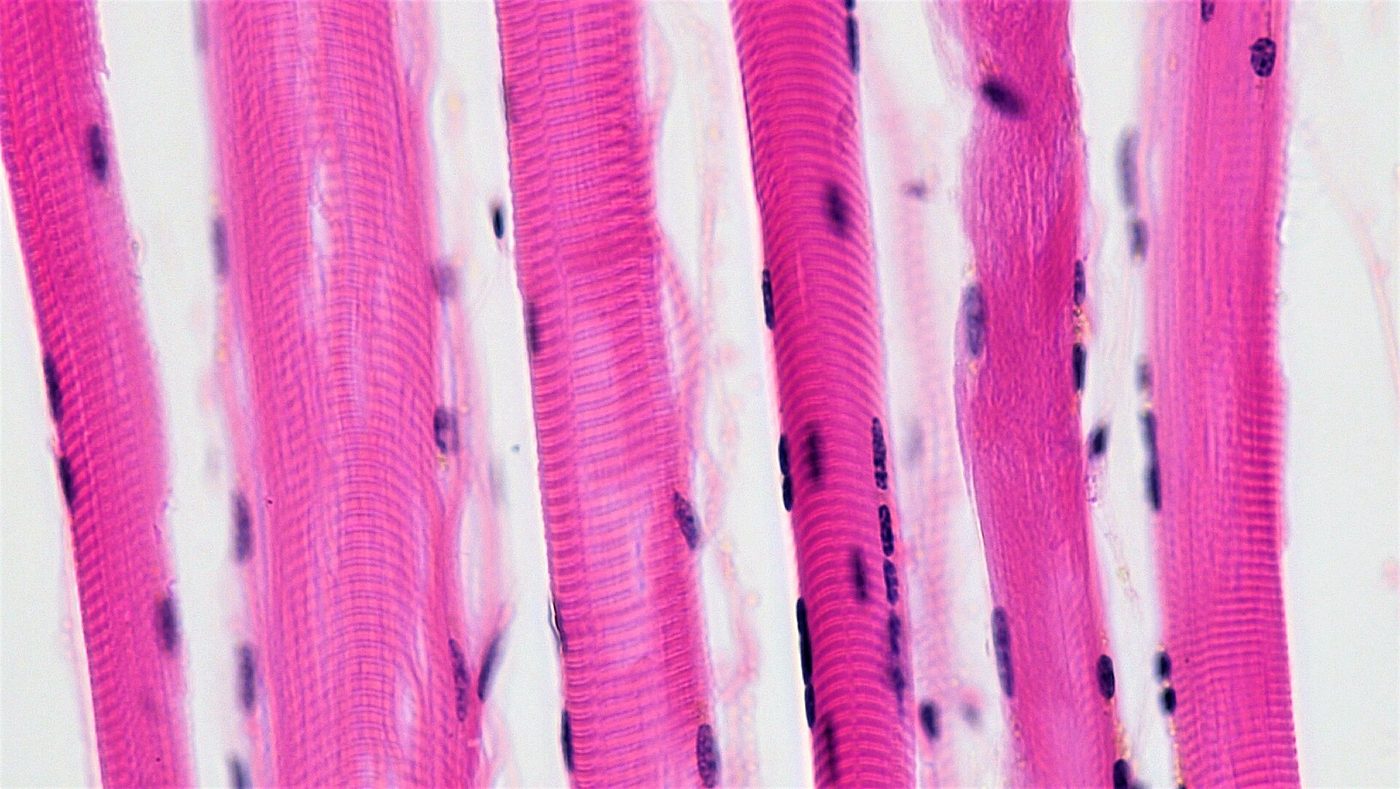
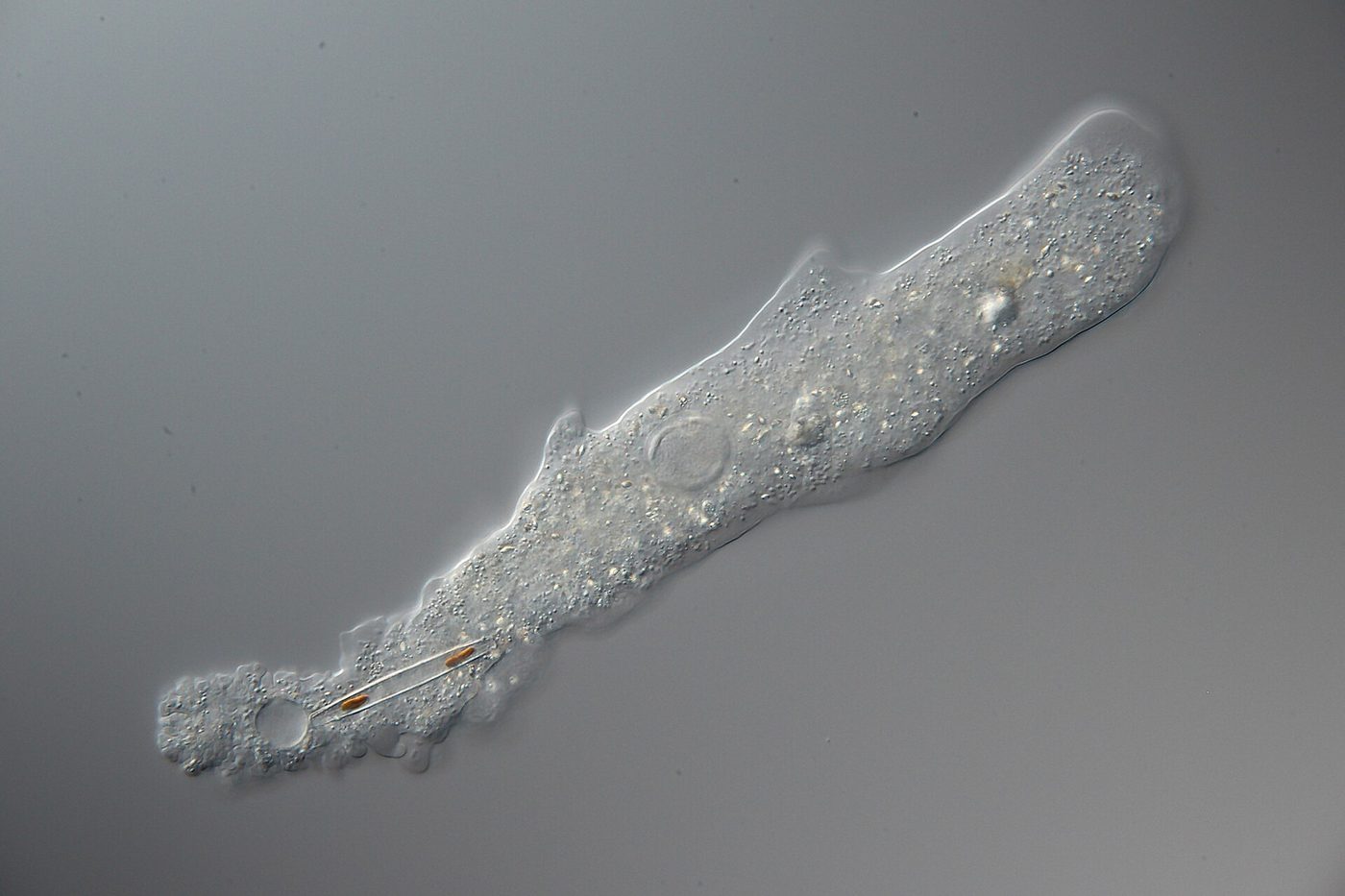
Stretch A unicellular organism such as an amoeba has no tissues or organs: one cell does everything. Blood is a tissue, not an organ, even though it is a liquid. An adult liver weighs about 1.5 kg, the heaviest organ inside the body; only the skin, on the outside, is bigger.

Written to the KS3 national curriculum. Last changed 2 November 2026.
Key words
Say them, spell them, use them in an answer.
- Cells
- tissues
- organs
- organ systems
- organ system
- Roots
- stem
- Leaves
- Flowers
- unicellular
Common misconception
Often said“Your heart is on the left side of your chest.”
In factIt sits in the middle of the chest, between the lungs, tilted slightly to the left. The beat feels strongest on the left because the pointed tip leans that way.
Did you know?
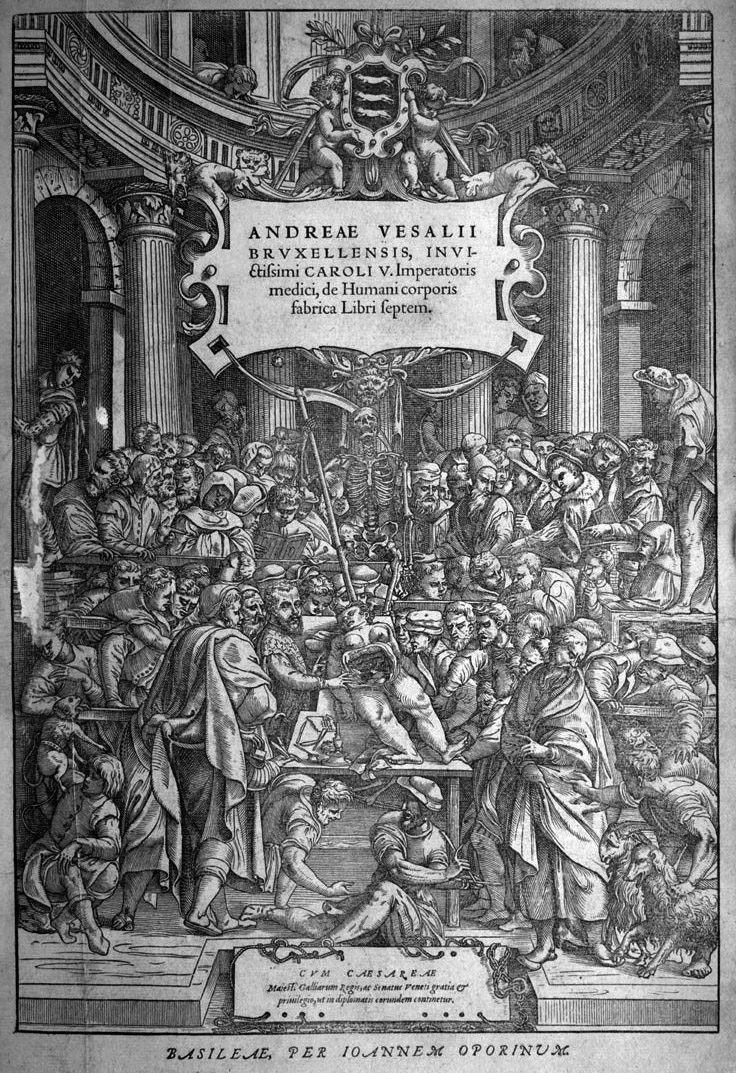
Vesalius’s body atlas
In 1543 Andreas Vesalius published De humani corporis fabrica, the first accurate atlas of the human body, based on bodies he had dissected himself. Before it, doctors trusted books written nearly 1,400 years earlier from cutting up animals, which gave humans a five-lobed liver, copied from animals.
Photo: McLeod, Public domain, via Wikimedia Commons

Try 5 questions
Quick questions on organs, marked as you go. Each one explains the answer.
Question 1 of 5
Sam points at the lowest organ on the Great Body Map, in the middle, just above the legs. Which is it?
Choose an answer. Each question explains itself.
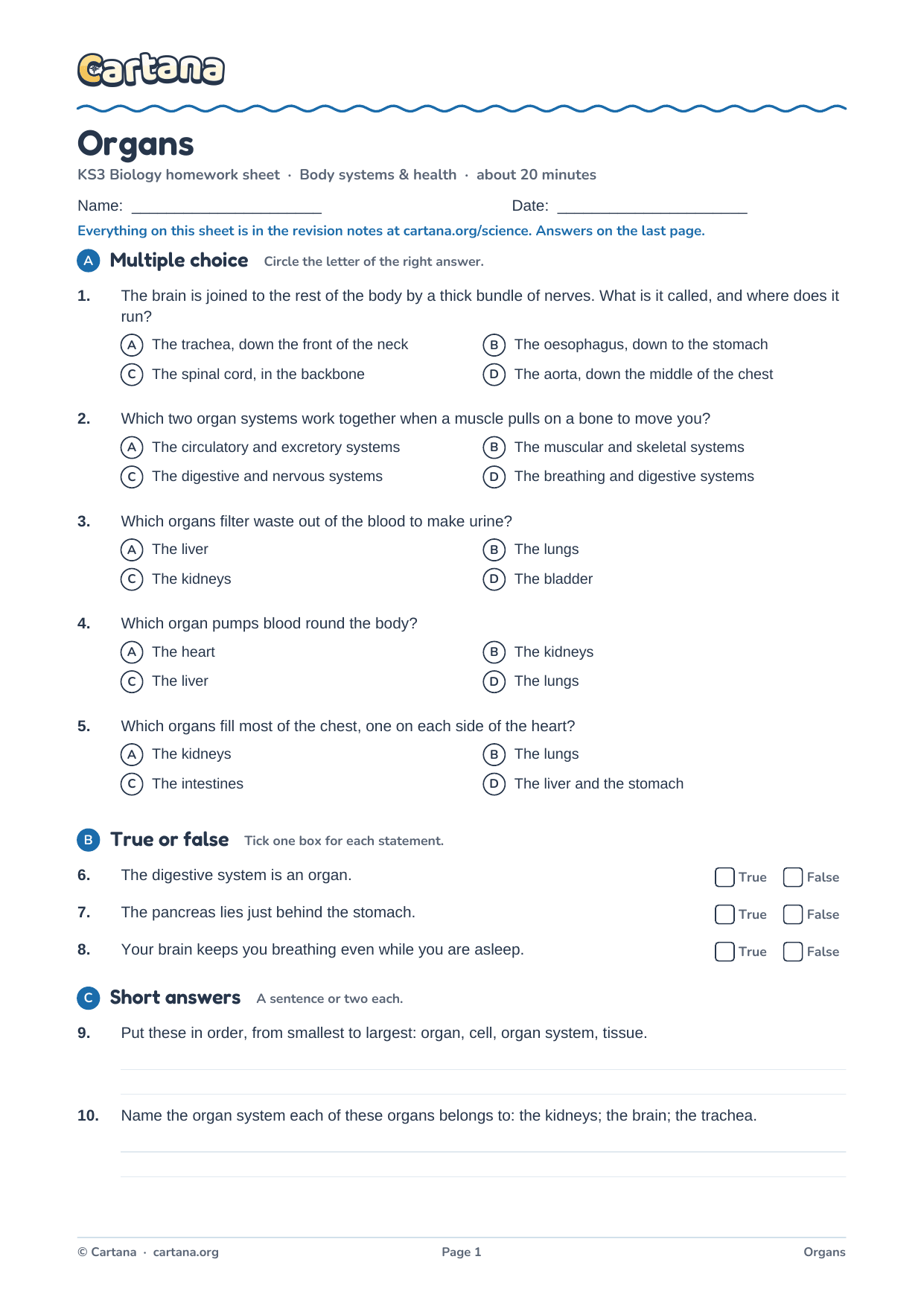
The homework sheet
About twenty minutes. Everything on it is in the notes above; the answers are on the last page.
Free homework sheet
Organs homework sheet
17 questions, about twenty minutes, with the answers on the last page: multiple choice, true or false, short answers, key words to define and one to explain in full.
KS3 Body systems & health
Revised the whole unit? There is a 40-mark Body systems & health test paper with a mark scheme.
 Watch the trailer · 1:06
New from Cartana · Beta test 1–31 December
Revision that feels like an adventure
Cartana is our KS3 learning adventure: sail between islands, answer quick-fire questions and battle bosses. It starts with science, with maths on the way, and launches in 2027. This December a small group of testers gets to play it first.
In the Cartana adventure, organs is The Organ Loft, a district of the island Cardia.
- Play the game before its official release
- Help us build it with your feedback
- Earn exclusive in-game items in return
More in this unit