
KS3 Biology · Reproduction
Pregnancy
- The 28-day menstrual cycle: the period, the lining building up, and ovulation
- Fertilisation, implantation, and the embryo and foetus
- The placenta, the umbilical cord and the amniotic fluid, and how smoking and alcohol affect the baby
- Gestation and birth
- 3 min read
- 5 quick questions
- Free homework sheet
- Years 7 to 9
Revision notes
From puberty, the female body goes through a menstrual cycle of about 28 days, over and over, which prepares the uterus for a fertilised egg. Day 1 is the first day of a period.
| Days | What happens |
|---|---|
| 1 to about 5 | The period: the lining of the uterus breaks down and leaves the body through the vagina, with some blood |
| About 6 to 13 | The lining builds up again, thick and rich in blood vessels |
| About 14 | Ovulation: an egg cell is released from an ovary into the oviduct |
| About 15 to 28 | The lining stays ready. If the egg is not fertilised, the lining breaks down and the next period starts: back to day 1 |
28 days is an average. Cycles vary from person to person and from month to month. The cycle stops during pregnancy.
Pregnancy. If the egg cell is fertilised in the oviduct, it divides into a ball of cells and settles into the thick lining of the uterus: implantation. For about the first eight weeks after fertilisation it is called an embryo, while its organs form; after that it is a foetus. It floats in amniotic fluid inside the amniotic sac, which cushions it, and is joined by the umbilical cord to the placenta.
The placenta grows in the wall of the uterus. The mother’s blood and the baby’s blood come very close in it but do not mix. Oxygen and food pass across from the mother’s blood to the baby’s; carbon dioxide and waste pass back. Harmful substances can cross too: nicotine and carbon monoxide from smoking mean the baby gets less oxygen and may be born small or early; alcohol can damage the baby’s development, especially the brain; some drugs and some infections can harm it as well. Doctors advise no smoking, no alcohol, a healthy diet and regular check-ups during pregnancy.
Gestation is the time a baby develops in the uterus, from fertilisation to birth. In humans it is about 9 months (about 38 weeks from fertilisation; doctors count 40 weeks from the start of the mother’s last period); other mammals differ: a hamster about 16 days, a dog about 9 weeks, an elephant about 22 months.
Birth. After about 40 weeks (nine months), the muscles of the uterus begin to contract (labour), the cervix opens, the amniotic sac breaks and the baby is pushed out through the vagina. The placenta is delivered afterwards (the afterbirth). Identical twins come from one fertilised egg that splits; non-identical twins come from two eggs fertilised at the same time.
Written to the KS3 national curriculum. Last changed 2 November 2026.
Key words
Say them, spell them, use them in an answer.
- menstrual cycle
- Pregnancy
- implantation
- embryo
- foetus
- amniotic fluid
- umbilical cord
- placenta
- Oxygen and food
- alcohol
- Gestation
- Birth
Common misconception
Often said“The mother’s blood flows into the baby.”
In factThe two bloods come close together in the placenta but do not mix. Oxygen and food pass across to the baby, and carbon dioxide and waste pass back.
Did you know?
The first baby scan
In 1958 Ian Donald, a doctor in Glasgow, and the engineer Tom Brown used ultrasound, sound too high to hear, to make the first pictures of a baby inside the uterus. Scans are now a normal part of pregnancy check-ups.
Try 5 questions
Quick questions on pregnancy, marked as you go. Each one explains the answer.
Question 1 of 5
What is ovulation?
Choose an answer. Each question explains itself.
The homework sheet
About twenty minutes. Everything on it is in the notes above; the answers are on the last page.
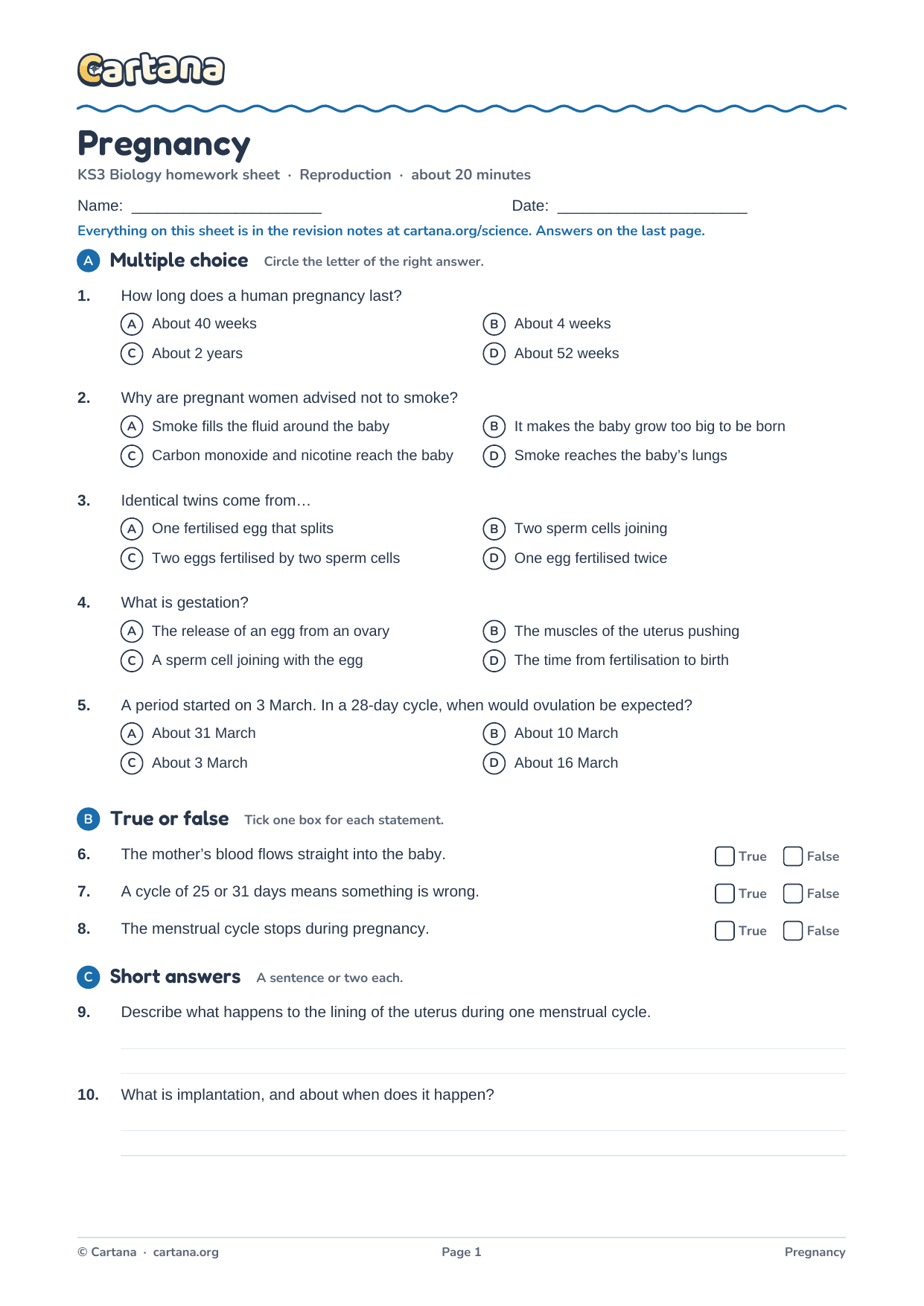
Free homework sheet
Pregnancy homework sheet
17 questions, about twenty minutes, with the answers on the last page: multiple choice, true or false, short answers, key words to define and one to explain in full.
KS3 Reproduction
Revised the whole unit? There is a 40-mark Reproduction test paper with a mark scheme.
 Watch the trailer · 1:06
New from Cartana · Beta test 1–31 December
Revision that feels like an adventure
Cartana is our KS3 learning adventure: sail between islands, answer quick-fire questions and battle bosses. It starts with science, with maths on the way, and launches in 2027. This December a small group of testers gets to play it first.
In the Cartana adventure, pregnancy is The Calendar Room, a district of the island The Nursery.
- Play the game before its official release
- Help us build it with your feedback
- Earn exclusive in-game items in return
More in this unit