
KS3 Biology · Body systems & health
Circulation
- The four chambers of the heart, its valves and the route the blood takes
- Double circulation, and why the left ventricle has the thickest wall
- Arteries, veins and capillaries, and the four parts of blood
- Taking a pulse, and how exercise and fitness change the heart rate
- 3 min read
- 5 quick questions
- Free homework sheet
- Years 7 to 9
Revision notes
The heart is a pump made of cardiac muscle. It has four chambers: two atria at the top, which receive blood, and two ventricles below, which pump it out. Valves stop blood flowing backwards, and their snapping shut is the “lub-dub” of your heartbeat.
- vena cava (from the body)
- pulmonary artery (to the lungs)
- right atrium
- right ventricle
- aorta (to the body)
- pulmonary vein (from the lungs)
- left atrium
- left ventricle
Heart diagrams face you, as if you are looking at the person, so the heart’s right side is on the left of the picture. Diagrams colour blood low in oxygen blue to tell it apart, but real blood is always red.
One full trip: body → vena cava → right atrium → right ventricle → pulmonary artery → lungs (pick up oxygen) → pulmonary vein → left atrium → left ventricle → aorta → body. Blood passes through the heart twice on every trip: a double circulation. The right side pumps blood to the lungs; the left side pumps it round the whole body, so the left ventricle has the thickest wall.
| Vessel | Carries blood | What it is like |
|---|---|---|
| Artery | Away from the heart | Thick, muscular, stretchy walls for blood at high pressure. Your pulse is felt in arteries |
| Vein | Back to the heart | Thinner walls and a wide space inside, with valves; blood at low pressure |
| Capillary | Between them, through every tissue | Walls one cell thick, so oxygen and glucose get out and carbon dioxide gets in |
| Part of blood | Job |
|---|---|
| Plasma | Pale yellow liquid that carries dissolved glucose, carbon dioxide and other substances |
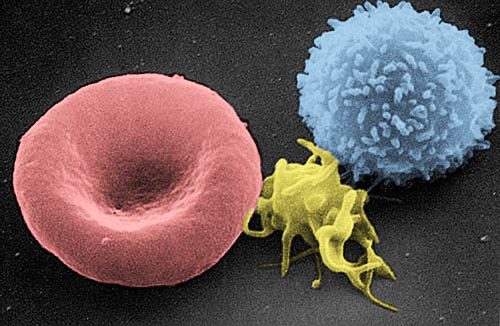
| Red blood cells | Carry oxygen, using haemoglobin. They have no nucleus, leaving more room for it |
| White blood cells | Fight microbes that cause infections |
| Platelets | Help the blood clot when you cut yourself |

Pulse and exercise. Your pulse is the surge of blood through an artery with each heartbeat; feel it at your wrist or your neck. Count for 15 seconds and multiply by 4 to get beats per minute. Exercise raises the heart rate, sending more oxygen and glucose to the muscles and taking more carbon dioxide away. The time it takes to get back to the resting rate is the recovery time. Fitter people recover faster and have lower resting heart rates.
Stretch The heart muscle gets its own blood from the coronary arteries. If fatty deposits block them, part of the heart runs short of oxygen: a heart attack. Smoking, a poor diet and too little exercise all raise the risk.
Written to the KS3 national curriculum. Last changed 2 November 2026.
Key words
Say them, spell them, use them in an answer.
- heart
- cardiac muscle
- atria
- ventricles
- Valves
- One full trip
- double circulation
- Pulse and exercise
- recovery time
- coronary arteries
Common misconception
Often said“The blood in your veins is blue.”
In factBlood is always red. Blood with less oxygen is a darker red, and veins only look blue through your skin.
Did you know?
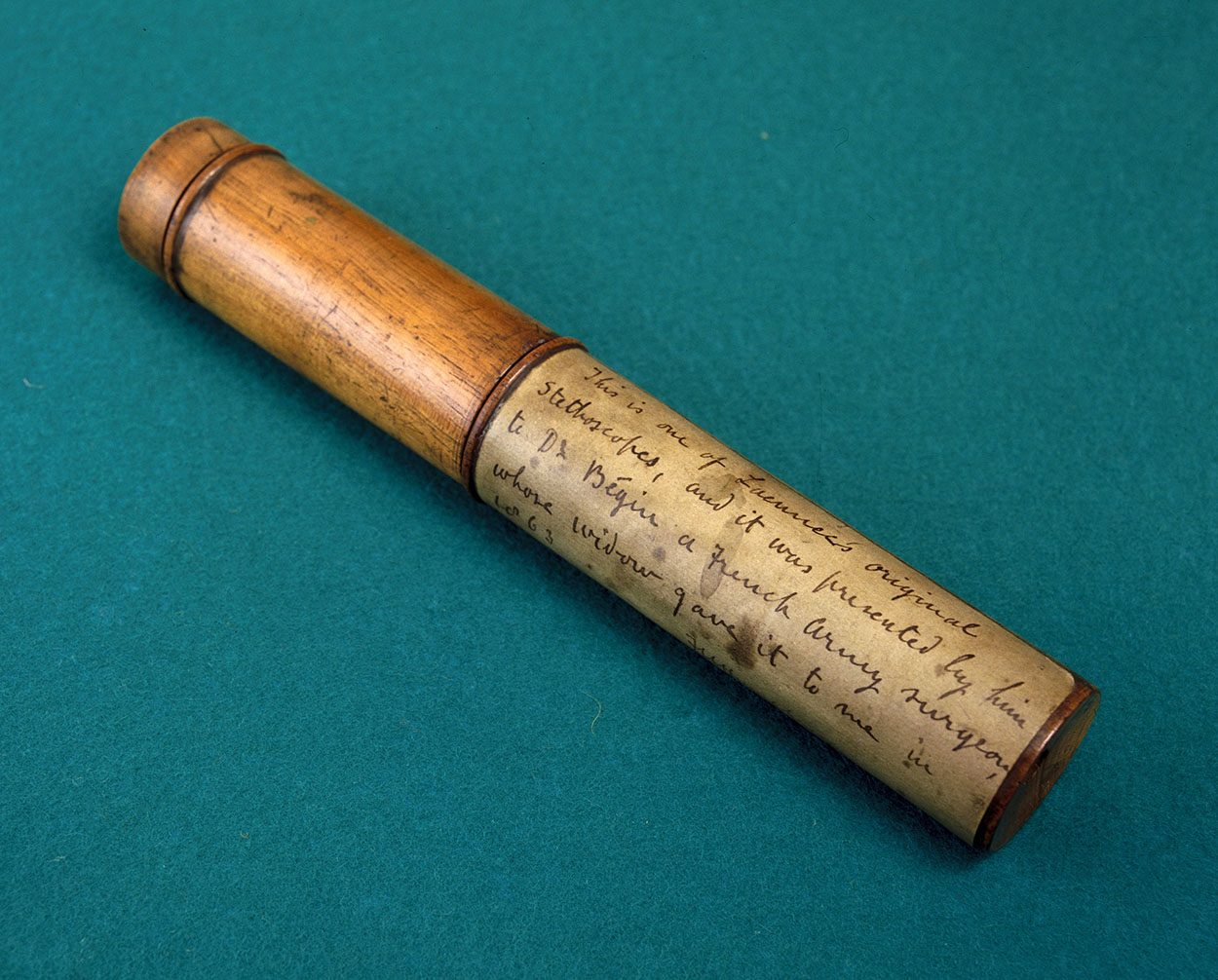
Laennec’s stethoscope
In 1816 the French doctor René Laennec rolled a sheet of paper into a tube to listen to a patient’s heart, and was amazed how clearly he could hear it. He went on to make wooden tubes: the first stethoscopes.
Photo: Science Museum London / Science and Society Picture Library, CC BY-SA 2.0, via Wikimedia Commons

Try 5 questions
Quick questions on circulation, marked as you go. Each one explains the answer.
Question 1 of 5
Why is human circulation called a double circulation?
Choose an answer. Each question explains itself.
The homework sheet
About twenty minutes. Everything on it is in the notes above; the answers are on the last page.
Free homework sheet
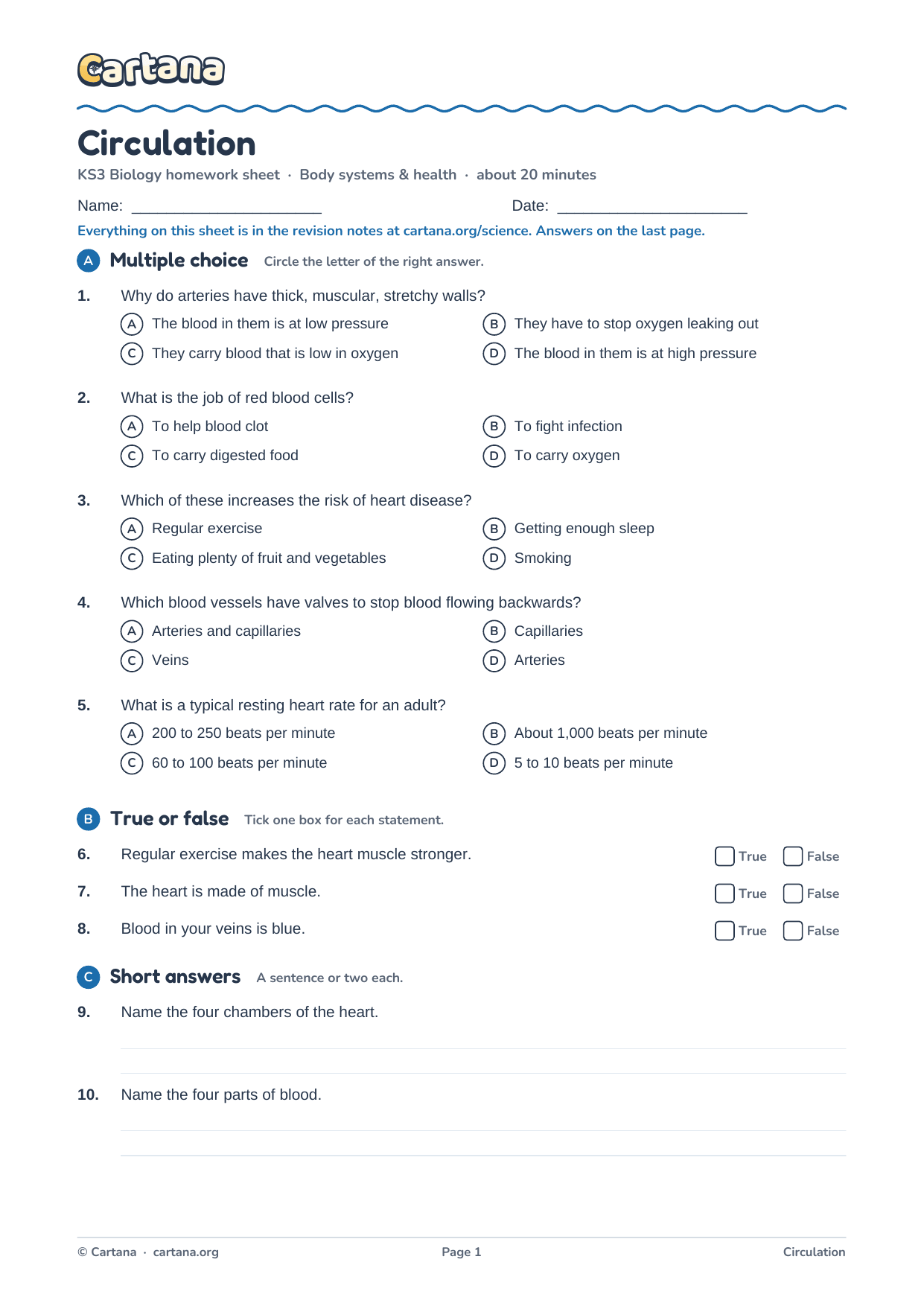
Circulation homework sheet
17 questions, about twenty minutes, with the answers on the last page: multiple choice, true or false, short answers, key words to define and one to explain in full.
KS3 Body systems & health
Revised the whole unit? There is a 40-mark Body systems & health test paper with a mark scheme.
 Watch the trailer · 1:06
New from Cartana · Beta test 1–31 December
Revision that feels like an adventure
Cartana is our KS3 learning adventure: sail between islands, answer quick-fire questions and battle bosses. It starts with science, with maths on the way, and launches in 2027. This December a small group of testers gets to play it first.
In the Cartana adventure, circulation is The Four Chambers, a district of the island Cardia.
- Play the game before its official release
- Help us build it with your feedback
- Earn exclusive in-game items in return
More in this unit