
KS3 Biology · Reproduction
Reproductive systems
- The parts of the male reproductive system and what each one does
- The parts of the female reproductive system and what each one does
- Sperm cells and egg cells, and how each is adapted to its job
- Where and how fertilisation happens
- 2 min read
- 5 quick questions
- Free homework sheet
- Years 7 to 9
Revision notes
Humans reproduce sexually: a male sex cell (a sperm cell) joins with a female sex cell (an egg cell). Sex cells are called gametes. Each carries 23 chromosomes, half the usual number, so that the fertilised egg has the full 46. The organs that make the sex cells and bring them together are the reproductive systems.
| Male system | Job |
|---|---|
| Testis (plural: testes) | Makes sperm cells |
| Scrotum | The bag of skin that holds the testes outside the body, where they stay slightly cooler |
| Sperm duct | Carries sperm cells from a testis towards the urethra |
| Glands | Add fluid to the sperm cells to make semen |
| Urethra | Carries semen, or urine, out of the body through the penis |
| Penis | Releases semen into the vagina during sexual intercourse |
| Female system | Job |
|---|---|
| Ovary (plural: ovaries) | Contains egg cells, and releases one about every 28 days |
| Oviduct (fallopian tube) | Carries an egg cell from the ovary to the uterus; where fertilisation usually happens |
| Uterus (womb) | The muscular bag in which the baby develops |
| Cervix | The ring of muscle at the bottom of the uterus; it stays closed in pregnancy and opens at birth |
| Vagina | Where semen is released, and the passage the baby is born through |
| Sperm cell | Egg cell |
|---|---|
| Made in the testes, millions every day, from puberty onwards | Stored in the ovaries from birth; one is released about every 28 days, from puberty onwards |
| Tiny and streamlined, with a tail to swim and many mitochondria to power it | Large (about 0.1 mm), with a store of food for the first days after fertilisation |
| A nucleus with 23 chromosomes | A nucleus with 23 chromosomes |
Fertilisation. During sexual intercourse, semen (sperm cells in fluid) is released into the vagina. The sperm cells swim through the cervix and uterus into the oviducts. If an egg cell is there, one sperm cell may enter it and the two nuclei join: this is fertilisation. The fertilised egg then divides again and again as it moves towards the uterus.
Written to the KS3 national curriculum. Last changed 2 November 2026.
Key words
Say them, spell them, use them in an answer.
- sperm cell
- egg cell
- gametes
- reproductive systems
- Fertilisation
Common misconception
Often said“A baby grows in its mother’s stomach.”
In factA baby grows in the uterus, which is a separate organ with a thick muscular wall. The stomach is for food.
Did you know?
Leeuwenhoek’s microscope
In 1677 Antonie van Leeuwenhoek, a cloth merchant in Delft who built his own tiny microscopes, was one of the first people to see sperm cells under a microscope, and wrote to the Royal Society in London to describe them.
Try 5 questions
Quick questions on reproductive systems, marked as you go. Each one explains the answer.
Question 1 of 5
What does the urethra do in the male system?
Choose an answer. Each question explains itself.
The homework sheet
About twenty minutes. Everything on it is in the notes above; the answers are on the last page.
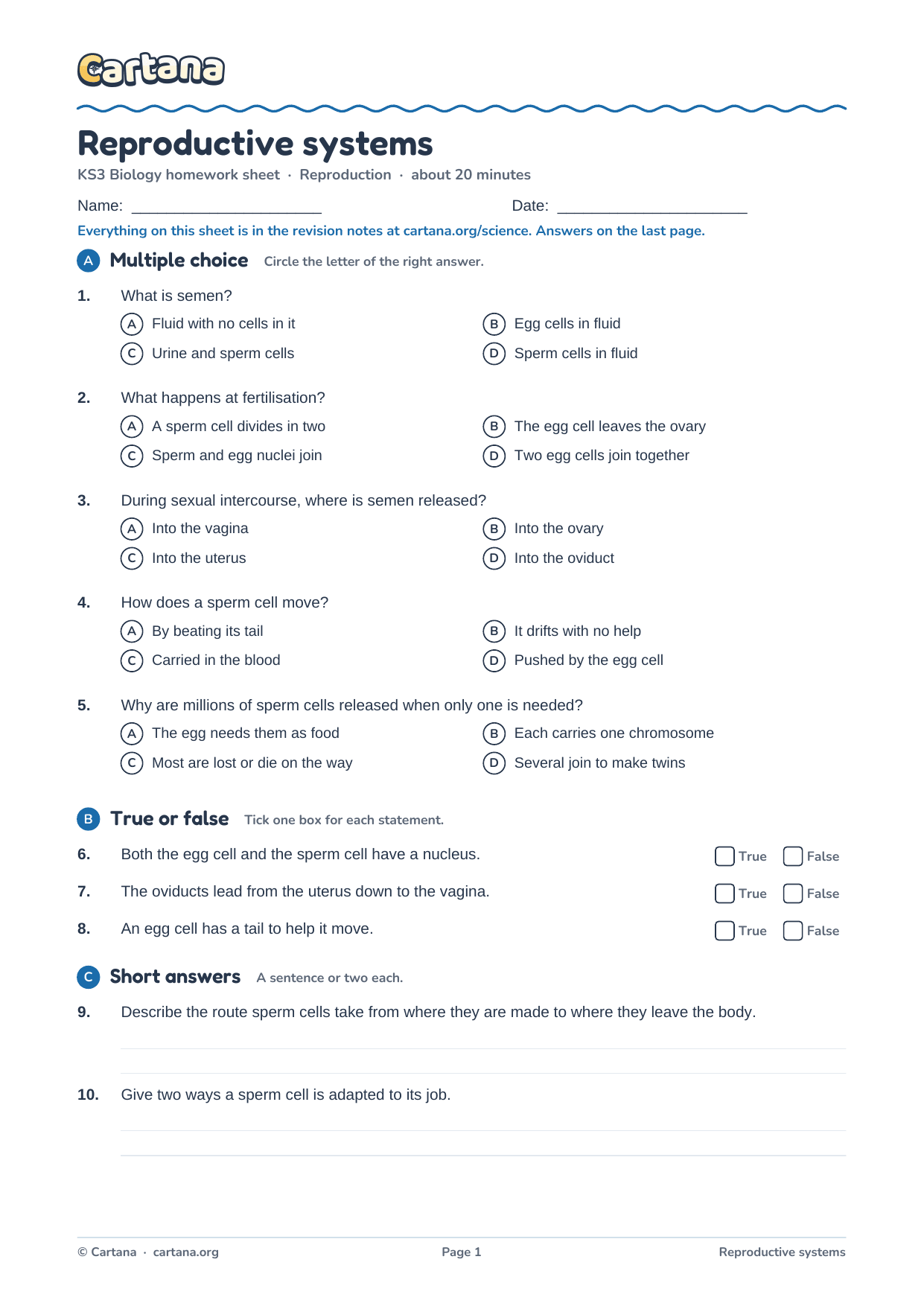
Free homework sheet
Reproductive systems homework sheet
17 questions, about twenty minutes, with the answers on the last page: multiple choice, true or false, short answers, key words to define and one to explain in full.
KS3 Reproduction
Revised the whole unit? There is a 40-mark Reproduction test paper with a mark scheme.
 Watch the trailer · 1:06
New from Cartana · Beta test 1–31 December
Revision that feels like an adventure
Cartana is our KS3 learning adventure: sail between islands, answer quick-fire questions and battle bosses. It starts with science, with maths on the way, and launches in 2027. This December a small group of testers gets to play it first.
In the Cartana adventure, reproductive systems is The Atlas Room, a district of the island The Nursery.
- Play the game before its official release
- Help us build it with your feedback
- Earn exclusive in-game items in return
More in this unit