
KS3 Biology · Cells & life processes
Cells at work
- Diffusion: particles spreading from a high to a low concentration
- What diffuses into and out of cells, in the lungs and in a leaf
- Specialised cells and how each one is adapted to its job
- Single-celled organisms, and how cells build up into tissues, organs, systems and organisms
- 3 min read
- 5 quick questions
- Free homework sheet
- Years 7 to 9
Revision notes
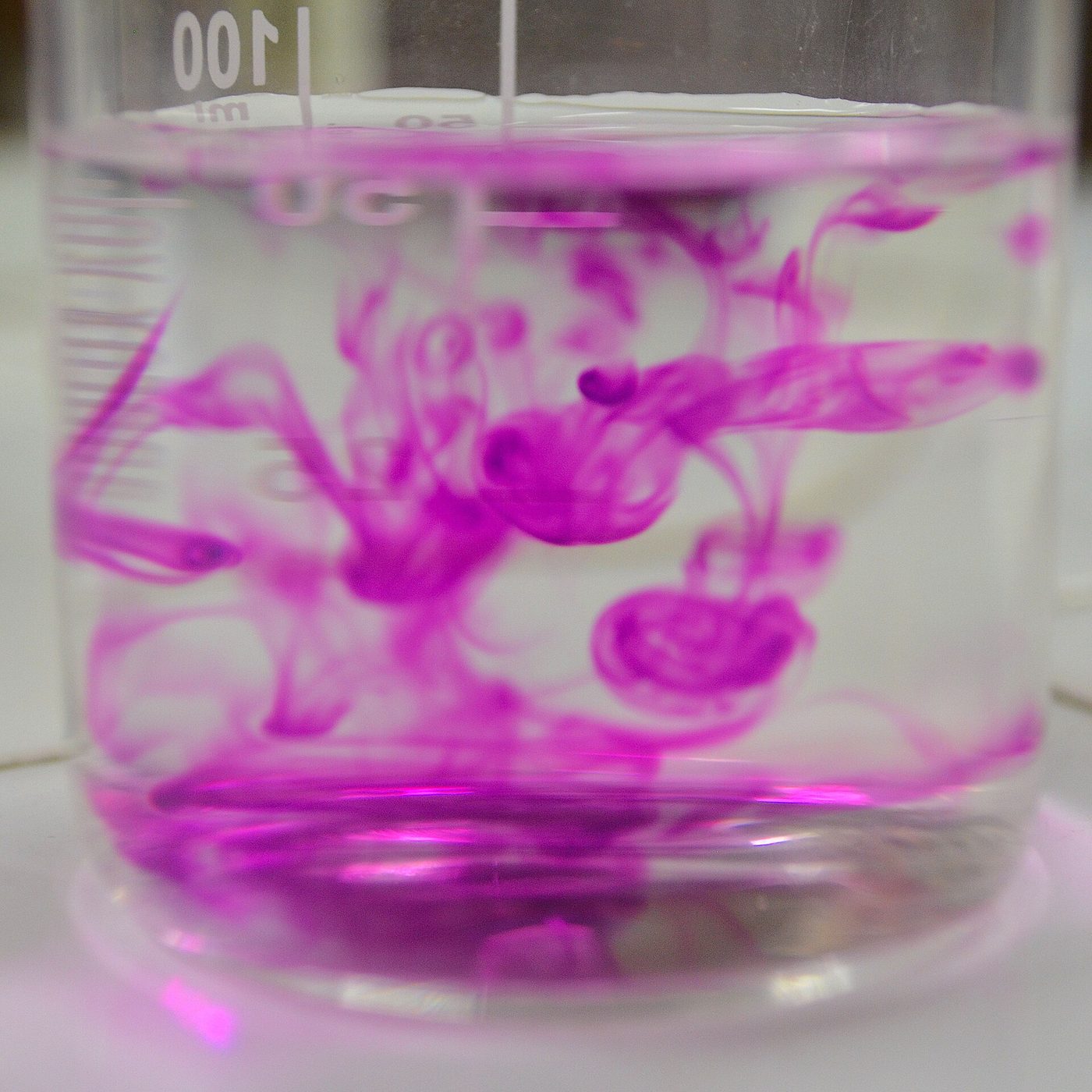
Diffusion is the spreading of particles from where there is a high concentration to where there is a low concentration. It happens in gases and liquids, because the particles are always moving about at random. The cell does not use energy for it. When the particles are evenly spread they keep moving, but there is no net movement.
Substances diffuse across the cell membrane: oxygen and glucose into respiring cells, carbon dioxide out. In the lungs, oxygen diffuses from the air into the blood. In a leaf in the light, carbon dioxide diffuses in and oxygen diffuses out.
| Specialised cell | Job | Adapted by |
|---|---|---|
| Root hair cell | Absorbs water and minerals from the soil | A long, thin extension that gives a large surface area |
| Palisade cell | Carries out most of the leaf’s photosynthesis | Tall, thin and packed with chloroplasts near the light |
| Red blood cell | Carries oxygen from the lungs round the body | No nucleus, leaving more room for the haemoglobin that carries oxygen |
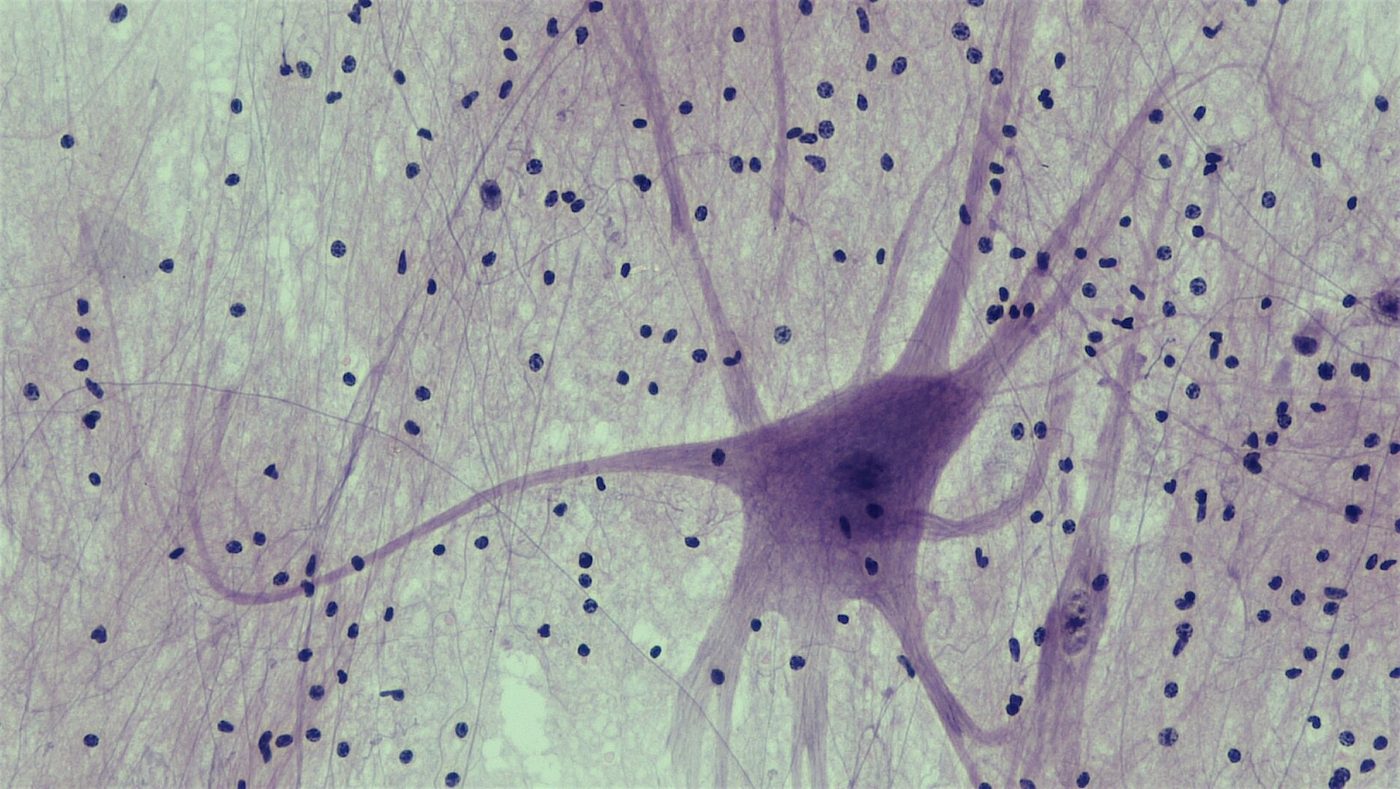
| Nerve cell | Carries electrical impulses round the body | A very long fibre, with branched endings that connect to other cells |
| Sperm cell | Swims to the egg cell and fertilises it | A tail to swim with, and many mitochondria to release the energy |
| Egg cell | Joins with a sperm cell, then feeds the early embryo | A large store of food in its cytoplasm |
| Ciliated cell | Sweeps mucus and trapped dirt up out of the airways | Tiny hairs (cilia) on its surface that beat together |

| Single-celled organism | What it is and how it is adapted |
|---|---|
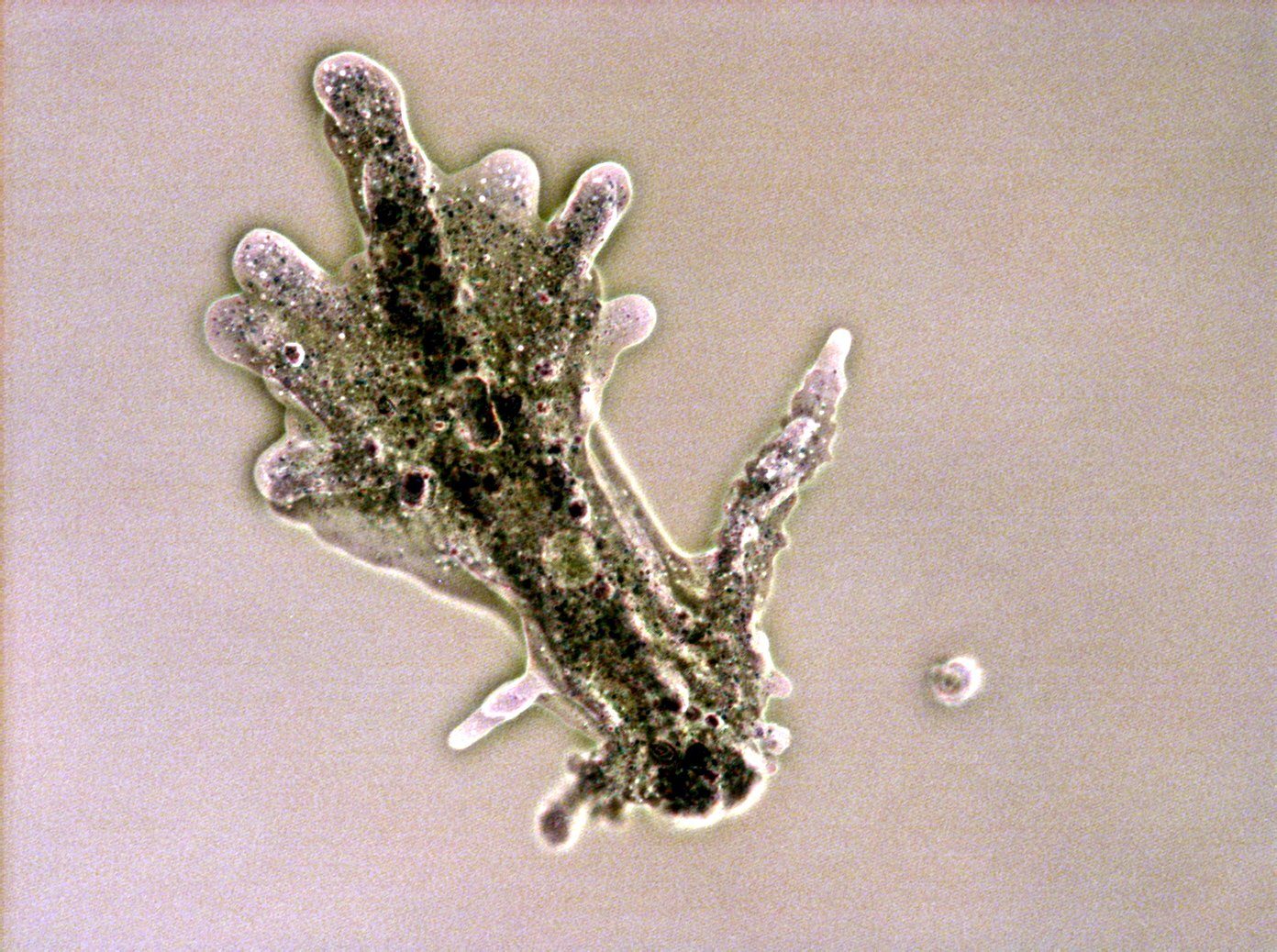
| Amoeba | A single-celled organism that lives in ponds and damp soil. It moves by pushing out part of its cytoplasm (a pseudopod), and flows round its food to take it in. |
| Euglena | A single-celled organism that lives in ponds. It has chloroplasts to make its own food, an eyespot that detects light, and a flagellum (a whip-like tail) to swim towards it. |
| Yeast | A single-celled fungus. It has a cell wall, a nucleus and mitochondria, and reproduces by budding: a new cell grows out of the old one. |
| Bacterium | A single-celled organism, much smaller than an animal cell. It has no nucleus: its genetic material is a loop in the cytoplasm. Some have a flagellum to swim. |

From cells to organisms. In a many-celled organism, similar cells work together as a tissue; several tissues make an organ; organs work together in an organ system; and the systems together make the organism. Muscle cell → muscle tissue → the heart → the circulatory system → you. Palisade cell → palisade tissue → a leaf → the shoot system → the plant. Organs and organ systems are covered in full in the Body systems & health unit.
Written to the KS3 national curriculum. Last changed 2 November 2026.
Key words
Say them, spell them, use them in an answer.
- Diffusion
- high concentration
- low concentration
- oxygen
- glucose
- carbon dioxide
- tissue
- organ
- organ system
- organism
Common misconception
Often said“Particles stop moving once they have spread out evenly.”
In factThey keep moving at random. Once they are evenly spread, as many go one way as the other, so there is no net movement.
Did you know?
Puff
Found drifting across Diffusion Bay, from where there were lots of puffs to where there were none. That is diffusion.
Photo: Alessandro e Damiano, CC BY 4.0, via Wikimedia Commons

Try 5 questions
Quick questions on cells at work, marked as you go. Each one explains the answer.
Question 1 of 5
Which way does carbon dioxide diffuse at a respiring muscle cell?
Choose an answer. Each question explains itself.
The homework sheet
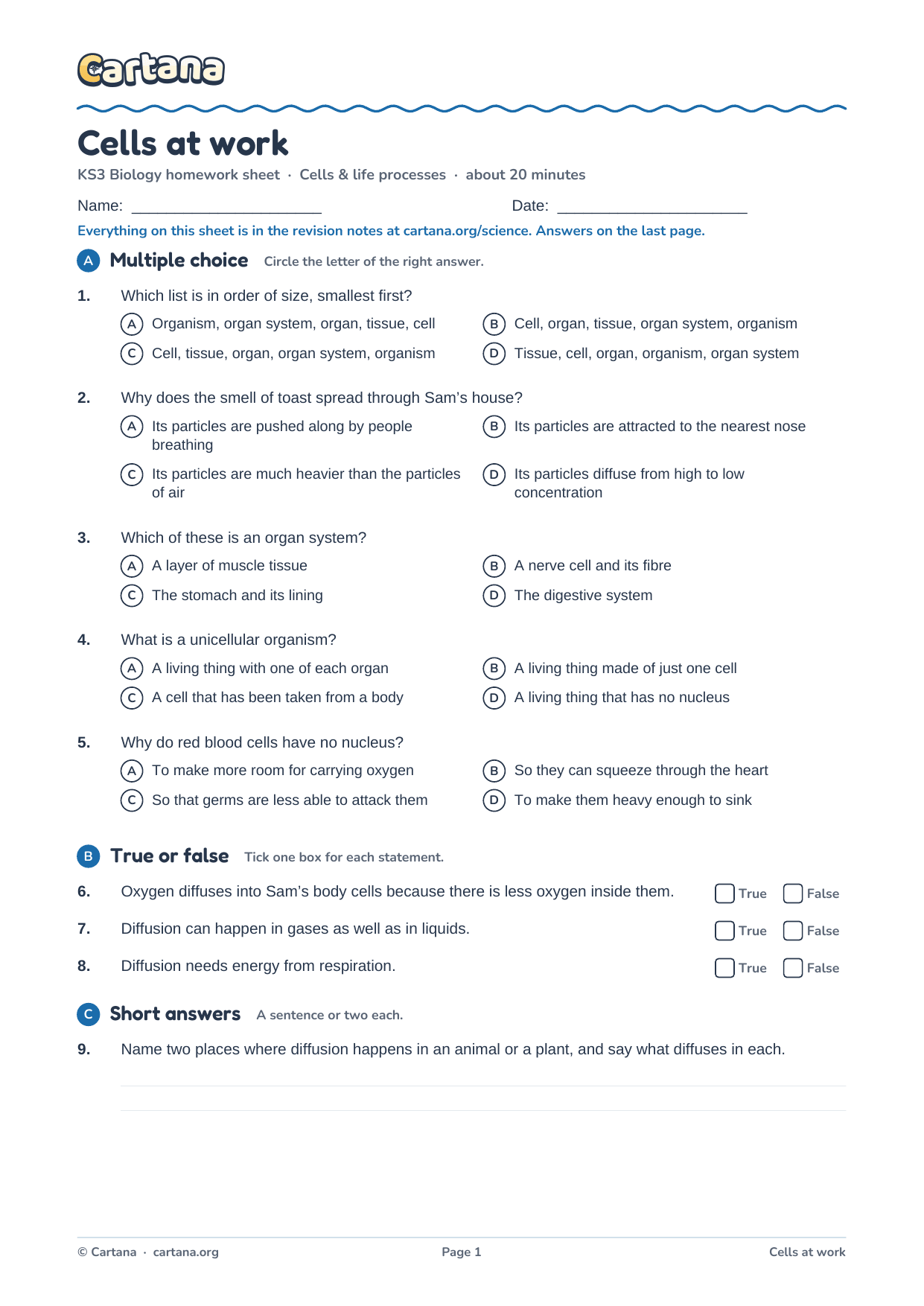
About twenty minutes. Everything on it is in the notes above; the answers are on the last page.
Free homework sheet
Cells at work homework sheet
17 questions, about twenty minutes, with the answers on the last page: multiple choice, true or false, short answers, key words to define and one to explain in full.
KS3 Cells & life processes
Revised the whole unit? There is a 40-mark Cells & life processes test paper with a mark scheme.
 Watch the trailer · 1:06
New from Cartana · Beta test 1–31 December
Revision that feels like an adventure
Cartana is our KS3 learning adventure: sail between islands, answer quick-fire questions and battle bosses. It starts with science, with maths on the way, and launches in 2027. This December a small group of testers gets to play it first.
In the Cartana adventure, cells at work is Diffusion Bay, a district of the island Cytopia.
- Play the game before its official release
- Help us build it with your feedback
- Earn exclusive in-game items in return
More in this unit