
KS3 Biology · Years 7 to 9
Ecosystems & food webs
How energy passes along food chains and food webs, why a change to one species spreads to others, how toxins build up in top predators, why pollinators matter for our food, how to sample a habitat with quadrats, and how competition and predator–prey cycles shape populations.
- 5 topics
- 8 min of notes
- 5 homework sheets
- Test paper
The topics, in order
Each has its revision notes, key words, a common misconception and quick questions; the homework sheets are free to print.
- 1Food chainsFood chains, feeding words and energy2 min read5 questionsHomework sheet
- 2Food websFood webs, interdependence and newcomers1 min read5 questionsHomework sheet
- 3Toxins and pollinatorsToxins in food chains, pollinators and food2 min read5 questionsHomework sheet
- 4Ecosystems and samplingEcosystems, niches and sampling2 min read5 questionsHomework sheet
- 5CompetitionCompetition and predator–prey cycles1 min read5 questionsHomework sheet
Test the whole unit
When the topics are revised, one paper covers them all, marked the way an exam would be.
Test paper
KS3 Ecosystems & food webs Test Paper with Mark Scheme
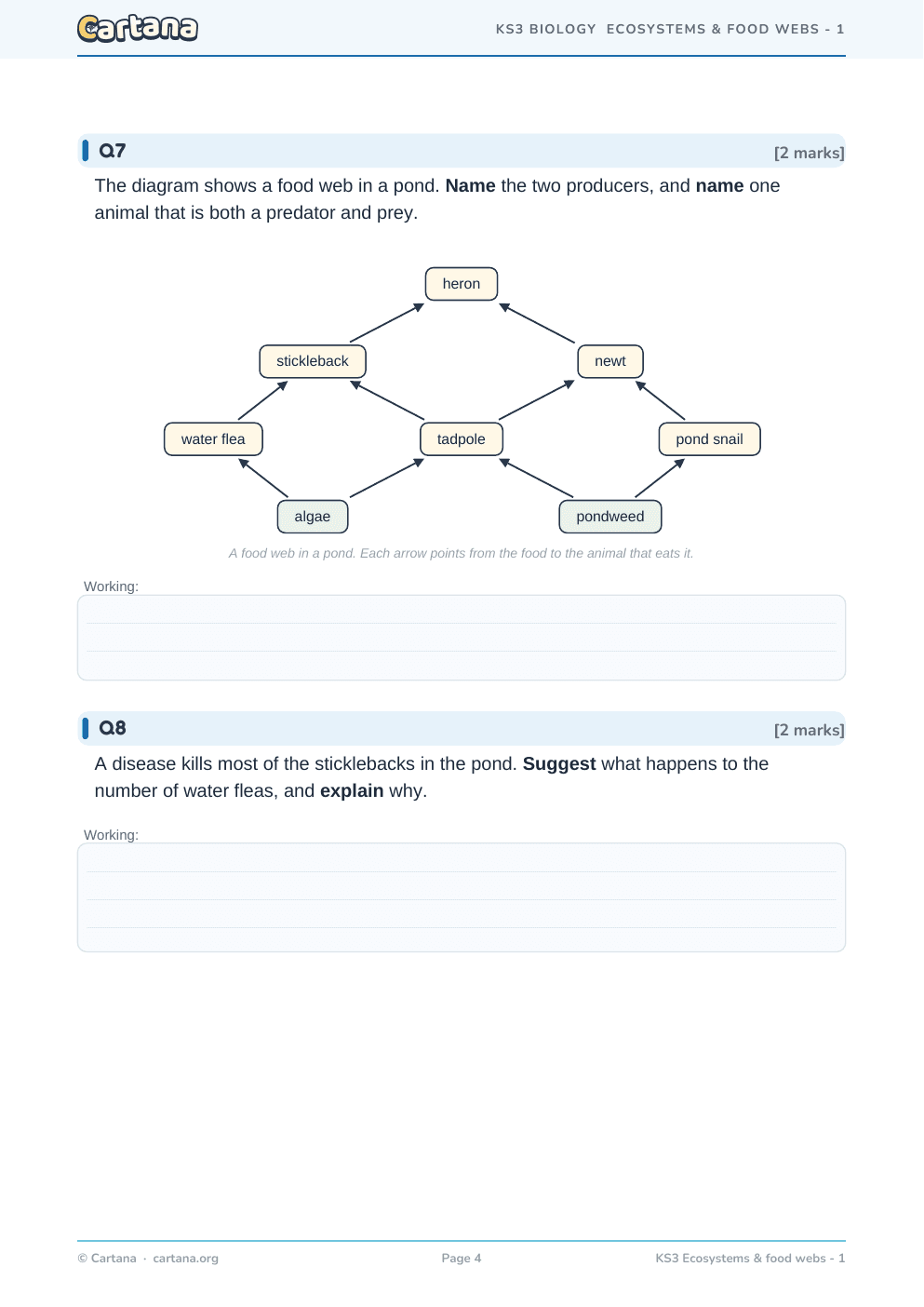
A 40-mark KS3 biology test paper on ecosystems and food webs for Years 7 to 9: 23 questions in 40 minutes, with a pond food web, pyramids of numbers, DDT in a food chain, a quadrat to count and a predator–prey graph. Plain-English mark scheme included.
- 40 marks, 23 questions
- 40 minutes
- Mark scheme included, 14 pages
Did you know?
- Cane toads were brought to Australia in 1935 to eat beetles in the sugar cane. They ignored the beetles, and there are now millions of them.
- A sea otter eats about a quarter of its own body weight in food every day.
- A harpy eagle’s back talons can be longer than a grizzly bear’s claws.
- Honeybees visit around two million flowers to make about half a kilo of honey.
 Watch the trailer · 1:06
New from Cartana · Beta test 1–31 December
Revision that feels like an adventure
Cartana is our KS3 learning adventure: sail between islands, answer quick-fire questions and battle bosses. It starts with science, with maths on the way, and launches in 2027. This December a small group of testers gets to play it first.
In the Cartana adventure, ecosystems & food webs is the island Munchu Picchu.
- Play the game before its official release
- Help us build it with your feedback
- Earn exclusive in-game items in return