
KS3 Biology · Body systems & health
Muscles
- Why muscles can only pull, and how a tendon passes the pull to the bone
- Antagonistic pairs: biceps and triceps, hamstrings and quadriceps, calf and shin
- Bones as levers and joints as pivots, and measuring force in newtons
- Skeletal, cardiac and smooth muscle
- 2 min read
- 5 quick questions
- Free homework sheet
- Years 7 to 9
Revision notes
Muscles can only pull. When a muscle contracts, it gets shorter and pulls on a bone through a tendon. It cannot push, so muscles work in antagonistic pairs: when one contracts, its partner relaxes, and then they swap.
| Pair | This one contracts to… | Its partner contracts to… |
|---|---|---|
| Biceps and triceps | Biceps (front of the upper arm): bend the arm at the elbow | Triceps (back of the upper arm): straighten it |
| Hamstrings and quadriceps | Hamstrings (back of the thigh): bend the leg at the knee | Quadriceps (front of the thigh): straighten it |
| Calf and shin muscles | Calf muscle: pull the heel up, so you stand on tiptoe | Shin muscle: pull the toes up |
Muscles get the energy to contract from respiration in their cells. Regular exercise makes them stronger.
Biomechanics. Bones are levers, joints are pivots and muscles supply the force. Forces are measured in newtons (N) with a force meter; a grip meter measures how hard your hand can squeeze. For a fair test, change one thing (such as which hand), keep everything else the same, and repeat each reading to find the mean. Bigger muscles can usually pull with bigger forces.
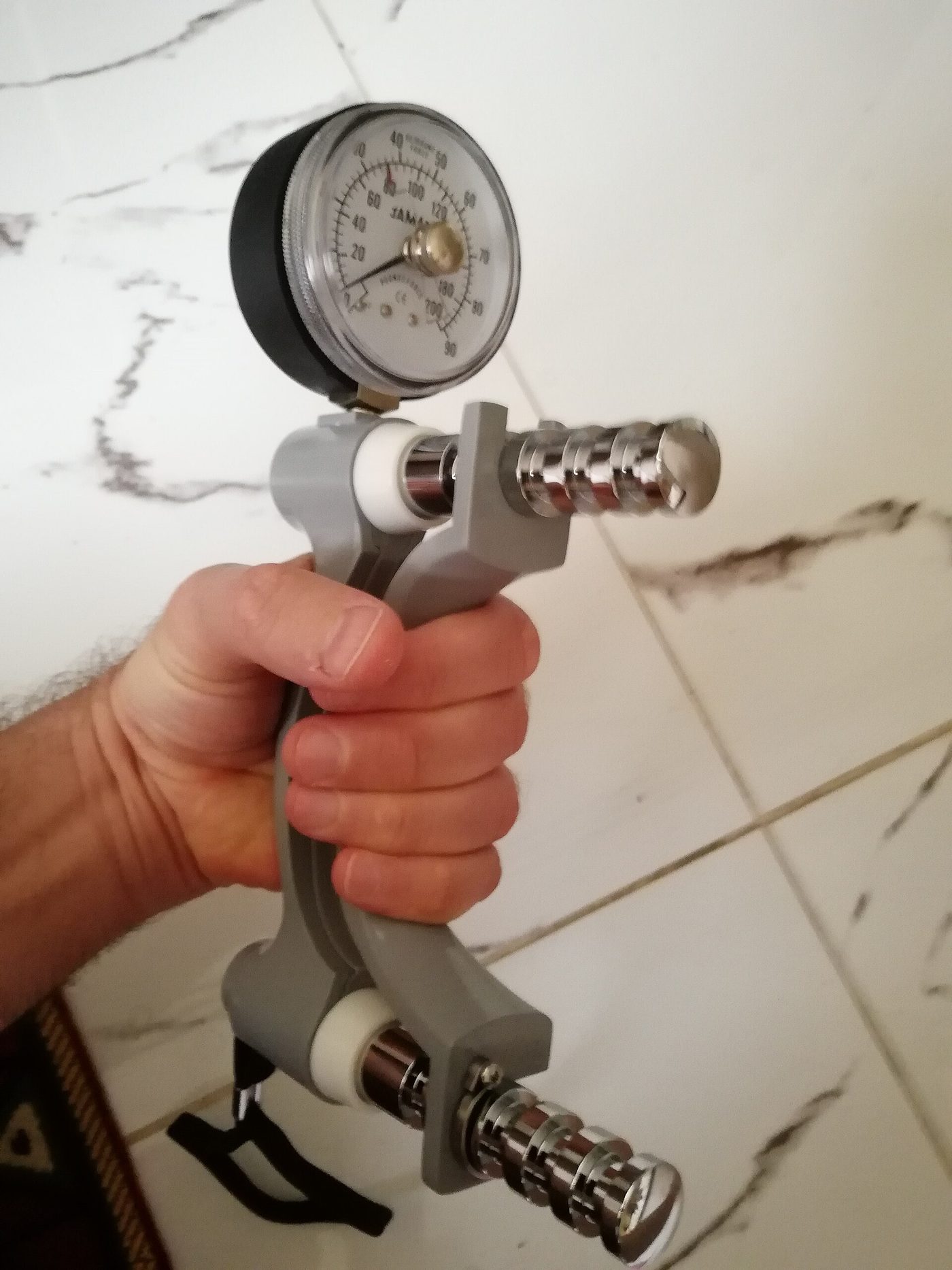

Stretch The biceps is attached very close to the elbow, so it must pull with a force several times bigger than a weight held in the hand. Moments balance: muscle force × its distance from the pivot = weight × its distance from the pivot. There are three kinds of muscle: skeletal muscle moves bones, cardiac muscle is the heart, and smooth muscle is in the walls of the gut and blood vessels.
Written to the KS3 national curriculum. Last changed 2 November 2026.
Key words
Say them, spell them, use them in an answer.
- contracts
- tendon
- respiration
- Biomechanics
- levers
- pivots
- force
- newtons (N)
- force meter
- skeletal
- cardiac
- smooth
Common misconception
Often said“Muscles can push as well as pull.”
In factMuscles only pull, by contracting. That is why they work in antagonistic pairs: one pulls a bone one way, its partner pulls it back.
Did you know?
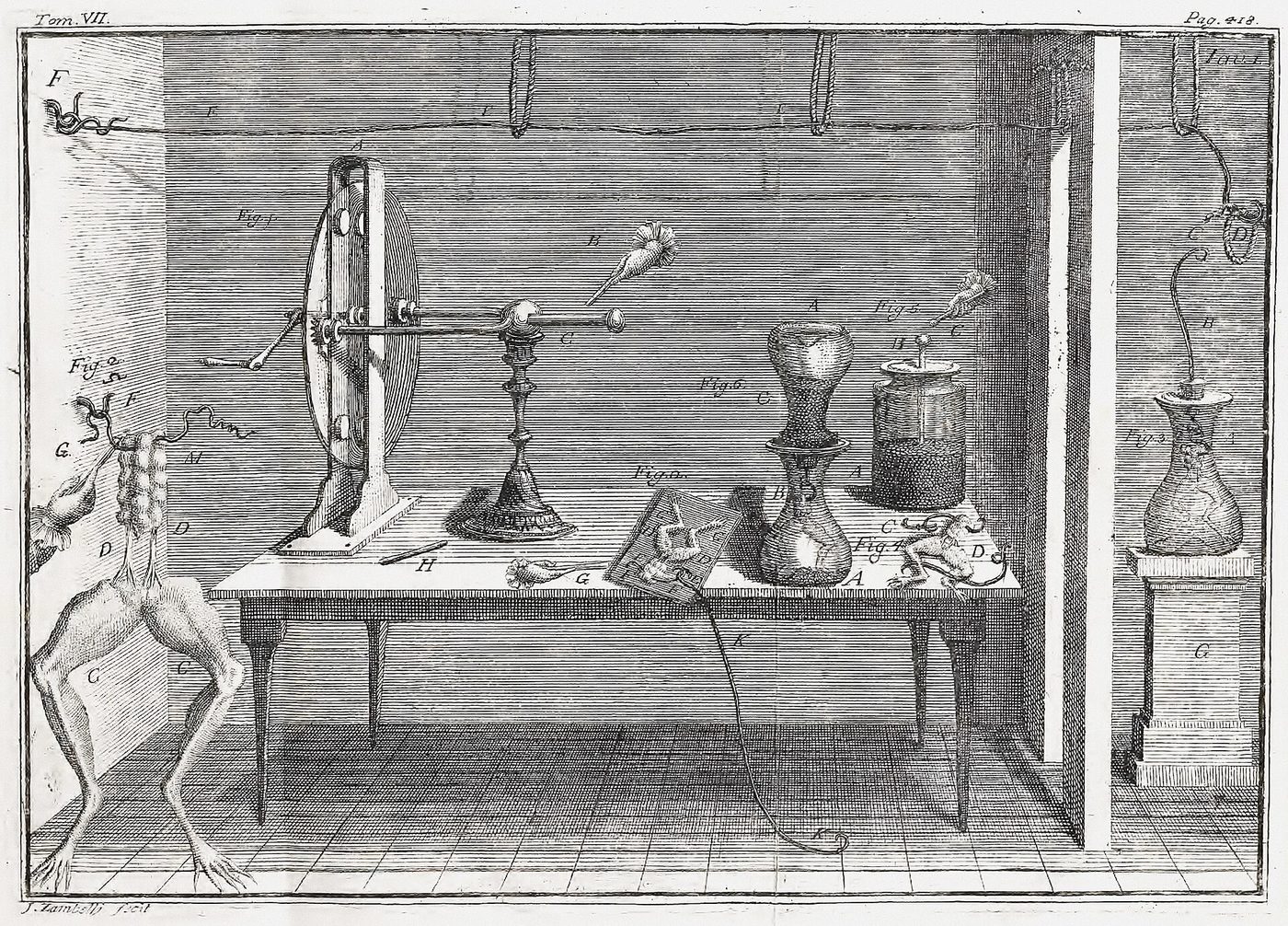
Galvani’s frog legs
In the 1780s Luigi Galvani found that the leg muscles of a dead frog twitched when a spark was made nearby, or when two different metals touched its nerve. Your muscles contract when nerves send them electrical signals.
Photo: Luigi Galvani, Public domain, via Wikimedia Commons

Try 5 questions
Quick questions on muscles, marked as you go. Each one explains the answer.
Question 1 of 5
Sam lifts a heavy school bag. Which muscle contracts to bend the arm at the elbow?
Choose an answer. Each question explains itself.
The homework sheet
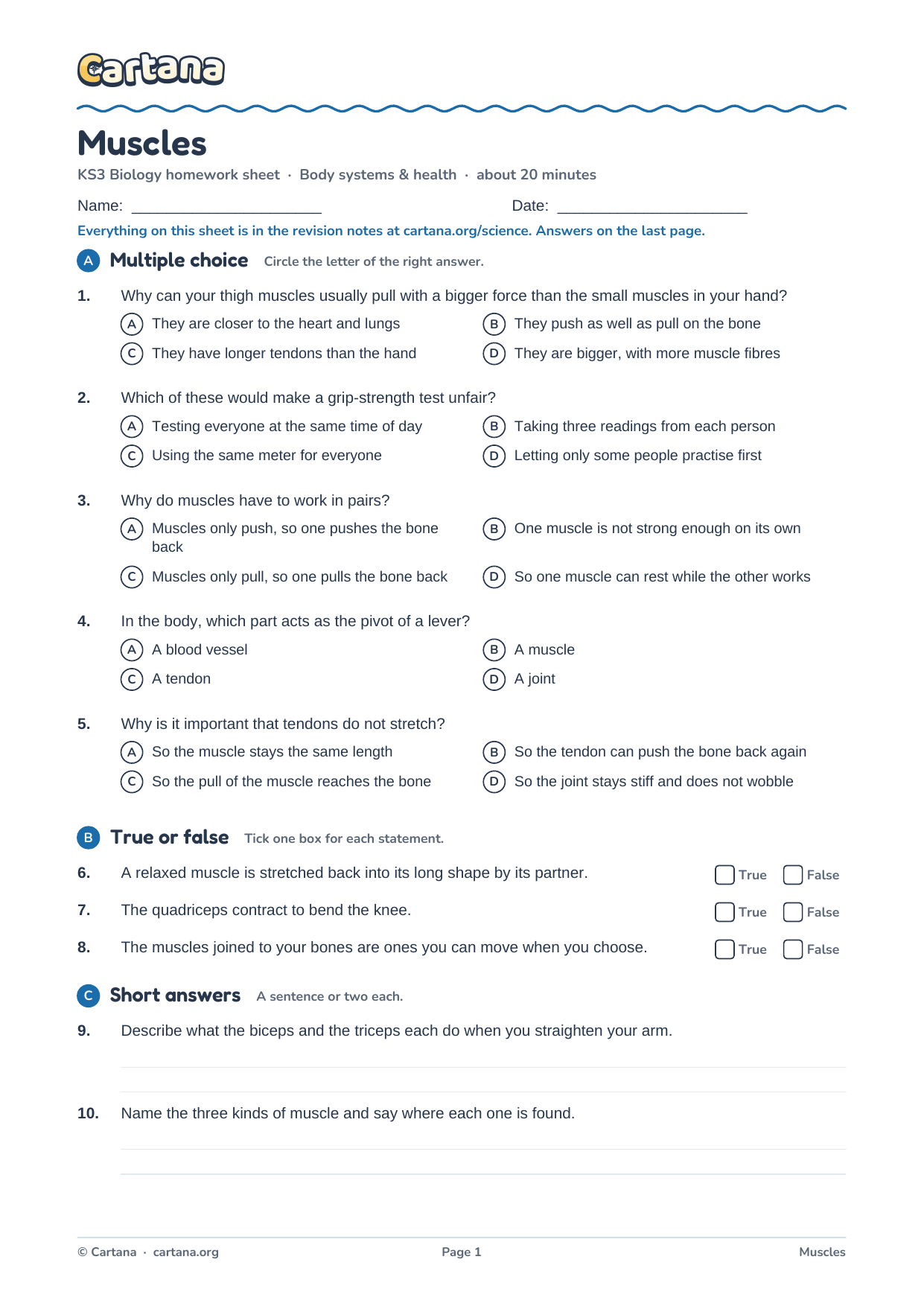
About twenty minutes. Everything on it is in the notes above; the answers are on the last page.
Free homework sheet
Muscles homework sheet
17 questions, about twenty minutes, with the answers on the last page: multiple choice, true or false, short answers, key words to define and one to explain in full.
KS3 Body systems & health
Revised the whole unit? There is a 40-mark Body systems & health test paper with a mark scheme.
 Watch the trailer · 1:06
New from Cartana · Beta test 1–31 December
Revision that feels like an adventure
Cartana is our KS3 learning adventure: sail between islands, answer quick-fire questions and battle bosses. It starts with science, with maths on the way, and launches in 2027. This December a small group of testers gets to play it first.
In the Cartana adventure, muscles is Tendon Docks, a district of the island Cardia.
- Play the game before its official release
- Help us build it with your feedback
- Earn exclusive in-game items in return
More in this unit