
KS3 Physics · Years 7 to 9
Sound & waves
Sound and waves for KS3 physics: transverse and longitudinal waves, how sound is made and why it needs a medium, pitch and loudness on an oscilloscope, how the ear works and what people and animals can hear, and echoes, sonar and ultrasound.
- 5 topics
- 23 min of notes
- 5 homework sheets
- 2 test papers
The topics, in order
Each has its revision notes, key words, a common misconception and quick questions; the homework sheets are free to print.
- 1WavesWaves carrying energy, transverse and longitudinal waves, amplitude, wavelength and frequency, and water waves reflecting and adding (superposition)5 min read5 questionsHomework sheet
- 2Sound wavesSound made by vibrations, longitudinal sound waves, the need for a medium and the bell-jar experiment, the speed of sound in solids, liquids and gases, and sound against light5 min read5 questionsHomework sheet
- 3Pitch and loudnessFrequency and pitch in hertz, amplitude and loudness, reading oscilloscope traces, and loudness in decibels4 min read5 questionsHomework sheet
- 4HearingHow the ear works from pinna to auditory nerve, the hearing range of people and other animals, how hearing is damaged, and microphones and loudspeakers5 min read5 questionsHomework sheet
- 5Echoes and ultrasoundReflection and absorption of sound, distance from an echo, ultrasound for scans, cleaning and physiotherapy, and echolocation and sonar5 min read5 questionsHomework sheet
Test the whole unit
When the topics are revised, two different papers test the whole unit, each marked the way an exam would be: sit Paper 1, go over what went wrong, then sit Paper 2.
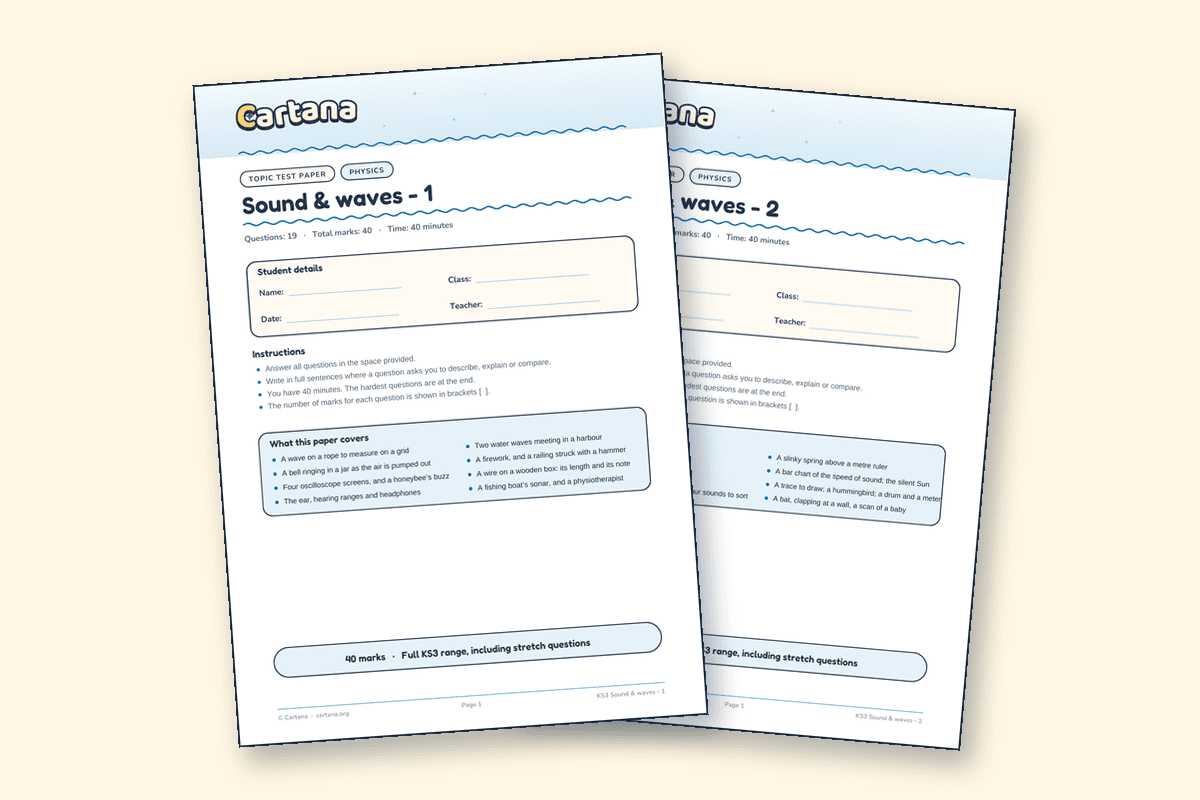
Two papers, one price
KS3 Sound & waves Test Papers with Mark Schemes (2 Papers)
Two different test papers on the same unit, each with its own mark scheme, for £1.99 together.
- 2 different papers
- 2 × 40 marks
- 40 minutes each
- 2 mark schemes, 27 pages
Also in the Physics Pack: 14 papers for £8.99, save 35%.
Did you know?
- Sound travels about fifteen times faster through steel than through air. Put your ear to one end of a long metal railing while a friend taps the far end, and you may hear the tap twice: first through the metal, then through the air.
- The first aeroplane to fly faster than sound in level flight was the Bell X-1, flown by Chuck Yeager on 14 October 1947. High up, where the air is cold, sound travels at only about 1,060 km/h, so he needed a little more than that.
- The greater wax moth can hear sounds of up to about 300,000 Hz, the highest of any animal tested. It hears the ultrasound calls of the bats that hunt it.
- Ultrasound was first used to look at babies before birth by the Scottish doctor Ian Donald, who described the method in 1958. Scans are now a normal part of pregnancy care.
More physics units
- Forces 6 topics
- Motion & pressure 6 topics
- Energy 6 topics
- Electricity & magnetism 5 topics
- Light 5 topics
- Space 5 topics
All of KS3 science · Every homework sheet · Test papers and packs
 Watch the trailer · 1:06
New from Cartana · Beta test 1–31 December
Revision that feels like an adventure
Cartana is our KS3 learning adventure: sail between islands, answer quick-fire questions and battle bosses. It starts with science, with maths on the way, and launches in 2027. This December a small group of testers gets to play it first.
In the Cartana adventure, every science unit is an island to explore. The island for sound & waves is being built.
- Play the game before its official release
- Help us build it with your feedback
- Earn exclusive in-game items in return