
KS3 Physics · Sound & waves
Sound waves
- How vibrating objects, from guitar strings to loudspeakers, make sound
- Sound as a longitudinal wave of compressions and rarefactions
- Why sound needs a medium: the bell-jar experiment
- The speed of sound in air, water and steel, and sound against light
- 5 min read
- 5 quick questions
- Free homework sheet
- Years 7 to 9
Revision notes
Sound is a wave made when an object vibrates. The vibrations pass through a solid, liquid or gas as a longitudinal wave, so sound cannot travel through empty space.
How is sound made?
Every sound starts with a vibration: something moving quickly back and forth. It might be a guitar string, a drum skin, the vocal folds in your throat or the cone of a loudspeaker, the part of a speaker that turns electrical signals into sound. As the cone moves forwards, it squashes the air in front of it into a compression. As it moves back, it leaves a rarefaction, where the air is spread out. It does this hundreds or thousands of times a second, sending out a train of compressions and rarefactions.
Each air particle only vibrates back and forth about one place, passing the push on to the next particle. The particles do not travel from the loudspeaker to your ear: the wave and its energy do. The particles vibrate along the direction the sound travels, so sound is a longitudinal wave (see waves).
Why can’t sound travel through space?
Sound needs particles to pass its vibrations along, so it can only travel through a material: a solid, a liquid or a gas. The material a wave travels through is called a medium. Space is a vacuum, a place with almost no particles at all, so sound cannot cross it. Astronauts on a spacewalk talk to each other by radio: radio waves, like light, need no medium.
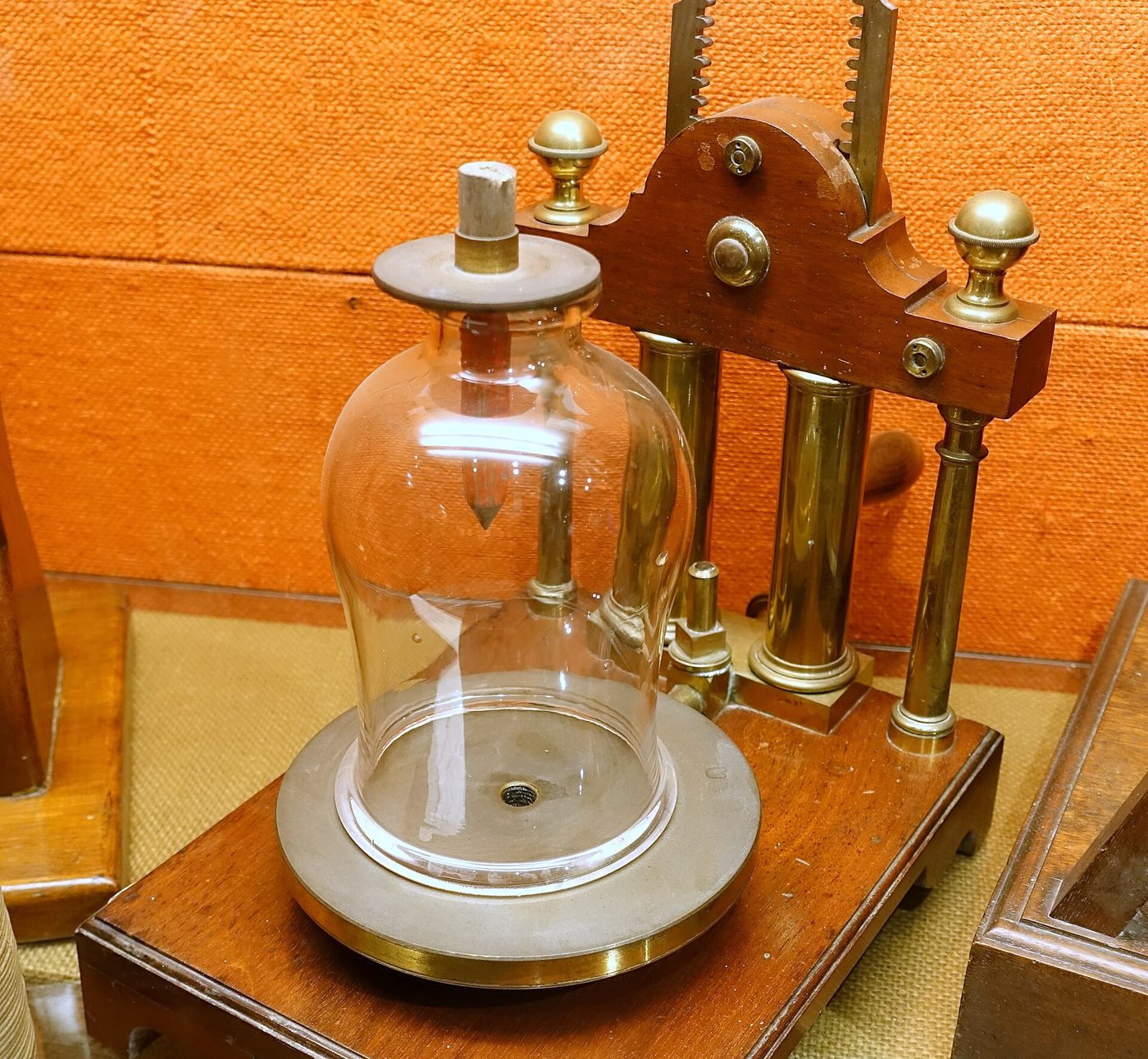
The bell-jar experiment:
- Hang an electric bell inside a glass bell jar and switch it on. You hear it ringing.
- Switch on a vacuum pump to take the air out of the jar. The ringing gets quieter and quieter until you can hardly hear it, yet you can still see the hammer hitting the gong.
- Let the air back in. The ringing gets loud again.
This shows that sound needs a medium but light does not: you can still see the bell. A faint sound is left because no pump removes every particle, and some vibrations pass up the wires the bell hangs from. Robert Boyle showed this with a ticking watch in 1660.
How fast does sound travel?
The speed of sound is how far sound travels in one second, and it depends on the medium:
| Medium | State | Speed of sound |
|---|---|---|
| Air | Gas | About 340 m/s |
| Water | Liquid | About 1,500 m/s |
| Steel | Solid | About 5,000 m/s |
In one medium, all sounds travel at the same speed, loud or quiet, high or low. Sound is usually fastest in solids and slowest in gases. In a solid the particles are close together and strongly held to their neighbours, so each one passes a vibration on quickly. In a gas the particles are far apart, so the vibrations are passed on more slowly. The particle model of solids, liquids and gases explains the difference.
How is sound different from light?
| Sound | Light | |
|---|---|---|
| Kind of wave | Longitudinal | Transverse |
| Needs a medium | Yes | No: it crosses empty space |
| Speed in air | About 340 m/s | About 300,000 km/s |
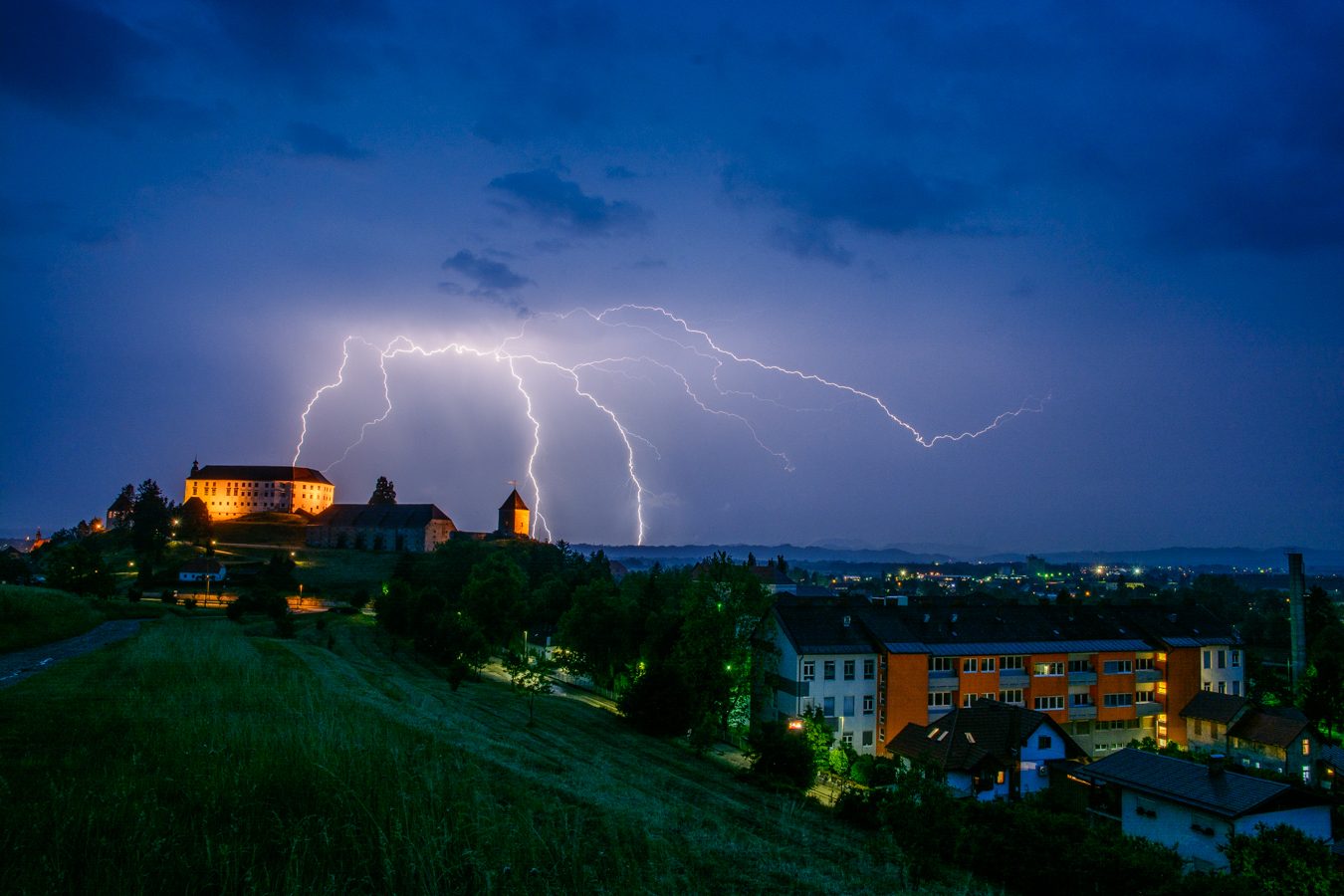
Light is nearly a million times faster than sound. In a thunderstorm the lightning and the thunder are made at the same moment, but you see the flash first and hear the thunder later. You can work out how far away the lightning was, using the equation from speed:
With the speed in m/s and the time in seconds (s), the distance is in metres (m).
You hear thunder 5 s after you see the lightning. How far away was the lightning?
distance = speed × time
distance = 340 m/s × 5 s = 1,700 m (about 1.7 km)
The light took so little time that you can ignore it. A quick rule: sound goes about 1 km in 3 s.
Stretch The speed of sound in air depends on its temperature: about 331 m/s at 0 °C and 343 m/s at 20 °C. In warmer air the particles move faster, so they pass the vibrations on sooner. That is why 340 m/s is only an everyday figure, not an exact one.
Written to the KS3 national curriculum. Last changed 14 November 2026.
Key words
Say them, spell them, use them in an answer.
- vibration
- loudspeaker
- compression
- rarefaction
- longitudinal wave
- medium
- vacuum
- speed of sound
Common misconception
Often said“Sound can travel through space, like in films where you hear spaceships explode.”
In factSpace is a vacuum with almost no particles, so there is nothing to carry the vibrations. A real explosion in space would be silent. Film-makers add the bangs because a silent battle feels wrong to an audience.
Did you know?
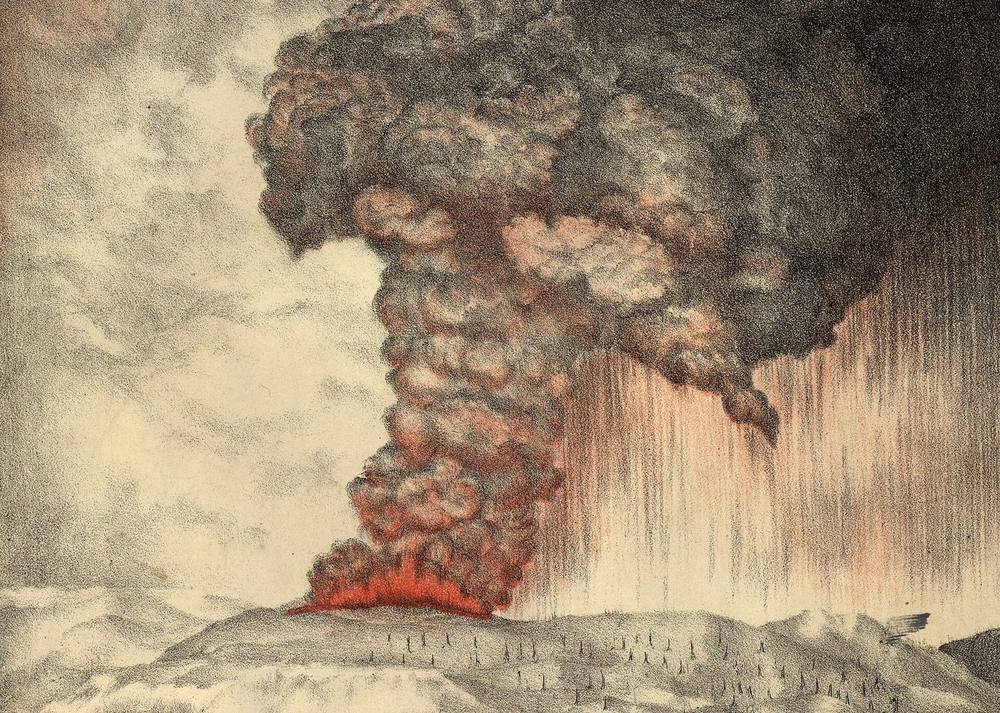
Krakatoa
When the volcano Krakatoa erupted in 1883, the bang was heard about 4,800 km away on the island of Rodrigues, near Mauritius, where people took it for the roar of distant guns. Travelling at about 340 m/s, the sound took around four hours to get there.
Photo: Parker & Coward (lithograph, 1888), Public domain, via Wikimedia Commons
Try 5 questions
Quick questions on sound waves, marked as you go. Each one explains the answer.
Question 1 of 5
What vibrates to make the sound of your voice?
Choose an answer. Each question explains itself.
The homework sheet
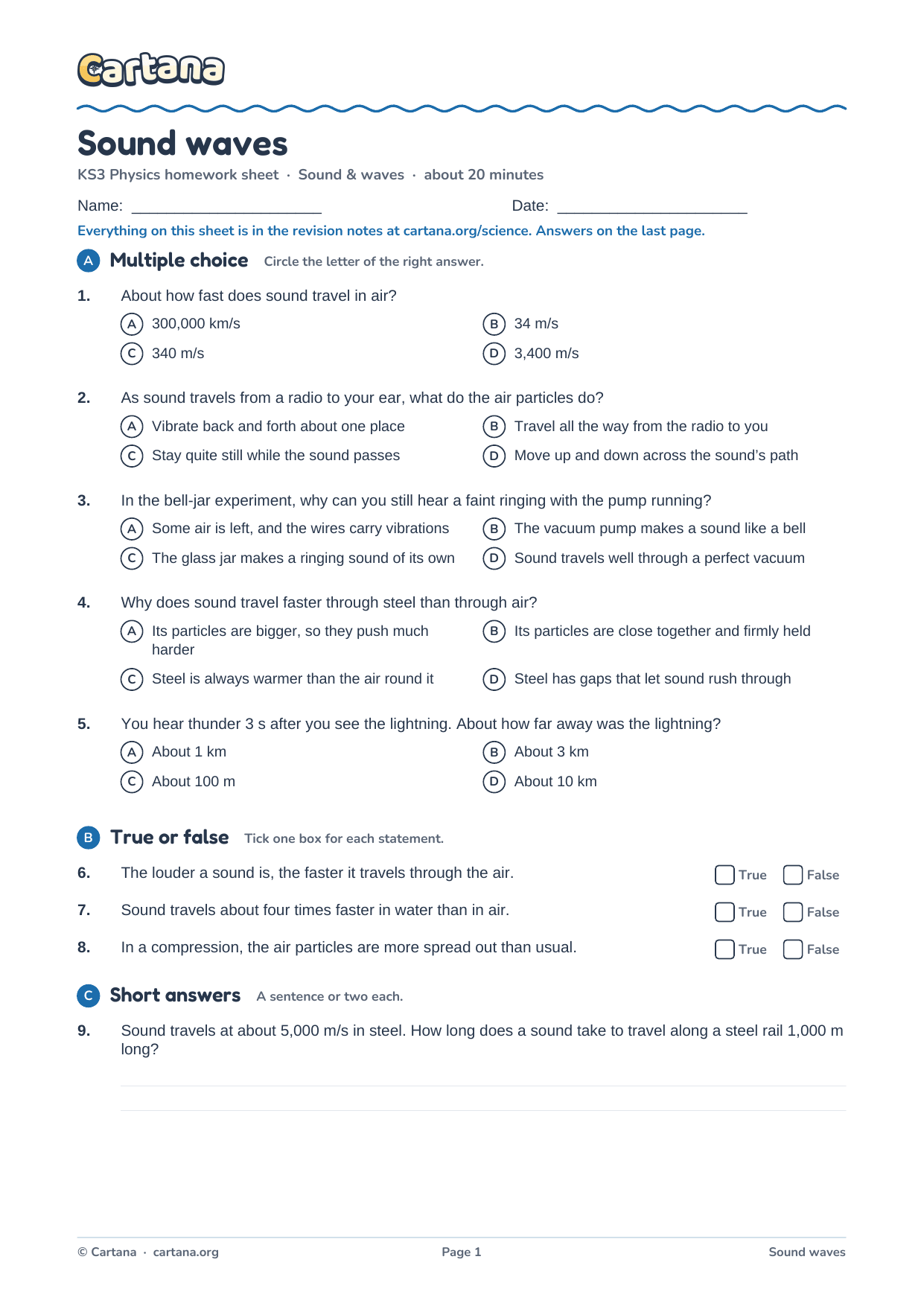
About twenty minutes. Everything on it is in the notes above; the answers are on the last page.
Free homework sheet
Sound waves homework sheet
17 questions, about twenty minutes, with the answers on the last page: multiple choice, true or false, short answers, key words to define and one to explain in full.
KS3 Sound & waves
Revised the whole unit?
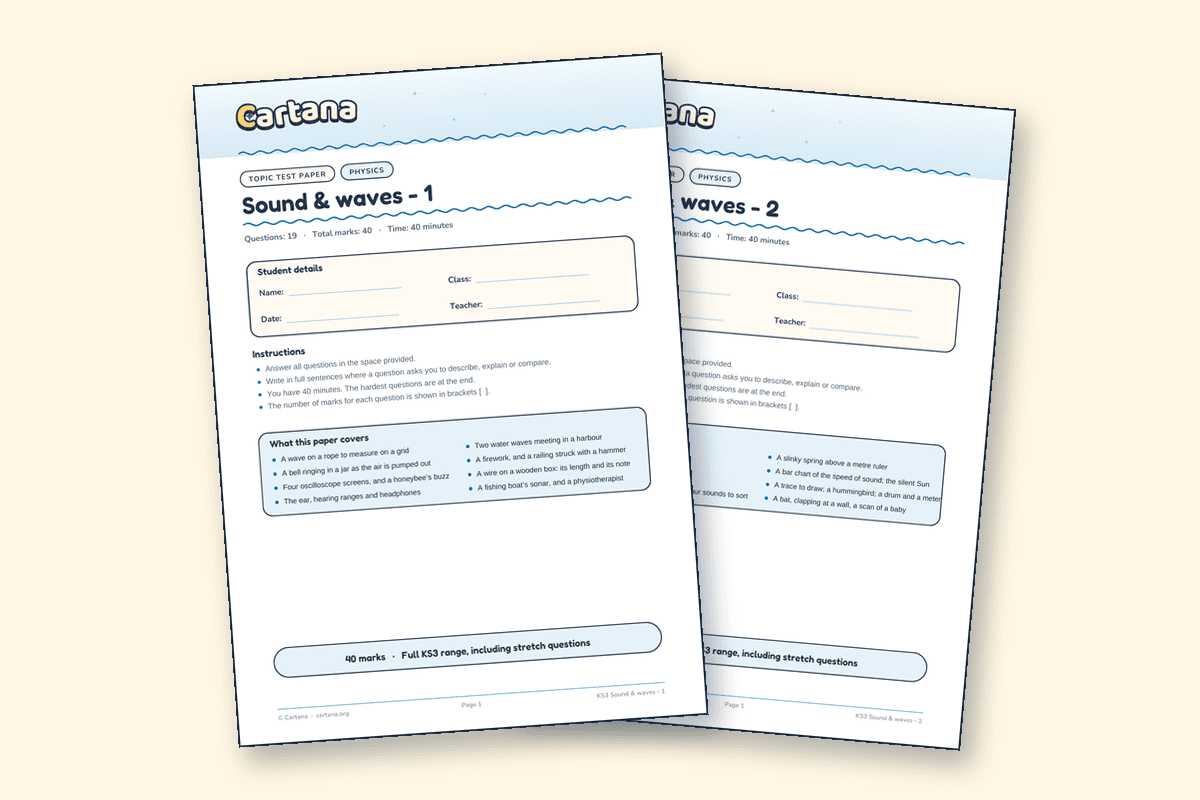
When every topic in sound & waves is done, two different papers test the whole unit, each with its own mark scheme.


 Watch the trailer · 1:06
New from Cartana · Beta test 1–31 December
Revision that feels like an adventure
Cartana is our KS3 learning adventure: sail between islands, answer quick-fire questions and battle bosses. It starts with science, with maths on the way, and launches in 2027. This December a small group of testers gets to play it first.
In the Cartana adventure, every science unit is an island to explore. The island for sound & waves is being built.
- Play the game before its official release
- Help us build it with your feedback
- Earn exclusive in-game items in return
More in this unit
Sound & waves
- 1WavesWaves carrying energy, transverse and longitudinal waves, amplitude, wavelength and frequency, and water waves reflecting and adding (superposition)
- 3Pitch and loudnessNextFrequency and pitch in hertz, amplitude and loudness, reading oscilloscope traces, and loudness in decibels
- 4HearingHow the ear works from pinna to auditory nerve, the hearing range of people and other animals, how hearing is damaged, and microphones and loudspeakers
- 5Echoes and ultrasoundReflection and absorption of sound, distance from an echo, ultrasound for scans, cleaning and physiotherapy, and echolocation and sonar