
KS3 Chemistry · Years 7 to 9
Particles & states of matter
The particle model for KS3 chemistry and physics: how particles are arranged and move in solids, liquids and gases, changes of state, diffusion and Brownian motion, gas pressure, and density, including why ice floats on water.
- 5 topics
- 20 min of notes
- 5 homework sheets
- 2 test papers
The topics, in order
Each has its revision notes, key words, a common misconception and quick questions; the homework sheets are free to print.
- 1Solids, liquids and gasesThe particle model and the three states of matter4 min read5 questionsHomework sheet
- 2Changes of stateMelting, freezing, boiling, evaporating, condensing and sublimation4 min read5 questionsHomework sheet
- 3Diffusion and Brownian motionDiffusion in liquids and gases, and Brownian motion4 min read5 questionsHomework sheet
- 4Gas pressureGas pressure and the particle model4 min read5 questionsHomework sheet
- 5DensityDensity, floating and sinking, and why ice floats4 min read5 questionsHomework sheet
Test the whole unit
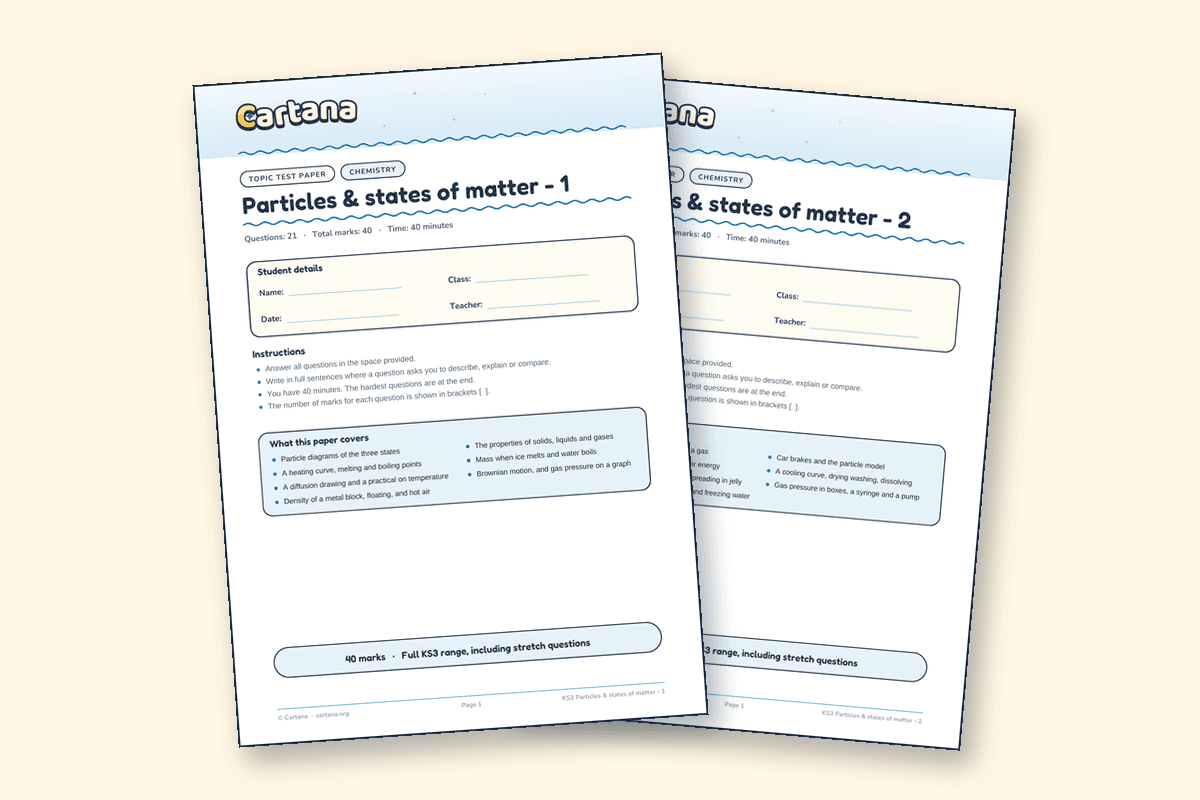
When the topics are revised, two different papers test the whole unit, each marked the way an exam would be: sit Paper 1, go over what went wrong, then sit Paper 2.
Two papers, one price
KS3 Particles & states of matter Test Papers with Mark Schemes (2 Papers)
Two different test papers on the same unit, each with its own mark scheme, for £1.99 together.
- 2 different papers
- 2 × 40 marks
- 40 minutes each
- 2 mark schemes, 28 pages
Also in the Chemistry Pack: 16 papers for £9.99, save 37%.
Did you know?
- Water expands by about 9% when it freezes. That is why ice floats, and why water pipes can burst in a hard frost.
- At room temperature, the nitrogen molecules in the air move at nearly 500 metres a second. Each one travels only a tiny distance before it hits another, which is why a smell takes seconds to cross a room.
- When water boils, it turns into about 1,600 times its own volume of steam.
- At the top of Mount Everest the air pressure is about a third of that at sea level, so water boils at only about 70 °C.
More chemistry units
- Atoms, elements & compounds 5 topics
- Separating mixtures 5 topics
- Chemical reactions 6 topics
- Acids & alkalis 5 topics
- The periodic table 5 topics
- Metals & materials 5 topics
- Earth & atmosphere 7 topics
All of KS3 science · Every homework sheet · Test papers and packs
 Watch the trailer · 1:06
New from Cartana · Beta test 1–31 December
Revision that feels like an adventure
Cartana is our KS3 learning adventure: sail between islands, answer quick-fire questions and battle bosses. It starts with science, with maths on the way, and launches in 2027. This December a small group of testers gets to play it first.
In the Cartana adventure, every science unit is an island to explore. The island for particles & states of matter is being built.
- Play the game before its official release
- Help us build it with your feedback
- Earn exclusive in-game items in return