
KS3 Chemistry · Particles & states of matter
Density
- Density = mass ÷ volume, its units (g/cm³ and kg/m³) and a worked example
- Why solids and liquids are usually denser than gases, and why things expand when heated
- Floating, sinking and liquids in layers, and why ice floats on water
- Measuring the density of a regular solid, an irregular solid and a liquid
- 4 min read
- 5 quick questions
- Free homework sheet
- Years 7 to 9
Revision notes
Density is how much mass is packed into a given volume of a material. To find it, divide the mass by the volume. It is usually given in g/cm³ or kg/m³.
What is density?
A block of iron is much heavier than a block of wood the same size: iron is denser. A tonne of feathers has the same mass as a tonne of iron, but takes up far more space: a much bigger volume.
With the mass in grams (g) and the volume in cubic centimetres (cm³), the density is in g/cm³. With the mass in kilograms and the volume in cubic metres, it is in kg/m³. 1 g/cm³ is the same as 1000 kg/m³.
A block of aluminium measures 2 cm by 3 cm by 5 cm, and has a mass of 81 g. What is its density?
Volume = 2 × 3 × 5 = 30 cm³
Density = mass ÷ volume = 81 ÷ 30 = 2.7 g/cm³
Why are solids usually denser than gases?
In a solid or a liquid the particles are touching, so a lot of mass fits in a small space. In a gas the particles are far apart, so the same mass takes up far more room. Water is about 800 times denser than the air around us. The densities below are in g/cm³.
| Material | Density |
|---|---|
| Gold | 19.3 |
| Iron | 7.9 |
| Aluminium | 2.7 |
| Water | 1.00 |
| Ice | 0.92 |
| Cork | 0.24 |
| Air | 0.0012 |
A solid floats on a liquid if it is less dense than the liquid, and sinks if it is denser. Liquids that do not mix settle in layers, the densest at the bottom.
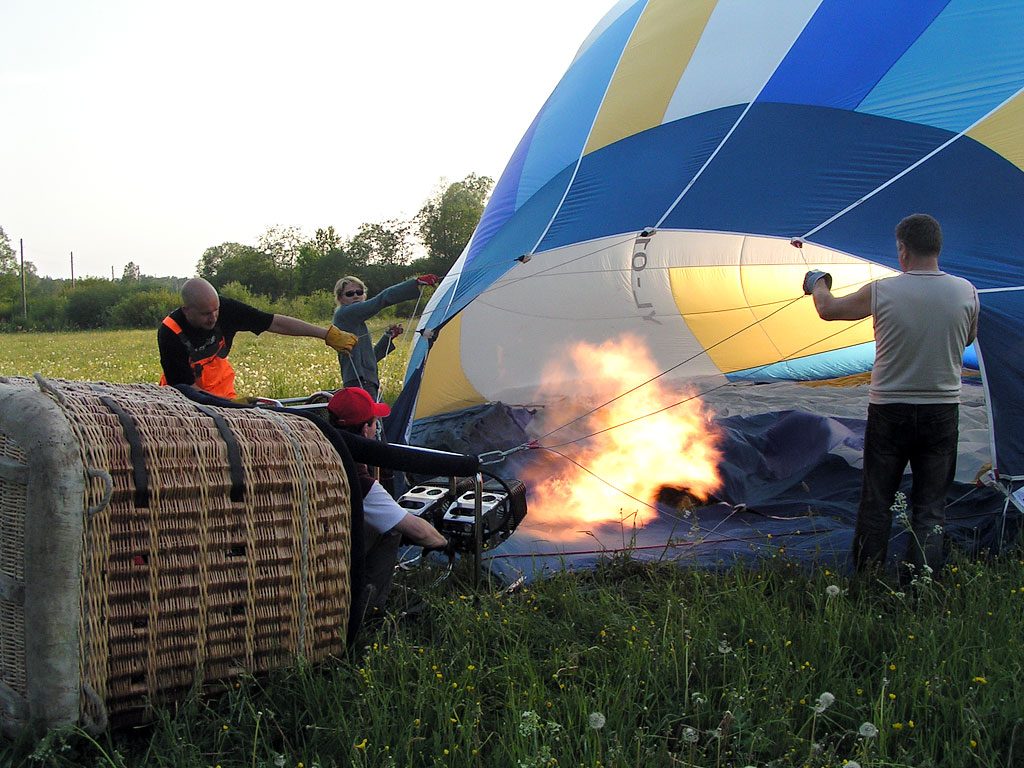
Most materials expand when heated: their particles move faster and push further apart. The particles themselves do not get bigger. The mass stays the same but the volume grows, so the density falls. Hot air is less dense than cold air, so a hot-air balloon rises.
Why does ice float on water?
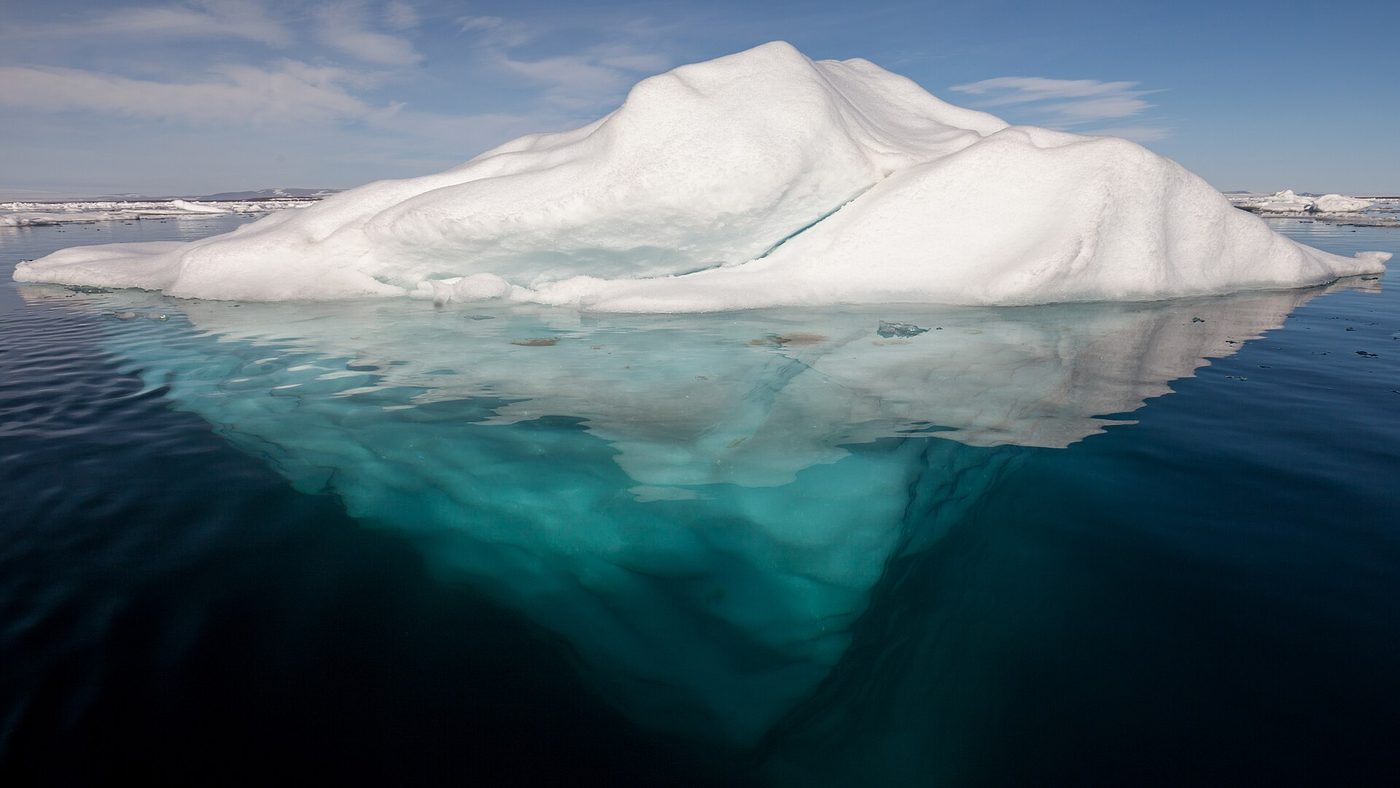
Nearly every substance is denser as a solid than as a liquid. Water is the odd one out: this is called the anomaly of water. As it freezes, its molecules lock into an open pattern of rings, which takes up about 9% more room than the liquid. So ice (0.92 g/cm³) is less dense than water (1.00 g/cm³), and it floats with about a tenth above the surface.
- Ponds freeze from the top down; the ice keeps the water below from freezing, so fish survive.
- Water pipes can burst in a freeze, as the water expands into ice.
How do you measure density?
A regular solid, such as a block: find its mass on a balance; measure its length, width and height and multiply them for the volume.
An irregular solid, such as a stone: find its mass, then its volume by displacement. Half fill a measuring cylinder with water and read the level; lower the stone in on a thread and read it again. The water rises by the stone’s volume (1 cm³ is the same as 1 ml). Read the level at the bottom of the water’s curved surface, with your eye level with it.
The stone above has a mass of 31.2 g. The water rises from 30.0 cm³ to 42.0 cm³.
Volume = 42.0 − 30.0 = 12.0 cm³
Density = 31.2 ÷ 12.0 = 2.6 g/cm³
A liquid: find the mass of an empty measuring cylinder, pour in 50 cm³ of the liquid and find the mass again. The difference is the liquid’s mass; divide it by 50 cm³.
Stretch Rearranged, the equation gives mass = density × volume. A classroom 8 m by 7 m by 3 m holds 168 m³ of air. Air’s density is about 1.2 kg/m³, so the air in the room has a mass of about 1.2 × 168 = 202 kg: more than two adults.
Written to the KS3 national curriculum. Last changed 13 November 2026.
Key words
Say them, spell them, use them in an answer.
- density
- mass
- volume
- g/cm³
- kg/m³
- float
- sink
- expand
- displacement
- measuring cylinder
- anomaly of water
Common misconception
Often said“Heavy things sink and light things float.”
In factIt depends on density, not weight. A steel ship weighing thousands of tonnes floats because, with the air inside its hull, it is less dense overall than water. A tiny pebble sinks because stone is denser than water.
Did you know?
Saturn
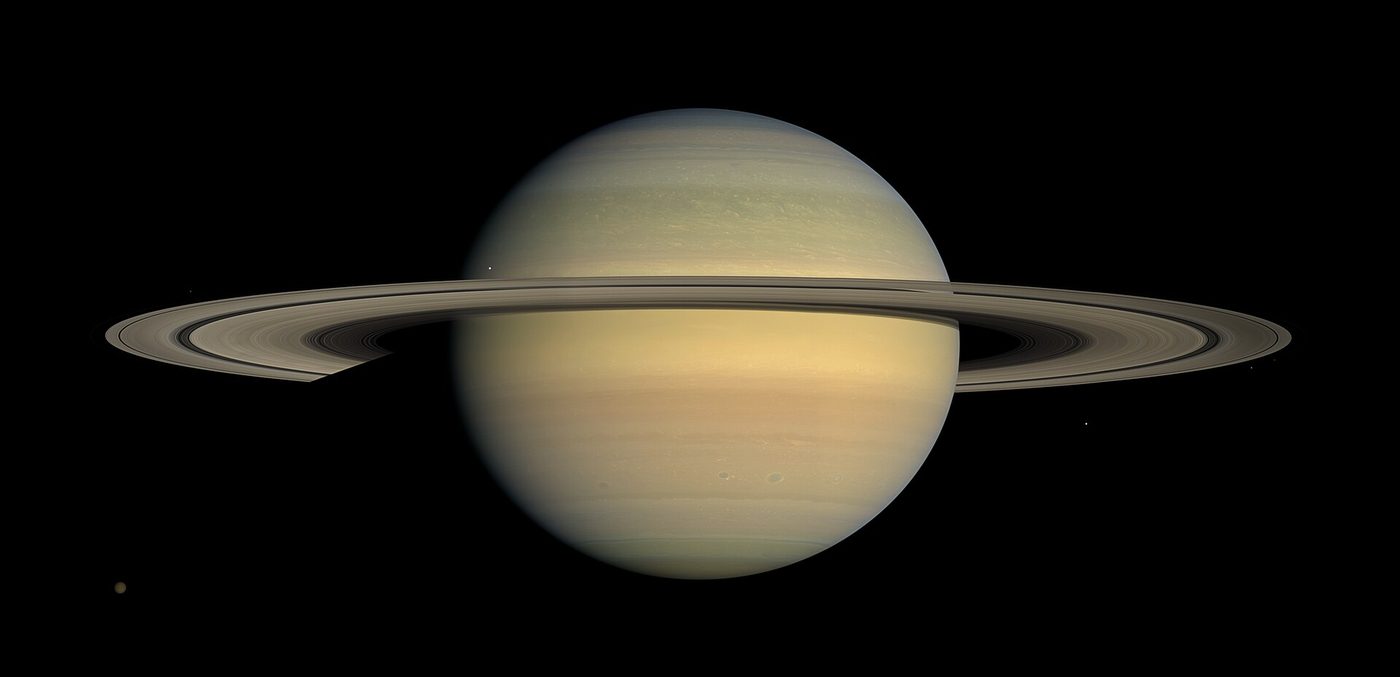
More than 700 Earths would fit inside Saturn, yet its average density is only about 0.69 g/cm³, less than water’s. It is made mostly of hydrogen and helium. In a bath of water big enough to hold it, Saturn would float.
Photo: NASA / JPL / Space Science Institute, Public domain, via Wikimedia Commons
Try 5 questions
Quick questions on density, marked as you go. Each one explains the answer.
Question 1 of 5
A block has a mass of 60 g and a volume of 20 cm³. What is its density?
Choose an answer. Each question explains itself.
The homework sheet
About twenty minutes. Everything on it is in the notes above; the answers are on the last page.
Free homework sheet
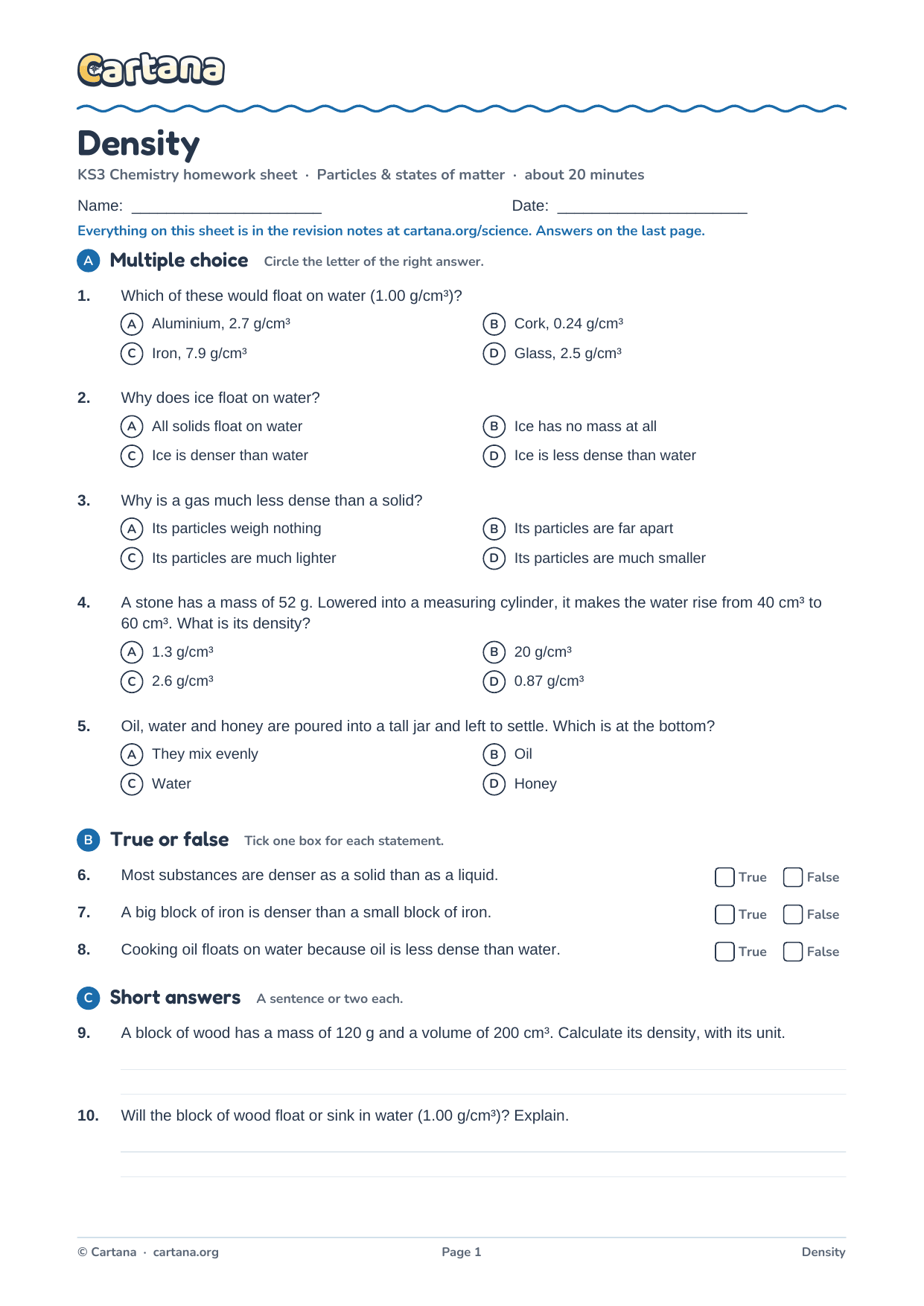
Density homework sheet
17 questions, about twenty minutes, with the answers on the last page: multiple choice, true or false, short answers, key words to define and one to explain in full.
KS3 Particles & states of matter
Revised the whole unit?
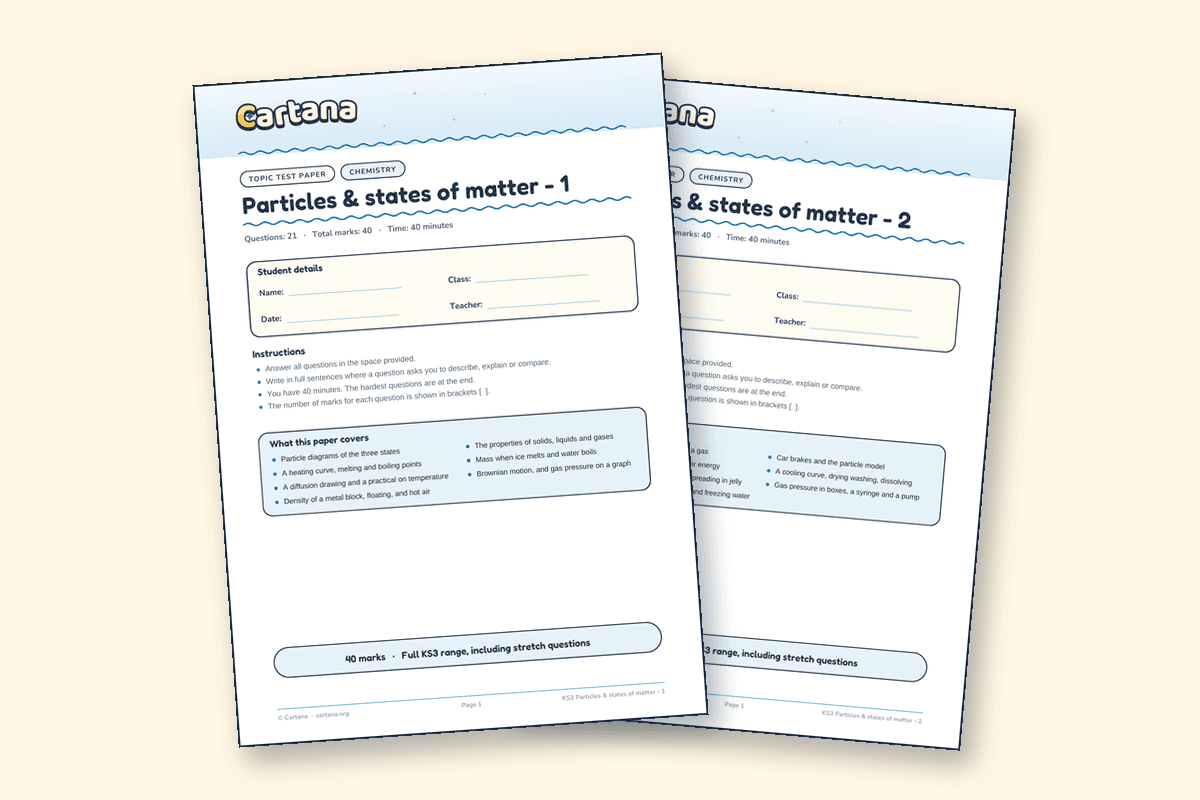
When every topic in particles & states of matter is done, two different papers test the whole unit, each with its own mark scheme.


 Watch the trailer · 1:06
New from Cartana · Beta test 1–31 December
Revision that feels like an adventure
Cartana is our KS3 learning adventure: sail between islands, answer quick-fire questions and battle bosses. It starts with science, with maths on the way, and launches in 2027. This December a small group of testers gets to play it first.
In the Cartana adventure, every science unit is an island to explore. The island for particles & states of matter is being built.
- Play the game before its official release
- Help us build it with your feedback
- Earn exclusive in-game items in return
More in this unit