
KS3 Chemistry · Years 7 to 9
Separating mixtures
Pure substances and mixtures for KS3 chemistry: what pure means to a chemist, dissolving and solubility, and the four ways to separate a mixture: filtration, evaporation and crystallisation, distillation and chromatography, with the apparatus drawn and labelled.
- 5 topics
- 19 min of notes
- 5 homework sheets
- 2 test papers
The topics, in order
Each has its revision notes, key words, a common misconception and quick questions; the homework sheets are free to print.
- 1Pure and impure substancesWhat pure means in chemistry, mixtures, and testing purity by melting point4 min read5 questionsHomework sheet
- 2Solutions and solubilitySolute, solvent and solution, dissolving, saturated solutions and solubility curves4 min read5 questionsHomework sheet
- 3Filtration and crystallisationFiltering an insoluble solid, evaporating and crystallising a dissolved one, and the rock salt practical4 min read5 questionsHomework sheet
- 4DistillationSimple distillation, the Liebig condenser, and fractional distillation4 min read5 questionsHomework sheet
- 5ChromatographyPaper chromatography: the method, why substances separate, and reading a chromatogram4 min read5 questionsHomework sheet
Test the whole unit
When the topics are revised, two different papers test the whole unit, each marked the way an exam would be: sit Paper 1, go over what went wrong, then sit Paper 2.
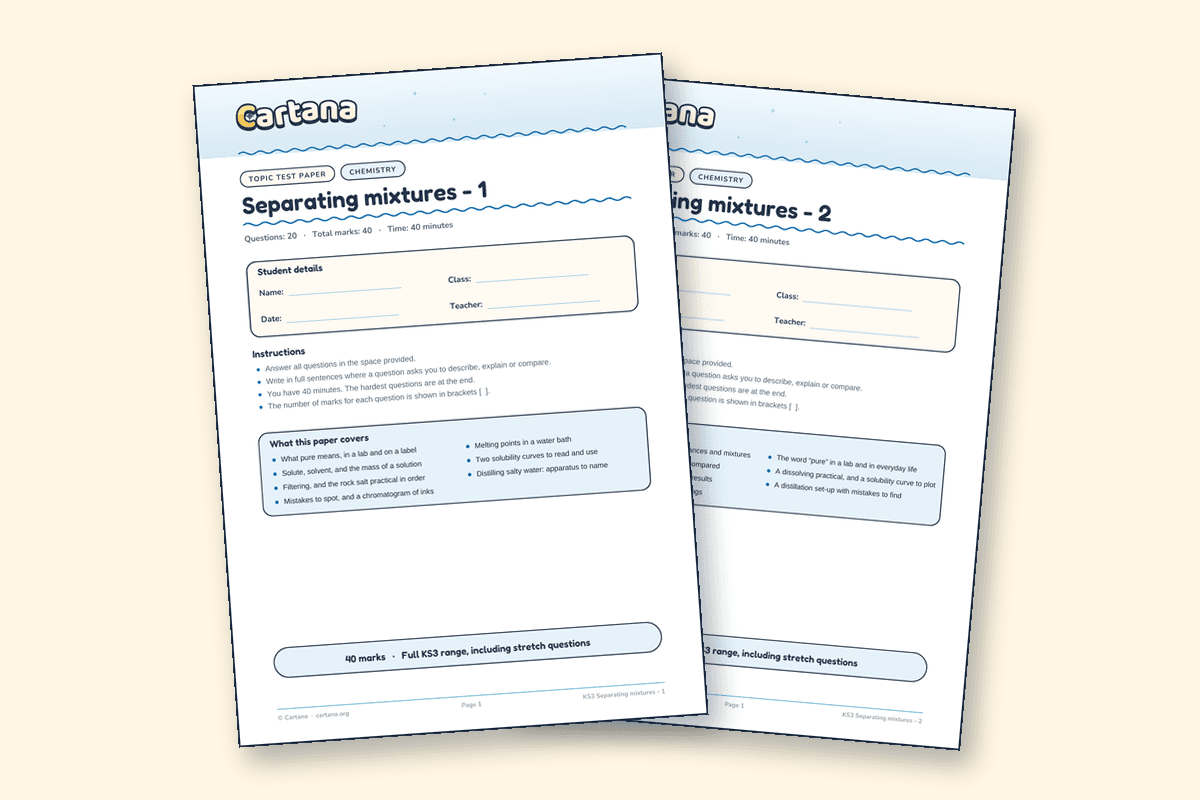
Two papers, one price
KS3 Separating mixtures Test Papers with Mark Schemes (2 Papers)
Two different test papers on the same unit, each with its own mark scheme, for £1.99 together.
- 2 different papers
- 2 × 40 marks
- 40 minutes each
- 2 mark schemes, 28 pages
Also in the Chemistry Pack: 16 papers for £9.99, save 37%.
Did you know?
- Sea water is about 3.5% dissolved salts: every kilogram of it holds about 35 grams.
- By one estimate, the salt dissolved in the oceans, spread evenly over all the land on Earth, would make a layer more than 150 metres thick: as tall as a 40-storey building.
- Perfumers distil rose petals with steam to make rose oil. It takes roughly 3,000 to 4,000 kilograms of petals to make just one kilogram of oil.
- Pure water is a very poor conductor of electricity. Tap water conducts much better because of the substances dissolved in it.
More chemistry units
- Particles & states of matter 5 topics
- Atoms, elements & compounds 5 topics
- Chemical reactions 6 topics
- Acids & alkalis 5 topics
- The periodic table 5 topics
- Metals & materials 5 topics
- Earth & atmosphere 7 topics
All of KS3 science · Every homework sheet · Test papers and packs
 Watch the trailer · 1:06
New from Cartana · Beta test 1–31 December
Revision that feels like an adventure
Cartana is our KS3 learning adventure: sail between islands, answer quick-fire questions and battle bosses. It starts with science, with maths on the way, and launches in 2027. This December a small group of testers gets to play it first.
In the Cartana adventure, every science unit is an island to explore. The island for separating mixtures is being built.
- Play the game before its official release
- Help us build it with your feedback
- Earn exclusive in-game items in return