
KS3 Chemistry · Separating mixtures
Solutions and solubility
- Solute, solvent and solution, with soluble and insoluble substances
- What happens to the particles when a substance dissolves, and why the mass stays the same
- Saturated solutions and solubility: how much dissolves in 100 g of water
- Reading a solubility curve, and working out the mass of crystals when a solution cools
- 4 min read
- 5 quick questions
- Free homework sheet
- Years 7 to 9
Revision notes
A solution forms when a substance dissolves in a liquid and its particles spread out evenly among the liquid’s particles. The substance that dissolves is the solute; the liquid is the solvent.
What are a solute, a solvent and a solution?
Stir sugar into water and the crystals seem to vanish. The sugar is the solute, the water is the solvent, and the sweet liquid is a sugar solution: a mixture.
| Word | Meaning | Example |
|---|---|---|
| Solute | The substance that dissolves | Salt |
| Solvent | The liquid it dissolves in | Water |
| Solution | The mixture they make | Salty water |
| Soluble | Able to dissolve | Sugar, salt |
| Insoluble | Will not dissolve | Sand, chalk |
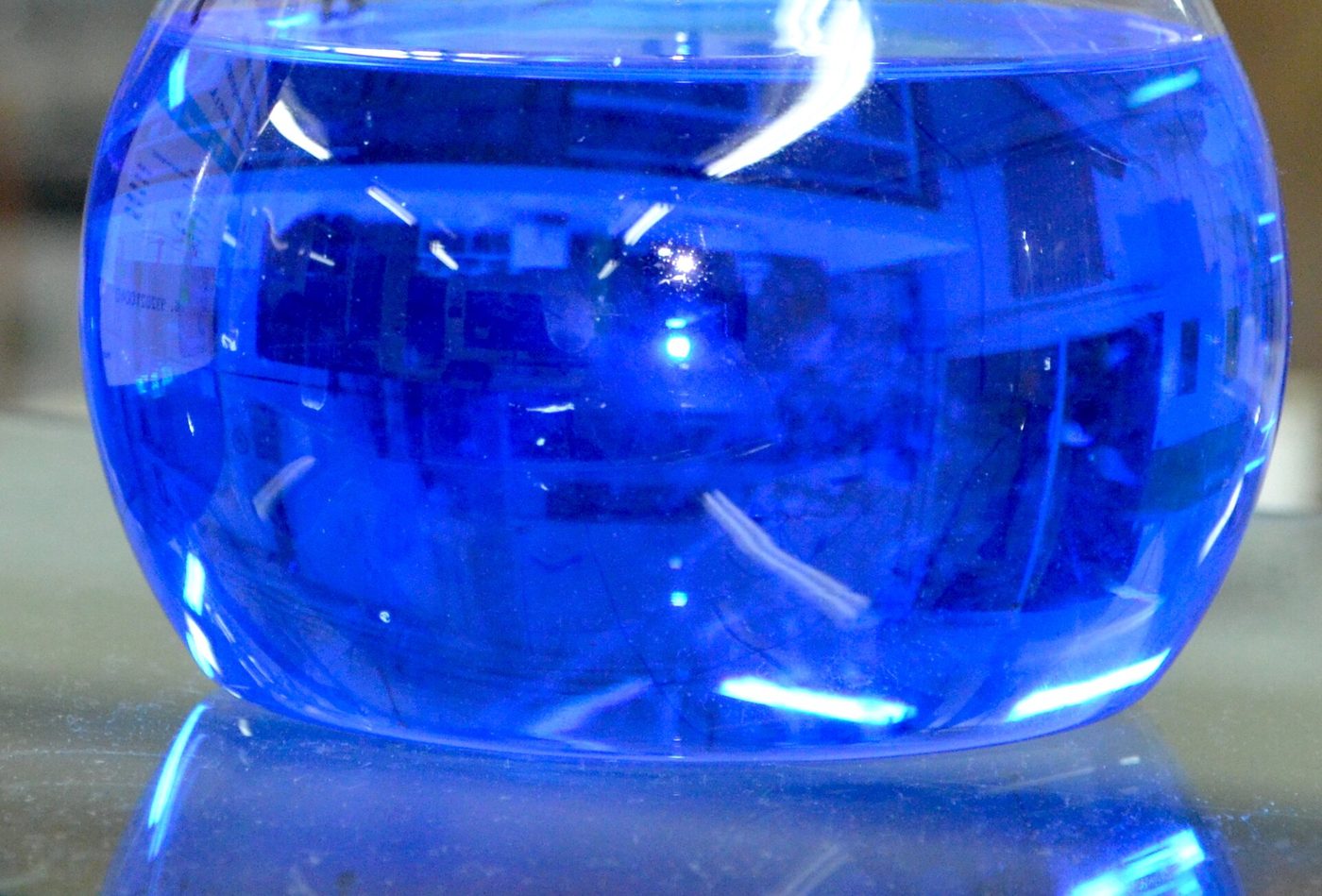
A solution is always see-through, though it can be coloured: copper sulfate solution is clear and blue. Chalk stirred into water makes a cloudy liquid that settles if left: the chalk is insoluble, so this is not a solution. Water is the commonest solvent but not the only one. Nail varnish will not dissolve in water, but it does dissolve in acetone, the solvent in many nail-varnish removers.
What happens to the particles when something dissolves?
The water particles are always moving. They bump into the sugar crystal and pull its particles away, a few at a time, until the sugar particles are spread evenly among the water particles (they spread by diffusion). Each sugar particle is far too small to see, so the solution looks clear, but the sugar is still there: you can taste it.
A soluble solid dissolves faster in warm water, when it is stirred, and when it is crushed into smaller pieces.
When something dissolves, no particles are made or destroyed, so mass is conserved: 100 g of water and 5 g of salt make 105 g of salt solution.
What is a saturated solution?
Keep adding salt to a glass of water, stirring, and at last no more will dissolve: the extra salt just sits at the bottom. The solution is now saturated. It holds as much solute as it can at that temperature.
The solubility of a substance is the largest mass of it that will dissolve in 100 g of water at a given temperature. Different substances have very different solubilities. At 20 °C, about 36 g of salt dissolves in 100 g of water, and about 200 g of sugar. Twice as much water dissolves twice as much.
How do you read a solubility curve?
For most solids, solubility rises with temperature: more dissolves in hot water than in cold. A solubility curve shows how much dissolves at each temperature. To read it, go up from the temperature to the curve, then across to the solubility.
When a hot saturated solution cools, it can hold less solute, so the extra comes out of the solution as crystals.
100 g of water at 60 °C is saturated with potassium nitrate. It is cooled to 20 °C. What mass of crystals forms?
At 60 °C, 110 g dissolves in 100 g of water.
At 20 °C, only 32 g stays dissolved.
Mass of crystals = 110 − 32 = 78 g
Salt’s curve is almost flat, so cooling a salt solution gives hardly any crystals. Salt is got back by evaporating the water instead (see filtration and crystallisation).
Stretch Gases dissolve too, but the other way round: a gas is less soluble in warm water than in cold. A fizzy drink goes flat faster when it is warm, as the dissolved carbon dioxide escapes. In a hot summer, a river holds less dissolved oxygen, and fish can struggle to breathe.
Written to the KS3 national curriculum. Last changed 13 November 2026.
Key words
Say them, spell them, use them in an answer.
- solution
- solute
- solvent
- dissolve
- soluble
- insoluble
- saturated
- solubility
- solubility curve
- conservation of mass
Common misconception
Often said“When sugar dissolves in tea, it melts and disappears.”
In factDissolving is not melting: melting needs heat to turn a solid into a liquid. The sugar’s particles have spread out among the water’s particles, too small to see. The sugar is still there: you can taste it, and the tea weighs more by exactly the mass of the sugar.
Did you know?
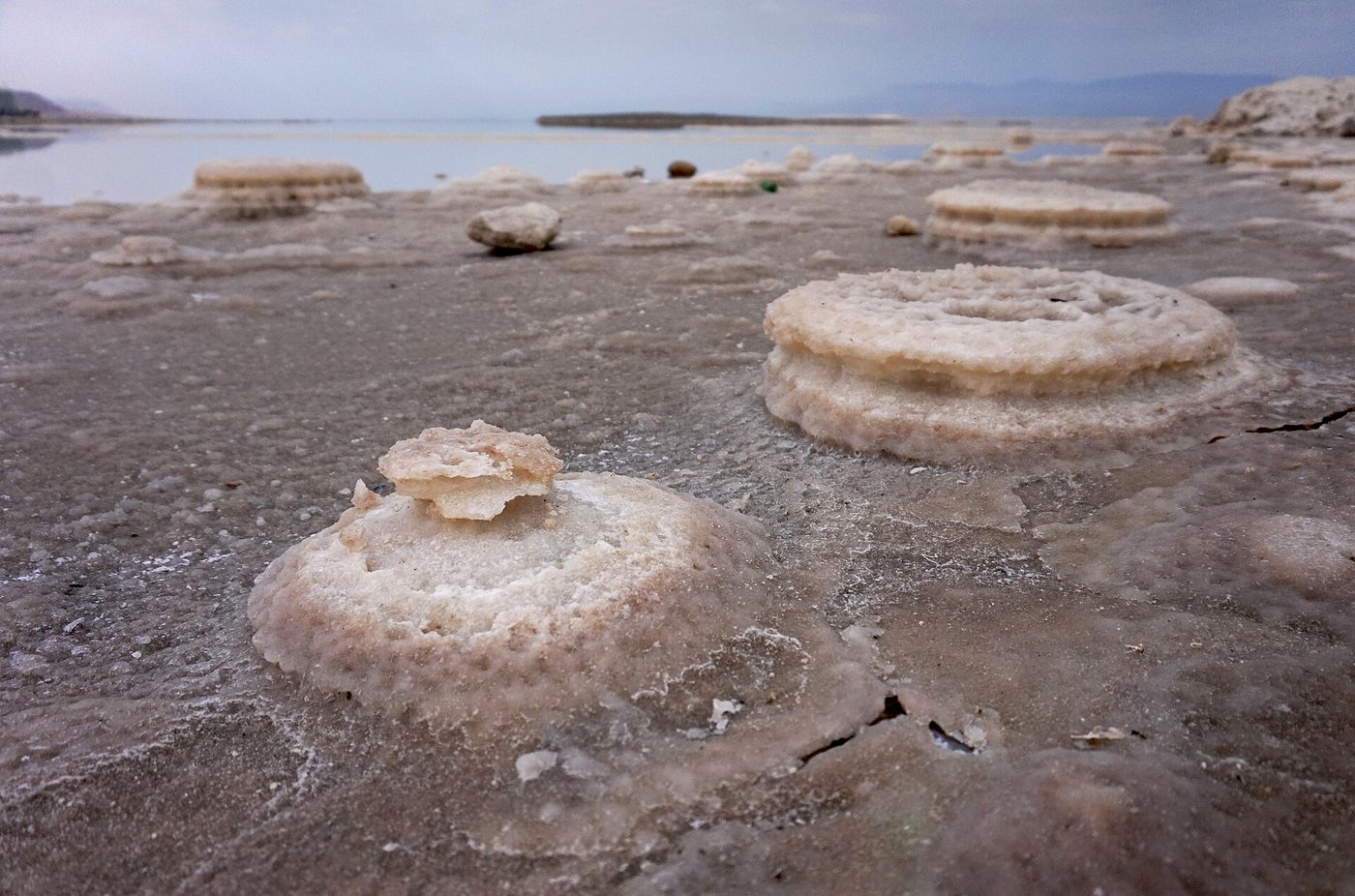
The Dead Sea
So much is dissolved in the Dead Sea that its water is about 34% dissolved salts, nearly ten times saltier than the ocean. The water is so dense that people float in it without trying, and salt crystallises out in white crusts along its shores.
Photo: Tiia Monto, CC BY-SA 3.0, via Wikimedia Commons
Try 5 questions
Quick questions on solutions and solubility, marked as you go. Each one explains the answer.
Question 1 of 5
What is a solvent?
Choose an answer. Each question explains itself.
The homework sheet
About twenty minutes. Everything on it is in the notes above; the answers are on the last page.
Free homework sheet
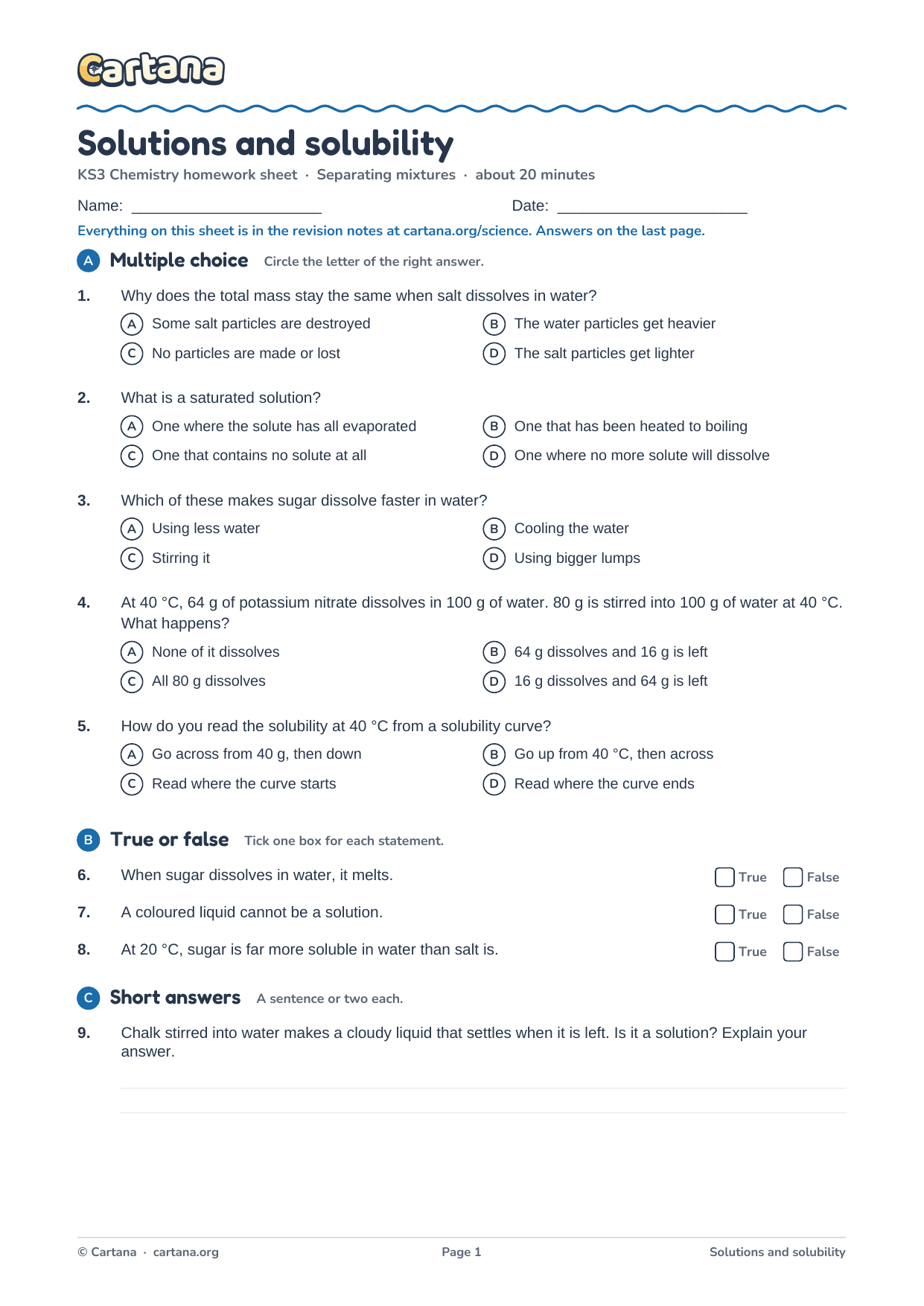
Solutions and solubility homework sheet
17 questions, about twenty minutes, with the answers on the last page: multiple choice, true or false, short answers, key words to define and one to explain in full.
KS3 Separating mixtures
Revised the whole unit?
When every topic in separating mixtures is done, two different papers test the whole unit, each with its own mark scheme.


 Watch the trailer · 1:06
New from Cartana · Beta test 1–31 December
Revision that feels like an adventure
Cartana is our KS3 learning adventure: sail between islands, answer quick-fire questions and battle bosses. It starts with science, with maths on the way, and launches in 2027. This December a small group of testers gets to play it first.
In the Cartana adventure, every science unit is an island to explore. The island for separating mixtures is being built.
- Play the game before its official release
- Help us build it with your feedback
- Earn exclusive in-game items in return
More in this unit
Separating mixtures
- 1Pure and impure substancesWhat pure means in chemistry, mixtures, and testing purity by melting point
- 3Filtration and crystallisationNextFiltering an insoluble solid, evaporating and crystallising a dissolved one, and the rock salt practical
- 4DistillationSimple distillation, the Liebig condenser, and fractional distillation
- 5ChromatographyPaper chromatography: the method, why substances separate, and reading a chromatogram