
KS3 Physics · Years 7 to 9
Motion & pressure
Motion and pressure for KS3 physics: calculating speed, distance-time graphs, how forces change the way things move, pressure on solids, pressure in liquids and gases, and why things float or sink.
- 6 topics
- 30 min of notes
- 6 homework sheets
- 2 test papers
The topics, in order
Each has its revision notes, key words, a common misconception and quick questions; the homework sheets are free to print.
- 1SpeedSpeed = distance ÷ time, units and converting them, average speed and relative motion4 min read5 questionsHomework sheet
- 2Distance-time graphsReading and drawing distance-time graphs, and working out speed from the gradient5 min read5 questionsHomework sheet
- 3Forces and motionHow a resultant force starts, stops, speeds up, slows down or turns an object, and what happens as things fall5 min read5 questionsHomework sheet
- 4Pressure on solidsPressure = force ÷ area, in N/m² and N/cm², with snowshoes, drawing pins and calculations5 min read5 questionsHomework sheet
- 5Pressure in liquids and gasesPressure in fluids acts in all directions and increases with depth; dams, divers and atmospheric pressure5 min read5 questionsHomework sheet
- 6Floating and sinkingUpthrust, floating when upthrust equals weight, density, ships and submarines5 min read5 questionsHomework sheet
Test the whole unit
When the topics are revised, two different papers test the whole unit, each marked the way an exam would be: sit Paper 1, go over what went wrong, then sit Paper 2.
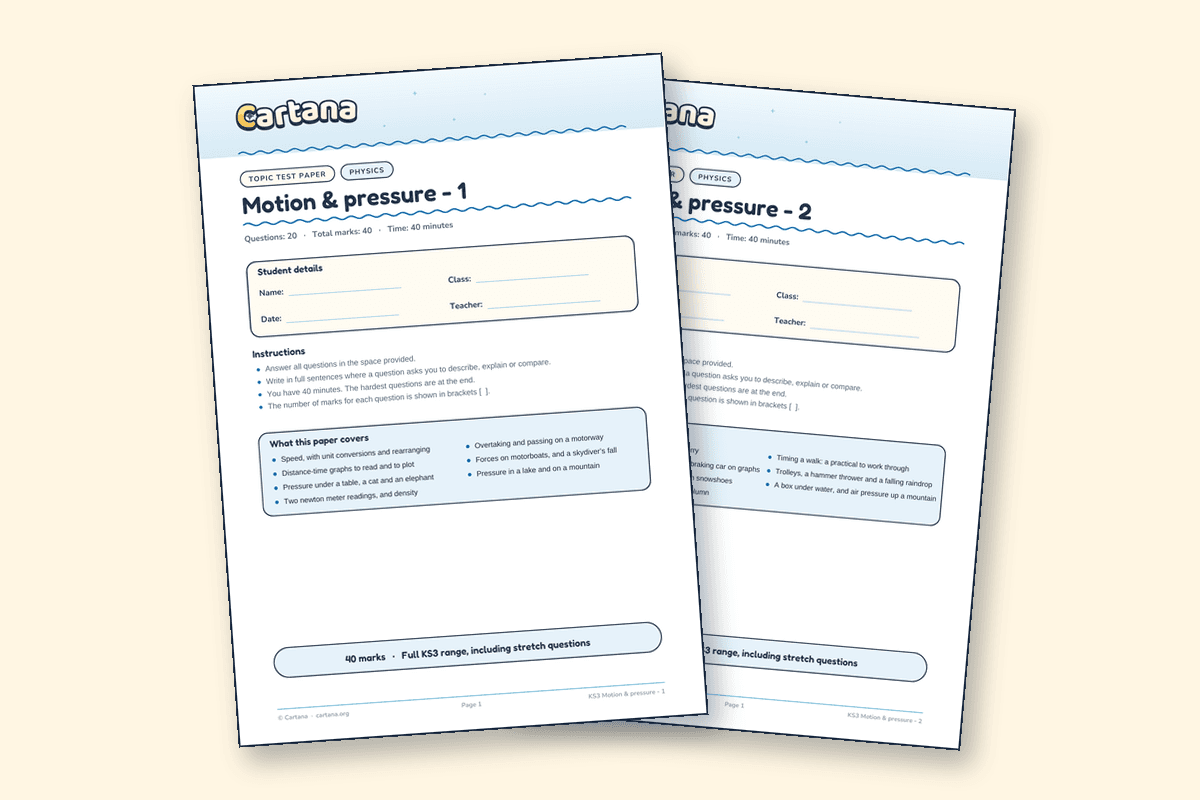
Two papers, one price
KS3 Motion & pressure Test Papers with Mark Schemes (2 Papers)
Two different test papers on the same unit, each with its own mark scheme, for £1.99 together.
- 2 different papers
- 2 × 40 marks
- 40 minutes each
- 2 mark schemes, 26 pages
Also in the Physics Pack: 14 papers for £8.99, save 35%.
Did you know?
- Sound travels through air at about 340 m/s, so the thunder from lightning 1 km away arrives about 3 seconds after the flash.
- Average speed cameras time each car between two cameras a known distance apart, so slowing down just for the camera does not help.
- Every 10 m a diver goes down adds about as much pressure as the whole atmosphere above: 10 m under the sea, the pressure on her is about double the pressure at the surface.
- Archimedes is said to have shouted “Eureka” (“I have found it”) in his bath, when he saw how to test a gold crown by the water it pushed aside. The story was first written down about 200 years after his death, so it may not be true.
More physics units
- Forces 6 topics
- Energy 6 topics
- Electricity & magnetism 5 topics
- Sound & waves 5 topics
- Light 5 topics
- Space 5 topics
All of KS3 science · Every homework sheet · Test papers and packs
 Watch the trailer · 1:06
New from Cartana · Beta test 1–31 December
Revision that feels like an adventure
Cartana is our KS3 learning adventure: sail between islands, answer quick-fire questions and battle bosses. It starts with science, with maths on the way, and launches in 2027. This December a small group of testers gets to play it first.
In the Cartana adventure, every science unit is an island to explore. The island for motion & pressure is being built.
- Play the game before its official release
- Help us build it with your feedback
- Earn exclusive in-game items in return