
KS3 Physics · Motion & pressure
Floating and sinking
- Upthrust, and measuring it with a newton meter
- An object floats when the upthrust can equal its weight
- Density decides: what floats and what sinks
- How steel ships float and submarines dive
- 5 min read
- 5 quick questions
- Free homework sheet
- Years 7 to 9
Revision notes
Floating and sinking depend on two forces: an object’s weight (the pull of gravity on it) pulling it down and the upthrust of the water pushing it up. An object floats when the upthrust can grow to match its weight, and sinks when its weight is bigger.
What is upthrust?
A liquid or a gas pushes up on any object in it. This upward force is called upthrust, and like any force it is measured in newtons (N). It comes from pressure increasing with depth: the bottom of an object is deeper than its top, so the water pushes up on it harder than it pushes down.
Measuring upthrust:
- Hang a stone from a newton meter (a spring balance that measures forces) and read its weight in air, for example 5.0 N.
- Lower the stone, still hanging, until it is completely under the water in a beaker. Read the meter again, for example 3.0 N.
- The upthrust is the difference: 5.0 N − 3.0 N = 2.0 N.
The stone’s weight has not changed; the water is holding part of it up. That is why you feel lighter in a swimming pool.
When does an object float?
Put an object in water and it sinks in, pushing water aside. The further in it goes, the more water it pushes aside and the bigger the upthrust. If the upthrust grows to equal the object’s weight before the object is completely under, the forces are balanced and it floats. If its weight is still bigger than the upthrust when it is fully under, it sinks.
- A heavier load makes a boat sit lower in the water, because it must push aside more water to get enough upthrust.
- Air gives upthrust too: a helium balloon rises because the upthrust is bigger than its weight.
Why do some things float and others sink?
It is not how heavy an object is but its density: its mass divided by its volume. A solid less dense than a liquid floats on it; a solid denser than the liquid sinks. The densities below are in g/cm3.
| Material | Density | In water |
|---|---|---|
| Cork | 0.24 | Floats high |
| Ice | 0.92 | Floats, mostly under |
| Fresh water | 1.00 | The liquid itself |
| Sea water | 1.03 | Denser than fresh water |
| Aluminium | 2.7 | Sinks |
| Iron | 7.9 | Sinks |
A block has a mass of 60 g and a volume of 80 cm3. Will it float in water?
density = 60 g ÷ 80 cm3 = 0.75 g/cm3
That is less than water’s 1.00 g/cm3, so it floats.
A log has a mass of 2 kg and a volume of 2500 cm3. Will it float?
mass = 2 kg = 2 × 1000 = 2000 g
density = 2000 g ÷ 2500 cm3 = 0.8 g/cm3, less than 1.00, so it floats.
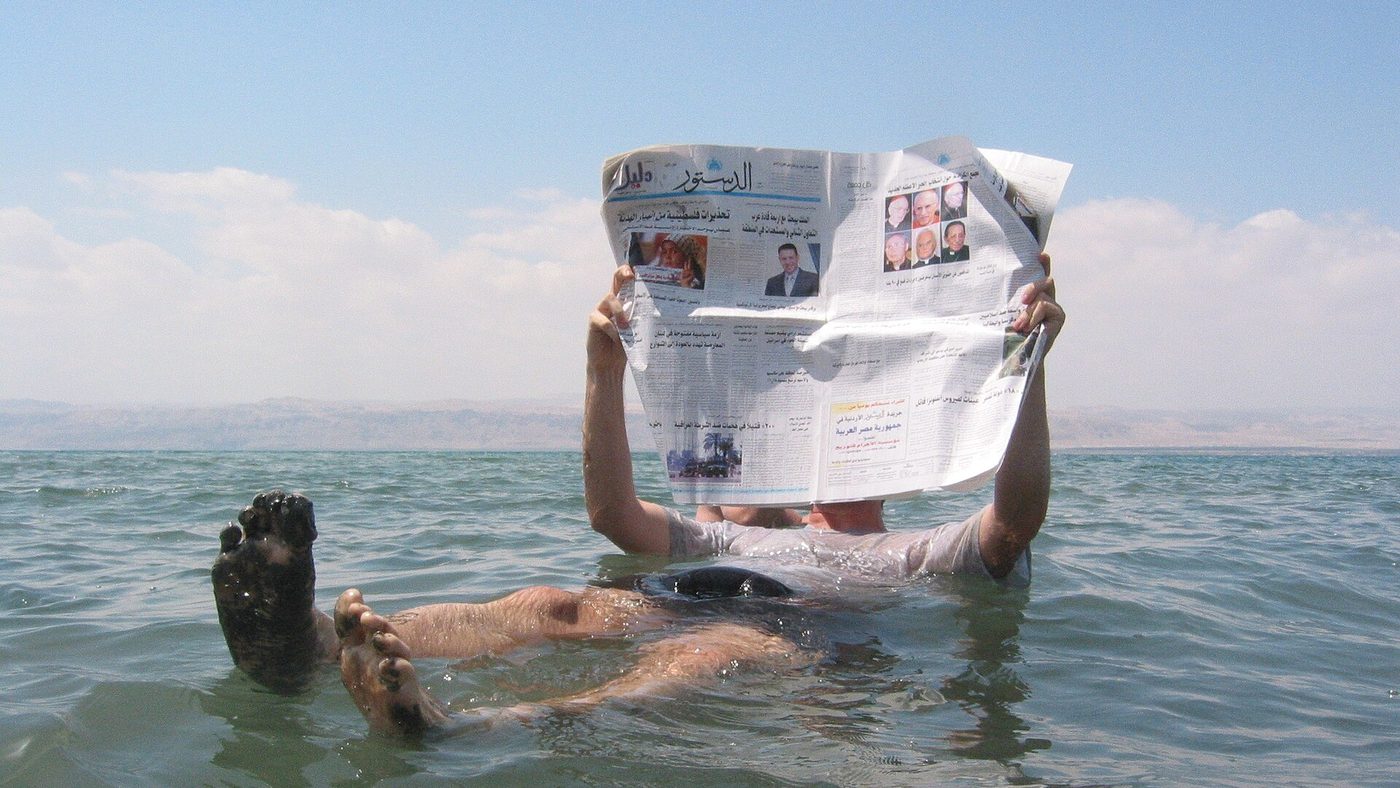
Sea water is denser than fresh water, so a ship floats a little higher in the sea than in a river.
How can a steel ship float?
Steel is nearly eight times denser than water, yet ships are made of it. A ship is a hollow steel shell full of air, so the ship as a whole has a smaller average density than water, and its wide hull pushes aside enough water for a big upthrust.
The plasticine boat: a ball of plasticine sinks, but the same plasticine shaped into a wide, thin-walled boat floats. Its mass has not changed; the boat pushes aside far more water, so the upthrust can match its weight.
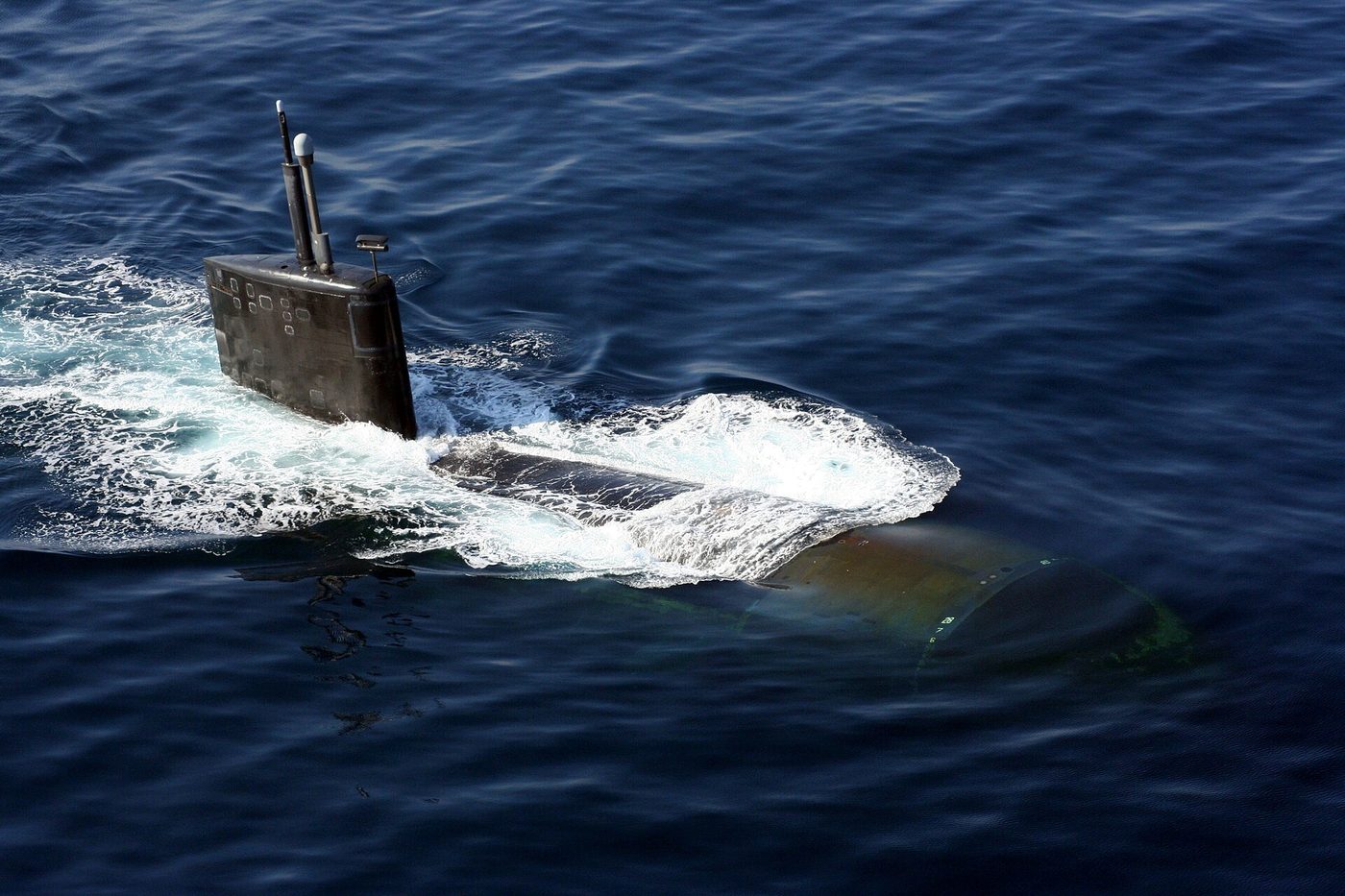
A submarine can float or sink when it chooses. To dive, it opens valves and lets sea water into its ballast tanks, so it becomes heavier for the same size. To rise, compressed air blows the water out of the tanks, and it becomes lighter again.
Stretch The Greek scientist Archimedes found the rule over 2,200 years ago: the upthrust on an object equals the weight of the fluid it pushes aside. A stone of volume 200 cm3, completely under water, pushes aside 200 cm3 of water, which has a mass of 200 g and a weight of 2 N, so the upthrust on it is 2 N.
Written to the KS3 national curriculum. Last changed 15 November 2026.
Key words
Say them, spell them, use them in an answer.
- upthrust
- weight
- float
- sink
- density
- newton meter
- ballast tanks
- submarine
Common misconception
Often said“Heavy things sink and light things float.”
In factWhether something floats depends on its density, not its weight. A ship of 100,000 tonnes floats because its hollow hull is mostly air, while a tiny pebble, denser than water, sinks.
Did you know?
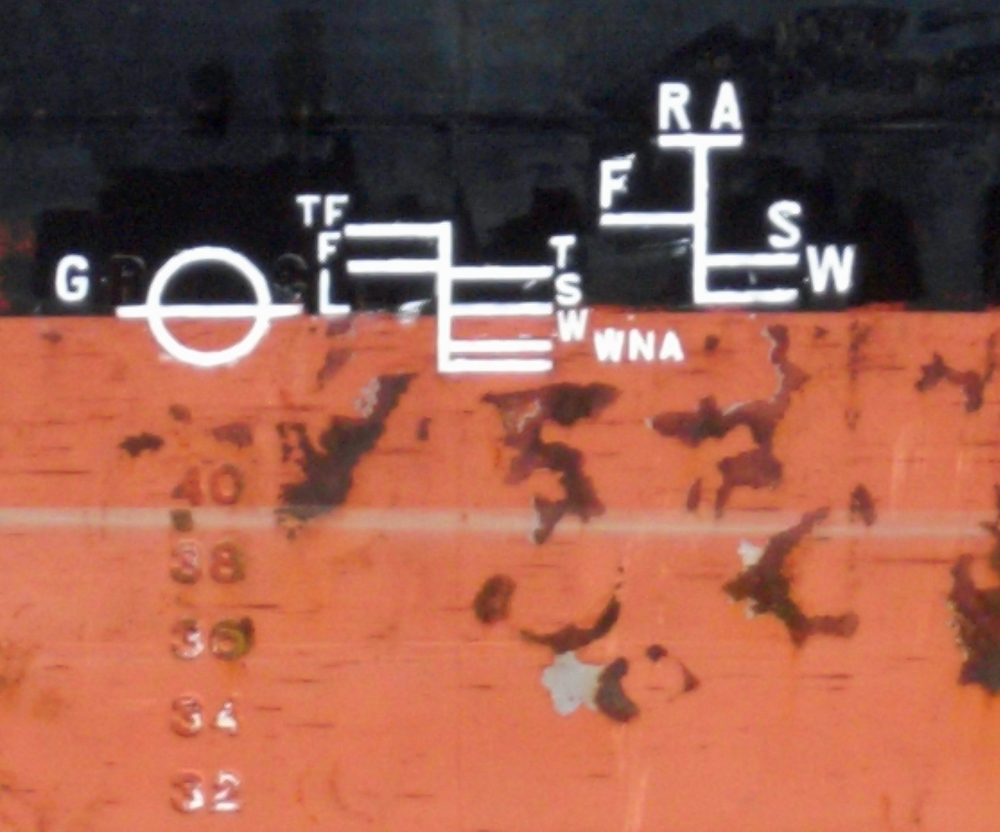
The Plimsoll line
Since the Merchant Shipping Act of 1876, British cargo ships have had to carry a load line on their hulls, named after the MP Samuel Plimsoll, who campaigned for it after overloaded ships sank. When the water reaches the line, the ship is loaded as deeply as is safe.
Photo: David Wright, CC BY-SA 2.0, via Wikimedia Commons
Try 5 questions
Quick questions on floating and sinking, marked as you go. Each one explains the answer.
Question 1 of 5
An object that sinks has no upthrust on it at all.
Choose an answer. Each question explains itself.
The homework sheet
About twenty minutes. Everything on it is in the notes above; the answers are on the last page.
Free homework sheet
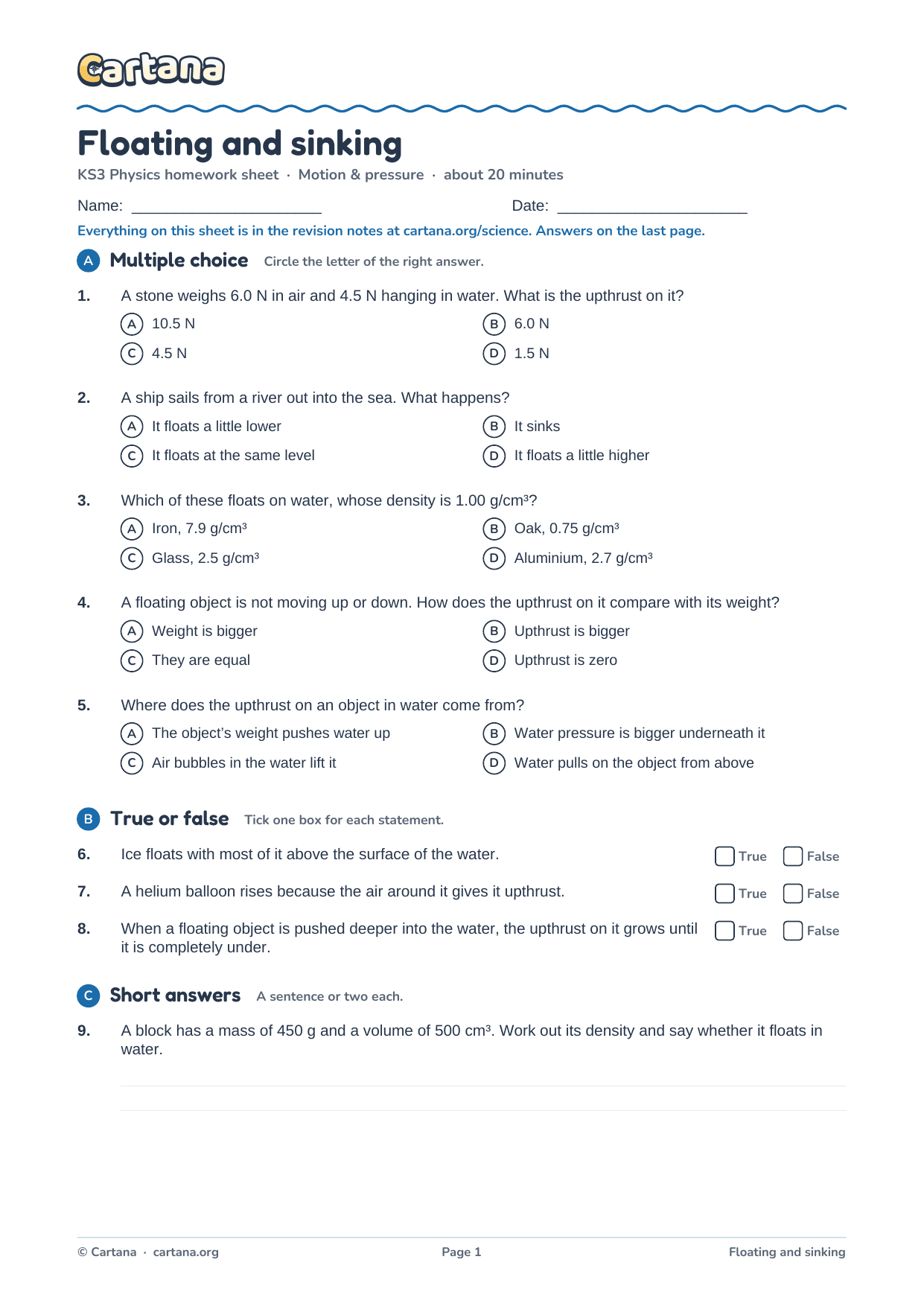
Floating and sinking homework sheet
17 questions, about twenty minutes, with the answers on the last page: multiple choice, true or false, short answers, key words to define and one to explain in full.
KS3 Motion & pressure
Revised the whole unit?
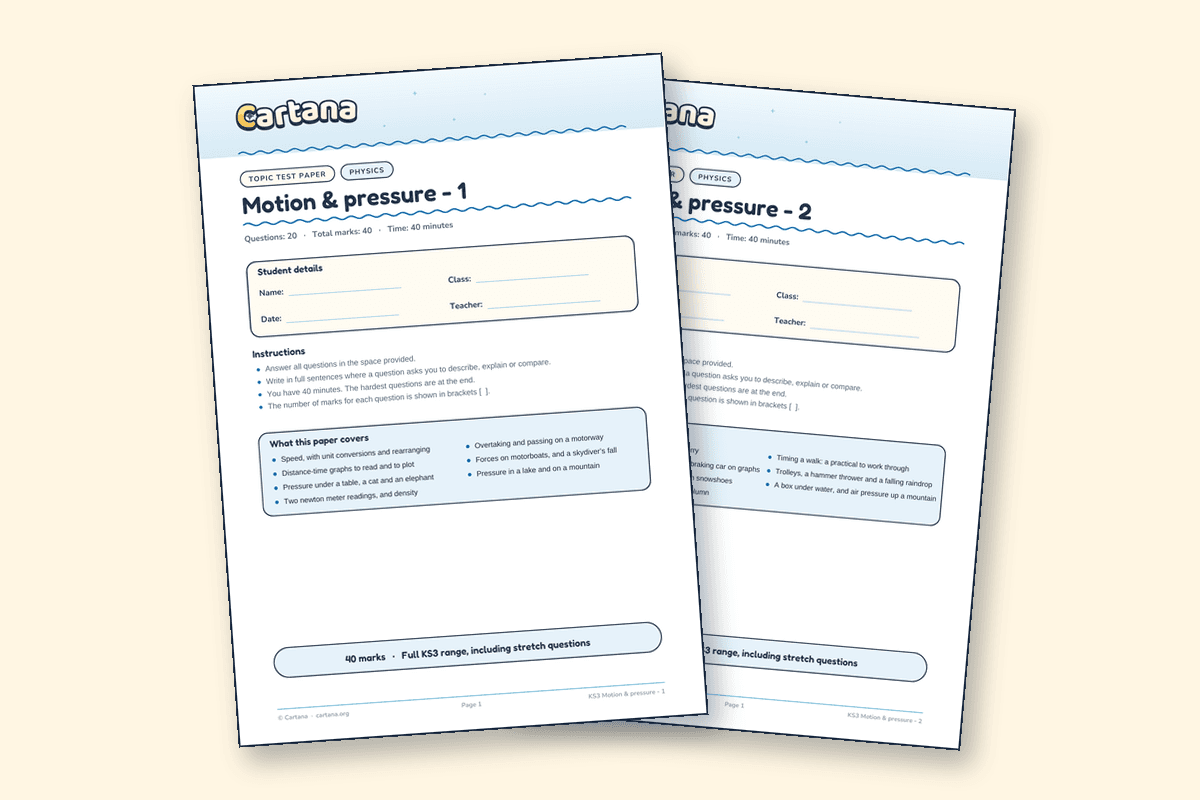
When every topic in motion & pressure is done, two different papers test the whole unit, each with its own mark scheme.


 Watch the trailer · 1:06
New from Cartana · Beta test 1–31 December
Revision that feels like an adventure
Cartana is our KS3 learning adventure: sail between islands, answer quick-fire questions and battle bosses. It starts with science, with maths on the way, and launches in 2027. This December a small group of testers gets to play it first.
In the Cartana adventure, every science unit is an island to explore. The island for motion & pressure is being built.
- Play the game before its official release
- Help us build it with your feedback
- Earn exclusive in-game items in return
More in this unit
Motion & pressure
- 1SpeedSpeed = distance ÷ time, units and converting them, average speed and relative motion
- 2Distance-time graphsReading and drawing distance-time graphs, and working out speed from the gradient
- 3Forces and motionHow a resultant force starts, stops, speeds up, slows down or turns an object, and what happens as things fall
- 4Pressure on solidsPressure = force ÷ area, in N/m² and N/cm², with snowshoes, drawing pins and calculations
- 5Pressure in liquids and gasesPressure in fluids acts in all directions and increases with depth; dams, divers and atmospheric pressure