
KS3 Physics · Forces
Balanced and unbalanced forces
- Adding forces along a line to find the resultant force
- Balanced forces: staying still, or moving at a steady speed
- Unbalanced forces: speeding up, slowing down or changing direction
- How the forces on a skydiver change during a jump
- 3 min read
- 5 quick questions
- Free homework sheet
- Years 7 to 9
Revision notes
The forces on an object are balanced when they cancel out, so its movement does not change. Unbalanced forces leave a resultant force, which changes the object's speed or direction.
What is a resultant force?
When several forces act along the same line, they add up to one resultant force: the single force that would have the same effect as all of them together.
- Forces in the same direction: add them.
- Forces in opposite directions: take the smaller from the bigger. The resultant points the same way as the bigger force.
A boat's engine pushes it forwards with 500 N. The wind behind it pushes it forwards with 100 N. Water resistance pulls it back with 300 N. What is the resultant force?
Forwards: 500 N + 100 N = 600 N
Backwards: 300 N
Resultant: 600 N − 300 N = 300 N forwards, so the boat speeds up.
What do balanced forces do?
When the forces are balanced, the resultant force is zero, and nothing about the object's movement changes:
- An object at rest stays still. A book on a table is pulled down by its weight and pushed up just as hard by the table.
- A moving object keeps going at a steady speed in a straight line. A car cruising on a motorway still needs its engine, but only to match the air resistance and friction.
What do unbalanced forces do?
| Resultant force, compared with the way it moves | What happens |
|---|---|
| Forwards | The object speeds up |
| Backwards | The object slows down |
| At an angle | The object changes direction |
A bigger resultant force makes a bigger change. The same force changes a heavy object's movement less than a light one's: a push that gets a bike going barely moves a car.
How do the forces on a skydiver change?
- Just after jumping, her weight is much bigger than the air resistance: the forces are unbalanced and she speeds up.
- The faster she falls, the bigger the air resistance, until it equals her weight. Now the forces are balanced and she falls at a steady speed of about 200 km/h, her terminal speed (also called terminal velocity).
- The parachute opens. Air resistance becomes much bigger than her weight, so she slows down.
- As she slows, air resistance falls until it equals her weight again. She reaches a new, much lower steady speed and lands safely.

Stretch How quickly the speed changes depends on the resultant force and the mass: resultant force = mass × acceleration, where acceleration is the change in speed each second. A resultant force of 2000 N on a car of mass 1000 kg makes it 2 m/s faster every second. The same force on a 2000 kg van adds only 1 m/s each second.
Written to the KS3 national curriculum. Last changed 13 November 2026.
Key words
Say them, spell them, use them in an answer.
- resultant force
- balanced forces
- unbalanced forces
- at rest
- steady speed
- driving force
- air resistance
- terminal speed
Common misconception
Often said“If something is moving, there must be a force pushing it forwards.”
In factA moving object keeps going at a steady speed in a straight line when the forces on it are balanced. A car's engine is needed only to match friction and air resistance. Far out in space, with almost nothing to slow it, a probe coasts on for years with no engine pushing it.
Did you know?
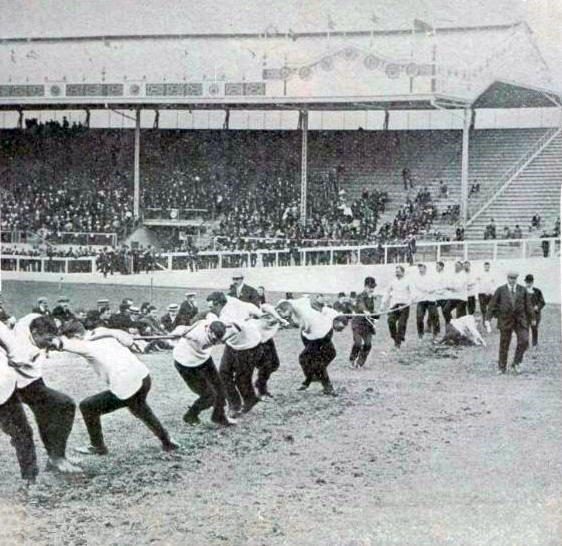
Olympic tug of war
Tug of war was an Olympic sport from 1900 to 1920. A team of City of London Police officers won the gold medal for Great Britain in 1908 and again in 1920.
Photo: La Vie au Grand Air, Public domain, via Wikimedia Commons
Try 5 questions
Quick questions on balanced and unbalanced forces, marked as you go. Each one explains the answer.
Question 1 of 5
Why does a skydiver slow down when her parachute opens?
Choose an answer. Each question explains itself.
The homework sheet
About twenty minutes. Everything on it is in the notes above; the answers are on the last page.
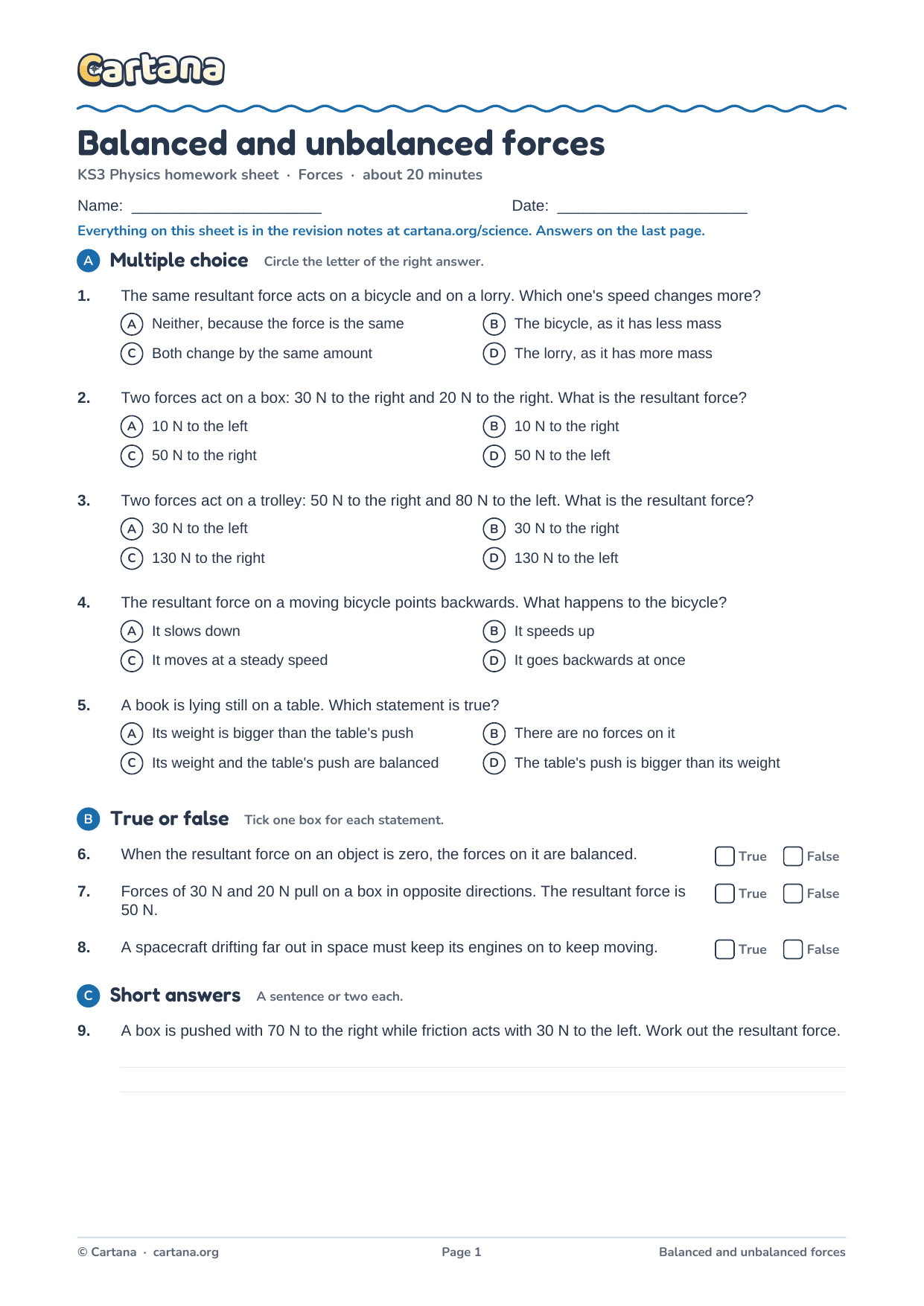
Free homework sheet
Balanced and unbalanced forces homework sheet
17 questions, about twenty minutes, with the answers on the last page: multiple choice, true or false, short answers, key words to define and one to explain in full.
KS3 Forces
Revised the whole unit?
When every topic in forces is done, two different papers test the whole unit, each with its own mark scheme.


 Watch the trailer · 1:06
New from Cartana · Beta test 1–31 December
Revision that feels like an adventure
Cartana is our KS3 learning adventure: sail between islands, answer quick-fire questions and battle bosses. It starts with science, with maths on the way, and launches in 2027. This December a small group of testers gets to play it first.
In the Cartana adventure, every science unit is an island to explore. The island for forces is being built.
- Play the game before its official release
- Help us build it with your feedback
- Earn exclusive in-game items in return
More in this unit
Forces
- 1Introduction to forcesPushes and pulls, contact and non-contact forces, newtons, force arrows and interaction pairs
- 3Friction and dragNextFriction between surfaces, air and water resistance, streamlining, and investigating friction
- 4Stretching and squashingDeforming objects, extension, the spring practical, Hooke's law and the energy stored in a spring
- 5MomentsTurning forces, moment = force × distance, the principle of moments and levers
- 6Gravity, mass and weightMass and weight, weight = mass × g, weight on the Moon, gravity and the three non-contact forces