
KS3 Physics · Forces
Gravity, mass and weight
- Mass in kilograms against weight in newtons
- Calculating weight: weight = mass × g, with g = 10 N/kg on Earth
- Why you would weigh less on the Moon
- Gravity, and the three non-contact forces
- 4 min read
- 5 quick questions
- Free homework sheet
- Years 7 to 9
Revision notes
Mass is the amount of matter in an object, measured in kilograms (kg). Weight is the force of gravity on it, in newtons (N). Weight = mass × g.
What is the difference between mass and weight?
| Mass | Weight | |
|---|---|---|
| What it is | How much matter (stuff) the object has | The force of gravity pulling on the object |
| Unit | Kilogram (kg) | Newton (N) |
| Measured with | A balance | A newton meter |
| On the Moon | The same | About a sixth as much |
In everyday speech "how much do you weigh?" is answered in kilograms, which is really a mass. Bathroom scales measure the force you push down with, then show it as the mass that would have that weight on Earth.
How do you calculate weight?
Weight in newtons (N), mass in kilograms (kg) and gravitational field strength (g) in newtons per kilogram (N/kg). On Earth, g is about 10 N/kg (9.8 N/kg more exactly): every kilogram is pulled down with a force of 10 N.
What is the weight of a pupil of mass 45 kg on Earth?
weight = mass × g
weight = 45 kg × 10 N/kg = 450 N
A 200 g apple: change grams to kilograms first, 200 g = 0.2 kg, so its weight = 0.2 × 10 = 2 N.
Working backwards: to find a mass from a weight, divide by g. A bag that weighs 50 N on Earth has a mass of 50 ÷ 10 = 5 kg.
Why would you weigh less on the Moon?
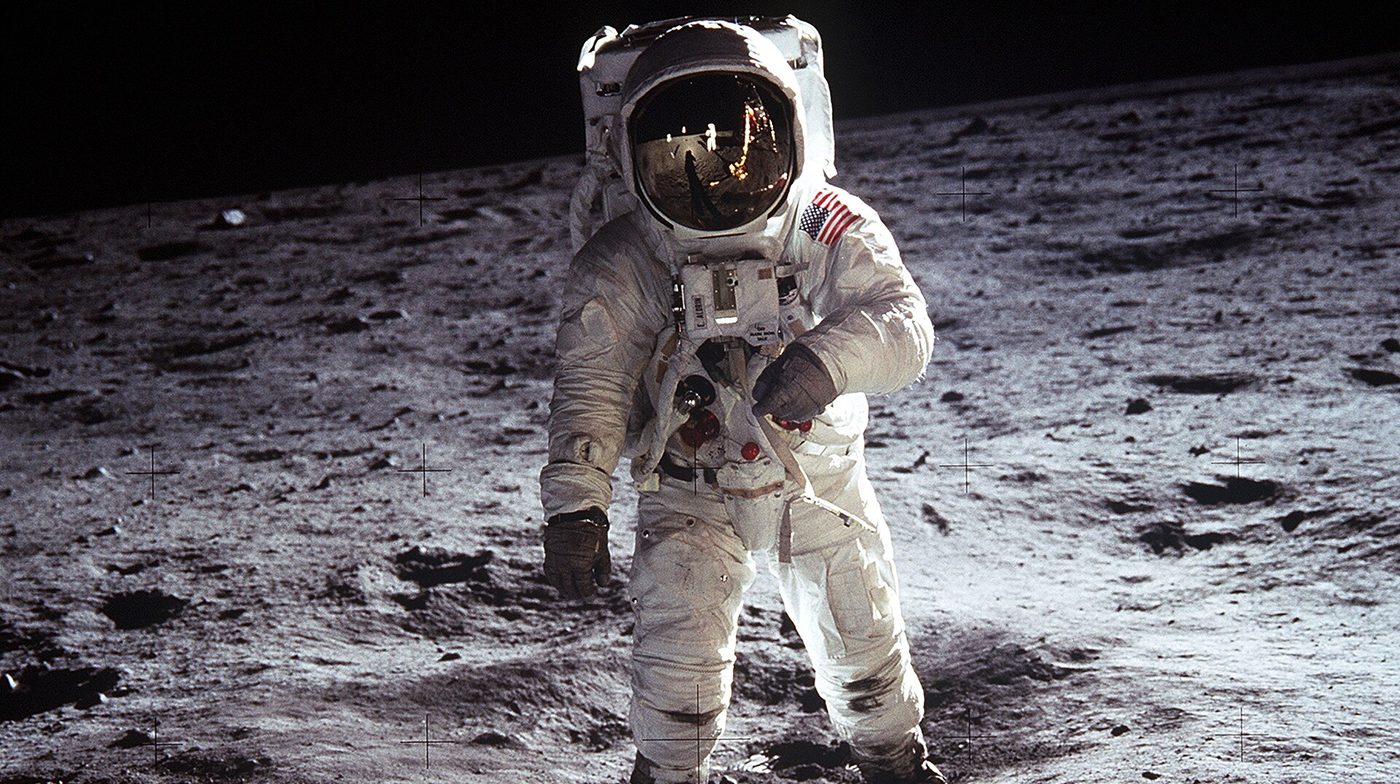
The Moon's mass is much smaller than the Earth's, so its gravity is weaker: g on the Moon is 1.6 N/kg. A 45 kg pupil would weigh 45 × 1.6 = 72 N there, about a sixth of their weight on Earth. Their mass, 45 kg, is the same everywhere.
| Place | Gravitational field strength | The pupil's weight |
|---|---|---|
| The Moon | 1.6 N/kg | 72 N |
| Mars | 3.7 N/kg | About 167 N |
| Earth | 10 N/kg | 450 N |
| Jupiter (at its cloud tops) | 25 N/kg | 1125 N |
What is gravity?
Gravity is a force of attraction between any two objects that have mass. It is always a pull. It is stronger when:
- the masses are bigger: a planet pulls far harder than a person
- the objects are closer together: it gets weaker further away
Gravity acts across empty space without touching. The Earth's gravity keeps the Moon in orbit, and the Sun's keeps the Earth in orbit. Every object pulls on every other one, but the pull between two people is far too small to notice.
What are the three non-contact forces?
Gravity, magnetism and static electricity all act at a distance. Each acts through a field: the space around the object where its force can be felt.
| Force | Acts between | Attract or repel? |
|---|---|---|
| Gravity | Any two masses | Always attracts |
| Magnetic | Magnets, and magnets and magnetic metals such as iron | Both: like poles repel, unlike poles attract |
| Electrostatic | Objects with an electric charge | Both: like charges repel, unlike charges attract |
More on magnets and fields and static electricity.
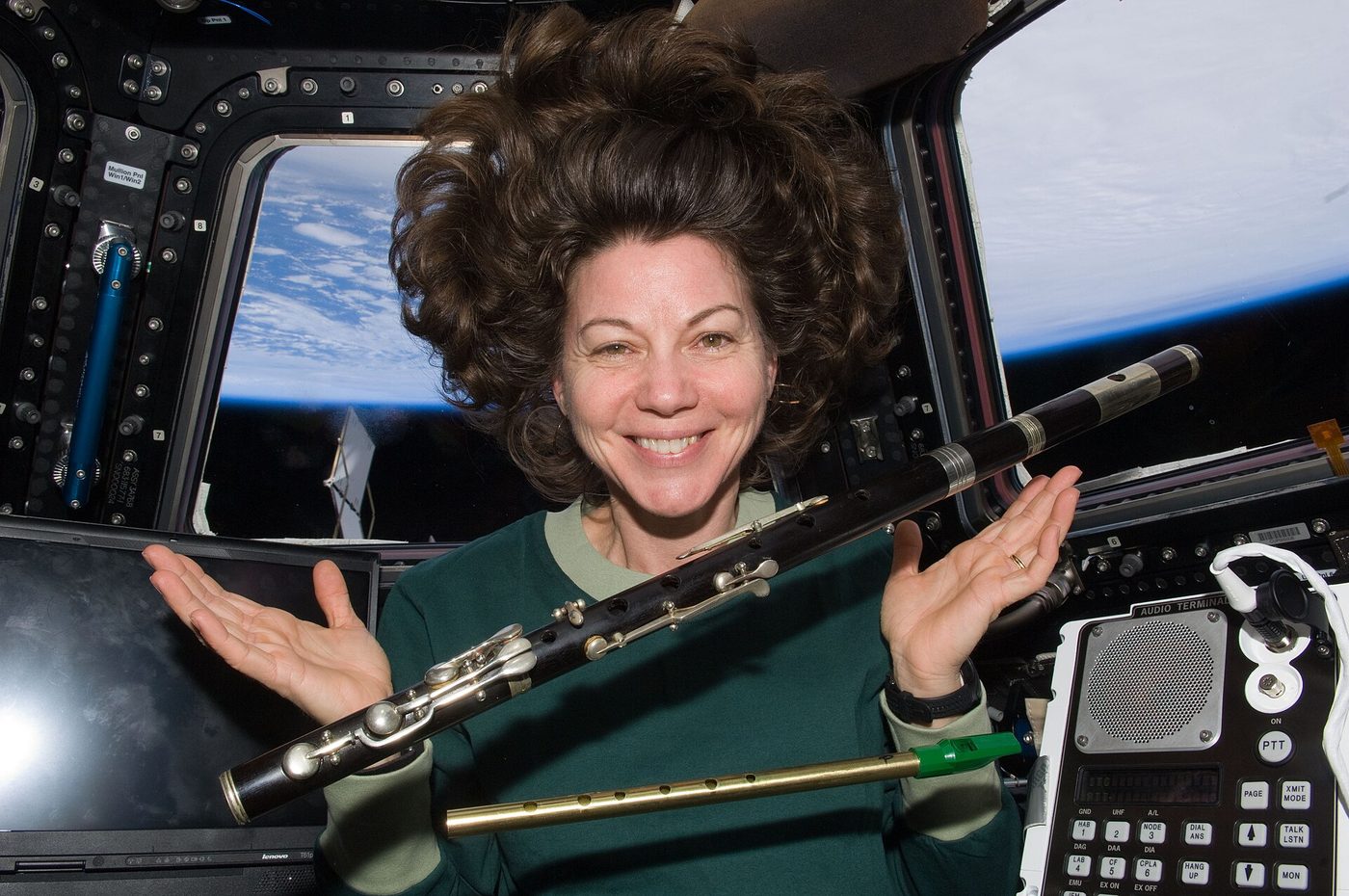
Stretch Astronauts on the International Space Station, about 400 km up, still have nearly 90% of their weight on the ground: gravity there is only a little weaker. They float because the station and everyone in it are falling around the Earth together, all the time, so nothing presses them against the floor.
Written to the KS3 national curriculum. Last changed 13 November 2026.
Key words
Say them, spell them, use them in an answer.
- mass
- weight
- kilogram
- newton
- gravitational field strength
- gravity
- field
- non-contact force
- newton meter
Common misconception
Often said“Mass and weight are the same thing.”
In factMass is how much matter an object has, in kilograms, and it is the same everywhere. Weight is the pull of gravity on that mass, in newtons, and it depends on where you are: a 45 kg pupil weighs 450 N on Earth but 72 N on the Moon.
Did you know?
Lighter at the equator
Gravity is slightly weaker at the equator (about 9.78 N/kg) than at the poles (about 9.83 N/kg), because the Earth bulges at the equator and spins. You would weigh about half a per cent less in Ecuador than at the North Pole.
Try 5 questions
Quick questions on gravity, mass and weight, marked as you go. Each one explains the answer.
Question 1 of 5
An apple has a mass of 150 g. What is its weight on Earth (g = 10 N/kg)?
Choose an answer. Each question explains itself.
The homework sheet
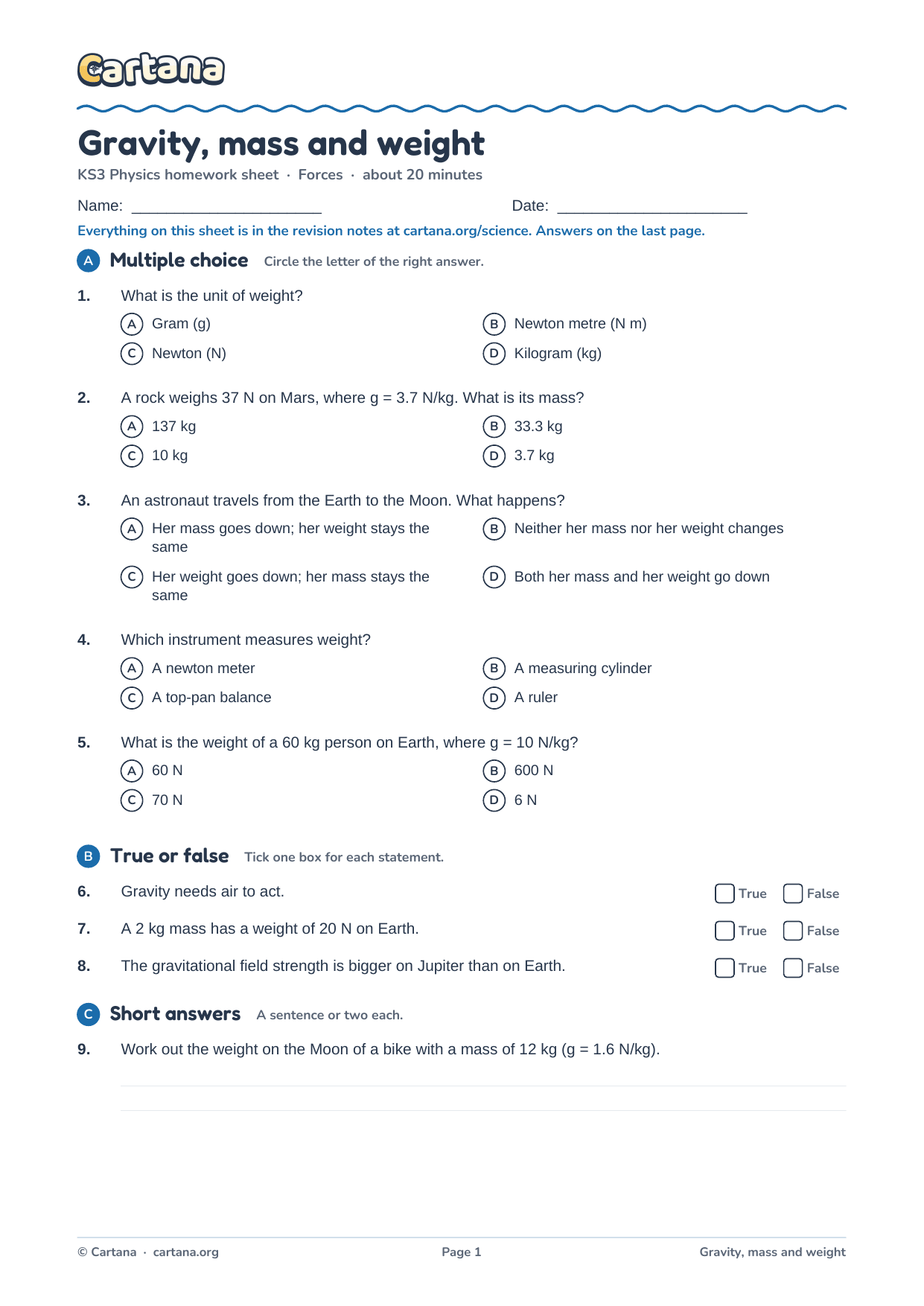
About twenty minutes. Everything on it is in the notes above; the answers are on the last page.
Free homework sheet
Gravity, mass and weight homework sheet
17 questions, about twenty minutes, with the answers on the last page: multiple choice, true or false, short answers, key words to define and one to explain in full.
KS3 Forces
Revised the whole unit?
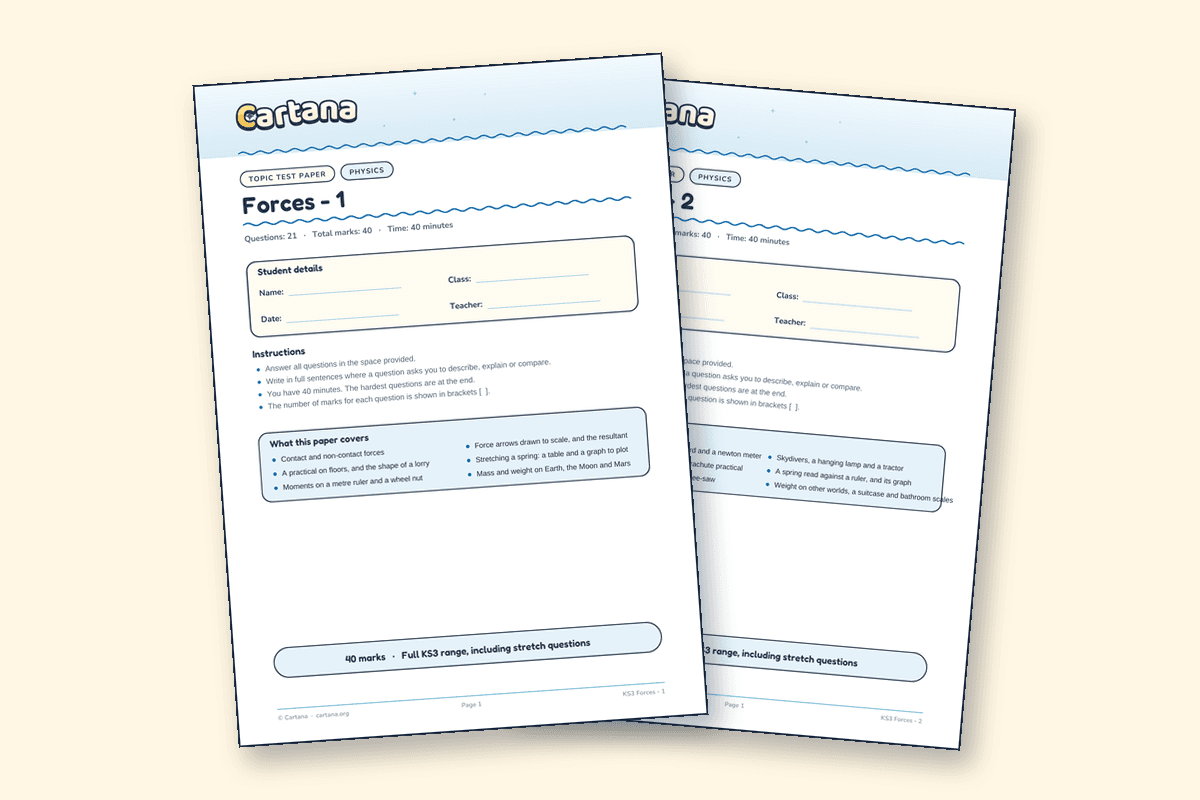
When every topic in forces is done, two different papers test the whole unit, each with its own mark scheme.


 Watch the trailer · 1:06
New from Cartana · Beta test 1–31 December
Revision that feels like an adventure
Cartana is our KS3 learning adventure: sail between islands, answer quick-fire questions and battle bosses. It starts with science, with maths on the way, and launches in 2027. This December a small group of testers gets to play it first.
In the Cartana adventure, every science unit is an island to explore. The island for forces is being built.
- Play the game before its official release
- Help us build it with your feedback
- Earn exclusive in-game items in return
More in this unit
Forces
- 1Introduction to forcesPushes and pulls, contact and non-contact forces, newtons, force arrows and interaction pairs
- 2Balanced and unbalanced forcesAdding forces along a line, the resultant force, and what balanced and unbalanced forces do
- 3Friction and dragFriction between surfaces, air and water resistance, streamlining, and investigating friction
- 4Stretching and squashingDeforming objects, extension, the spring practical, Hooke's law and the energy stored in a spring
- 5MomentsTurning forces, moment = force × distance, the principle of moments and levers