
KS3 Physics · Forces
Moments
- Turning forces about a pivot, clockwise and anticlockwise
- Calculating a moment: force × distance, in newton metres
- The principle of moments and balancing a see-saw
- Levers as force multipliers
- 4 min read
- 5 quick questions
- Free homework sheet
- Years 7 to 9
Revision notes
A moment is the turning effect of a force about a pivot. Moment = force × distance from the pivot, measured in newton metres (N m).
What is a moment?
A force can make an object turn about a fixed point called the pivot (or fulcrum): a door turns on its hinges, a spanner turns a nut, a see-saw rocks on its middle. The turning effect is bigger when:
- the force is bigger
- the force acts further from the pivot
That is why a door handle is on the side away from the hinges: push near the hinges and the door hardly moves. A moment turns either clockwise or anticlockwise.
How do you calculate a moment?
Force in newtons (N) and distance in metres (m) give the moment in newton metres (N m). The distance is measured from the pivot to the line of the force.
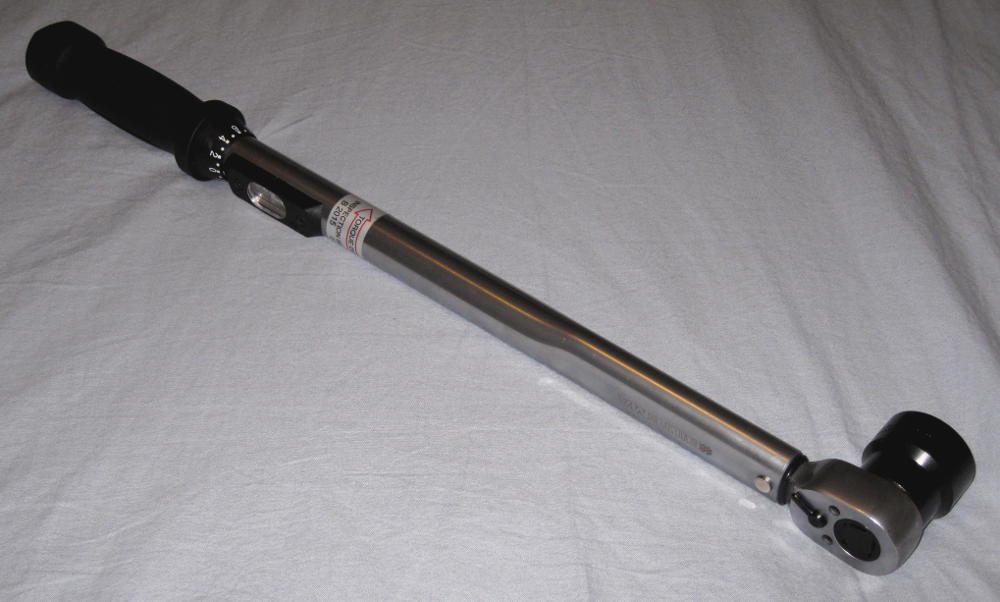
You push on the end of a spanner, 0.25 m from the centre of the nut, with a force of 40 N. What is the moment?
moment = force × distance
moment = 40 N × 0.25 m = 10 N m
A spanner twice as long needs only 20 N for the same 10 N m.
When does a see-saw balance?
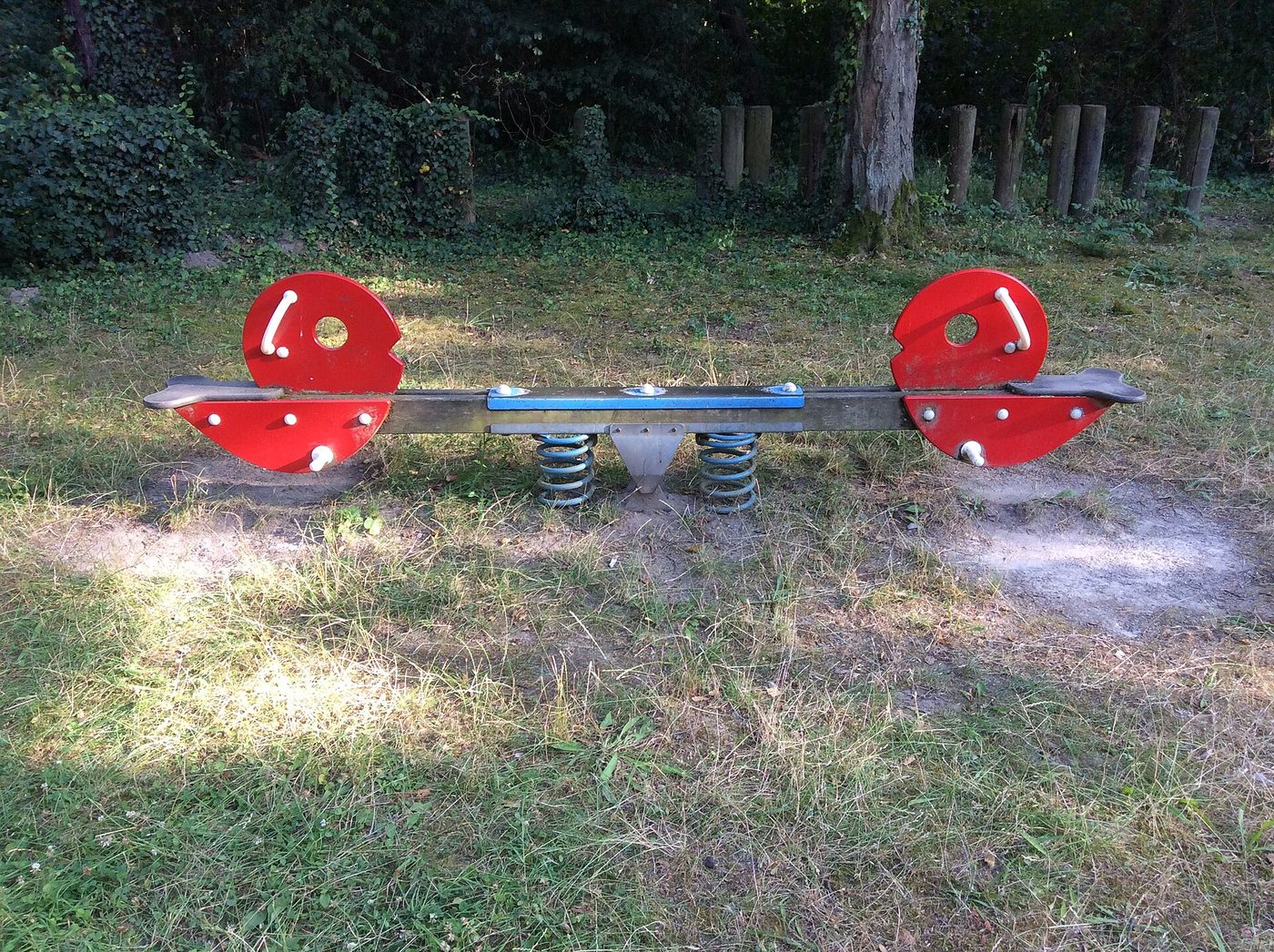
An object balances when the total clockwise moment about the pivot equals the total anticlockwise moment. This is the principle of moments (some books call it the law of moments).
Amir weighs 300 N and sits 2.0 m to the left of a see-saw's pivot. Where must Beth, who weighs 400 N, sit to balance him?
Anticlockwise moment = 300 N × 2.0 m = 600 N m
Clockwise moment must also be 600 N m, so 400 N × distance = 600 N m
distance = 600 ÷ 400 = 1.5 m to the right of the pivot
The heavier person sits nearer the pivot. You can test the principle with a metre ruler balanced on a pivot at its middle: hang masses on both sides, move them until the ruler balances, then work out each side's moment.
How do levers make jobs easier?
A lever lets a small force far from the pivot make a big force close to it: it is a force multiplier. A crowbar, a claw hammer pulling a nail, a bottle opener and a wheelbarrow all work this way. The catch is that the small force must move much further than the load does.
Stretch Strictly, the distance in a moment is the perpendicular distance: measured from the pivot to the line the force acts along, at right angles to it. Push a spanner at a slant and that distance is shorter than the handle, so the moment is smaller. Push straight along the handle towards the nut and the moment is zero: nothing turns.
Written to the KS3 national curriculum. Last changed 13 November 2026.
Key words
Say them, spell them, use them in an answer.
- moment
- pivot
- clockwise
- anticlockwise
- newton metre
- principle of moments
- lever
- force multiplier
Common misconception
Often said“On a see-saw, the heavier person always goes down.”
In factWhat matters is the moment, force × distance from the pivot, not the weight alone. A 300 N child sitting 2 m from the pivot balances a 600 N adult sitting 1 m from it, and if the child moves further out, the adult goes up.
Did you know?
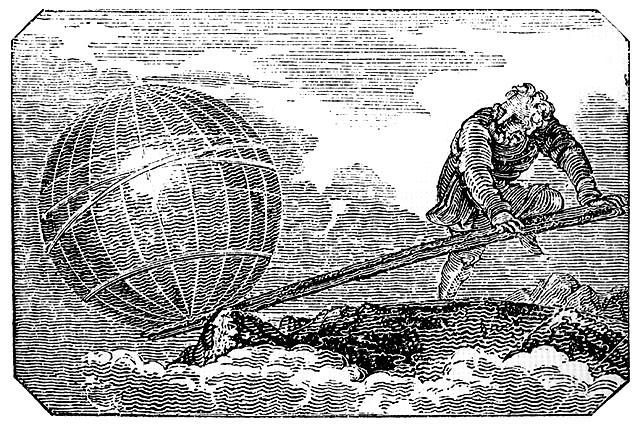
Archimedes' lever
Archimedes, the Greek mathematician who explained the lever more than 2,200 years ago, is said to have boasted: "Give me a place to stand, and I will move the Earth."
Photo: Mechanics Magazine, Public domain, via Wikimedia Commons
Try 5 questions
Quick questions on moments, marked as you go. Each one explains the answer.
Question 1 of 5
A force of 30 N acts 20 cm from a pivot. What is the moment in newton metres?
Choose an answer. Each question explains itself.
The homework sheet
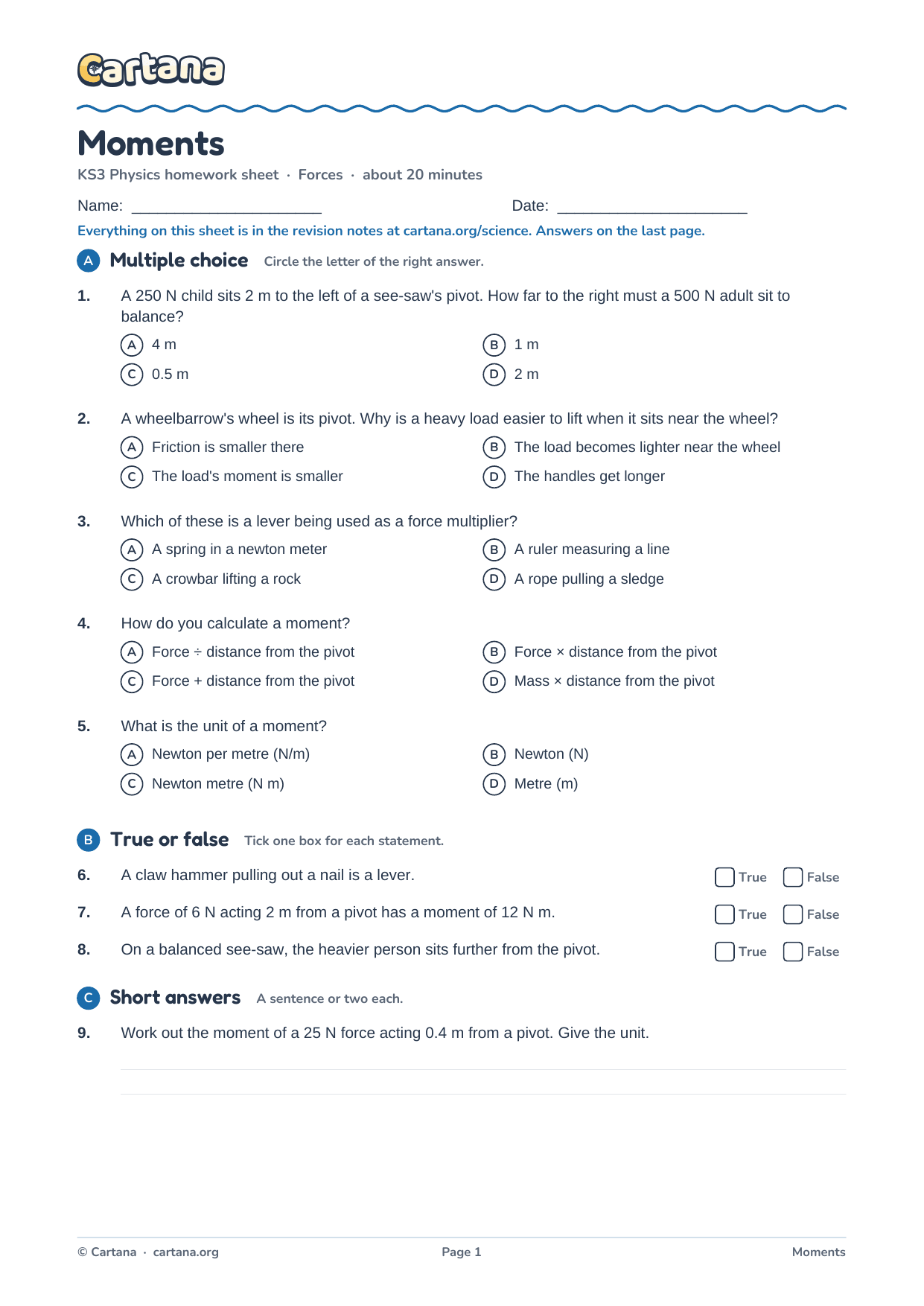
About twenty minutes. Everything on it is in the notes above; the answers are on the last page.
Free homework sheet
Moments homework sheet
17 questions, about twenty minutes, with the answers on the last page: multiple choice, true or false, short answers, key words to define and one to explain in full.
KS3 Forces
Revised the whole unit?
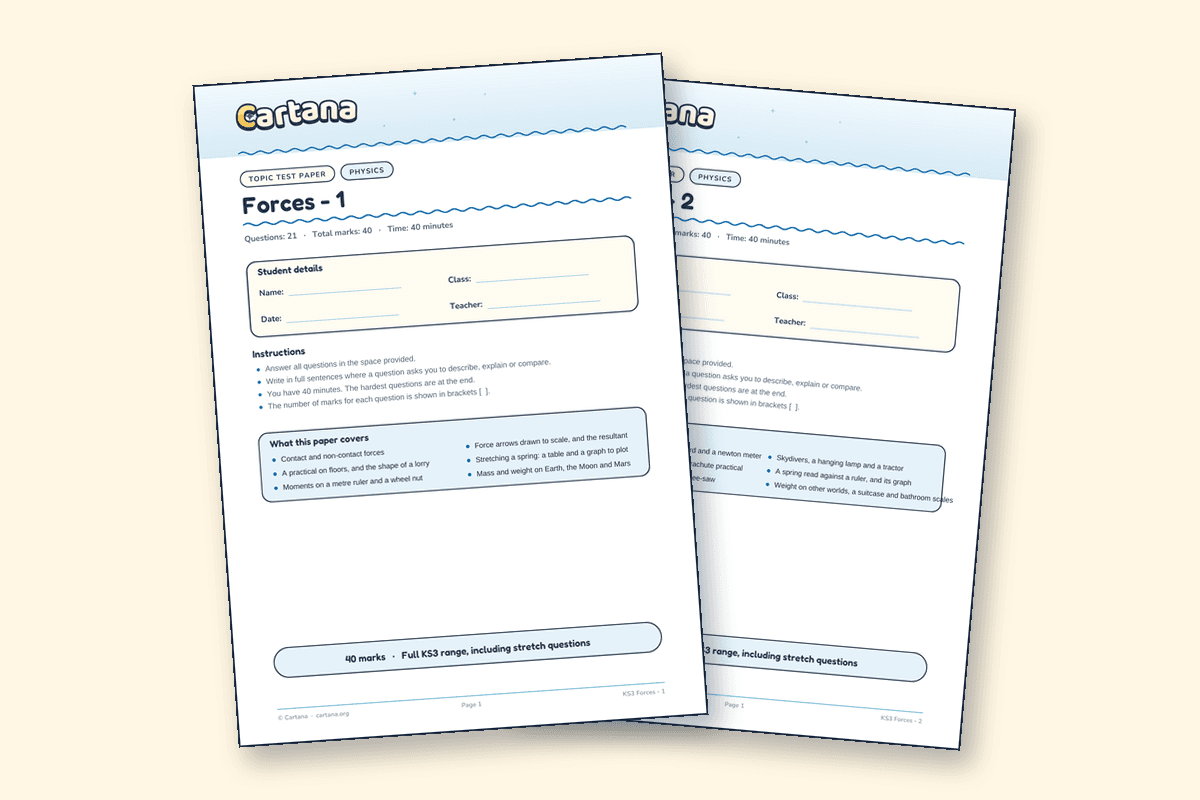
When every topic in forces is done, two different papers test the whole unit, each with its own mark scheme.


 Watch the trailer · 1:06
New from Cartana · Beta test 1–31 December
Revision that feels like an adventure
Cartana is our KS3 learning adventure: sail between islands, answer quick-fire questions and battle bosses. It starts with science, with maths on the way, and launches in 2027. This December a small group of testers gets to play it first.
In the Cartana adventure, every science unit is an island to explore. The island for forces is being built.
- Play the game before its official release
- Help us build it with your feedback
- Earn exclusive in-game items in return
More in this unit
Forces
- 1Introduction to forcesPushes and pulls, contact and non-contact forces, newtons, force arrows and interaction pairs
- 2Balanced and unbalanced forcesAdding forces along a line, the resultant force, and what balanced and unbalanced forces do
- 3Friction and dragFriction between surfaces, air and water resistance, streamlining, and investigating friction
- 4Stretching and squashingDeforming objects, extension, the spring practical, Hooke's law and the energy stored in a spring
- 6Gravity, mass and weightNextMass and weight, weight = mass × g, weight on the Moon, gravity and the three non-contact forces