
KS3 Working scientifically · Years 7 to 9
Working scientifically
How scientists investigate: working safely in the lab, asking questions that can be tested, choosing and controlling variables, planning a method, recording results in tables and graphs, and analysing and evaluating what the results show.
- 6 topics
- 8 min of notes
- 6 homework sheets
- 2 test papers
The topics, in order
Each has its revision notes, key words, a common misconception and quick questions; the homework sheets are free to print.
- 1Lab safetyWorking safely in the lab2 min read5 questionsHomework sheet
- 2Scientific questionsScientific questions and hypotheses1 min read5 questionsHomework sheet
- 3VariablesIndependent, dependent and control variables1 min read5 questionsHomework sheet
- 4Planning an investigationPlanning and types of data1 min read5 questionsHomework sheet
- 5Tables and graphsResults tables and graphs1 min read5 questionsHomework sheet
- 6Analysing resultsMeans, anomalies, conclusions and evaluation2 min read5 questionsHomework sheet
Test the whole unit
When the topics are revised, two different papers test the whole unit, each marked the way an exam would be: sit Paper 1, go over what went wrong, then sit Paper 2.
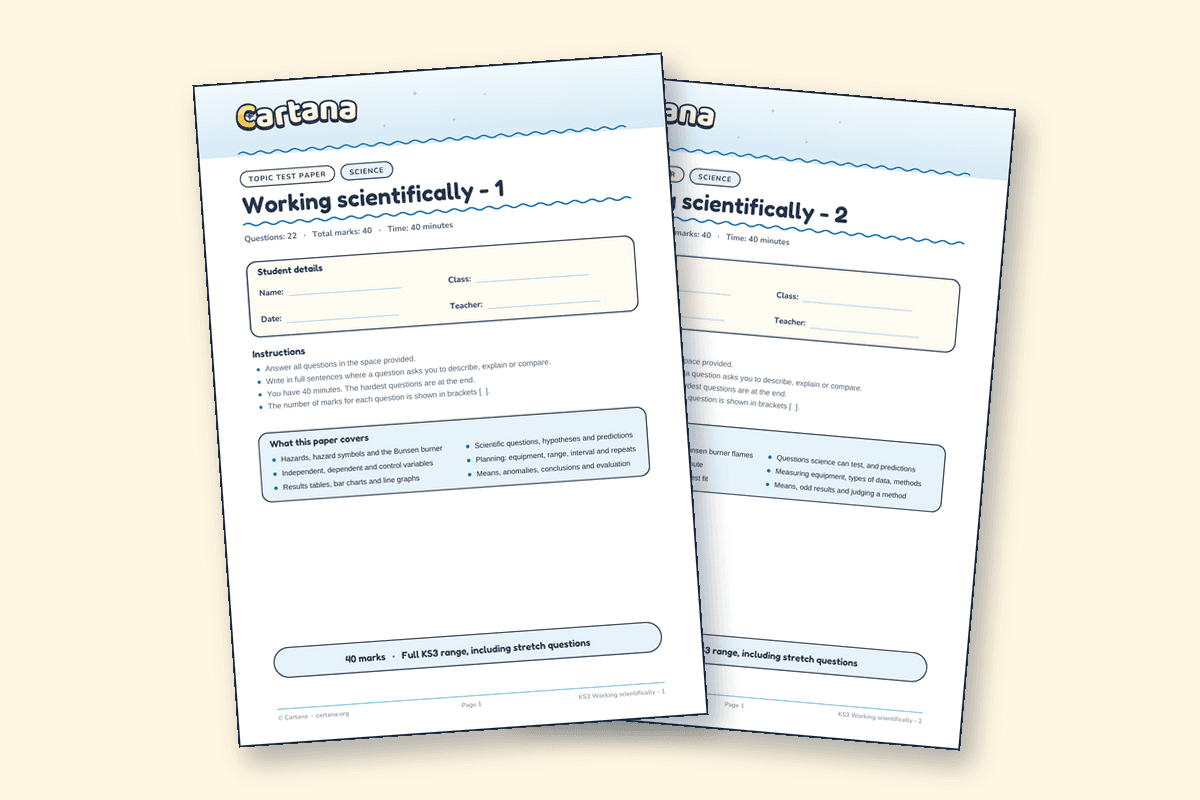
Two papers, one price
KS3 Working scientifically Test Papers with Mark Schemes (2 Papers)
Two different test papers on the same unit, each with its own mark scheme, for £1.99 together.
- 2 different papers
- 2 × 40 marks
- 40 minutes each
- 2 mark schemes, 28 pages
Also in the The Science Everything Pack: 46 papers for £22.99, save 50%.
Did you know?
- A fair test changes one variable at a time. Change two and you cannot tell which one did it.
- Repeating readings lets you spot anomalies and calculate a more reliable mean.
- A hypothesis says what you think will happen and why. A prediction says what you expect to measure.
- Continuous data, like temperature, can take any value in a range. It goes on a line graph.
 Watch the trailer · 1:06
New from Cartana · Beta test 1–31 December
Revision that feels like an adventure
Cartana is our KS3 learning adventure: sail between islands, answer quick-fire questions and battle bosses. It starts with science, with maths on the way, and launches in 2027. This December a small group of testers gets to play it first.
In the Cartana adventure, working scientifically is the island Beakerford.
- Play the game before its official release
- Help us build it with your feedback
- Earn exclusive in-game items in return