
KS3 Physics · Years 7 to 9
Energy
Energy for KS3 physics: energy stores and transfers, conservation of energy and efficiency, heating and cooling, energy resources and power stations, power and energy bills, and work done by simple machines.
- 6 topics
- 26 min of notes
- 6 homework sheets
- 2 test papers
The topics, in order
Each has its revision notes, key words, a common misconception and quick questions; the homework sheets are free to print.
- 1Energy stores and transfersThe energy stores, the four ways energy is transferred, and describing a change by its start and end4 min read5 questionsHomework sheet
- 2Conservation of energyEnergy is never made or destroyed; useful and wasted energy, dissipation, Sankey diagrams and efficiency5 min read5 questionsHomework sheet
- 3Heating and coolingTemperature and thermal energy, hot to cold until thermal equilibrium, conduction, convection, radiation and insulators4 min read5 questionsHomework sheet
- 4Energy resourcesFossil fuels, nuclear fuel and renewables, how a power station works, the UK's electricity and comparing resources fairly4 min read5 questionsHomework sheet
- 5Power and energy billsPower in watts and kilowatts, energy = power × time, the kilowatt-hour, working out a bill, and energy in food4 min read5 questionsHomework sheet
- 6Work and machinesWork done = force × distance; levers, ramps and pulleys trade force for distance; no machine gives out more energy than goes in5 min read5 questionsHomework sheet
Test the whole unit
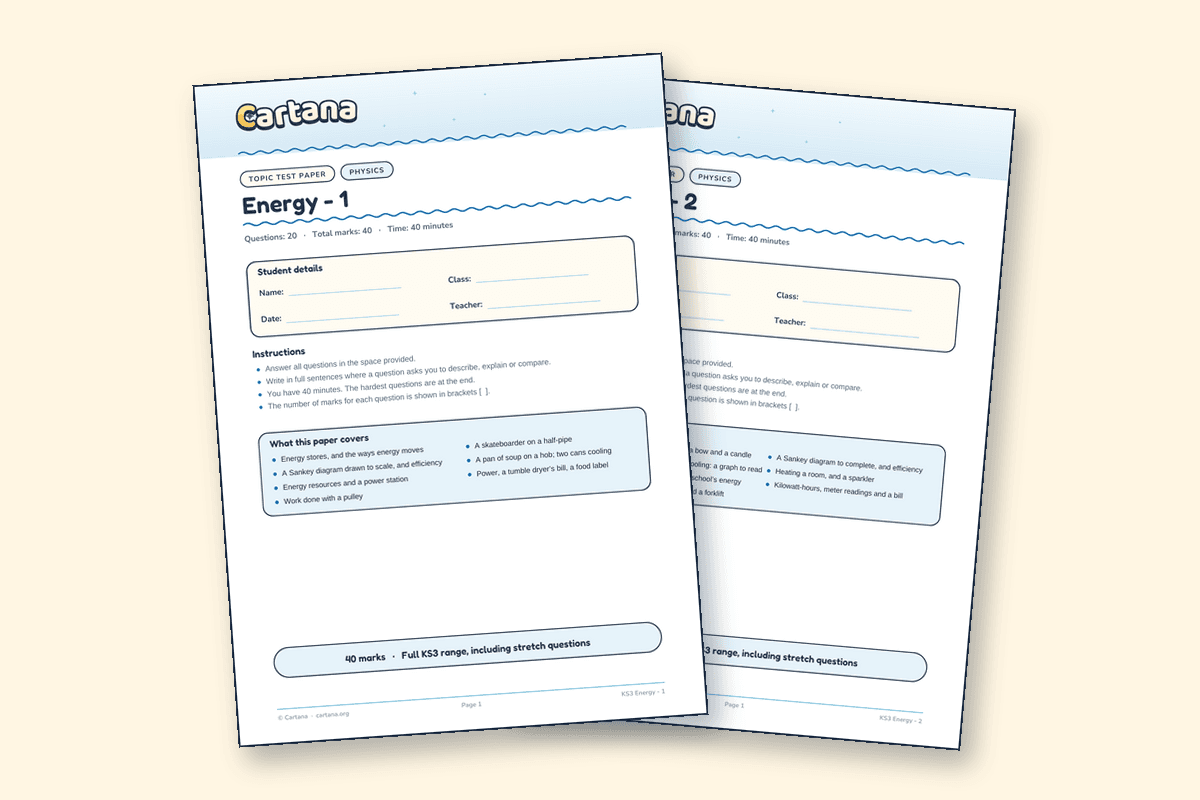
When the topics are revised, two different papers test the whole unit, each marked the way an exam would be: sit Paper 1, go over what went wrong, then sit Paper 2.
Two papers, one price
KS3 Energy Test Papers with Mark Schemes (2 Papers)
Two different test papers on the same unit, each with its own mark scheme, for £1.99 together.
- 2 different papers
- 2 × 40 marks
- 40 minutes each
- 2 mark schemes, 27 pages
Also in the Physics Pack: 14 papers for £8.99, save 35%.
Did you know?
- Britain's last coal power station, Ratcliffe-on-Soar, shut on 30 September 2024, 142 years after the world's first coal-fired public power station opened in London in 1882.
- Sunlight takes about 8 minutes 20 seconds to reach the Earth, crossing about 150 million km of empty space. Radiation is the only way energy can cross a vacuum.
- A Calorie with a capital C, as on American food labels, is really a kilocalorie: 1,000 calories, or about 4.2 kJ.
- The joule is named after James Prescott Joule, a brewer's son from Salford, who showed in the 1840s that doing work on water always warms it by the same amount for the same work.
More physics units
- Forces 6 topics
- Motion & pressure 6 topics
- Electricity & magnetism 5 topics
- Sound & waves 5 topics
- Light 5 topics
- Space 5 topics
All of KS3 science · Every homework sheet · Test papers and packs
 Watch the trailer · 1:06
New from Cartana · Beta test 1–31 December
Revision that feels like an adventure
Cartana is our KS3 learning adventure: sail between islands, answer quick-fire questions and battle bosses. It starts with science, with maths on the way, and launches in 2027. This December a small group of testers gets to play it first.
In the Cartana adventure, every science unit is an island to explore. The island for energy is being built.
- Play the game before its official release
- Help us build it with your feedback
- Earn exclusive in-game items in return