
KS3 Physics · Energy
Energy stores and transfers
- The eight energy stores, from kinetic and thermal to nuclear
- The four ways energy is transferred: by forces, heating, electrically and by radiation
- Describing a change by comparing the stores at the start and the end
- Energy measured in joules and kilojoules
- 4 min read
- 5 quick questions
- Free homework sheet
- Years 7 to 9
Revision notes
Energy stores are the places energy is held, such as the kinetic store of a moving car or the chemical store of a fuel. A transfer moves energy from one store to another. Energy is measured in joules (J).
What is energy?
Nothing happens without energy: a ball rolls, a kettle boils, a phone lights up. You cannot see energy, so scientists keep track of it with a model. Energy sits in stores, a bit like money in bank accounts, and moves between them in transfers. Energy is measured in joules (J); 1 kilojoule (kJ) is 1,000 J. Lifting a small apple up 1 m takes about 1 J.
What are the energy stores?
| Store | Where the energy is |
|---|---|
| Kinetic | In anything moving. The faster it moves, the more it has. |
| Thermal | In anything warm, from the movement of its particles. It rises with temperature. |
| Chemical | In food, fuels and batteries, released by chemical reactions. |
| Gravitational potential | In anything raised up in a gravitational field: the higher it is, the more it has. |
| Elastic potential | In anything stretched, squashed or bent that springs back, like a stretched spring. |
| Magnetic | In magnets that attract or repel, held apart or pushed together. |
| Electrostatic | In electric charges that attract or repel, held apart or pushed together. |
| Nuclear | In the centre (nucleus) of atoms, released in a nuclear reactor and in the Sun. |
Light and sound are not stores. They carry energy from place to place: light by radiation, and sound as vibrations passed through the air.
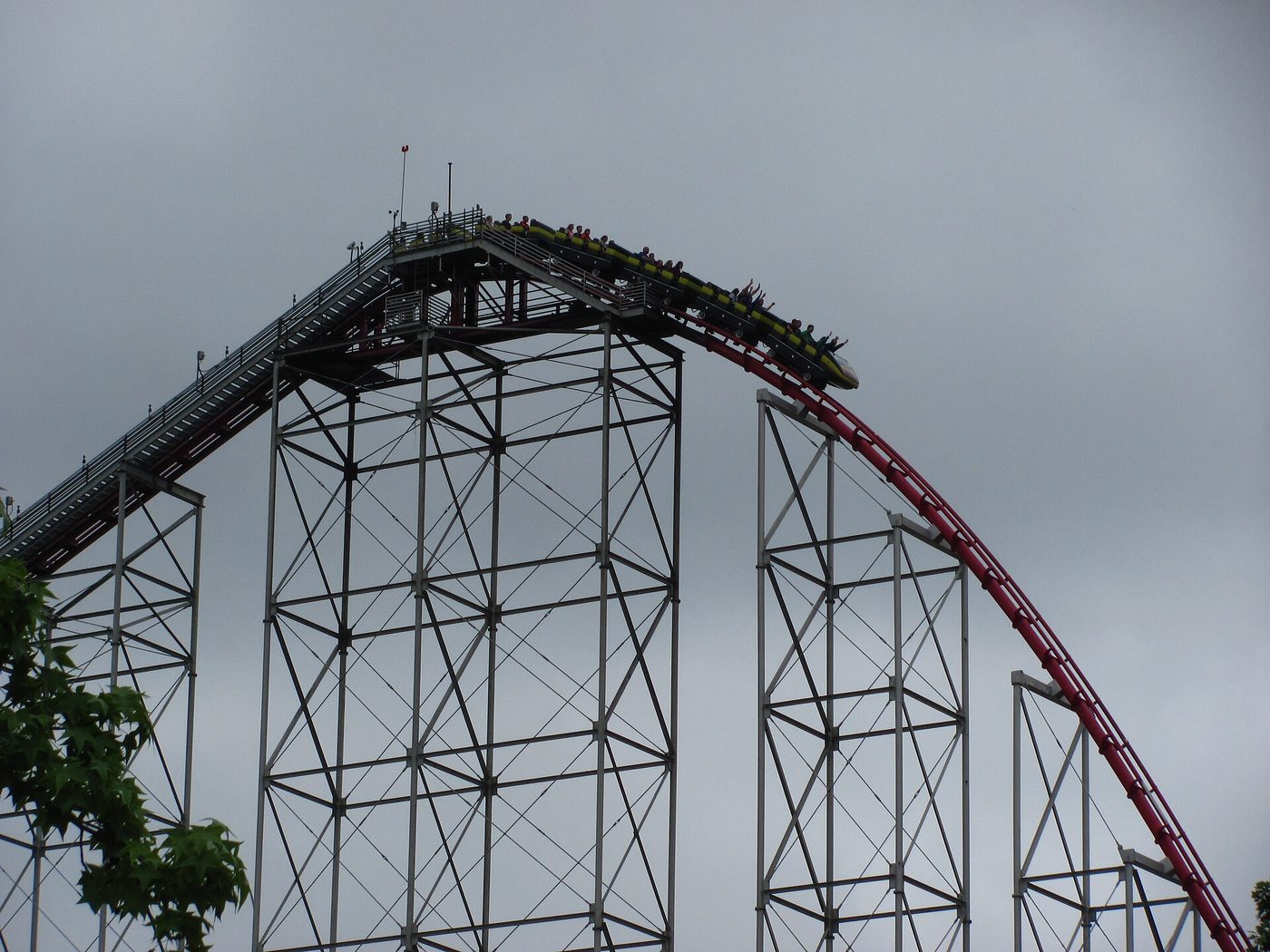
How is energy transferred?
Energy moves between stores in four ways:
- By forces (mechanical work): a push, a pull or a lift that moves something, such as kicking a ball or stretching a spring.
- By heating: from a hotter object to a cooler one, such as a flame warming a pan.
- Electrically: by a current in a circuit, such as a battery lighting a lamp (see current and circuits).
- By radiation: light and infrared, such as sunlight warming your face.
How do you describe an energy change?
Compare the start with the end. Say which stores have less energy at the end, which have more, and how the energy was transferred. Each store goes with something you can see or measure: speed (kinetic), temperature (thermal), height in a gravitational field (gravitational), stretching or squashing (elastic) and what the substances are made of (chemical).

| Change | Store that falls | Store that rises |
|---|---|---|
| Dropping a ball | Gravitational | Kinetic, then thermal when it lands |
| Braking a bike | Kinetic | Thermal store of the brakes and wheels |
| Lighting a lamp | Chemical store of the battery | Thermal store of the surroundings |
| Stretching a spring | Chemical store of your muscles | Elastic store of the spring |
| Using food | Chemical store of the food | Thermal and kinetic stores of your body |
| Burning fuel | Chemical store of the fuel and oxygen | Thermal store of the surroundings |
Your body releases the energy in food by respiration, and burning a fuel is combustion. In every change the total energy stays the same: see conservation of energy.
Stretch You can work out the energy in a gravitational store: energy = mass × gravitational field strength × height. For the ball in the figure, 0.5 kg × 10 N/kg × 2 m = 10 J. As it falls, every joule the gravitational store loses goes into the kinetic store (if air resistance is small enough to ignore).
Written to the KS3 national curriculum. Last changed 15 November 2026.
Key words
Say them, spell them, use them in an answer.
- energy store
- transfer
- joule
- kinetic store
- thermal store
- chemical store
- gravitational potential store
- elastic potential store
- heating
- radiation
Common misconception
Often said“A battery stores electrical energy.”
In factA battery's energy is in a chemical store. When the circuit is complete, chemical reactions in the battery push a current round, and the energy is transferred electrically to the lamp or motor. Electricity is a way of transferring energy, not a store.
Did you know?
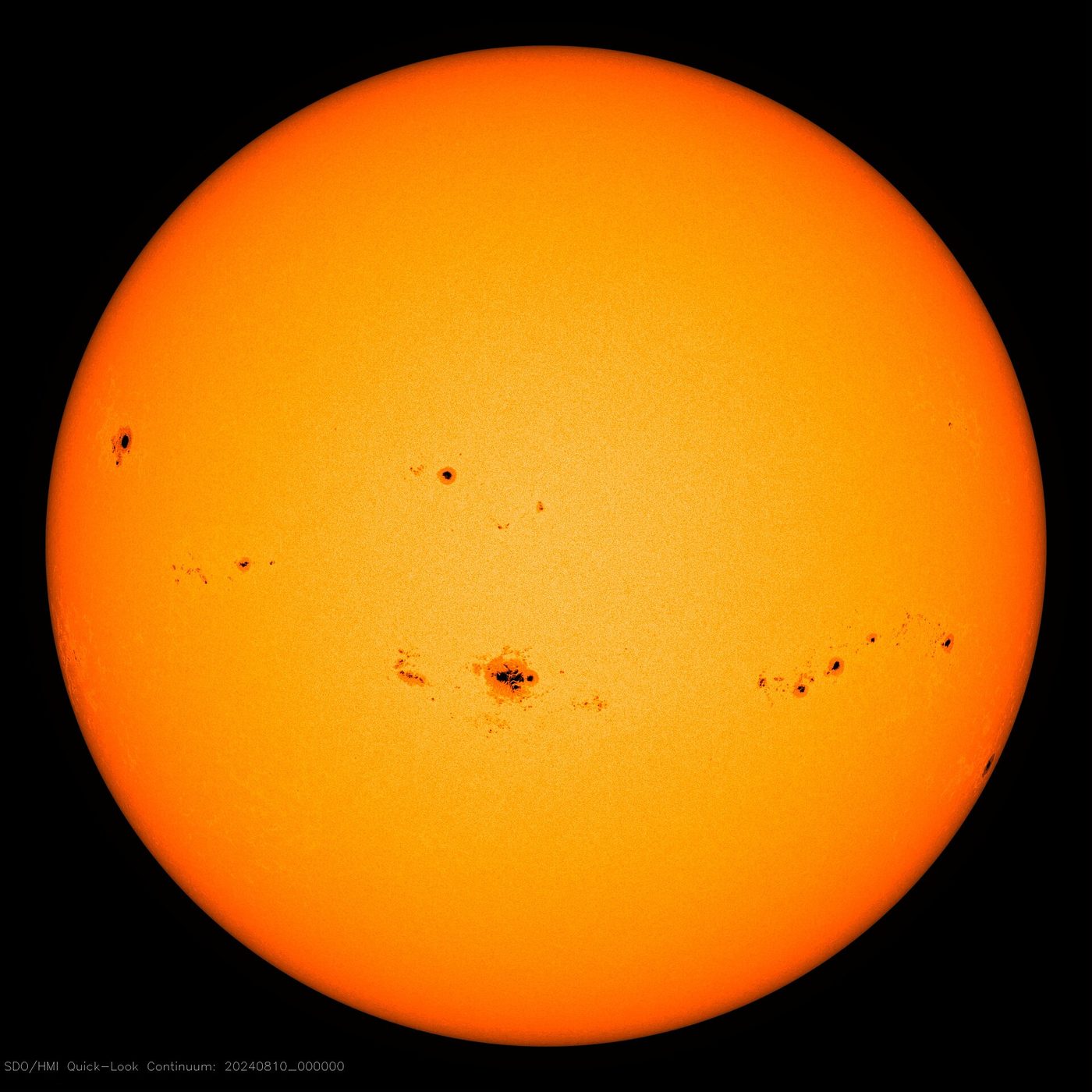
The Sun
The Sun has been shining for about 4.6 billion years, transferring energy from its nuclear store, and has enough left to keep going for roughly another 5 billion years.
Photo: Courtesy of NASA/SDO and the AIA, EVE, and HMI science teams., Public domain, via Wikimedia Commons
Try 5 questions
Quick questions on energy stores and transfers, marked as you go. Each one explains the answer.
Question 1 of 5
Heating always transfers energy from a cooler object to a hotter one.
Choose an answer. Each question explains itself.
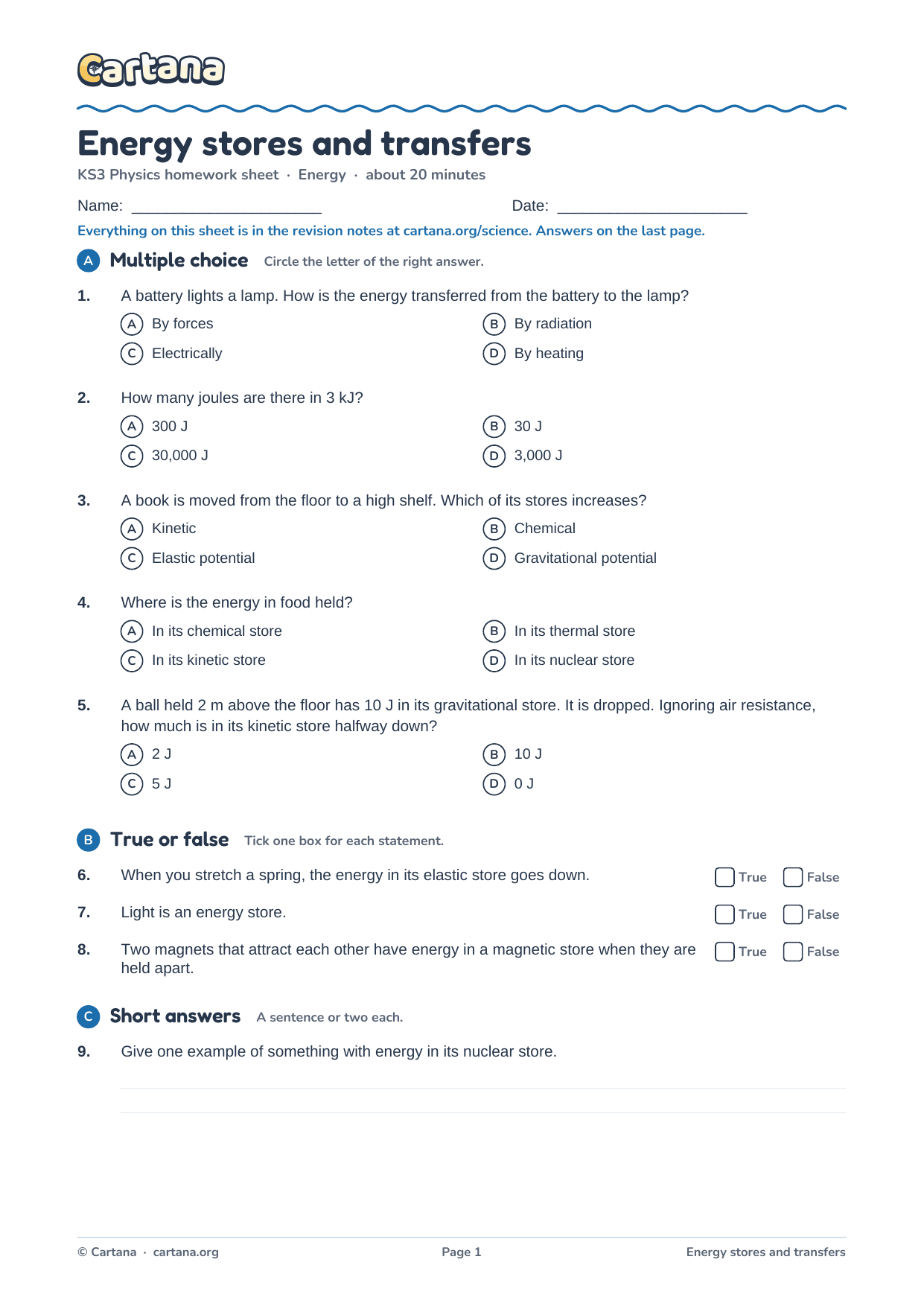
The homework sheet
About twenty minutes. Everything on it is in the notes above; the answers are on the last page.
Free homework sheet
Energy stores and transfers homework sheet
17 questions, about twenty minutes, with the answers on the last page: multiple choice, true or false, short answers, key words to define and one to explain in full.
KS3 Energy
Revised the whole unit?
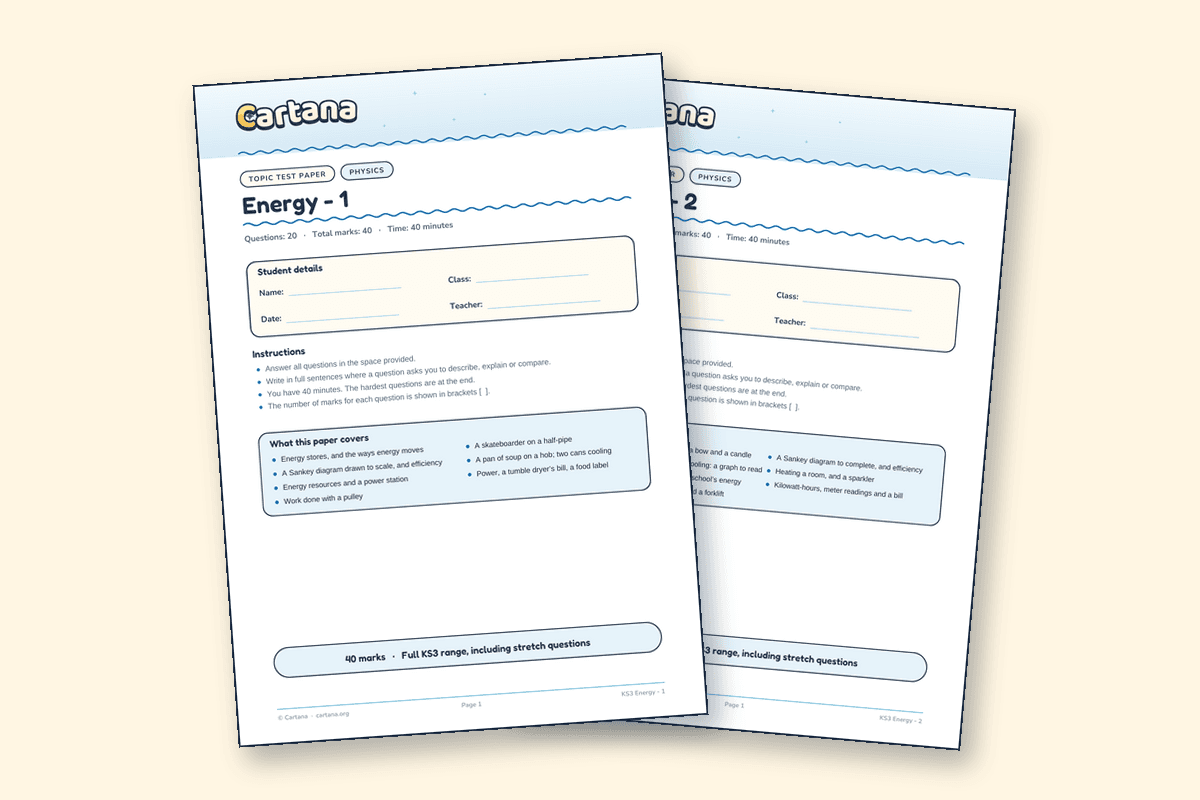
When every topic in energy is done, two different papers test the whole unit, each with its own mark scheme.


 Watch the trailer · 1:06
New from Cartana · Beta test 1–31 December
Revision that feels like an adventure
Cartana is our KS3 learning adventure: sail between islands, answer quick-fire questions and battle bosses. It starts with science, with maths on the way, and launches in 2027. This December a small group of testers gets to play it first.
In the Cartana adventure, every science unit is an island to explore. The island for energy is being built.
- Play the game before its official release
- Help us build it with your feedback
- Earn exclusive in-game items in return
More in this unit
Energy
- 2Conservation of energyNextEnergy is never made or destroyed; useful and wasted energy, dissipation, Sankey diagrams and efficiency
- 3Heating and coolingTemperature and thermal energy, hot to cold until thermal equilibrium, conduction, convection, radiation and insulators
- 4Energy resourcesFossil fuels, nuclear fuel and renewables, how a power station works, the UK's electricity and comparing resources fairly
- 5Power and energy billsPower in watts and kilowatts, energy = power × time, the kilowatt-hour, working out a bill, and energy in food
- 6Work and machinesWork done = force × distance; levers, ramps and pulleys trade force for distance; no machine gives out more energy than goes in