
KS3 Chemistry · Chemical reactions
Combustion and oxidation
- The fire triangle: fuel, oxygen and heat, and how fires are put out
- Oxidation of metals and non-metals, fast and slow
- What hydrocarbon fuels make when they burn: carbon dioxide and water, and carbon monoxide when air is short
- The practical: testing the gases from a candle with cobalt chloride paper and limewater
- 4 min read
- 5 quick questions
- Free homework sheet
- Years 7 to 9
Revision notes
Combustion is burning: a fuel reacts quickly with oxygen and gives out energy as heat and light. It is one kind of oxidation, a reaction in which a substance joins with oxygen.
What does a fire need?
A fire needs three things, shown as the fire triangle: a fuel to burn, oxygen (usually from the air), and heat to get it started. Firefighting works by taking one side away:
| Remove | How |
|---|---|
| Oxygen | A fire blanket, foam, or a lid on a burning pan |
| Heat | Water cools the fire (never on burning oil or electrics) |
| Fuel | Turn off the gas; cut a firebreak in a forest |
What is oxidation?
Oxidation is any reaction in which a substance joins with oxygen. The product is an oxide. Combustion is fast oxidation, but oxidation can be slow too.
- Magnesium burns with a dazzling white flame: magnesium + oxygen → magnesium oxide, 2Mg + O2 → 2MgO.
- Copper does not catch fire, but heated in a Bunsen flame its surface turns black: copper + oxygen → copper oxide.
- Iron rusts slowly in air and water, a slow oxidation.
- Non-metals burn too: carbon + oxygen → carbon dioxide; sulfur + oxygen → sulfur dioxide.
Metal oxides and non-metal oxides behave differently when they dissolve in water: see metals and non-metals.
What do hydrocarbons make when they burn?
Many fuels are hydrocarbons: compounds of hydrogen and carbon only. Methane (natural gas), propane and butane (camping gas) are hydrocarbons, and petrol and candle wax are mixtures of them. With plenty of air they burn completely, and the carbon and hydrogen atoms both join with oxygen:
For methane: CH4 + 2O2 → CO2 + 2H2O. Count the atoms: 1 C, 4 H and 4 O on each side. Burning also gives out a lot of energy, which is why we use fuels.
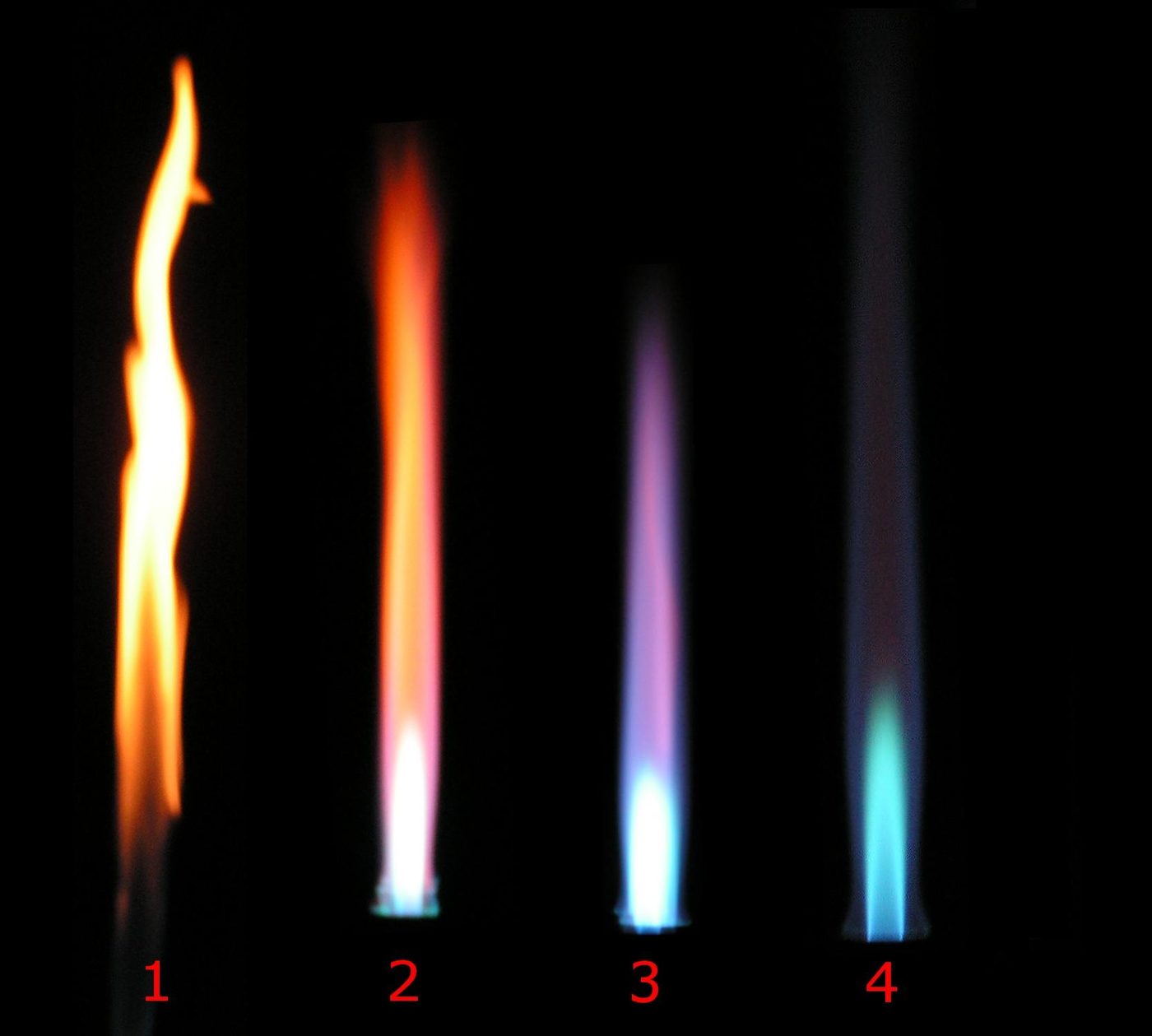
Without enough oxygen, a fuel burns incompletely, making carbon monoxide, a poisonous gas with no smell, and soot (carbon). A Bunsen burner with its air hole shut gives a sooty yellow flame for this reason, and gas boilers need servicing and a carbon monoxide alarm.
How do you test for the products of burning?
- Light a candle under an upside-down funnel joined to a U-tube standing in ice, then to a tube of limewater, then to a pump.
- Switch on the pump so it draws the gases from the flame through the apparatus.
- After a few minutes, look at the U-tube and the limewater.
| Product | What you see |
|---|---|
| Water | A clear liquid collects in the cold U-tube. It turns blue cobalt chloride paper pink. |
| CO2 | The limewater turns milky (cloudy white): the test for carbon dioxide. |
Three gas tests to know. Carbon dioxide turns limewater milky. Oxygen relights a glowing splint: the splint has only just gone out, and the extra oxygen lets it burn again. Hydrogen burns with a squeaky pop when a lit splint is held to the mouth of the tube.
The carbon and hydrogen in these products can only have come from the wax, so the wax must contain both elements; the oxygen came from the air. Run the pump with no candle and the limewater stays clear for much longer: the carbon dioxide comes from the flame. Anhydrous copper sulfate, which turns from white to blue, can be used instead of cobalt chloride paper.
Stretch Balance the equation for propane, the gas in many camping stoves: C3H8 + O2 → CO2 + H2O. The 3 carbons make 3CO2; the 8 hydrogens make 4H2O. That is 6 + 4 = 10 oxygen atoms on the right, so you need 5O2: C3H8 + 5O2 → 3CO2 + 4H2O.
Written to the KS3 national curriculum. Last changed 14 November 2026.
Key words
Say them, spell them, use them in an answer.
- combustion
- fire triangle
- fuel
- oxidation
- oxide
- hydrocarbon
- complete combustion
- incomplete combustion
- carbon monoxide
- limewater
- cobalt chloride paper
Common misconception
Often said“A candle gets smaller because its wax just melts away.”
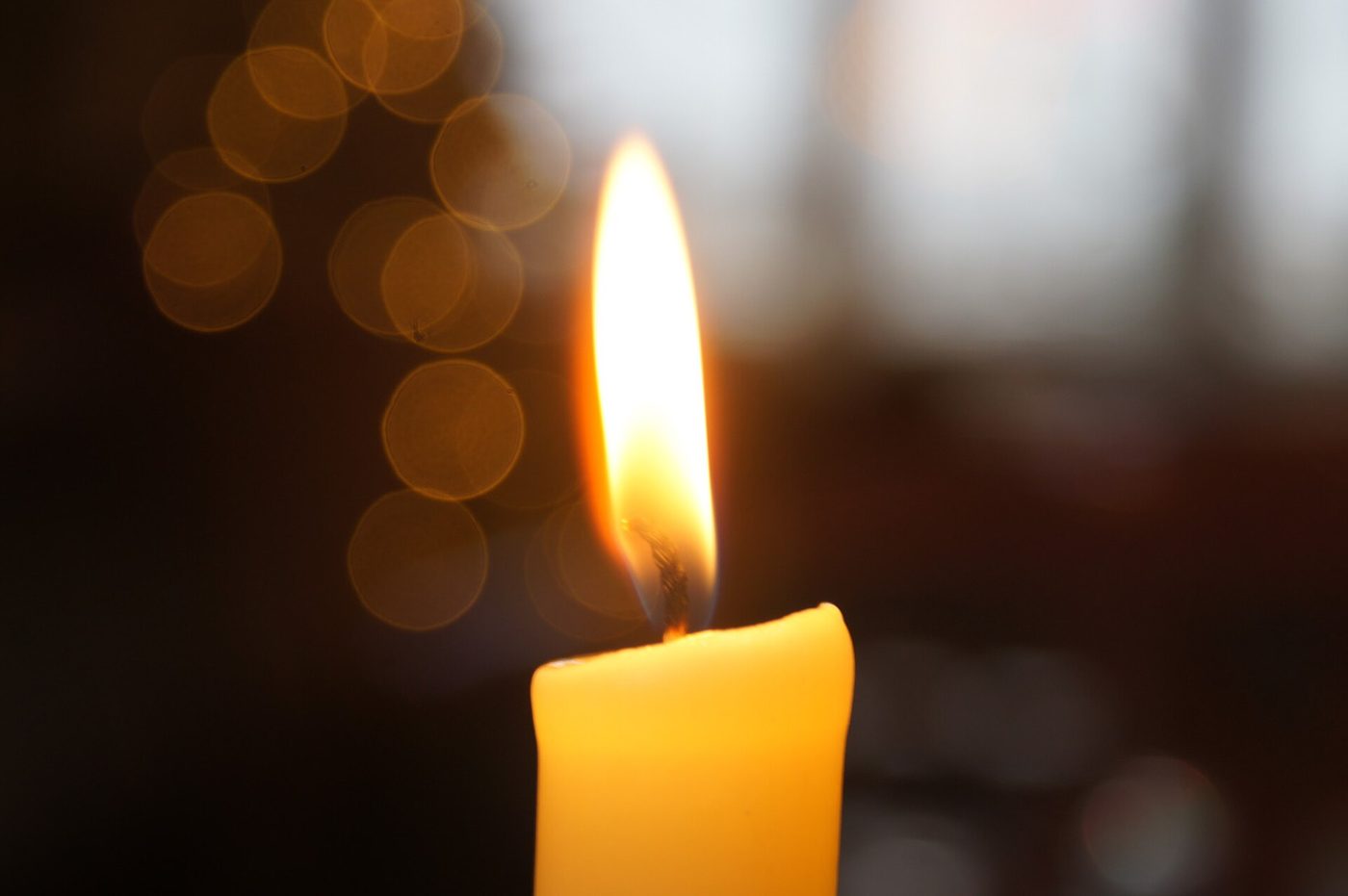
In factSome wax melts, but most of it burns. Melted wax is drawn up the wick, turns to vapour and reacts with oxygen to make carbon dioxide and water vapour, gases you cannot see. The wax really is used up in a chemical reaction.
Did you know?
Faraday's candle
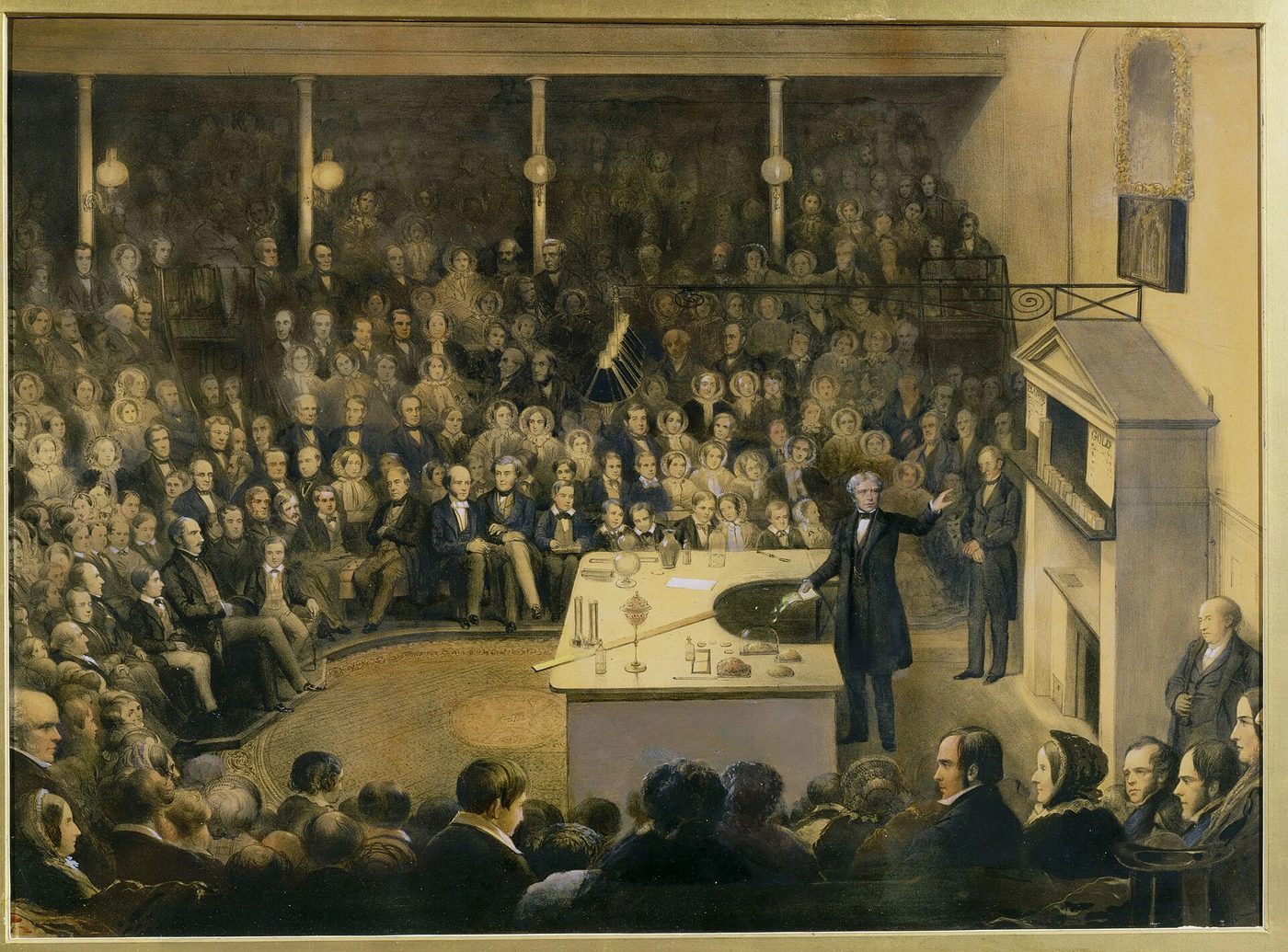
In 1848, and again at Christmas 1860, the scientist Michael Faraday gave six lectures for young people at the Royal Institution in London on how a candle burns. The book of the lectures, The Chemical History of a Candle, first published in 1861, has never been out of print.
Photo: Alexander Blaikley, Public domain, via Wikimedia Commons
Try 5 questions
Quick questions on combustion and oxidation, marked as you go. Each one explains the answer.
Question 1 of 5
Why should a home with a gas boiler have a carbon monoxide alarm?
Choose an answer. Each question explains itself.
The homework sheet
About twenty minutes. Everything on it is in the notes above; the answers are on the last page.
Free homework sheet
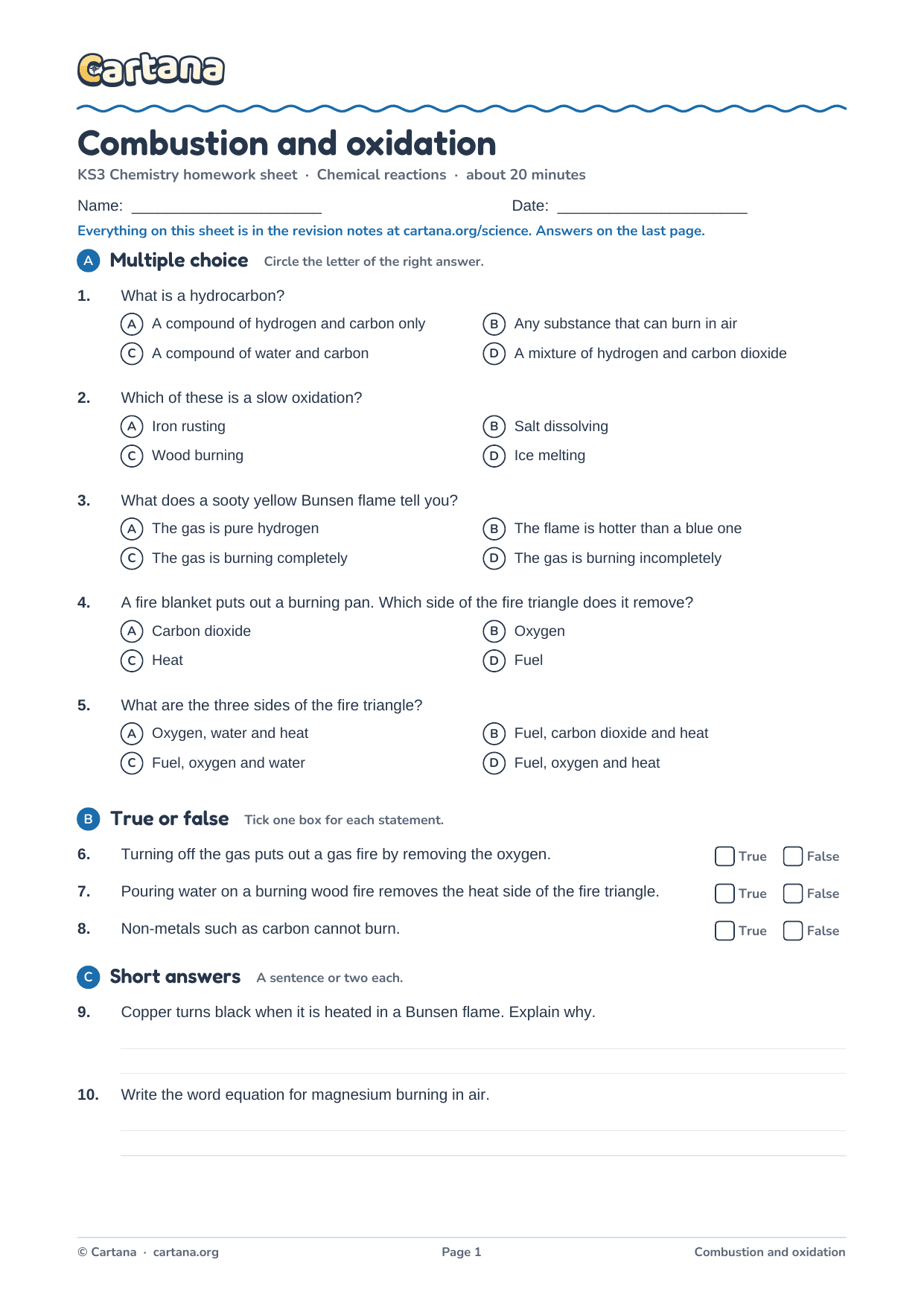
Combustion and oxidation homework sheet
17 questions, about twenty minutes, with the answers on the last page: multiple choice, true or false, short answers, key words to define and one to explain in full.
KS3 Chemical reactions
Revised the whole unit?
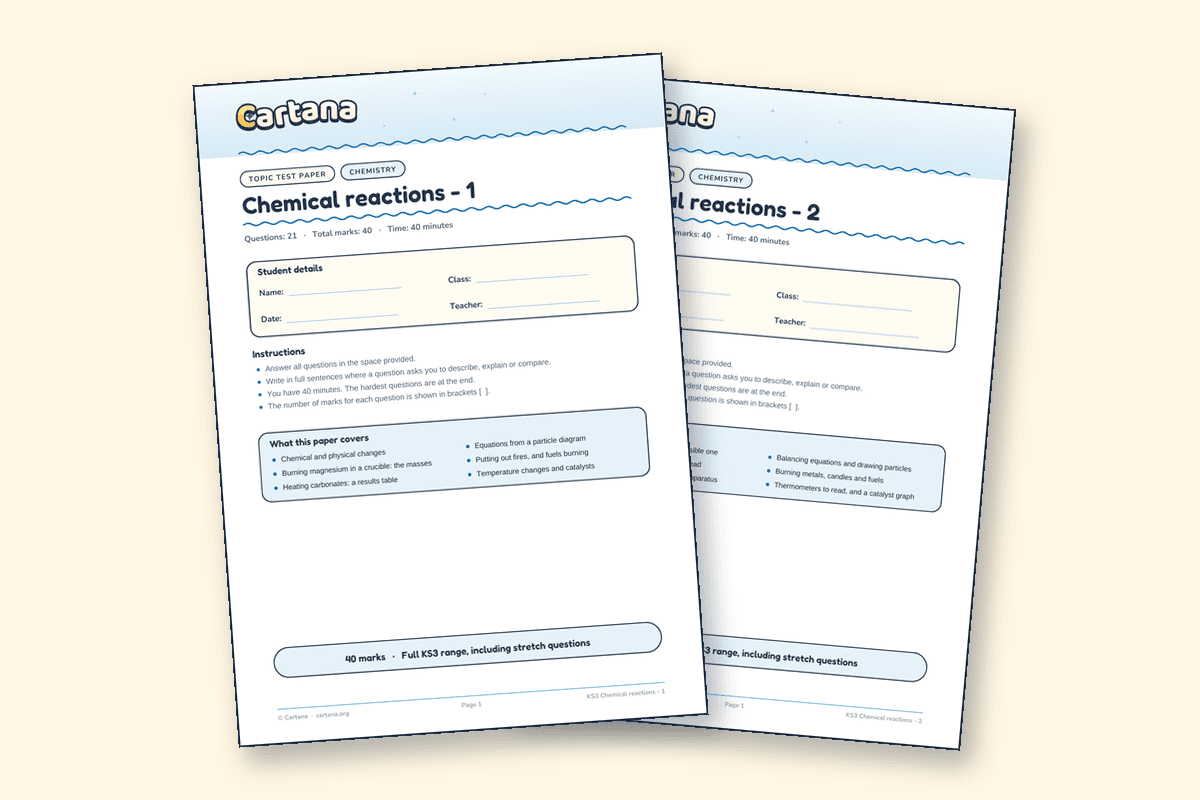
When every topic in chemical reactions is done, two different papers test the whole unit, each with its own mark scheme.


 Watch the trailer · 1:06
New from Cartana · Beta test 1–31 December
Revision that feels like an adventure
Cartana is our KS3 learning adventure: sail between islands, answer quick-fire questions and battle bosses. It starts with science, with maths on the way, and launches in 2027. This December a small group of testers gets to play it first.
In the Cartana adventure, every science unit is an island to explore. The island for chemical reactions is being built.
- Play the game before its official release
- Help us build it with your feedback
- Earn exclusive in-game items in return
More in this unit
Chemical reactions
- 1Chemical and physical changesChemical reactions as the rearrangement of atoms, the signs of a reaction, reactants and products, and physical changes
- 2Word and symbol equationsWord equations, state symbols, symbol equations and balancing simple equations by counting atoms
- 3Conservation of massConservation of mass in reactions: no atoms made or lost, gases leaving or joining, and simple calculations
- 5Thermal decompositionNextOne substance breaking down on heating, metal carbonates, copper carbonate, the limewater test and comparing carbonates
- 6Energy changes and catalystsExothermic and endothermic reactions, measuring the temperature change, and what catalysts do