
KS3 Chemistry · Chemical reactions
Energy changes and catalysts
- Exothermic reactions give energy out and warm their surroundings; endothermic reactions take energy in and cool them
- Everyday examples: fuels, hand warmers, self-heating cans and cold packs
- The practical: measuring a temperature change in a polystyrene cup
- What a catalyst does, with catalytic converters and enzymes
- 4 min read
- 5 quick questions
- Free homework sheet
- Years 7 to 9
Revision notes
An exothermic reaction gives out energy to its surroundings, so the temperature rises. An endothermic reaction takes in energy from its surroundings, so the temperature falls. A catalyst speeds up a reaction without being used up.
What is an exothermic reaction?
"Exo" means out. An exothermic reaction transfers energy out to its surroundings (the container, the air, your hand), so a thermometer in the mixture shows the temperature going up. Many everyday reactions are exothermic:
- Combustion: burning gas in a cooker or a boiler.
- Respiration in your cells, which keeps you warm (see respiration).
- Neutralisation: an acid reacting with an alkali.
- Hand warmers: in the disposable kind, iron powder reacts with oxygen from the air, a fast rusting.
- Self-heating cans: calcium oxide reacting with water heats the food or drink.
What is an endothermic reaction?
"Endo" means in. An endothermic reaction takes energy in from its surroundings, so the mixture and its container get colder. Some everyday examples:
- Thermal decomposition, such as heating copper carbonate: it only keeps going while you keep heating.
- Photosynthesis, which takes in energy from light.
- Citric acid reacting with sodium hydrogencarbonate (baking soda): the fizzing mixture feels cold.
Instant cold packs work by dissolving a salt such as ammonium nitrate in water. Dissolving is a physical change, not a reaction, but it takes in energy in the same way.
How do you measure the temperature change?
- Stand a polystyrene cup in a beaker so it cannot tip over. Polystyrene is a good insulator: energy does not pass through it easily.
- Measure 25 cm3 of the first solution into the cup and record its temperature.
- Add the second reactant, put the lid on and stir.
- Record the highest temperature reached (or the lowest, if it gets colder).
| In °C | Acid + alkali | Citric acid + baking soda |
|---|---|---|
| Start | 21 | 21 |
| End | 28 | 13 |
| Change | +7 | −8 |
Citric acid and baking soda: temperature change = 13 °C − 21 °C = −8 °C
The temperature fell, so energy was taken in: the reaction is endothermic.
To make it a fair test, use the same volumes and amounts each time, start from the same temperature and use the same cup.
What does a catalyst do?
A catalyst speeds up a reaction but is not used up: there is the same amount, chemically unchanged, at the end. So a small amount can be used again and again. A catalyst does not change what is made or how much; it only makes it happen faster.
- Catalytic converters in car exhausts hold a thin coat of metals such as platinum, which turn poisonous carbon monoxide into carbon dioxide.
- Enzymes are biological catalysts. Amylase in your saliva speeds up the breakdown of starch into sugar (see enzymes).
- Many industries use catalysts so their reactions run fast at lower temperatures, saving energy.
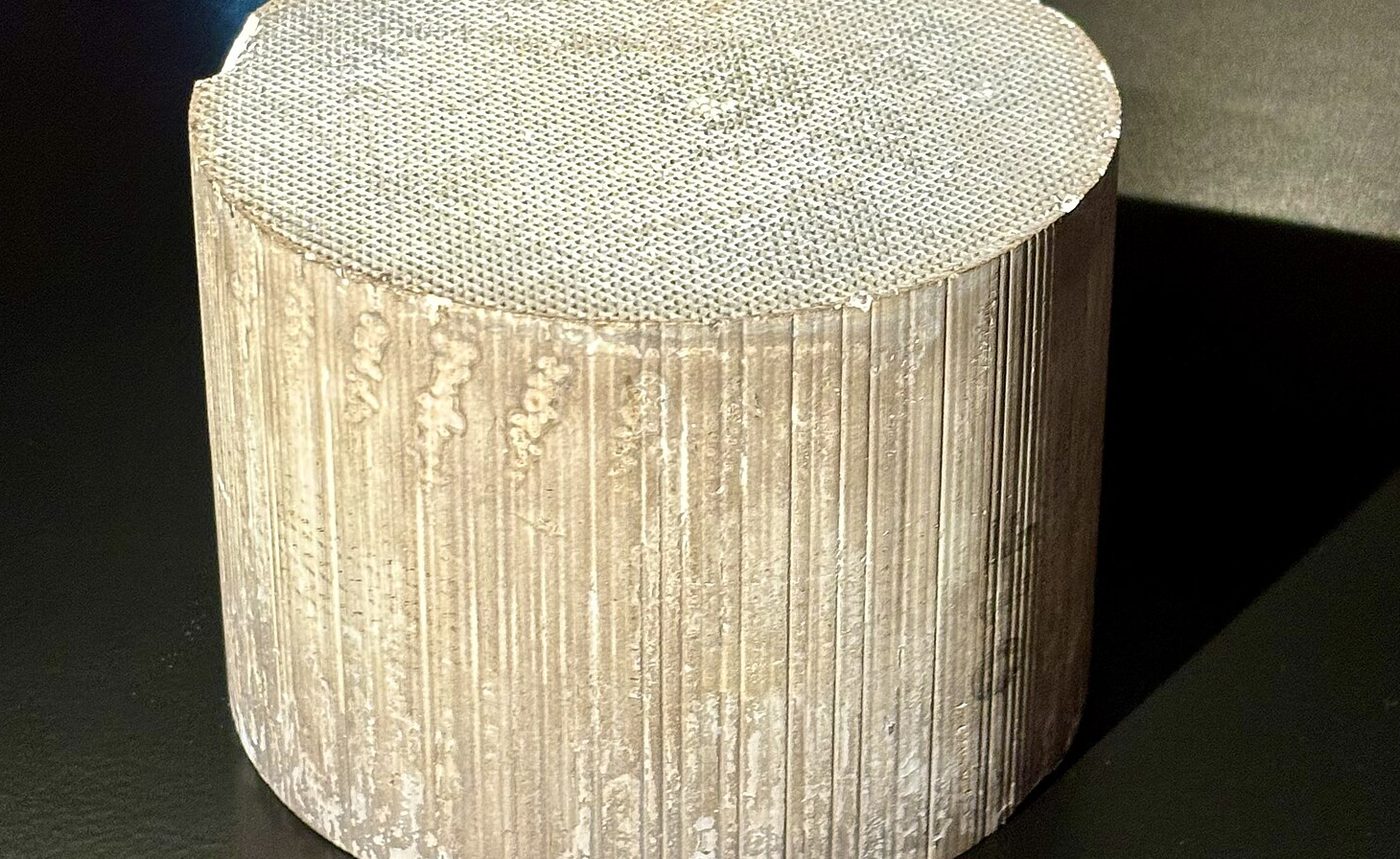
Stretch Most reactions need a push of energy to get started, even exothermic ones: gas in a cooker does not burn until a spark lights it. This starting energy is called the activation energy. A catalyst gives the reaction a different route that needs less activation energy, so more of the particles that collide have enough energy to react.
Written to the KS3 national curriculum. Last changed 14 November 2026.
Key words
Say them, spell them, use them in an answer.
- exothermic
- endothermic
- surroundings
- temperature change
- insulator
- catalyst
- enzyme
- catalytic converter
Common misconception
Often said“In an endothermic reaction the beaker feels cold because the reaction gives out cold.”
In factThere is no such thing as cold to give out. The reaction takes energy in from its surroundings, including the beaker and your hand, so they lose energy and their temperature falls.
Did you know?
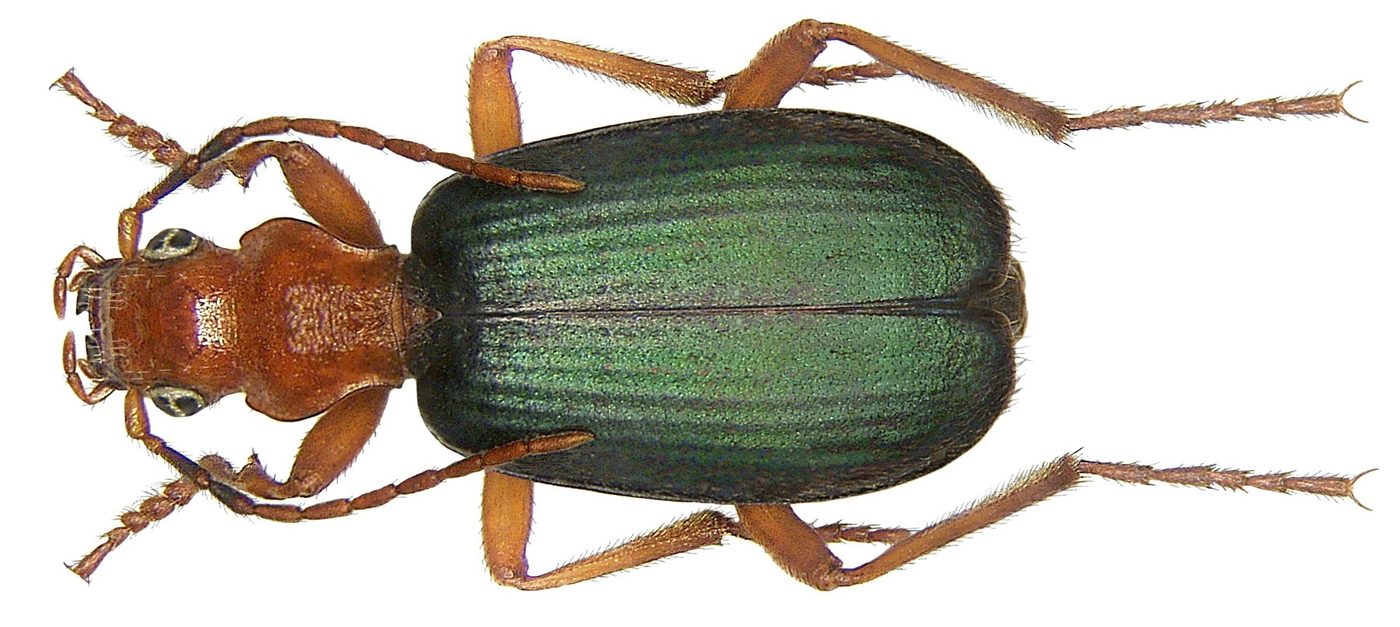
The bombardier beetle
The bombardier beetle defends itself with a boiling spray. It mixes hydrogen peroxide and other chemicals with enzymes, catalysts that make them react at once in an exothermic reaction, and squirts the mixture, at about 100 °C, at its attacker.
Photo: Udo Schmidt from Deutschland, CC BY-SA 2.0, via Wikimedia Commons
Try 5 questions
Quick questions on energy changes and catalysts, marked as you go. Each one explains the answer.
Question 1 of 5
What is an exothermic reaction?
Choose an answer. Each question explains itself.
The homework sheet
About twenty minutes. Everything on it is in the notes above; the answers are on the last page.
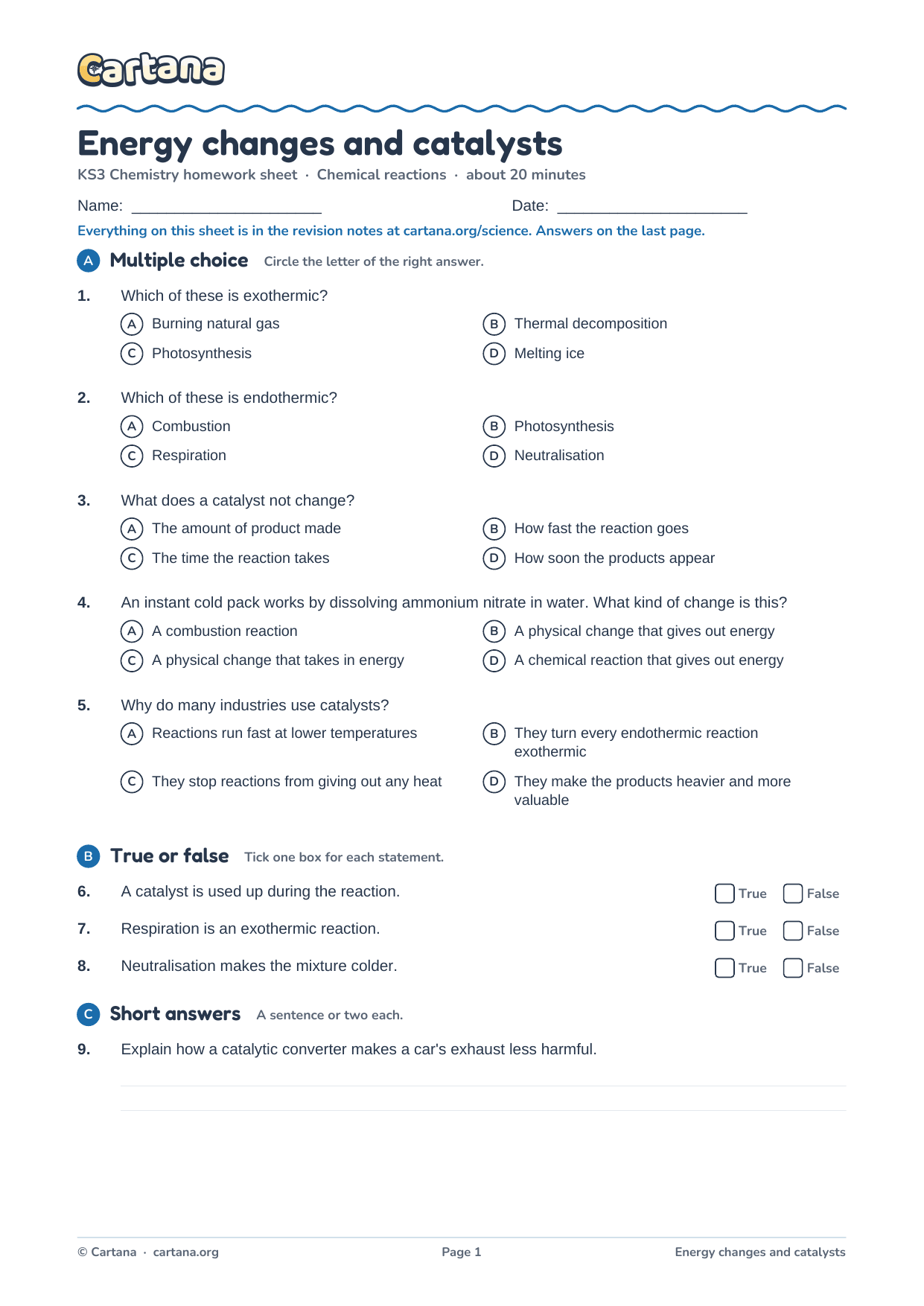
Free homework sheet
Energy changes and catalysts homework sheet
17 questions, about twenty minutes, with the answers on the last page: multiple choice, true or false, short answers, key words to define and one to explain in full.
KS3 Chemical reactions
Revised the whole unit?
When every topic in chemical reactions is done, two different papers test the whole unit, each with its own mark scheme.


 Watch the trailer · 1:06
New from Cartana · Beta test 1–31 December
Revision that feels like an adventure
Cartana is our KS3 learning adventure: sail between islands, answer quick-fire questions and battle bosses. It starts with science, with maths on the way, and launches in 2027. This December a small group of testers gets to play it first.
In the Cartana adventure, every science unit is an island to explore. The island for chemical reactions is being built.
- Play the game before its official release
- Help us build it with your feedback
- Earn exclusive in-game items in return
More in this unit
Chemical reactions
- 1Chemical and physical changesChemical reactions as the rearrangement of atoms, the signs of a reaction, reactants and products, and physical changes
- 2Word and symbol equationsWord equations, state symbols, symbol equations and balancing simple equations by counting atoms
- 3Conservation of massConservation of mass in reactions: no atoms made or lost, gases leaving or joining, and simple calculations
- 4Combustion and oxidationThe fire triangle, oxidation of metals and non-metals, burning hydrocarbons and testing for water and carbon dioxide
- 5Thermal decompositionOne substance breaking down on heating, metal carbonates, copper carbonate, the limewater test and comparing carbonates