
KS3 Chemistry · Years 7 to 9
Earth & atmosphere
The Earth and its air for KS3 chemistry: the layers inside the Earth, the three types of rock and the rock cycle, the gases in the atmosphere, the carbon cycle, climate change and the evidence for it, and why resources are limited and what recycling saves.
- 7 topics
- 31 min of notes
- 7 homework sheets
- 2 test papers
The topics, in order
Each has its revision notes, key words, a common misconception and quick questions; the homework sheets are free to print.
- 1Structure of the EarthThe crust, mantle, outer core and inner core: what each is made of and like, and how earthquake waves show what is inside5 min read5 questionsHomework sheet
- 2Types of rockHow igneous, sedimentary and metamorphic rocks form, what their grains, crystals, layers and fossils show, and how to tell them apart4 min read5 questionsHomework sheet
- 3The rock cycleWeathering (physical, chemical and biological), erosion, transport, deposition, burial, uplift and melting, and following a rock round the cycle4 min read5 questionsHomework sheet
- 4The atmosphereThe gases in dry air and their percentages, water vapour, where the oxygen came from, and the tests for gases4 min read5 questionsHomework sheet
- 5The carbon cycleThe stores of carbon and how carbon moves between them: photosynthesis, respiration, feeding, decay, combustion, dissolving and fossil fuels forming4 min read5 questionsHomework sheet
- 6Climate changeThe greenhouse effect, carbon dioxide and methane from human activity, the measured evidence, the effects, and what reduces emissions5 min read5 questionsHomework sheet
- 7Resources and recyclingWhy the Earth’s resources are limited, what getting them costs in energy and land, what recycling saves, and its limits4 min read5 questionsHomework sheet
Test the whole unit
When the topics are revised, two different papers test the whole unit, each marked the way an exam would be: sit Paper 1, go over what went wrong, then sit Paper 2.
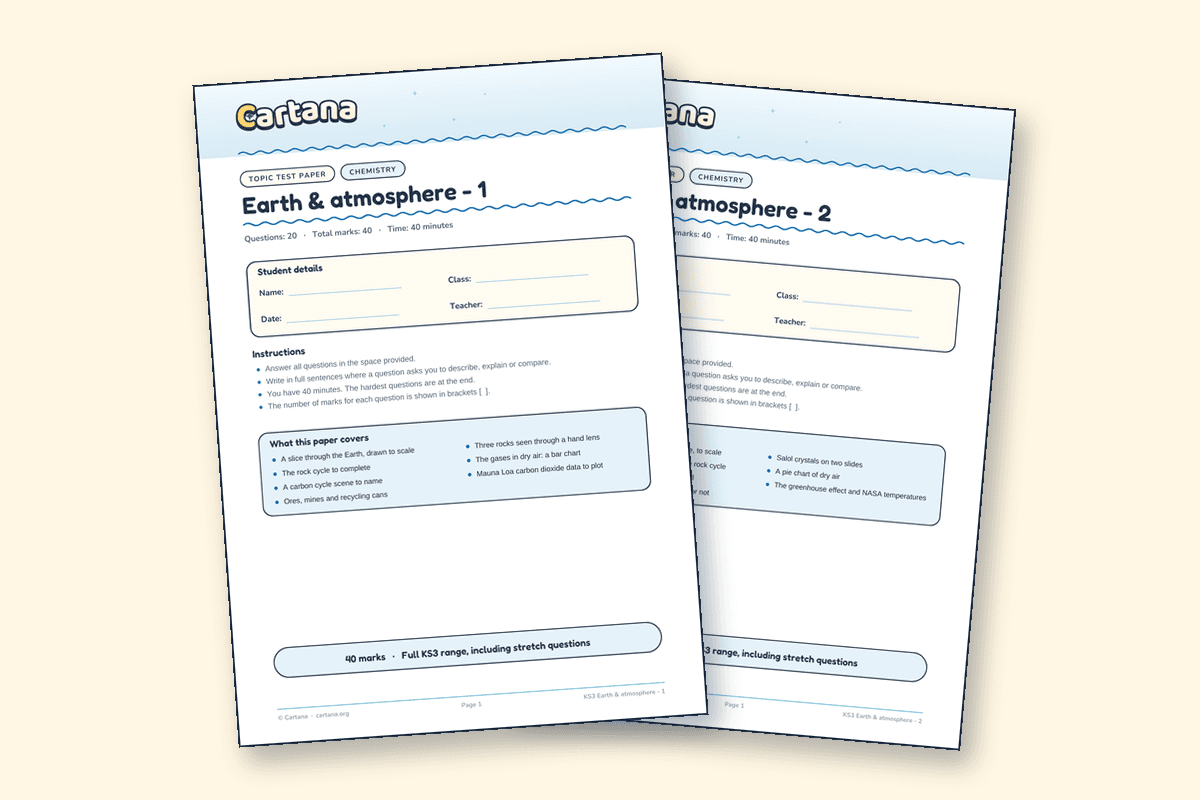
Two papers, one price
KS3 Earth & atmosphere Test Papers with Mark Schemes (2 Papers)
Two different test papers on the same unit, each with its own mark scheme, for £1.99 together.
- 2 different papers
- 2 × 40 marks
- 40 minutes each
- 2 mark schemes, 29 pages
Also in the Chemistry Pack: 16 papers for £9.99, save 37%.
Did you know?
- If you could drive straight down at 100 km/h, you would reach the centre of the Earth, about 6,370 km down, in less than three days.
- Most diamonds formed in the mantle, about 150 km or more below the surface, and were carried up by rare, fast volcanic eruptions.
- The air in a classroom of about 200 m³ has a mass of about 240 kg, more than three adults: each cubic metre of air is about 1.2 kg.
- Out of every 10,000 particles in the air, only about 4 are carbon dioxide molecules. That small share has risen by about half since before industry.
More chemistry units
- Particles & states of matter 5 topics
- Atoms, elements & compounds 5 topics
- Separating mixtures 5 topics
- Chemical reactions 6 topics
- Acids & alkalis 5 topics
- The periodic table 5 topics
- Metals & materials 5 topics
All of KS3 science · Every homework sheet · Test papers and packs
 Watch the trailer · 1:06
New from Cartana · Beta test 1–31 December
Revision that feels like an adventure
Cartana is our KS3 learning adventure: sail between islands, answer quick-fire questions and battle bosses. It starts with science, with maths on the way, and launches in 2027. This December a small group of testers gets to play it first.
In the Cartana adventure, every science unit is an island to explore. The island for Earth & atmosphere is being built.
- Play the game before its official release
- Help us build it with your feedback
- Earn exclusive in-game items in return