
KS3 Physics · Years 7 to 9
Light
Light for KS3 physics: how light travels and how fast, reflection and the law of reflection, refraction and convex lenses, the eye and the pinhole camera, and colour, prisms and filters.
- 5 topics
- 24 min of notes
- 5 homework sheets
- 2 test papers
The topics, in order
Each has its revision notes, key words, a common misconception and quick questions; the homework sheets are free to print.
- 1How light travelsLight as a wave that needs no medium, its speed, rays and shadows, transparent, translucent and opaque materials, luminous and non-luminous objects, and light against sound5 min read5 questionsHomework sheet
- 2ReflectionThe law of reflection, the normal, specular and diffuse reflection, the image in a plane mirror and the ray-box practical5 min read5 questionsHomework sheet
- 3RefractionLight changing speed and direction between materials, bending towards and away from the normal, the glass block practical, and a convex lens bringing rays to a focus5 min read5 questionsHomework sheet
- 4The eye and the cameraThe parts of the eye and their jobs, the image on the retina, the pinhole camera, the camera and the eye compared, and light causing chemical and electrical changes5 min read5 questionsHomework sheet
- 5ColourWhite light split by a prism, the spectrum and frequency, the primary colours of light, filters, and why objects look coloured in white and coloured light5 min read5 questionsHomework sheet
Test the whole unit
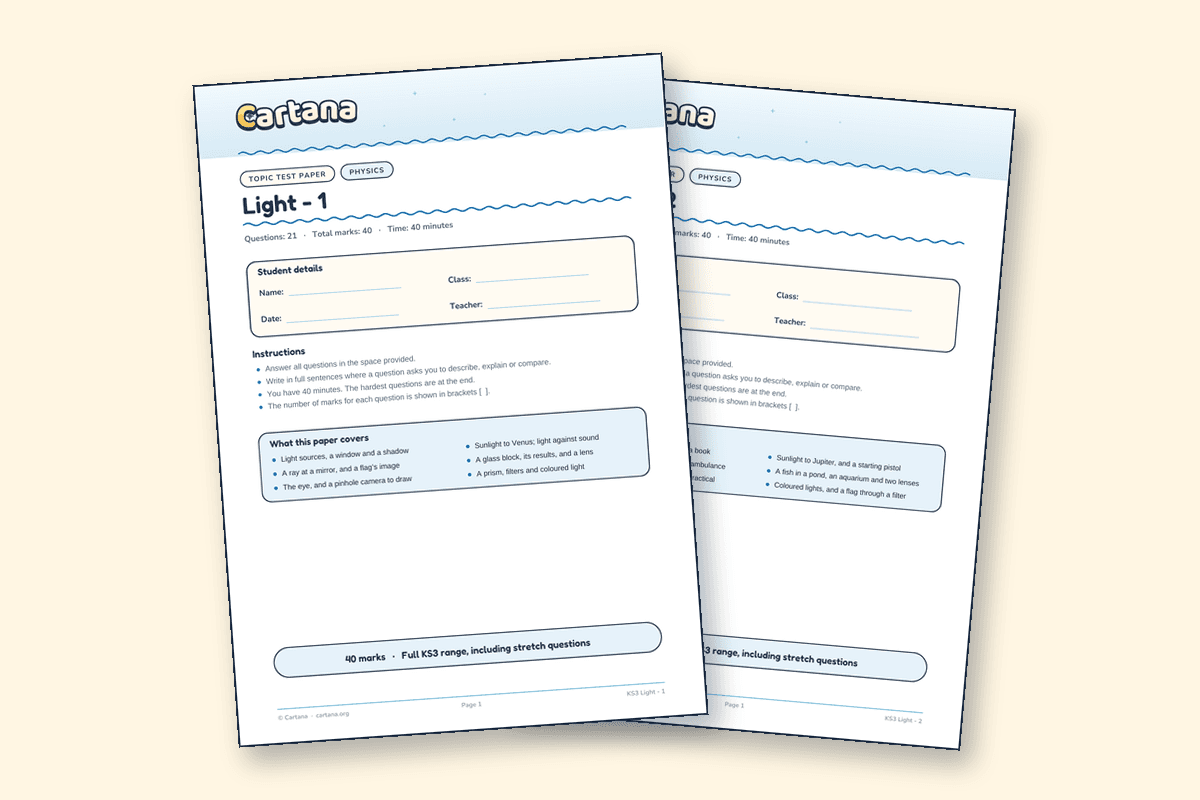
When the topics are revised, two different papers test the whole unit, each marked the way an exam would be: sit Paper 1, go over what went wrong, then sit Paper 2.
Two papers, one price
KS3 Light Test Papers with Mark Schemes (2 Papers)
Two different test papers on the same unit, each with its own mark scheme, for £1.99 together.
- 2 different papers
- 2 × 40 marks
- 40 minutes each
- 2 mark schemes, 28 pages
Also in the Physics Pack: 14 papers for £8.99, save 35%.
Did you know?
- After the Sun, the nearest star to us is Proxima Centauri. Its light takes about 4.2 years to reach the Earth, travelling at 300 000 km every second.
- Light slows to about 124 000 km/s inside a diamond, less than half its speed in air. Bending light so strongly is part of what makes a cut diamond sparkle.
- About a thousand years ago, the scholar Ibn al-Haytham, working in Cairo, showed by experiment that we see because light enters our eyes, not because our eyes send rays out. He also studied the images made by light through a small hole.
- Your pupils can open from about 2 mm across in bright light to about 8 mm in the dark, letting in about sixteen times as much light.
More physics units
- Forces 6 topics
- Motion & pressure 6 topics
- Energy 6 topics
- Electricity & magnetism 5 topics
- Sound & waves 5 topics
- Space 5 topics
All of KS3 science · Every homework sheet · Test papers and packs
 Watch the trailer · 1:06
New from Cartana · Beta test 1–31 December
Revision that feels like an adventure
Cartana is our KS3 learning adventure: sail between islands, answer quick-fire questions and battle bosses. It starts with science, with maths on the way, and launches in 2027. This December a small group of testers gets to play it first.
In the Cartana adventure, every science unit is an island to explore. The island for light is being built.
- Play the game before its official release
- Help us build it with your feedback
- Earn exclusive in-game items in return