
KS3 Physics · Light
Refraction
- Why light changes direction when it changes speed
- Towards the normal into glass, away from it coming out
- The glass block practical and why a straw looks bent
- How a convex lens brings light to a focus
- 5 min read
- 5 quick questions
- Free homework sheet
- Years 7 to 9
Revision notes
Refraction is the change in direction of light as it passes at an angle from one transparent material into another. It happens because light changes speed: it slows down going into glass or water and speeds up again coming out.
Why does light bend?
Light travels at about 300 000 km/s in air, about 225 000 km/s in water and about 200 000 km/s in glass. When a ray crosses from one material into another at an angle, one side of the beam changes speed before the other, so the beam swings round. Think of a shopping trolley pushed at a slant from smooth tiles onto carpet: the wheel that reaches the carpet first slows first, and the trolley turns.
| Light going | Its speed | Its direction |
|---|---|---|
| Air into glass | Slows down | Bends towards the normal |
| Glass into air | Speeds up | Bends away from the normal |
| Along the normal | Changes | Does not bend |
As with reflection, angles are measured from the normal. The angle between the refracted ray and the normal is the angle of refraction. Inside glass it is smaller than the angle of incidence.
What does the glass block experiment show?
- Put a rectangular glass block on paper and draw round it.
- Shine a ray from a ray box at the block at an angle, and mark the ray going in and the ray coming out with crosses.
- Take the block away, join the crosses and draw the ray’s path through the block.
- Draw a normal where the ray enters and leaves, and measure the angles. Repeat for other angles of incidence.
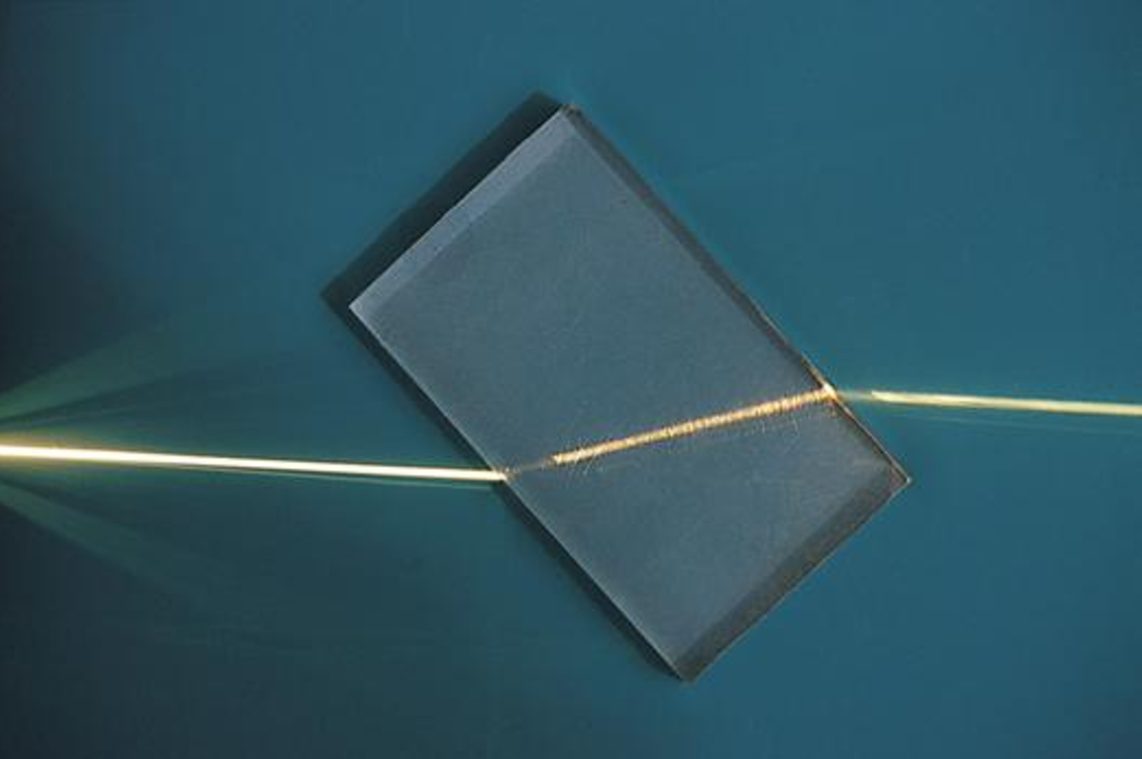
You will see the ray bend towards the normal as it enters and away from it as it leaves, so the ray that comes out (the emergent ray) is parallel to the one that went in. A ray going in at 40° to the normal travels through the glass at about 25°. A ray along the normal goes straight through.
Why does a straw look bent in water?
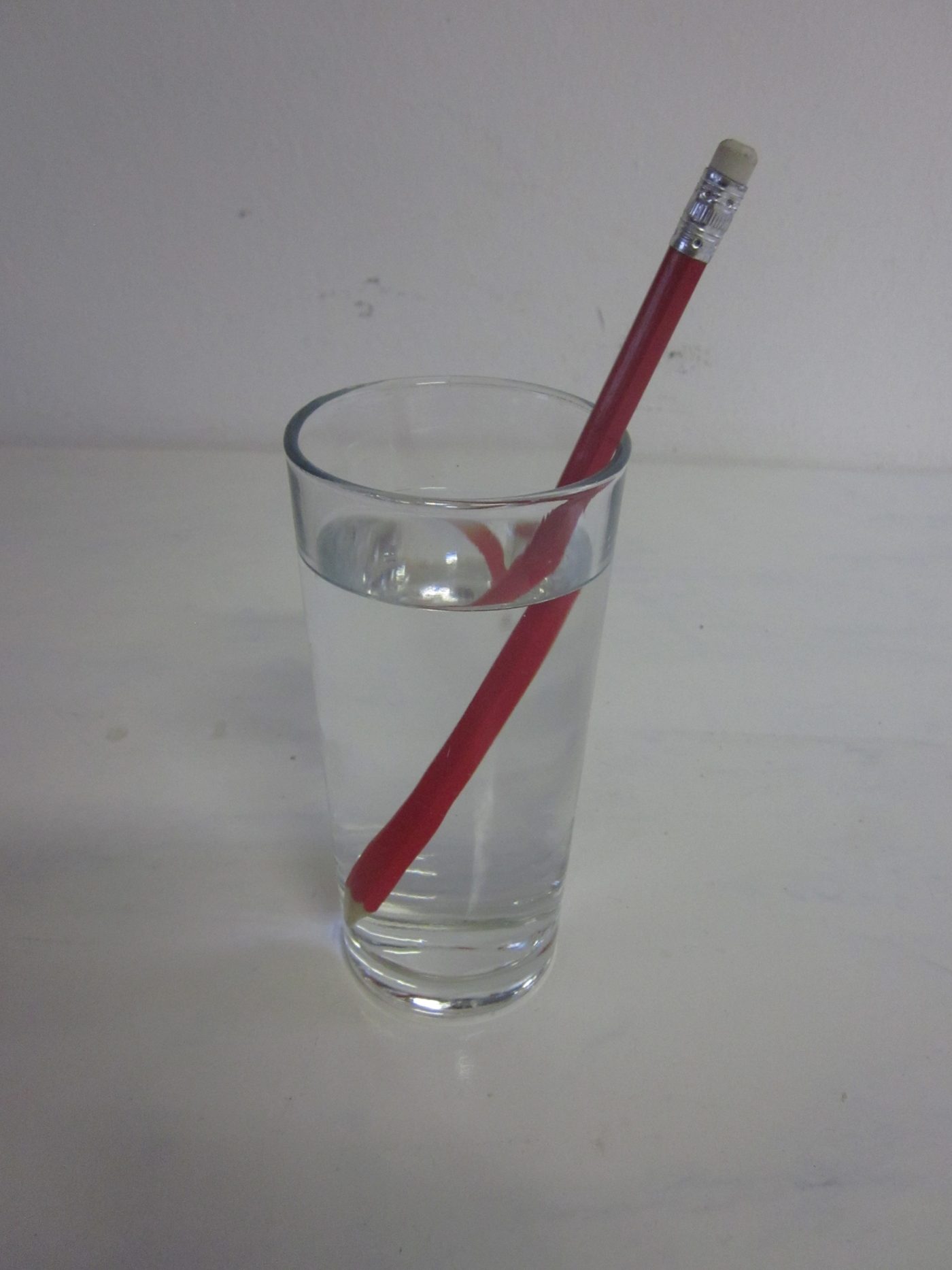
Light from the part of a straw under water bends away from the normal as it leaves the water. Your brain assumes light travels in straight lines, so it traces the ray straight back and sees the straw higher than it really is: the straw looks broken at the surface. For the same reason a swimming pool looks shallower than it really is, which is why you should never judge a pool’s depth by eye.
How does a convex lens focus light?
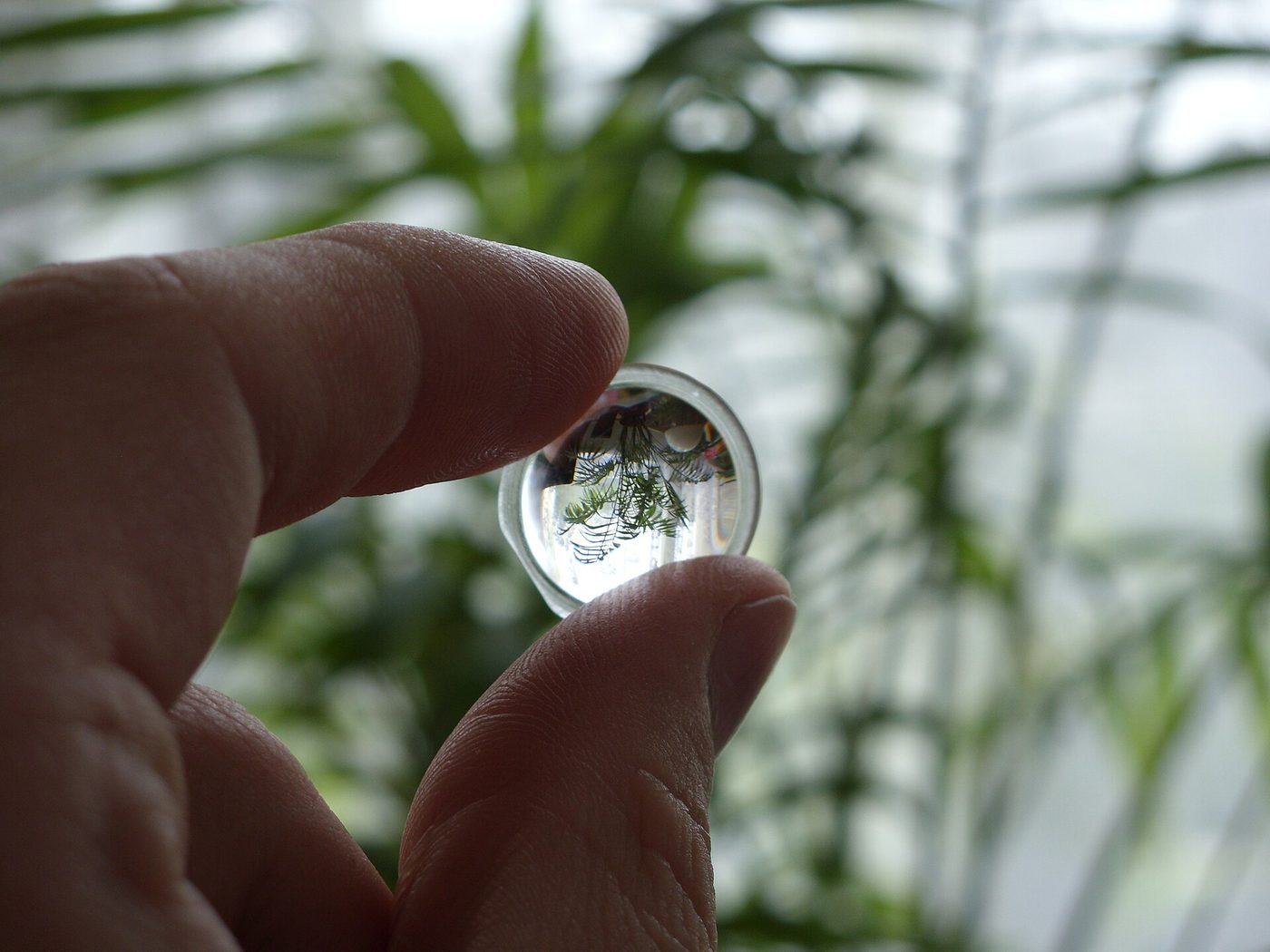
A lens is a shaped piece of glass or plastic that refracts light at both its surfaces. A convex lens is thicker in the middle than at the edges. It bends rays inwards, so rays arriving parallel to each other are brought together at one point, the focus (or focal point). The distance from the middle of the lens to the focus is the focal length. A fatter, more curved lens bends light more, so it has a shorter focal length.
Hold a magnifying glass (a convex lens) in sunlight and it focuses the light to a bright spot. A convex lens can also form an upside-down image of a distant scene on a screen: that is how a camera and your eye work (see the eye and the camera). A concave lens, thinner in the middle, spreads rays apart instead.
Stretch When light inside glass or water hits the surface at a big enough angle, none of it gets out: it all reflects back inside. This is total internal reflection. For glass it happens when the angle of incidence is more than about 42°, called the critical angle. Optical fibres use it to carry light signals for broadband along thin glass strands, bouncing from side to side without escaping.
Written to the KS3 national curriculum. Last changed 14 November 2026.
Key words
Say them, spell them, use them in an answer.
- refraction
- angle of refraction
- emergent ray
- lens
- convex lens
- focus
- focal length
- concave lens
Common misconception
Often said“Light always bends when it goes into glass or water.”
In factLight bends only when it meets the surface at an angle. A ray that hits along the normal, at 90° to the surface, still slows down but goes straight on without changing direction.
Did you know?
The archerfish
The archerfish knocks insects off leaves above the water by spitting a jet of water at them. Seen from under the water, the insect is not where it seems to be, because light refracts at the surface, yet the fish corrects its aim and still hits.
Try 5 questions
Quick questions on refraction, marked as you go. Each one explains the answer.
Question 1 of 5
In the glass block experiment, how does the ray that comes out compare with the ray that went in?
Choose an answer. Each question explains itself.
The homework sheet
About twenty minutes. Everything on it is in the notes above; the answers are on the last page.
Free homework sheet
Refraction homework sheet
17 questions, about twenty minutes, with the answers on the last page: multiple choice, true or false, short answers, key words to define and one to explain in full.
KS3 Light
Revised the whole unit?
When every topic in light is done, two different papers test the whole unit, each with its own mark scheme.


 Watch the trailer · 1:06
New from Cartana · Beta test 1–31 December
Revision that feels like an adventure
Cartana is our KS3 learning adventure: sail between islands, answer quick-fire questions and battle bosses. It starts with science, with maths on the way, and launches in 2027. This December a small group of testers gets to play it first.
In the Cartana adventure, every science unit is an island to explore. The island for light is being built.
- Play the game before its official release
- Help us build it with your feedback
- Earn exclusive in-game items in return
More in this unit
Light
- 1How light travelsLight as a wave that needs no medium, its speed, rays and shadows, transparent, translucent and opaque materials, luminous and non-luminous objects, and light against sound
- 2ReflectionThe law of reflection, the normal, specular and diffuse reflection, the image in a plane mirror and the ray-box practical
- 4The eye and the cameraNextThe parts of the eye and their jobs, the image on the retina, the pinhole camera, the camera and the eye compared, and light causing chemical and electrical changes
- 5ColourWhite light split by a prism, the spectrum and frequency, the primary colours of light, filters, and why objects look coloured in white and coloured light