
KS3 Chemistry · Years 7 to 9
Chemical reactions
Chemical reactions for KS3 chemistry: how to tell a chemical change from a physical one, word and symbol equations and how to balance them, conservation of mass, combustion and oxidation, thermal decomposition, and exothermic and endothermic reactions and catalysts.
- 6 topics
- 21 min of notes
- 6 homework sheets
- 2 test papers
The topics, in order
Each has its revision notes, key words, a common misconception and quick questions; the homework sheets are free to print.
- 1Chemical and physical changesChemical reactions as the rearrangement of atoms, the signs of a reaction, reactants and products, and physical changes3 min read5 questionsHomework sheet
- 2Word and symbol equationsWord equations, state symbols, symbol equations and balancing simple equations by counting atoms3 min read5 questionsHomework sheet
- 3Conservation of massConservation of mass in reactions: no atoms made or lost, gases leaving or joining, and simple calculations4 min read5 questionsHomework sheet
- 4Combustion and oxidationThe fire triangle, oxidation of metals and non-metals, burning hydrocarbons and testing for water and carbon dioxide4 min read5 questionsHomework sheet
- 5Thermal decompositionOne substance breaking down on heating, metal carbonates, copper carbonate, the limewater test and comparing carbonates3 min read5 questionsHomework sheet
- 6Energy changes and catalystsExothermic and endothermic reactions, measuring the temperature change, and what catalysts do4 min read5 questionsHomework sheet
Test the whole unit
When the topics are revised, two different papers test the whole unit, each marked the way an exam would be: sit Paper 1, go over what went wrong, then sit Paper 2.
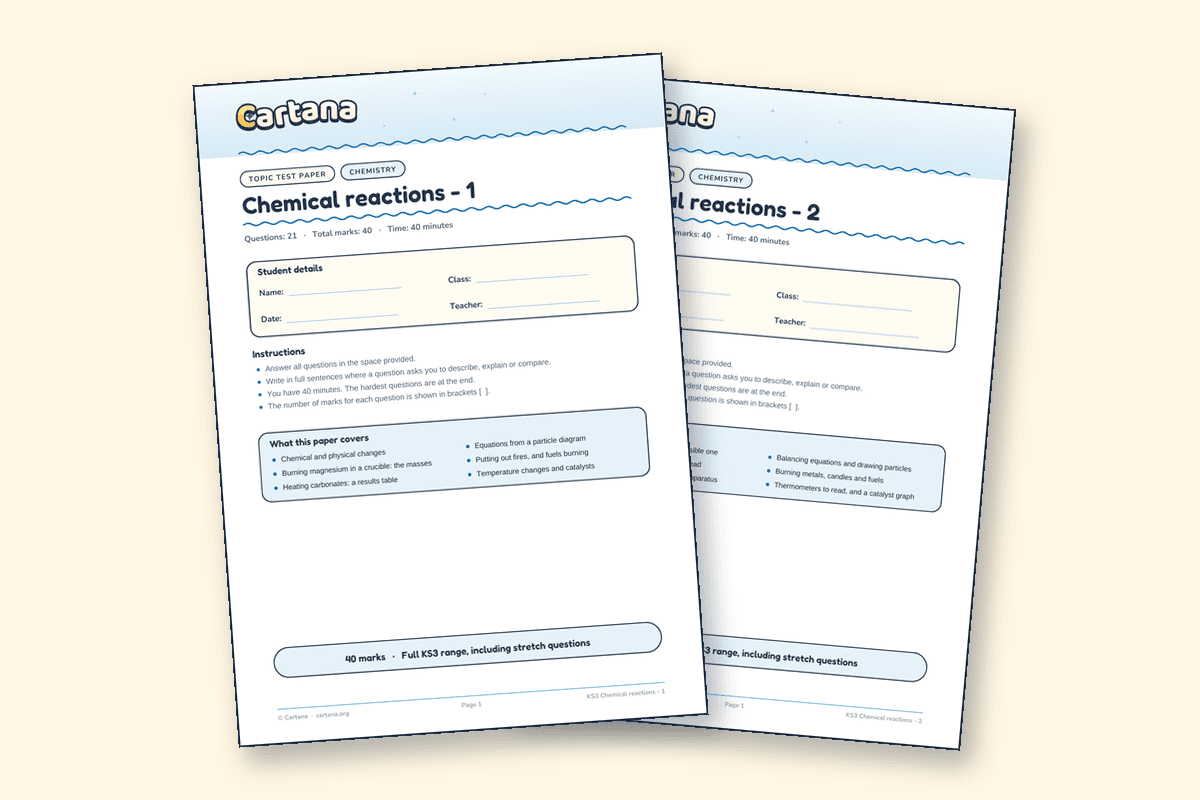
Two papers, one price
KS3 Chemical reactions Test Papers with Mark Schemes (2 Papers)
Two different test papers on the same unit, each with its own mark scheme, for £1.99 together.
- 2 different papers
- 2 × 40 marks
- 40 minutes each
- 2 mark schemes, 27 pages
Also in the Chemistry Pack: 16 papers for £9.99, save 37%.
Did you know?
- A glow stick glows because of a chemical reaction that gives out energy as light instead of heat. Put one in the freezer and the reaction slows down, so it glows more dimly but lasts longer.
- A rusty iron nail weighs more than it did before it rusted, because oxygen and water from the air have joined on to it.
- In the 1860s photographers began lighting their pictures by burning magnesium ribbon, which gives out a dazzling white light as it oxidises. Flash powder containing magnesium followed in the 1880s.
- Sherbet fizzes on your tongue because the citric acid and sodium hydrogencarbonate in it dissolve in your saliva and react, giving off bubbles of carbon dioxide.
More chemistry units
- Particles & states of matter 5 topics
- Atoms, elements & compounds 5 topics
- Separating mixtures 5 topics
- Acids & alkalis 5 topics
- The periodic table 5 topics
- Metals & materials 5 topics
- Earth & atmosphere 7 topics
All of KS3 science · Every homework sheet · Test papers and packs
 Watch the trailer · 1:06
New from Cartana · Beta test 1–31 December
Revision that feels like an adventure
Cartana is our KS3 learning adventure: sail between islands, answer quick-fire questions and battle bosses. It starts with science, with maths on the way, and launches in 2027. This December a small group of testers gets to play it first.
In the Cartana adventure, every science unit is an island to explore. The island for chemical reactions is being built.
- Play the game before its official release
- Help us build it with your feedback
- Earn exclusive in-game items in return