
KS3 Chemistry · Chemical reactions
Word and symbol equations
- Writing word equations, with reactants on the left and products on the right
- Reading formulae: the small numbers inside and the big numbers in front
- State symbols (s), (l), (g) and (aq)
- Balancing simple symbol equations by counting atoms, with a worked example
- 3 min read
- 5 quick questions
- Free homework sheet
- Years 7 to 9
Revision notes
A word equation names the reactants and products of a reaction, such as magnesium + oxygen → magnesium oxide. A symbol equation shows the same reaction with chemical formulae, and it must be balanced: the same number of each kind of atom on both sides.
How do you write a word equation?
Write the reactants on the left and the products on the right, with an arrow between them:
The arrow means "react to make". A plus sign on the left means "reacts with"; on the right it means "and". Never use an equals sign: the substances on each side are different.
- magnesium + oxygen → magnesium oxide
- methane + oxygen → carbon dioxide + water
- copper carbonate → copper oxide + carbon dioxide
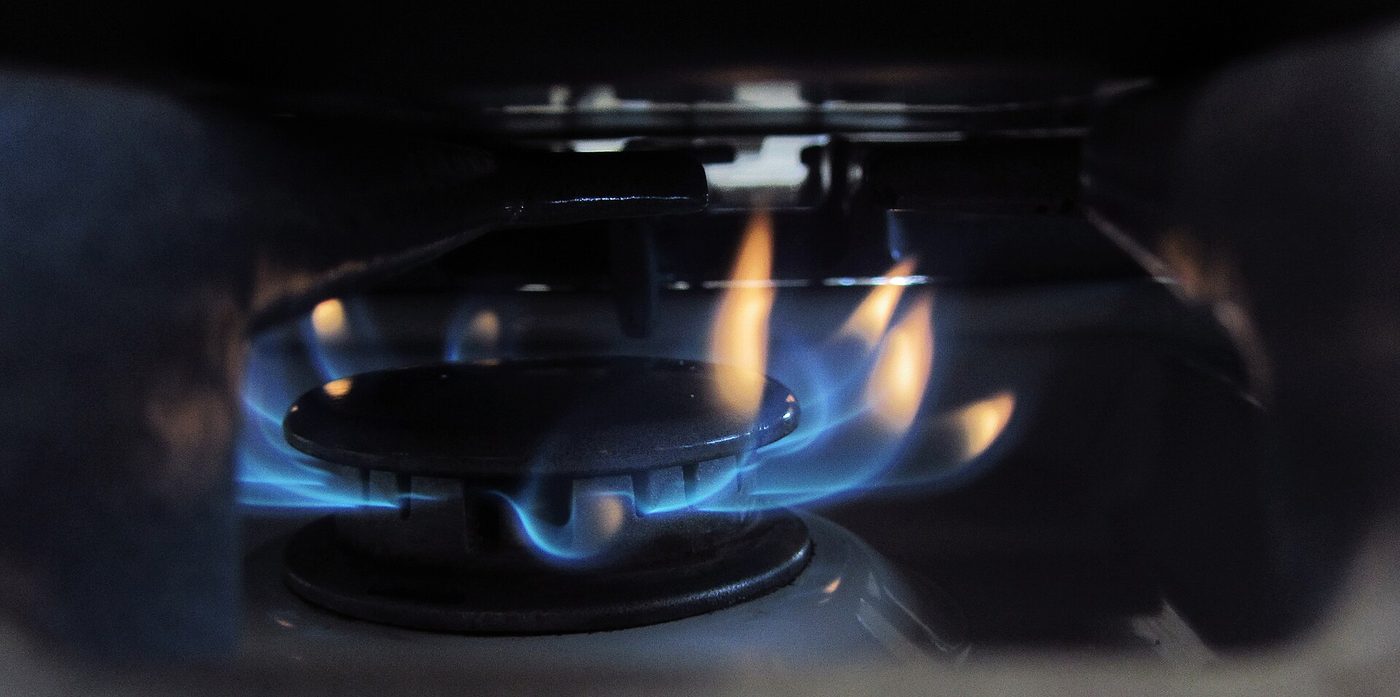
A compound of a metal with one other element usually takes the metal's name first and ends in -ide, so magnesium and oxygen make magnesium oxide.
What does a symbol equation show?
A symbol equation uses formulae in place of names. In a formula, a small number after a symbol counts the atoms of that element in one particle: CO2 is one carbon atom joined to two oxygen atoms. A big number in front counts whole particles: 2H2O is two molecules of water.
State symbols in brackets show the state of each substance:
| Symbol | Means | Example |
|---|---|---|
| (s) | solid | magnesium, Mg(s) |
| (l) | liquid | water, H2O(l) |
| (g) | gas | oxygen, O2(g) |
| (aq) | dissolved in water (aqueous) | salt water, NaCl(aq) |
So 2Mg(s) + O2(g) → 2MgO(s) says that solid magnesium burns in oxygen gas to make solid magnesium oxide.
How do you balance an equation?
Atoms are not made or destroyed in a reaction, so a symbol equation must have the same number of each kind of atom on both sides. Two rules:
- Never change the small numbers. Changing H2O to H2O2 would turn water into hydrogen peroxide, a different substance.
- Only put big numbers in front of formulae, then count again.
Balance: H2 + O2 → H2O
Count: left 2 H and 2 O; right 2 H and 1 O. Oxygen does not match.
Put a 2 in front of water: H2 + O2 → 2H2O. Now the right has 4 H and 2 O.
Oxygen matches, but hydrogen is 2 on the left and 4 on the right. Put a 2 in front of hydrogen.
2H2 + O2 → 2H2O: 4 H and 2 O on each side.
A second example: Mg + O2 → MgO. There are 2 O on the left but 1 on the right, so write 2MgO; then the magnesium needs a 2 as well: 2Mg + O2 → 2MgO.
Some equations balance as they stand. In CuCO3 → CuO + CO2 there is 1 Cu, 1 C and 3 O on each side.
Stretch Balance Na + O2 → Na2O. Oxygen first: 2Na2O gives 2 O on the right. That makes 4 Na on the right, so put 4 in front of Na: 4Na + O2 → 2Na2O. Check: 4 Na and 2 O on each side. Whatever you change, finish by counting every atom again.
Written to the KS3 national curriculum. Last changed 14 November 2026.
Key words
Say them, spell them, use them in an answer.
- word equation
- symbol equation
- reactants
- products
- formula
- state symbols
- aqueous
- balanced equation
- molecule
- atom
Common misconception
Often said“To balance an equation, you can change the small numbers in a formula.”
In factChanging a small number changes the substance. H₂O is water, but H₂O₂ is hydrogen peroxide, a bleach. You balance an equation only by putting big numbers in front of whole formulae.
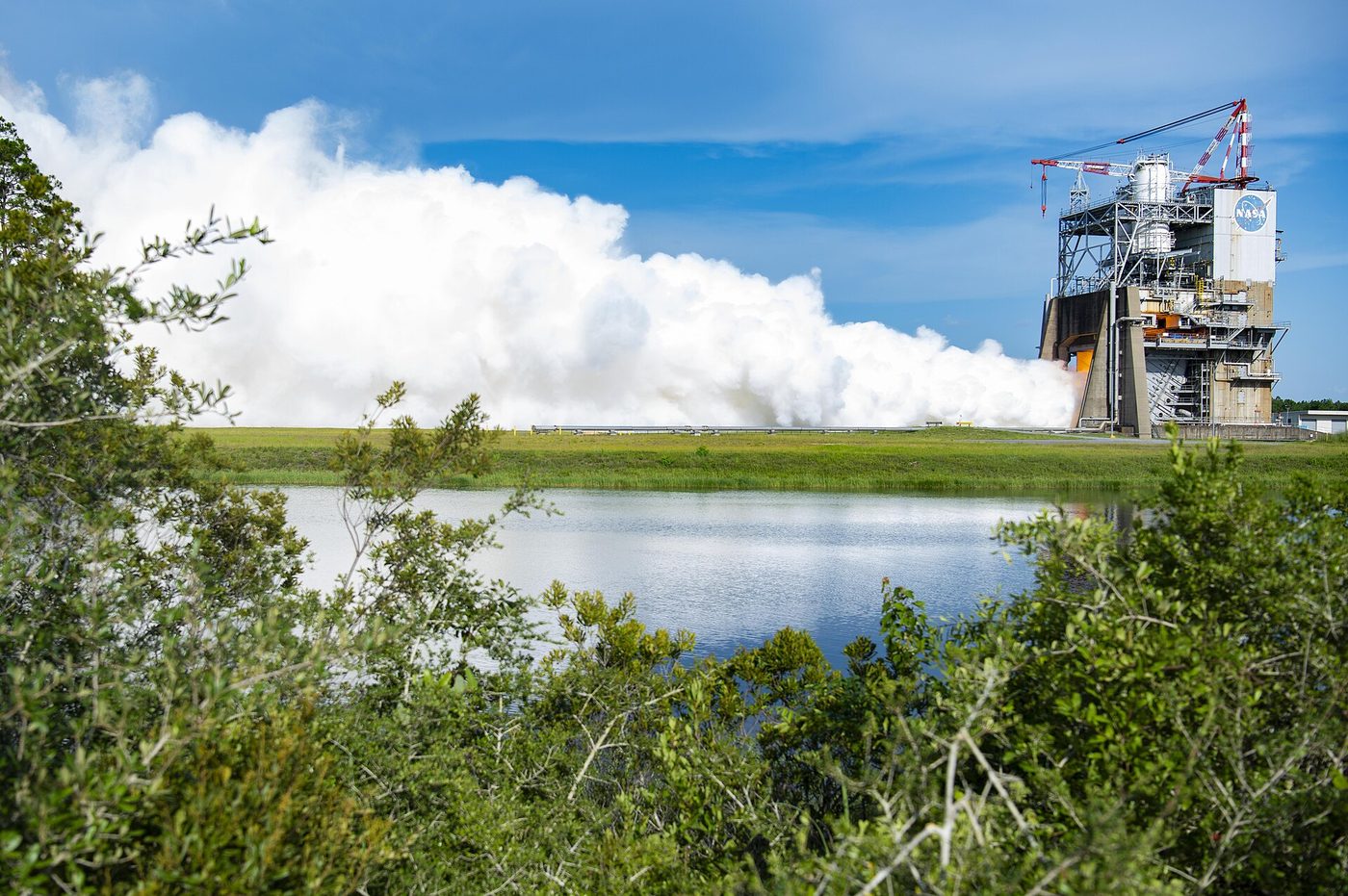
Did you know?
Rocket engines
The Space Shuttle's three main engines burned liquid hydrogen with liquid oxygen: 2H₂ + O₂ → 2H₂O. So what roared out of them was mostly very hot water vapour. When the same kind of engine is test-fired on the ground today, its huge white cloud is mostly steam.
Photo: NASA, Public domain, via Wikimedia Commons
Try 5 questions
Quick questions on word and symbol equations, marked as you go. Each one explains the answer.
Question 1 of 5
A plus sign on the left of an equation means "reacts with".
Choose an answer. Each question explains itself.
The homework sheet
About twenty minutes. Everything on it is in the notes above; the answers are on the last page.
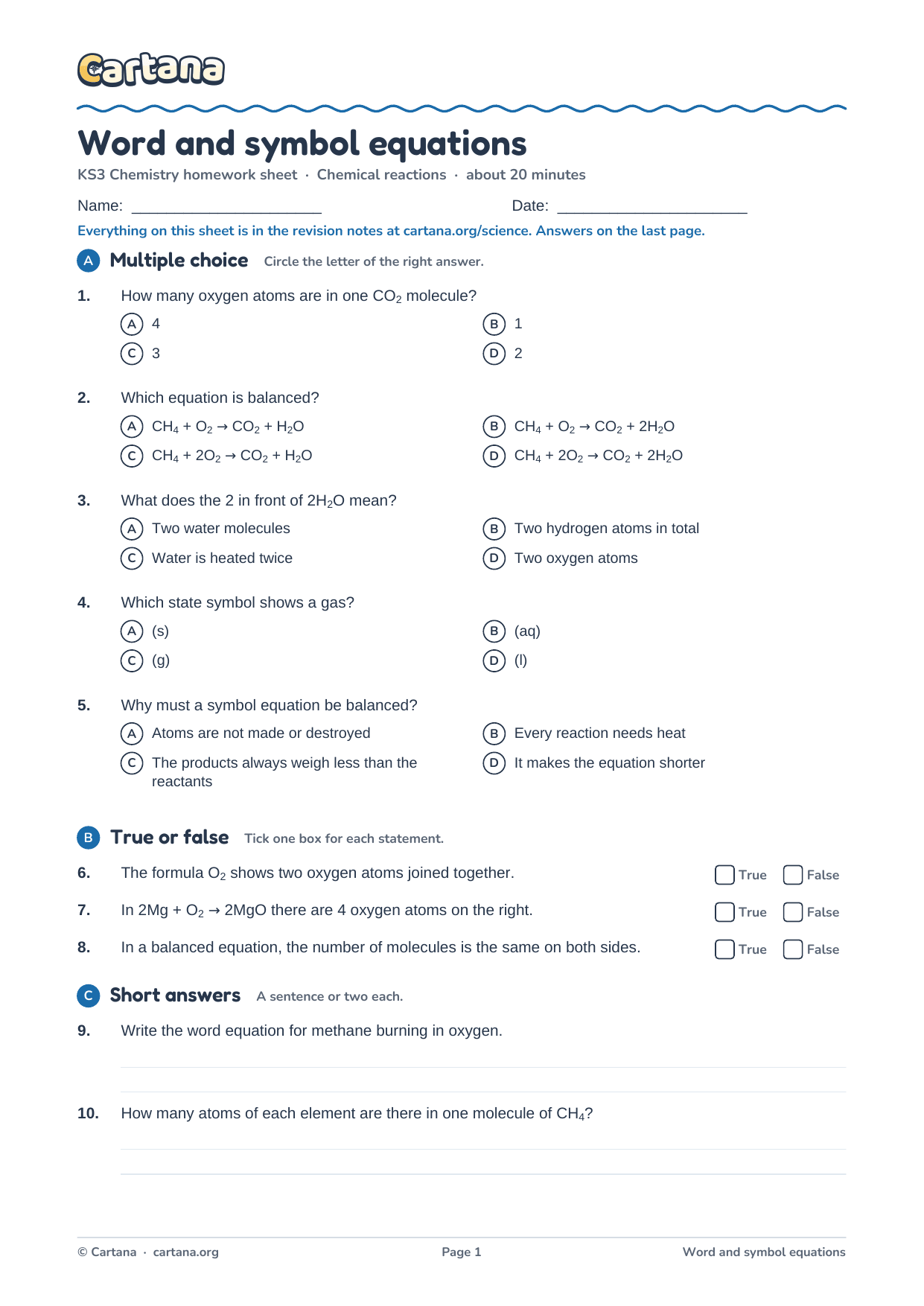
Free homework sheet
Word and symbol equations homework sheet
17 questions, about twenty minutes, with the answers on the last page: multiple choice, true or false, short answers, key words to define and one to explain in full.
KS3 Chemical reactions
Revised the whole unit?
When every topic in chemical reactions is done, two different papers test the whole unit, each with its own mark scheme.


 Watch the trailer · 1:06
New from Cartana · Beta test 1–31 December
Revision that feels like an adventure
Cartana is our KS3 learning adventure: sail between islands, answer quick-fire questions and battle bosses. It starts with science, with maths on the way, and launches in 2027. This December a small group of testers gets to play it first.
In the Cartana adventure, every science unit is an island to explore. The island for chemical reactions is being built.
- Play the game before its official release
- Help us build it with your feedback
- Earn exclusive in-game items in return
More in this unit
Chemical reactions
- 1Chemical and physical changesChemical reactions as the rearrangement of atoms, the signs of a reaction, reactants and products, and physical changes
- 3Conservation of massNextConservation of mass in reactions: no atoms made or lost, gases leaving or joining, and simple calculations
- 4Combustion and oxidationThe fire triangle, oxidation of metals and non-metals, burning hydrocarbons and testing for water and carbon dioxide
- 5Thermal decompositionOne substance breaking down on heating, metal carbonates, copper carbonate, the limewater test and comparing carbonates
- 6Energy changes and catalystsExothermic and endothermic reactions, measuring the temperature change, and what catalysts do