
KS3 Chemistry · Chemical reactions
Conservation of mass
- Why mass is conserved: no atoms are made or destroyed, only rearranged
- Why the mass seems to change when a gas escapes or joins, and closed systems
- The practical: burning magnesium in a crucible, and why its mass goes up
- Working out a missing mass, with worked examples
- 4 min read
- 5 quick questions
- Free homework sheet
- Years 7 to 9
Revision notes
In a chemical reaction no atoms are made or destroyed, only rearranged, so the total mass of the products equals the total mass of the reactants. This is the law of conservation of mass.
Why is mass conserved in a reaction?
Every atom in the reactants ends up somewhere in the products. The atoms swap partners, but the number of each kind stays the same, and so does their total mass. You can see this in a balanced equation: in 2Mg + O2 → 2MgO there are 2 magnesium and 2 oxygen atoms on each side.
Mass is conserved in physical changes too: when ice melts or salt dissolves, the particles are only moved about (see changes of state).
Why does the mass seem to change in some reactions?
Often a gas is given off or taken in, and gases are easy to forget because you cannot see them.
- A gas escapes, so the mass goes down. Calcium carbonate reacts with hydrochloric acid to make calcium chloride, water and carbon dioxide. In an open flask the carbon dioxide bubbles off into the air and the balance reading falls.
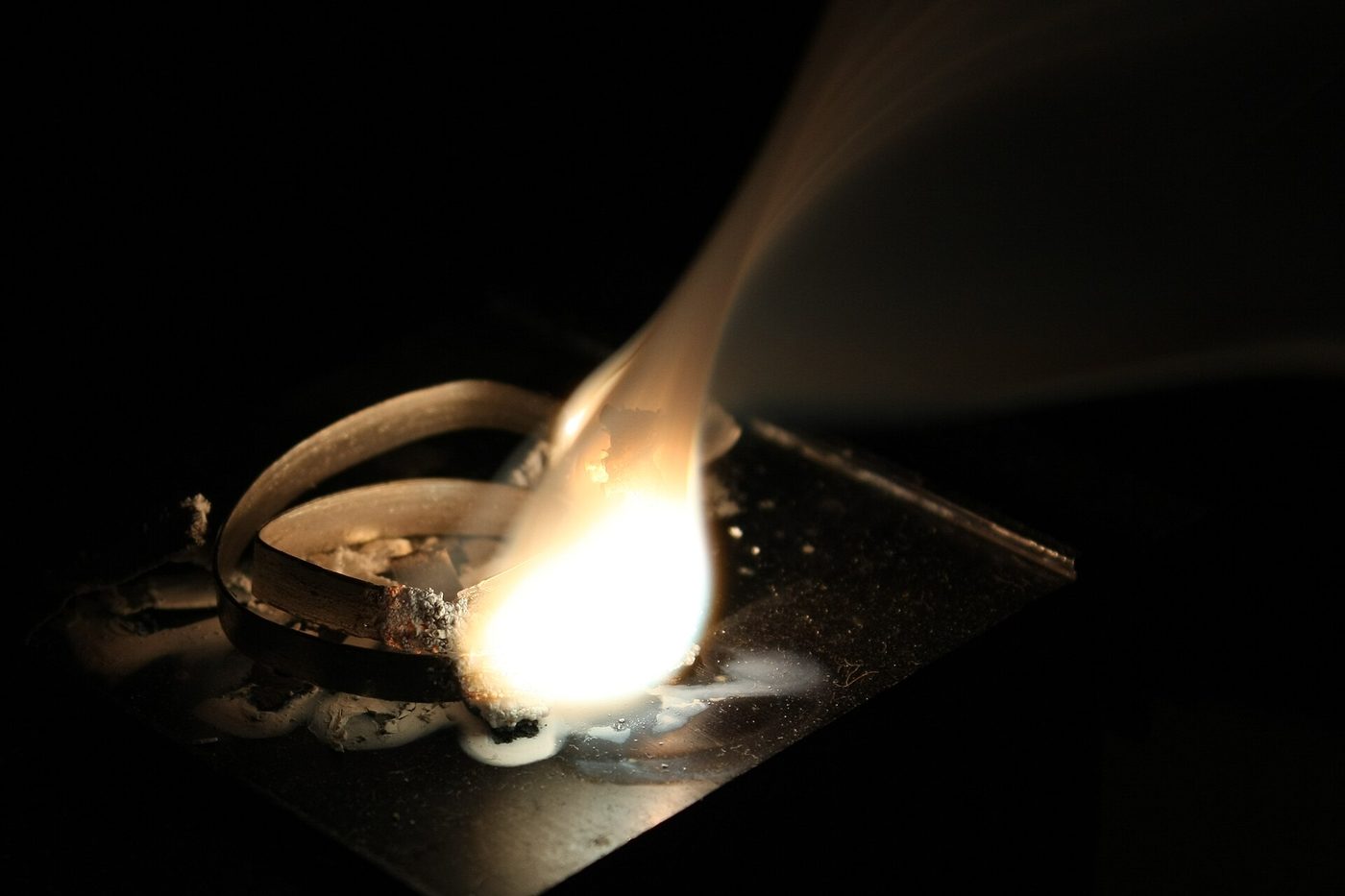
- A gas joins, so the mass goes up. When magnesium burns, oxygen atoms from the air join on. The white magnesium oxide weighs more than the magnesium did.
In a closed system, where nothing can get in or out, the mass stays exactly the same. Put a bung in the flask (with small amounts, so the pressure stays low) and the reading does not change at all. An open flask is an open system: gases can escape from it or get into it.
How do you show that magnesium gains mass when it burns?
- Weigh an empty crucible (a small heat-proof pot) with its lid.
- Add a coil of clean magnesium ribbon and weigh again.
- Heat strongly. Every so often, lift the lid a little with tongs to let air in, then put it back.
- When the magnesium no longer glows, let it cool and weigh the crucible, lid and white powder.
| Reading | Mass (g) |
|---|---|
| Crucible and lid | 24.62 |
| With magnesium | 24.86 |
| After heating | 25.02 |
Mass of magnesium = 24.86 g − 24.62 g = 0.24 g
Mass of magnesium oxide = 25.02 g − 24.62 g = 0.40 g
Mass of oxygen that joined = 0.40 g − 0.24 g = 0.16 g
The product is heavier because it contains the oxygen as well as the magnesium. If smoke had escaped, the result would have come out too small.
How do you work out a missing mass?
Add up what you know on each side and use the fact that the totals are equal.
Heating 10.0 g of calcium carbonate leaves 5.6 g of calcium oxide. What mass of carbon dioxide is given off?
calcium carbonate → calcium oxide + carbon dioxide
10.0 g = 5.6 g + mass of carbon dioxide
mass of carbon dioxide = 10.0 g − 5.6 g = 4.4 g
Stretch Elements always react in the same proportions. If 0.24 g of magnesium makes 0.40 g of magnesium oxide, then twice as much, 0.48 g, makes 0.80 g, and 2.4 g makes 4.0 g. Scaling results like this is how chemists worked out formulae such as MgO from their weighings.
Written to the KS3 national curriculum. Last changed 14 November 2026.
Key words
Say them, spell them, use them in an answer.
- conservation of mass
- reactants
- products
- closed system
- open system
- crucible
- magnesium oxide
- carbon dioxide
- balance
Common misconception
Often said“When magnesium burns it should get lighter, because burning uses things up.”
In factIt gets heavier. Oxygen atoms from the air join the magnesium to make magnesium oxide, so the product has the mass of the magnesium plus the mass of the oxygen. Things only seem to get lighter when a product is a gas that escapes.
Did you know?
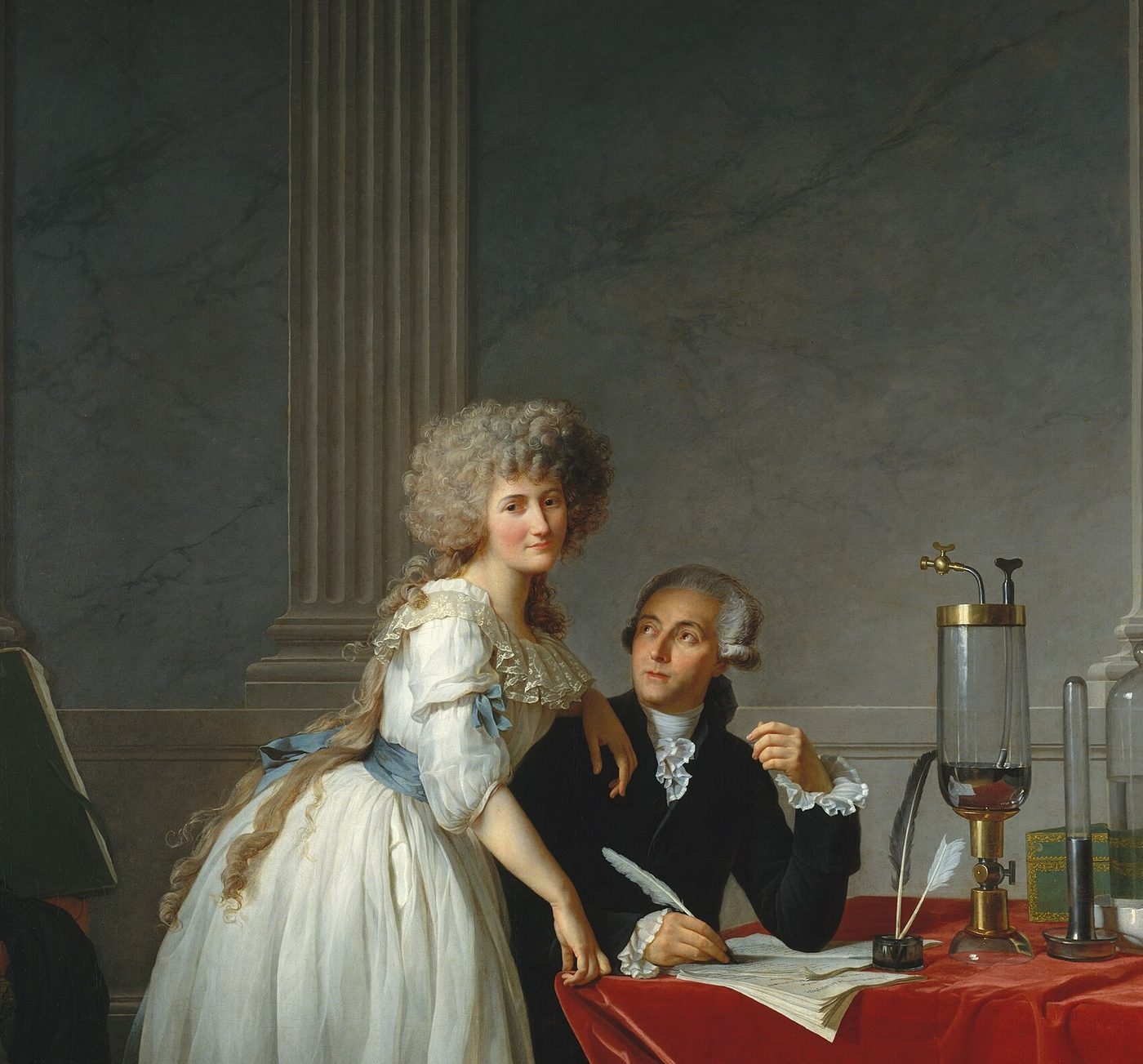
Antoine Lavoisier
The French chemist Antoine Lavoisier weighed reactions carefully in sealed glass vessels and set out the law of conservation of mass in his book of 1789. His wife, Marie-Anne, worked beside him, recording results and drawing the apparatus. He was executed in 1794, during the French Revolution.
Photo: Jacques-Louis David (1788), the Metropolitan Museum of Art, CC0, via Wikimedia Commons
Try 5 questions
Quick questions on conservation of mass, marked as you go. Each one explains the answer.
Question 1 of 5
Magnesium oxide weighs less than the magnesium it was made from.
Choose an answer. Each question explains itself.
The homework sheet
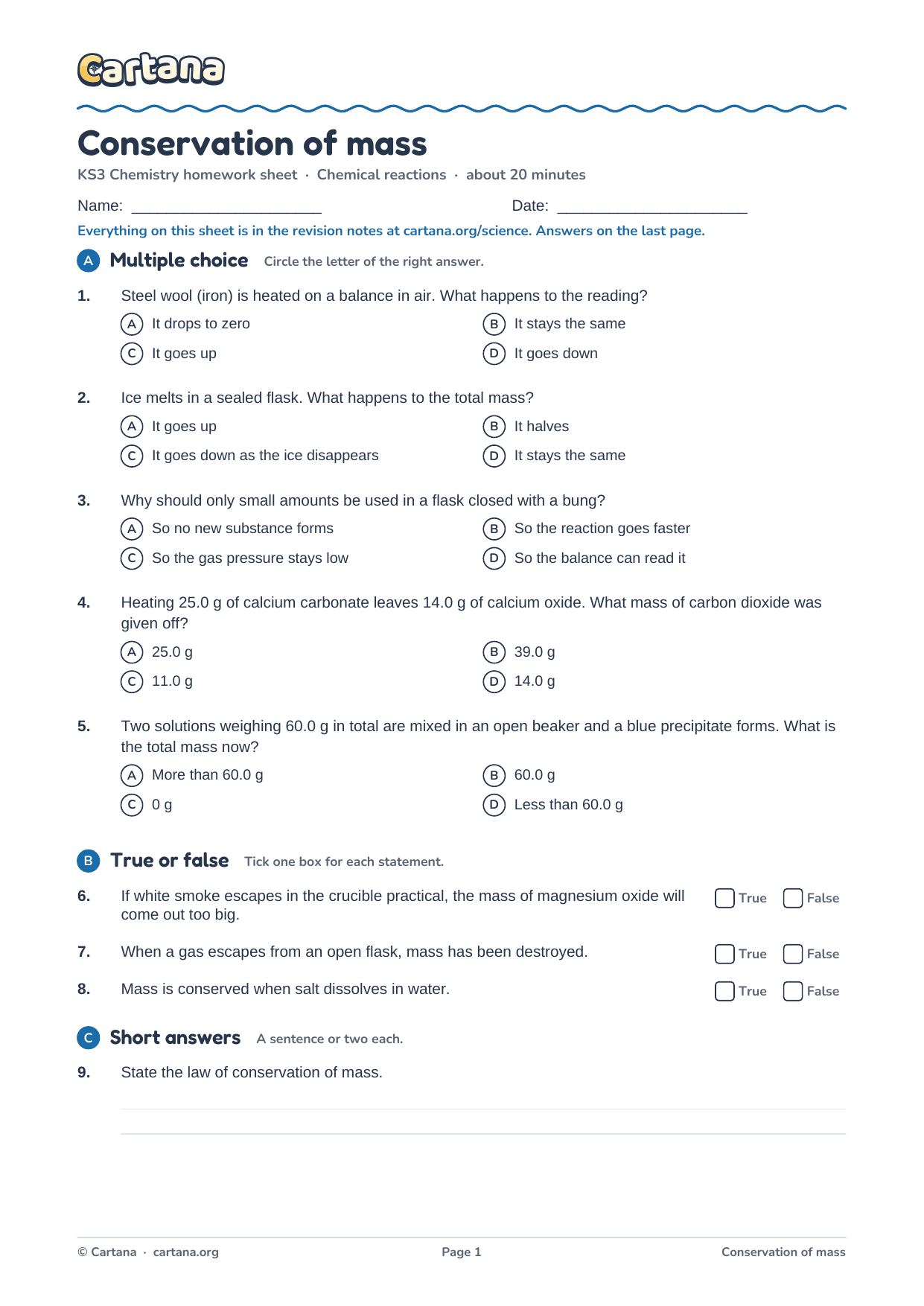
About twenty minutes. Everything on it is in the notes above; the answers are on the last page.
Free homework sheet
Conservation of mass homework sheet
17 questions, about twenty minutes, with the answers on the last page: multiple choice, true or false, short answers, key words to define and one to explain in full.
KS3 Chemical reactions
Revised the whole unit?
When every topic in chemical reactions is done, two different papers test the whole unit, each with its own mark scheme.


 Watch the trailer · 1:06
New from Cartana · Beta test 1–31 December
Revision that feels like an adventure
Cartana is our KS3 learning adventure: sail between islands, answer quick-fire questions and battle bosses. It starts with science, with maths on the way, and launches in 2027. This December a small group of testers gets to play it first.
In the Cartana adventure, every science unit is an island to explore. The island for chemical reactions is being built.
- Play the game before its official release
- Help us build it with your feedback
- Earn exclusive in-game items in return
More in this unit
Chemical reactions
- 1Chemical and physical changesChemical reactions as the rearrangement of atoms, the signs of a reaction, reactants and products, and physical changes
- 2Word and symbol equationsWord equations, state symbols, symbol equations and balancing simple equations by counting atoms
- 4Combustion and oxidationNextThe fire triangle, oxidation of metals and non-metals, burning hydrocarbons and testing for water and carbon dioxide
- 5Thermal decompositionOne substance breaking down on heating, metal carbonates, copper carbonate, the limewater test and comparing carbonates
- 6Energy changes and catalystsExothermic and endothermic reactions, measuring the temperature change, and what catalysts do