
KS3 Chemistry · Years 7 to 9
Acids & alkalis
Acids and alkalis for KS3 chemistry: everyday and laboratory acids and alkalis and how to handle them safely, indicators and the pH scale, neutralisation, the reactions of acids with metals, and how to name and make salts such as copper sulfate.
- 5 topics
- 22 min of notes
- 5 homework sheets
- 2 test papers
The topics, in order
Each has its revision notes, key words, a common misconception and quick questions; the homework sheets are free to print.
- 1Acids and alkalisEveryday and laboratory acids and alkalis, bases and alkalis, concentrated and dilute solutions, hazard symbols and working safely5 min read5 questionsHomework sheet
- 2Indicators and pHThe pH scale from 0 to 14, litmus and universal indicator, pH meters, strong and weak acids and alkalis, and making a red cabbage indicator4 min read5 questionsHomework sheet
- 3NeutralisationAcid + alkali → salt + water, following the pH as alkali is added to an acid, and uses of neutralisation for indigestion, soil, teeth and stings4 min read5 questionsHomework sheet
- 4Acids and metalsMetal + acid → salt + hydrogen, the squeaky pop test, which metals react with dilute acids, and naming the salt from the acid4 min read5 questionsHomework sheet
- 5Making saltsNaming salts, acids with metal oxides and metal carbonates, the test for carbon dioxide, and making copper sulfate crystals step by step5 min read5 questionsHomework sheet
Test the whole unit
When the topics are revised, two different papers test the whole unit, each marked the way an exam would be: sit Paper 1, go over what went wrong, then sit Paper 2.
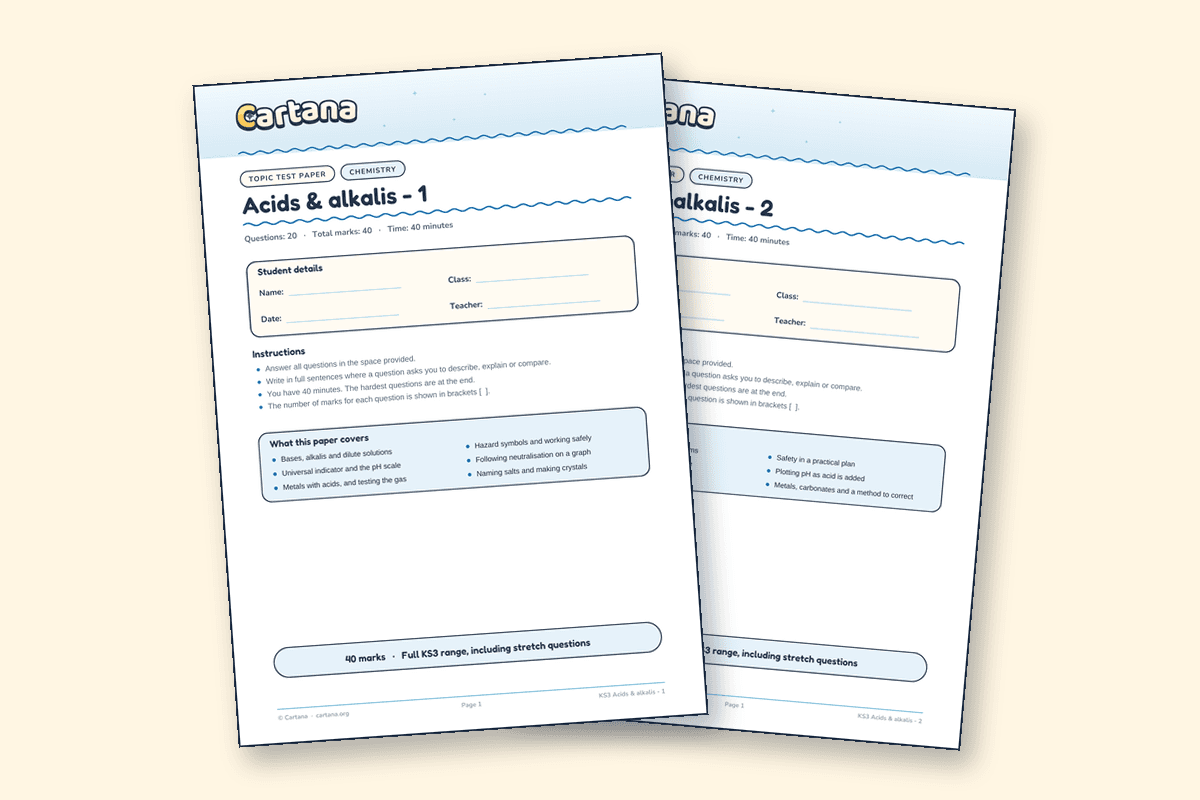
Two papers, one price
KS3 Acids & alkalis Test Papers with Mark Schemes (2 Papers)
Two different test papers on the same unit, each with its own mark scheme, for £1.99 together.
- 2 different papers
- 2 × 40 marks
- 40 minutes each
- 2 mark schemes, 27 pages
Also in the Chemistry Pack: 16 papers for £9.99, save 37%.
Did you know?
- Your stomach makes hydrochloric acid, which can reach about pH 1.5. A coat of mucus on the stomach wall stops the acid from digesting the stomach itself.
- Turmeric, the yellow spice in curry, is an indicator: it turns red-brown in alkalis. That is why a yellow curry stain on a white shirt can turn red when you scrub it with soap.
- Sea water is slightly alkaline, at about pH 8.1. As the oceans take up carbon dioxide from the air, its pH has fallen by about 0.1 since the Industrial Revolution began, a change called ocean acidification.
- Baking powder is a mixture of baking soda (sodium hydrogencarbonate) and a dry, weak acid. When the cake mix gets wet they react and give off bubbles of carbon dioxide, which make the cake rise.
More chemistry units
- Particles & states of matter 5 topics
- Atoms, elements & compounds 5 topics
- Separating mixtures 5 topics
- Chemical reactions 6 topics
- The periodic table 5 topics
- Metals & materials 5 topics
- Earth & atmosphere 7 topics
All of KS3 science · Every homework sheet · Test papers and packs
 Watch the trailer · 1:06
New from Cartana · Beta test 1–31 December
Revision that feels like an adventure
Cartana is our KS3 learning adventure: sail between islands, answer quick-fire questions and battle bosses. It starts with science, with maths on the way, and launches in 2027. This December a small group of testers gets to play it first.
In the Cartana adventure, every science unit is an island to explore. The island for acids & alkalis is being built.
- Play the game before its official release
- Help us build it with your feedback
- Earn exclusive in-game items in return