
KS3 Chemistry · Acids & alkalis
Acids and alkalis
- Acids and alkalis at home and in the laboratory, and where each sits on the pH scale
- The difference between a base and an alkali, defined by neutralisation
- What concentrated and dilute mean, with a particle picture
- Hazard symbols (corrosive and irritant) and how to work safely
- 5 min read
- 5 quick questions
- Free homework sheet
- Years 7 to 9
Revision notes
Acids and alkalis are chemical opposites. An acid is a substance whose solution in water has a pH below 7; an alkali dissolves to give a pH above 7. Mixed in the right amounts, they cancel each other out.
What are acids and alkalis?
Acids are all around you. Lemons and oranges contain citric acid, vinegar contains ethanoic acid, fizzy drinks contain carbonic acid, and your stomach makes hydrochloric acid to help digest food. Acids in food taste sour, but you must never taste anything in a laboratory to find out.
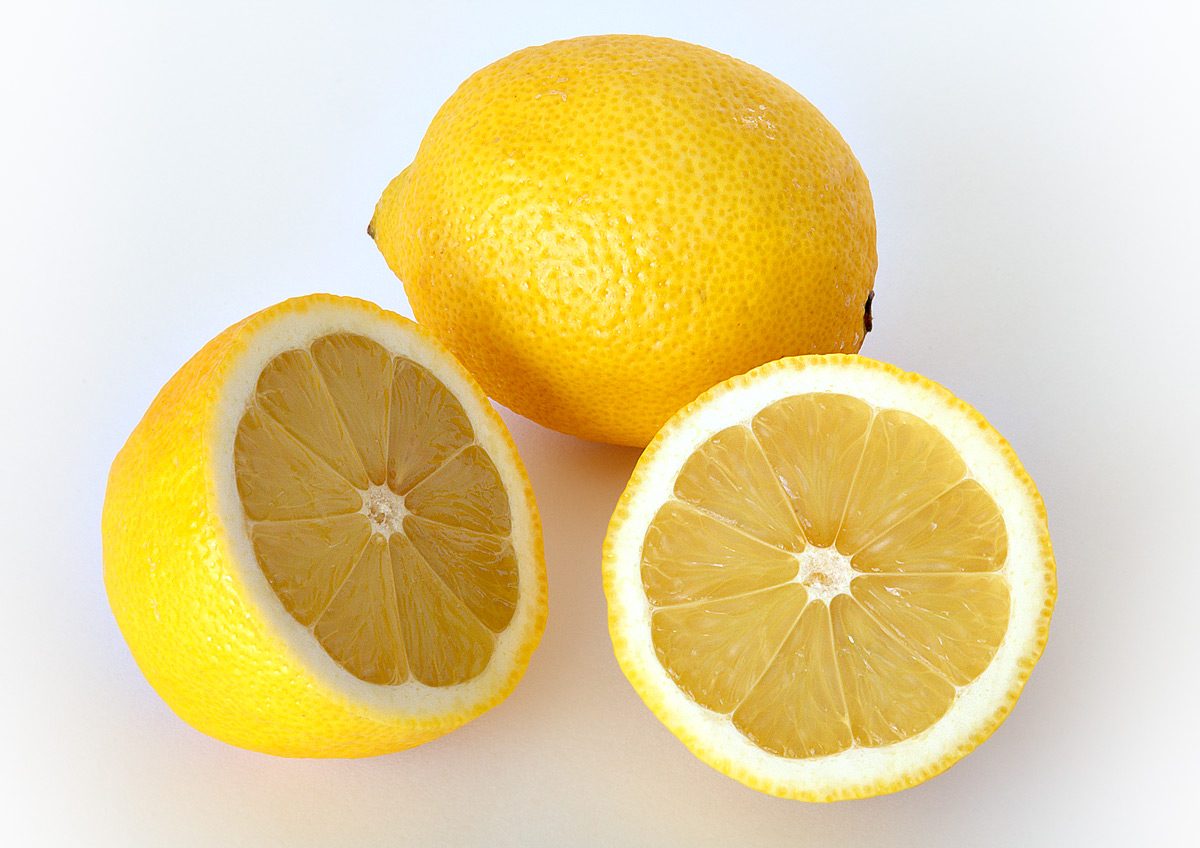
Alkalis are the chemical opposites of acids. Soap, bleach, oven cleaner and washing soda are alkaline. Alkaline solutions often feel soapy or slippery on the skin, because the alkali starts to react with the natural oils in your skin.
| Acids | Alkalis | |
|---|---|---|
| At home | Lemon juice, vinegar, cola | Soap, bleach, oven cleaner |
| In the lab | Hydrochloric acid (HCl), sulfuric acid (H2SO4), nitric acid (HNO3) | Sodium hydroxide (NaOH), calcium hydroxide (limewater) |
| pH | Below 7 | Above 7 |
How acidic or alkaline something is gets measured on the pH scale, with indicators (see indicators and pH). A solution that is neither acidic nor alkaline, such as pure water, is neutral: its pH is exactly 7.
What is the difference between a base and an alkali?
A base is any substance that reacts with an acid and cancels it out. That reaction is called neutralisation, and it is how chemists define these substances: an acid is neutralised by a base, and a base neutralises an acid.
Metal oxides (such as copper oxide), metal hydroxides (such as sodium hydroxide) and metal carbonates (such as calcium carbonate) are all bases. Most of them do not dissolve in water. An alkali is a base that dissolves in water. So every alkali is a base, but not every base is an alkali: copper oxide neutralises acids but does not dissolve, so it is a base and not an alkali. (More on oxides in metals and non-metals.)
What do concentrated and dilute mean?
An acid in the lab is a solution: the acid is dissolved in water. A concentrated solution has a lot of acid in a small amount of water. A dilute solution has only a little acid in a lot of water. Adding water makes a solution more dilute, and a more dilute acid or alkali is less dangerous. School experiments almost always use dilute solutions.
Are acids and alkalis dangerous?
Many can be. Bottles carry hazard symbols: red diamonds with a black picture that warn you of the danger.
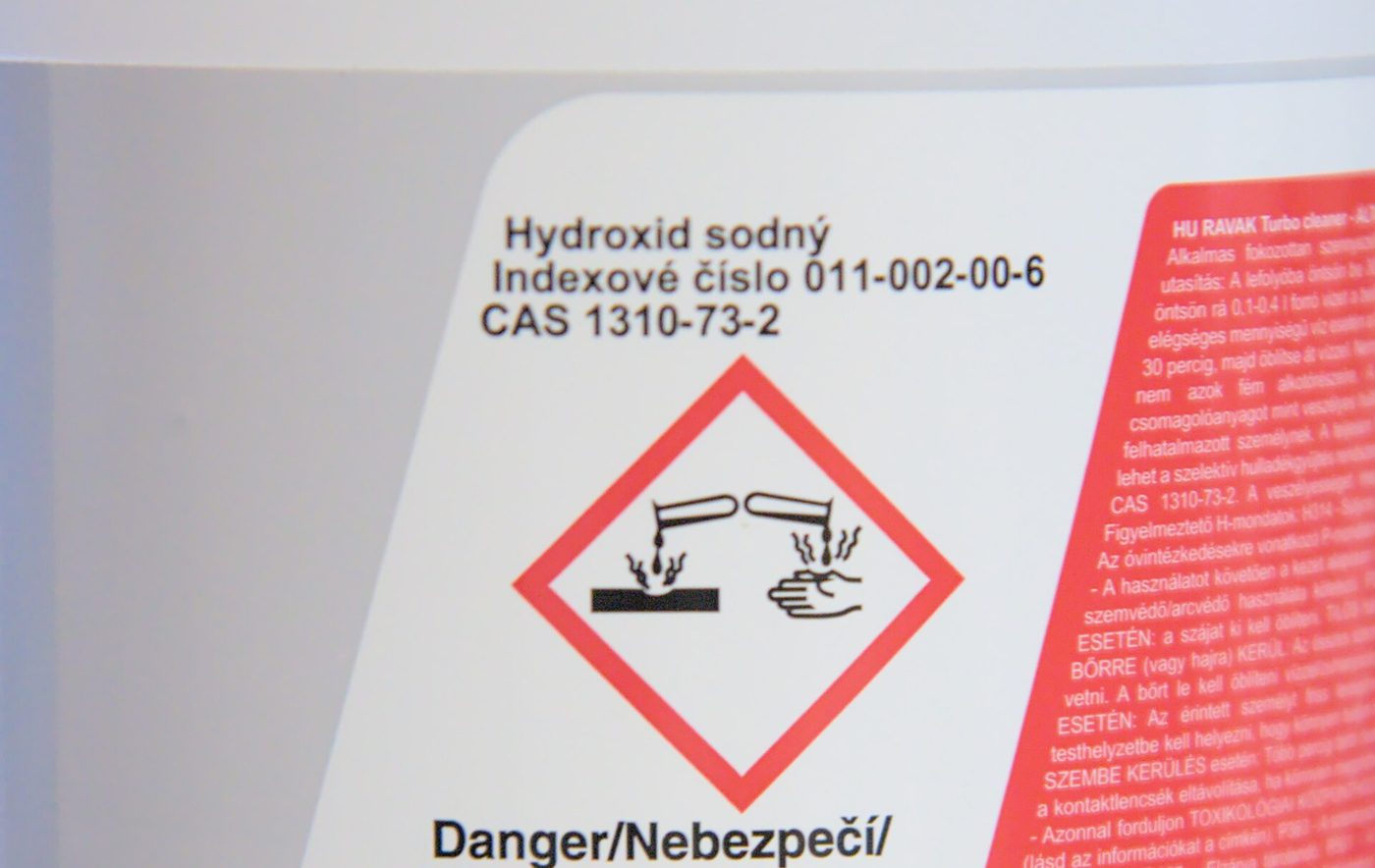
- A corrosive substance attacks and destroys living tissue, such as skin and eyes, and eats into many metals and stone. Concentrated acids are corrosive, and so are alkalis such as sodium hydroxide solution, even when they are fairly dilute.
- An irritant makes skin or eyes red, sore or itchy. Many dilute acids and alkalis are irritants.
Alkalis do especially bad damage to eyes.
How do you work safely with acids and alkalis?
- Wear eye protection the whole time, until everything is cleared away.
- Use the most dilute solution that will do the job, and only small amounts.
- Stand up while you work, so you can step back quickly from a spill, and tell your teacher about any spill straight away.
- If any gets on your skin, wash it off with plenty of cold running water. If any gets in your eye, rinse it under running water for at least ten minutes and get help.
- Diluting a concentrated acid is a job for a teacher: the acid is added slowly to the water, never water to the acid, because the mixture gets hot enough to spit.
Stretch Look at the formulae of the laboratory acids: HCl, H2SO4, HNO3. Every one contains hydrogen. In water, an acid releases hydrogen ions, H+, and these are what make a solution acidic. An alkali such as sodium hydroxide, NaOH, releases hydroxide ions, OH−, which make a solution alkaline.
Written to the KS3 national curriculum. Last changed 14 November 2026.
Key words
Say them, spell them, use them in an answer.
- acid
- alkali
- neutral
- base
- neutralisation
- concentrated
- dilute
- hazard symbol
- corrosive
- irritant
Common misconception
Often said“Acids are the dangerous ones. Alkalis are safe.”
In factAlkalis can be just as dangerous as acids. Oven cleaner and drain cleaner contain sodium hydroxide, which is corrosive, and alkalis do especially bad damage to eyes. Meanwhile many acids are safe to eat, such as the citric acid in oranges and the ethanoic acid in vinegar.
Did you know?
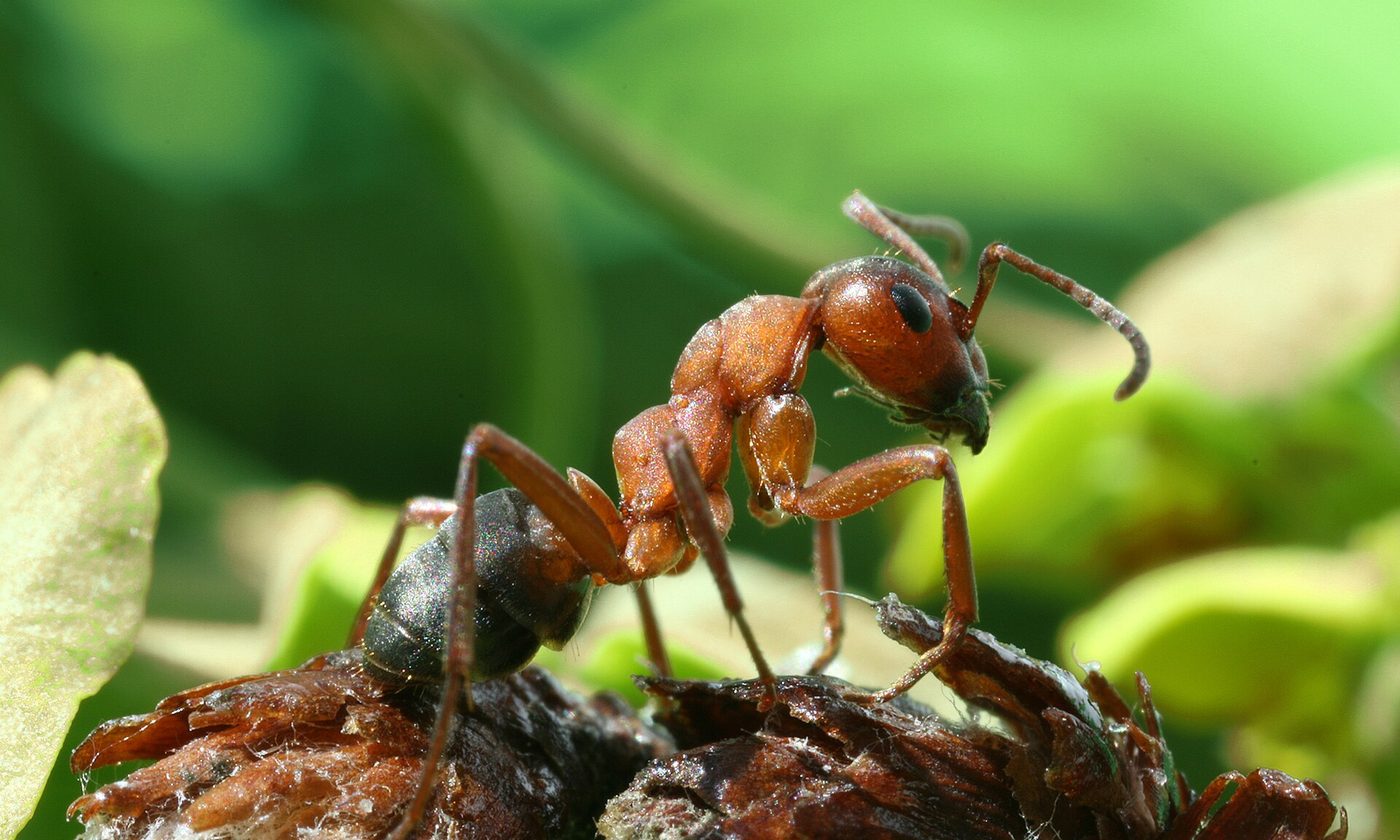
Wood ants
Wood ants defend their nests by spraying formic acid at attackers. The acid takes its name from formica, the Latin word for ant, and in 1671 the English naturalist John Ray described getting it out of ants by distilling large numbers of them.
Photo: Richard Bartz, Munich Makro Freak, CC BY-SA 2.5, via Wikimedia Commons
Try 5 questions
Quick questions on acids and alkalis, marked as you go. Each one explains the answer.
Question 1 of 5
Which pair are both laboratory acids?
Choose an answer. Each question explains itself.
The homework sheet
About twenty minutes. Everything on it is in the notes above; the answers are on the last page.
Free homework sheet
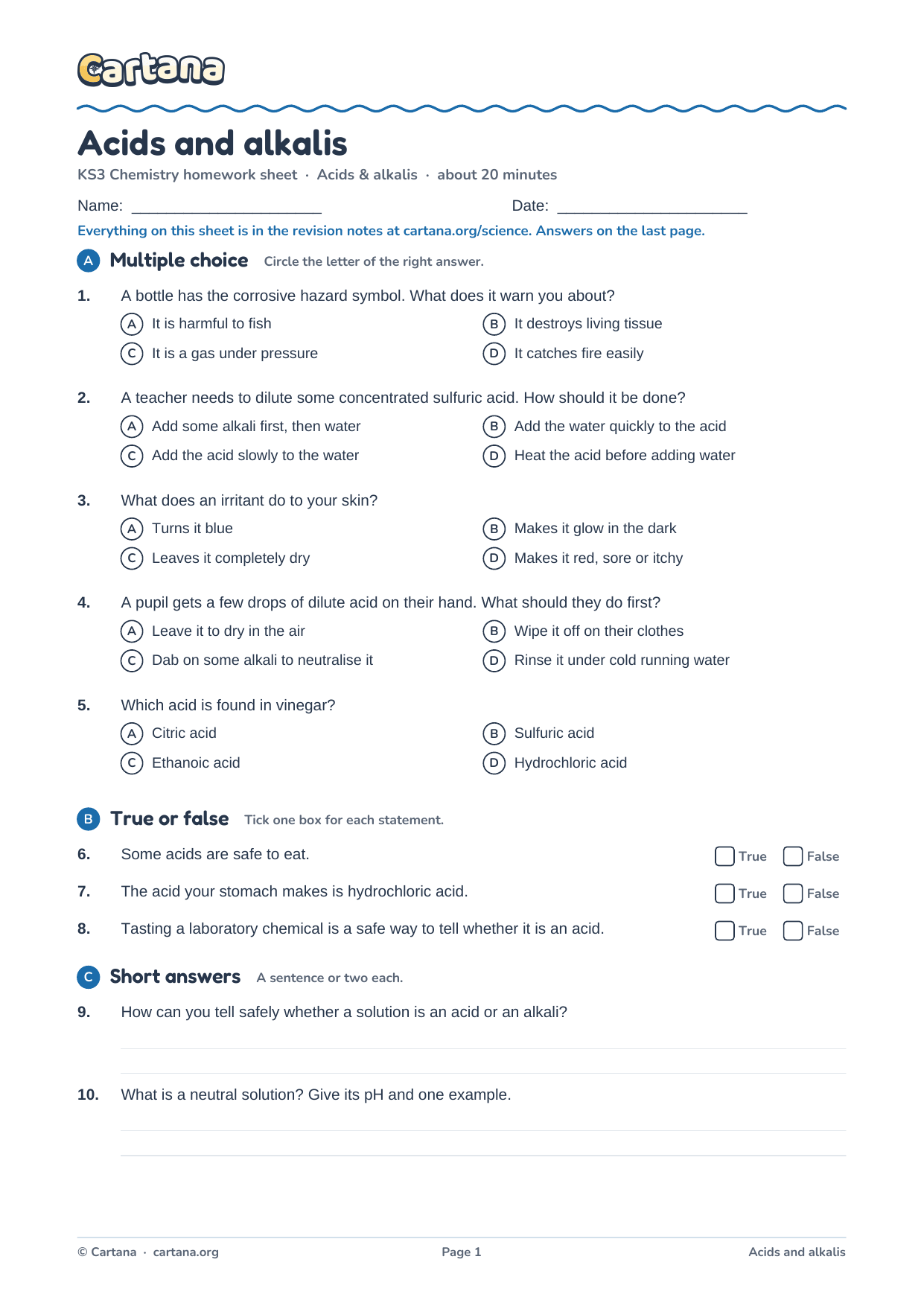
Acids and alkalis homework sheet
17 questions, about twenty minutes, with the answers on the last page: multiple choice, true or false, short answers, key words to define and one to explain in full.
KS3 Acids & alkalis
Revised the whole unit?
When every topic in acids & alkalis is done, two different papers test the whole unit, each with its own mark scheme.


 Watch the trailer · 1:06
New from Cartana · Beta test 1–31 December
Revision that feels like an adventure
Cartana is our KS3 learning adventure: sail between islands, answer quick-fire questions and battle bosses. It starts with science, with maths on the way, and launches in 2027. This December a small group of testers gets to play it first.
In the Cartana adventure, every science unit is an island to explore. The island for acids & alkalis is being built.
- Play the game before its official release
- Help us build it with your feedback
- Earn exclusive in-game items in return
More in this unit
Acids & alkalis
- 2Indicators and pHNextThe pH scale from 0 to 14, litmus and universal indicator, pH meters, strong and weak acids and alkalis, and making a red cabbage indicator
- 3NeutralisationAcid + alkali → salt + water, following the pH as alkali is added to an acid, and uses of neutralisation for indigestion, soil, teeth and stings
- 4Acids and metalsMetal + acid → salt + hydrogen, the squeaky pop test, which metals react with dilute acids, and naming the salt from the acid
- 5Making saltsNaming salts, acids with metal oxides and metal carbonates, the test for carbon dioxide, and making copper sulfate crystals step by step