
KS3 Physics · Years 7 to 9
Forces
Forces for KS3 physics: what a force is and how to measure it, balanced and unbalanced forces, friction and drag, stretching springs and Hooke's law, moments and levers, and gravity, mass and weight.
- 6 topics
- 22 min of notes
- 6 homework sheets
- 2 test papers
The topics, in order
Each has its revision notes, key words, a common misconception and quick questions; the homework sheets are free to print.
- 1Introduction to forcesPushes and pulls, contact and non-contact forces, newtons, force arrows and interaction pairs4 min read5 questionsHomework sheet
- 2Balanced and unbalanced forcesAdding forces along a line, the resultant force, and what balanced and unbalanced forces do3 min read5 questionsHomework sheet
- 3Friction and dragFriction between surfaces, air and water resistance, streamlining, and investigating friction4 min read5 questionsHomework sheet
- 4Stretching and squashingDeforming objects, extension, the spring practical, Hooke's law and the energy stored in a spring4 min read5 questionsHomework sheet
- 5MomentsTurning forces, moment = force × distance, the principle of moments and levers4 min read5 questionsHomework sheet
- 6Gravity, mass and weightMass and weight, weight = mass × g, weight on the Moon, gravity and the three non-contact forces4 min read5 questionsHomework sheet
Test the whole unit
When the topics are revised, two different papers test the whole unit, each marked the way an exam would be: sit Paper 1, go over what went wrong, then sit Paper 2.
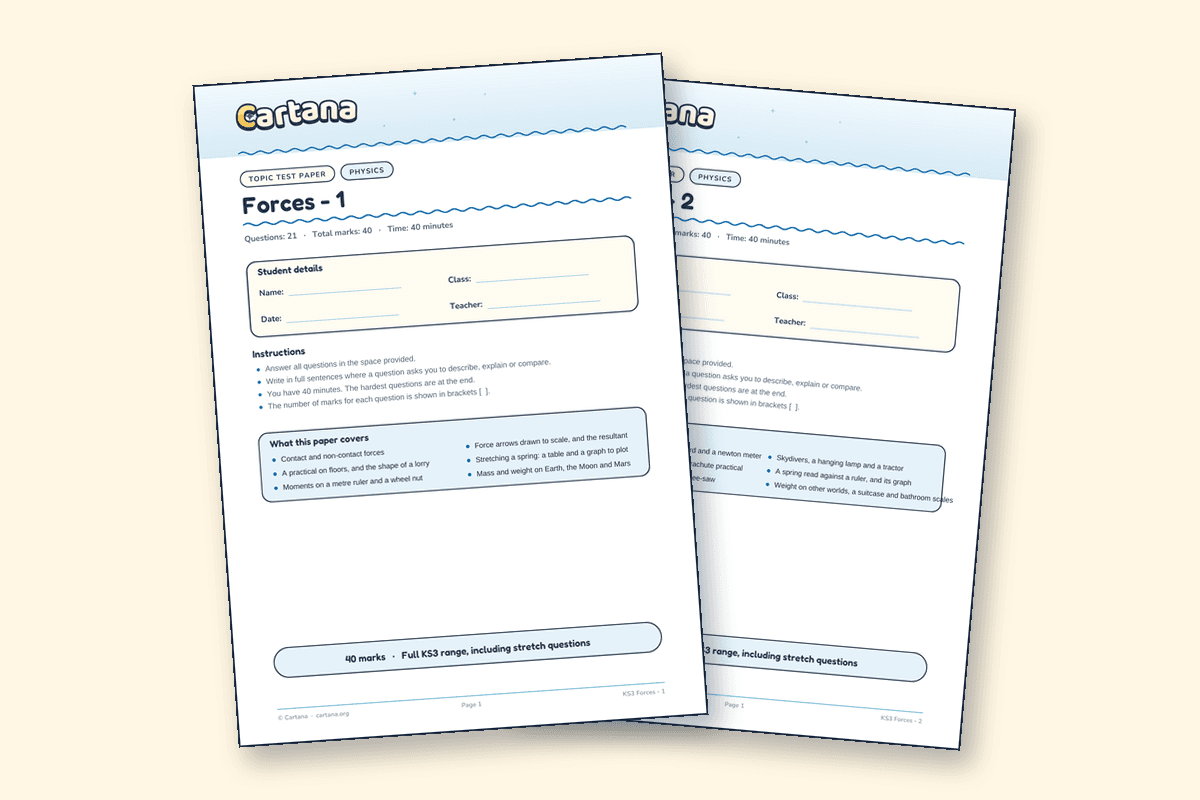
Two papers, one price
KS3 Forces Test Papers with Mark Schemes (2 Papers)
Two different test papers on the same unit, each with its own mark scheme, for £1.99 together.
- 2 different papers
- 2 × 40 marks
- 40 minutes each
- 2 mark schemes, 27 pages
Also in the Physics Pack: 14 papers for £8.99, save 35%.
Did you know?
- One newton is about the weight of a small apple of 100 g, a fitting size for a unit named after Isaac Newton.
- A gecko can run straight up a pane of glass. Each of its feet carries hundreds of thousands of tiny hairs, and the weak forces between their tips and the glass add up to enough to hold it on.
- In a lift that starts moving upwards, bathroom scales read more than usual: the floor has to push up harder than your weight to speed you up. As the lift slows at the top, they read less.
- Voyager 1 was launched in 1977 and is still travelling out through space, about 26 billion km away, with no engine pushing it. In space there is almost nothing to slow it down, so it keeps going.
More physics units
- Motion & pressure 6 topics
- Energy 6 topics
- Electricity & magnetism 5 topics
- Sound & waves 5 topics
- Light 5 topics
- Space 5 topics
All of KS3 science · Every homework sheet · Test papers and packs
 Watch the trailer · 1:06
New from Cartana · Beta test 1–31 December
Revision that feels like an adventure
Cartana is our KS3 learning adventure: sail between islands, answer quick-fire questions and battle bosses. It starts with science, with maths on the way, and launches in 2027. This December a small group of testers gets to play it first.
In the Cartana adventure, every science unit is an island to explore. The island for forces is being built.
- Play the game before its official release
- Help us build it with your feedback
- Earn exclusive in-game items in return