
KS3 Physics · Forces
Stretching and squashing
- Deforming objects: stretching, squashing, elastic and plastic
- Working out the extension of a spring
- The spring practical and the force-extension graph
- Hooke's law, its limit, and the energy stored in a spring
- 4 min read
- 5 quick questions
- Free homework sheet
- Years 7 to 9
Revision notes
A force can stretch or squash a spring, changing its length. Hooke's law says the extension (how much longer the spring gets) is proportional to the force, up to a limit.
What happens when you stretch or squash something?
Forces can deform an object: stretch it, squash it (compression), bend it or twist it. To stretch a spring you need two forces pulling in opposite directions: the hook it hangs from pulls up while the weight on it pulls down.
- Elastic deformation: the object goes back to its original shape when the force is removed, like a spring or a rubber band.
- Plastic deformation: it stays changed, like modelling clay or a bent paper clip.
What is extension?
Measure both lengths in the same unit, usually centimetres (cm).
How do you investigate stretching a spring?
- Hang the spring from a clamp, with a metre ruler upright beside it. Read the pointer's position with no load.
- Add a 100 g mass (a weight of 1 N) and read the pointer again, at eye level.
- Keep adding 1 N at a time, up to about 6 N. Work out the extension for each force.
- Plot extension against force. Wear eye protection and keep your feet clear of the masses.
What is Hooke's law?
For a spring, the extension is proportional to the force: double the force and the extension doubles. The graph of extension against force is a straight line through the origin. This is Hooke's law, after Robert Hooke, who described it in the 1670s.
A spring obeys Hooke's law. A force of 2 N gives it an extension of 3 cm. What is its extension with 6 N?
6 N is three times 2 N, so the extension is three times as big.
extension = 3 × 3 cm = 9 cm
It holds only up to the limit of proportionality. Past it the graph curves and the spring stretches more for each newton. Stretch it far enough and it passes its elastic limit: it stays longer for good. A rubber band never gives a straight line, so it does not obey Hooke's law.
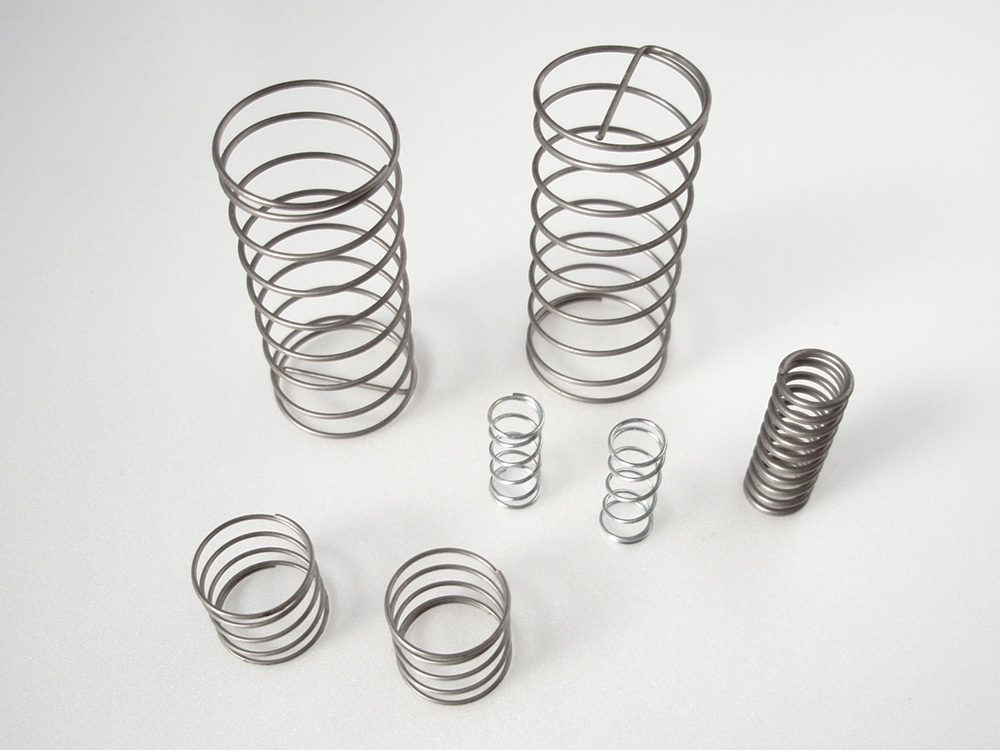
What energy is stored in a stretched spring?
Stretching or squashing a spring takes a force moving through a distance: work is done on it. That energy is stored in the spring's elastic store while it stays stretched, and released when it springs back, as in a catapult, a bow, a trampoline or a wind-up toy. The more it is stretched, the more energy it stores. A spring stretched past its elastic limit does not give back all the work done on it: some has warmed the metal.
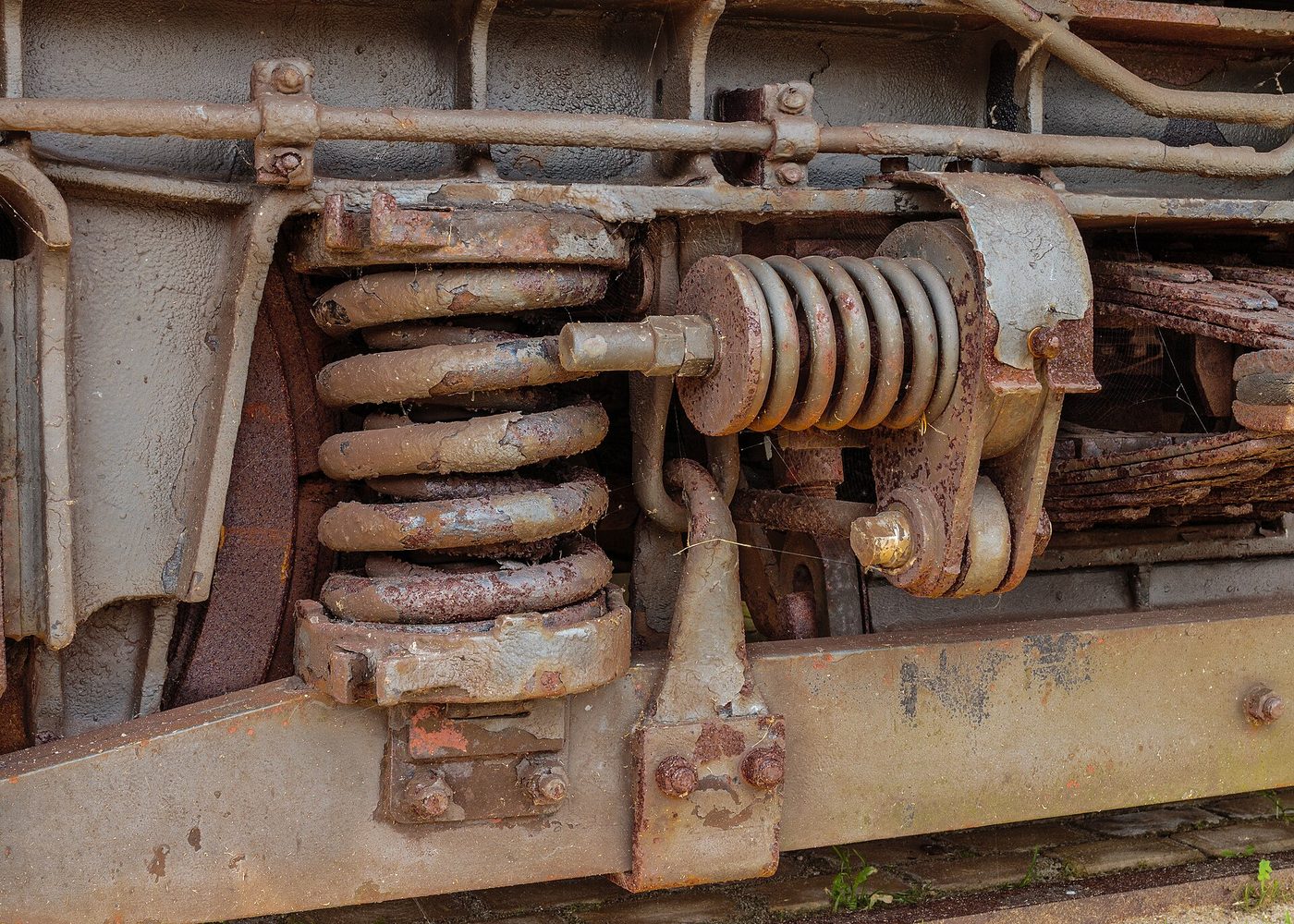
Stretch The energy stored is the area under the force-extension graph. Up to the limit it is a triangle: energy = ½ × force × extension, with the extension in metres. At 4 N and 8 cm (0.08 m): ½ × 4 × 0.08 = 0.16 J.
Written to the KS3 national curriculum. Last changed 13 November 2026.
Key words
Say them, spell them, use them in an answer.
- deform
- compression
- elastic
- plastic
- extension
- Hooke's law
- proportional
- limit of proportionality
- elastic limit
- elastic store
- work done
Common misconception
Often said“The extension is how long the spring is.”
In factThe extension is how much longer the spring gets: stretched length minus original length. A 5 cm spring stretched to 9 cm has an extension of 4 cm, not 9 cm. Plot lengths instead of extensions and the line misses the origin.
Did you know?
Hooke's secret code
In 1676 Robert Hooke published his law about springs as a jumbled-up anagram of letters, so that nobody could steal it. Two years later he revealed the answer, in Latin: ut tensio, sic vis, "as the extension, so the force".
Try 5 questions
Quick questions on stretching and squashing, marked as you go. Each one explains the answer.
Question 1 of 5
The further a spring is stretched, the more energy it stores.
Choose an answer. Each question explains itself.
The homework sheet
About twenty minutes. Everything on it is in the notes above; the answers are on the last page.
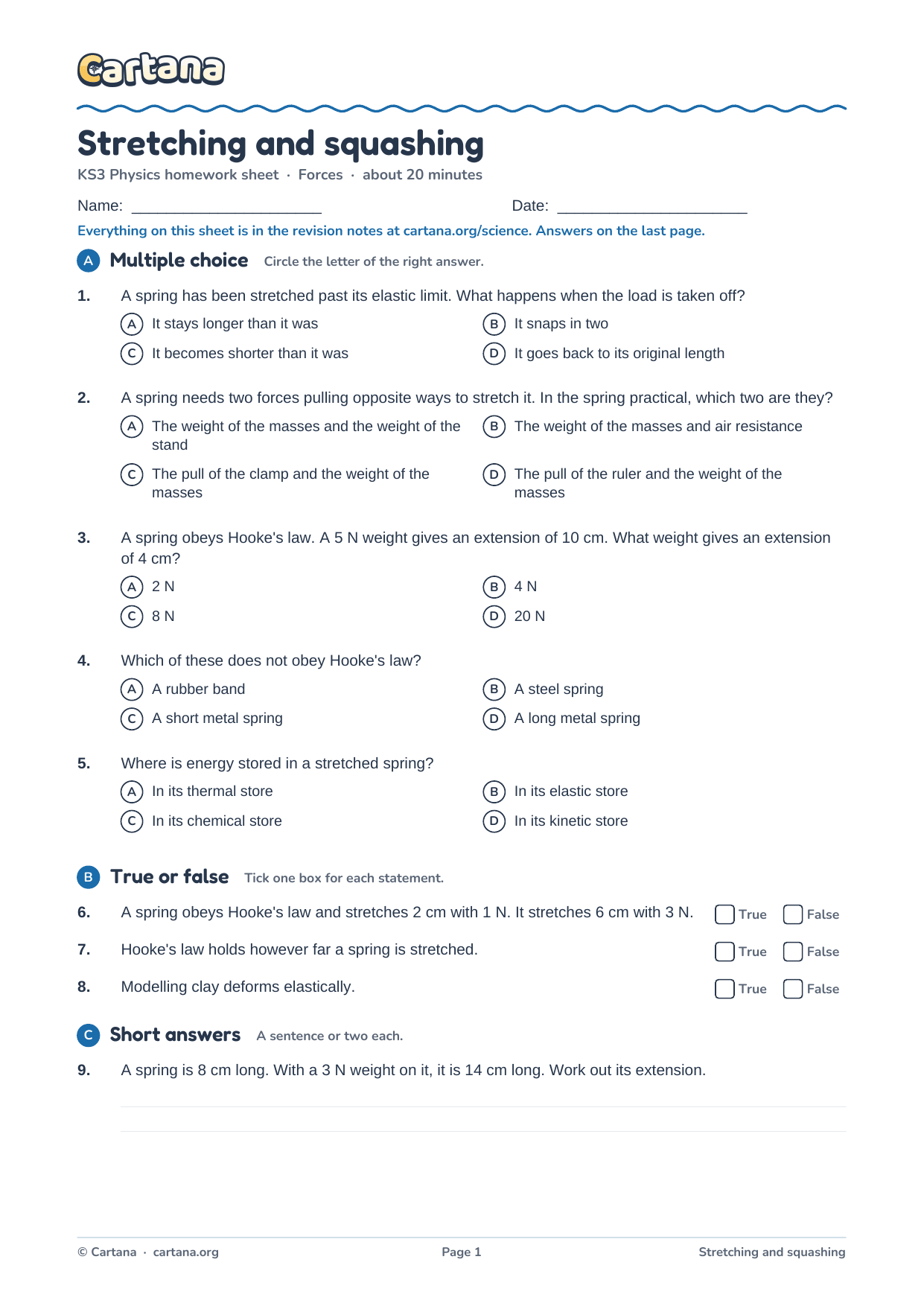
Free homework sheet
Stretching and squashing homework sheet
17 questions, about twenty minutes, with the answers on the last page: multiple choice, true or false, short answers, key words to define and one to explain in full.
KS3 Forces
Revised the whole unit?
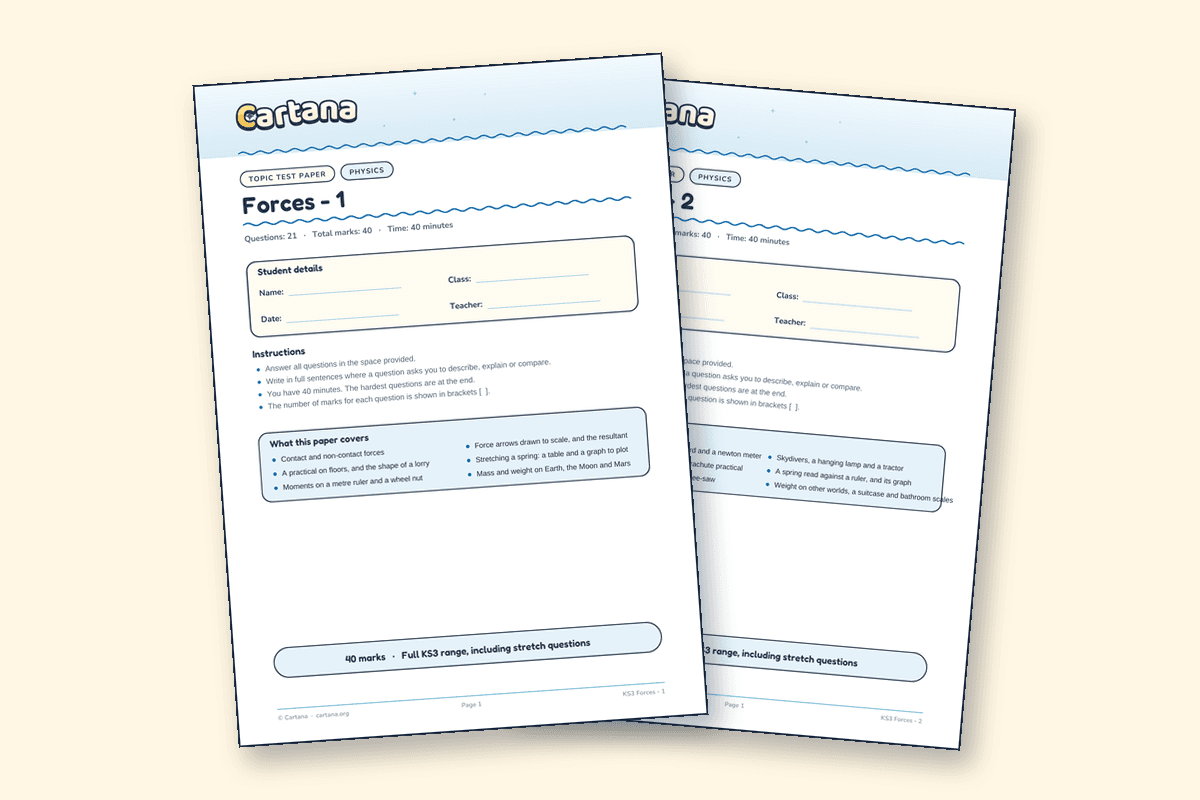
When every topic in forces is done, two different papers test the whole unit, each with its own mark scheme.


 Watch the trailer · 1:06
New from Cartana · Beta test 1–31 December
Revision that feels like an adventure
Cartana is our KS3 learning adventure: sail between islands, answer quick-fire questions and battle bosses. It starts with science, with maths on the way, and launches in 2027. This December a small group of testers gets to play it first.
In the Cartana adventure, every science unit is an island to explore. The island for forces is being built.
- Play the game before its official release
- Help us build it with your feedback
- Earn exclusive in-game items in return
More in this unit
Forces
- 1Introduction to forcesPushes and pulls, contact and non-contact forces, newtons, force arrows and interaction pairs
- 2Balanced and unbalanced forcesAdding forces along a line, the resultant force, and what balanced and unbalanced forces do
- 3Friction and dragFriction between surfaces, air and water resistance, streamlining, and investigating friction
- 5MomentsNextTurning forces, moment = force × distance, the principle of moments and levers
- 6Gravity, mass and weightMass and weight, weight = mass × g, weight on the Moon, gravity and the three non-contact forces