
KS3 Chemistry · Years 7 to 9
Metals & materials
Metals and materials for KS3 chemistry: how metals react with oxygen, water and acids, the reactivity series, displacement reactions, getting metals out of their ores with carbon, and the ceramics, polymers and composites we choose for different jobs.
- 5 topics
- 22 min of notes
- 5 homework sheets
- 2 test papers
The topics, in order
Each has its revision notes, key words, a common misconception and quick questions; the homework sheets are free to print.
- 1Reactions of metalsHow metals react with oxygen, water and dilute acids, and why iron rusts5 min read5 questionsHomework sheet
- 2The reactivity seriesThe order of the metals, with carbon and hydrogen placed, how it is worked out and how to use it to predict4 min read5 questionsHomework sheet
- 3Displacement reactionsA more reactive metal pushing a less reactive one out of its compound, from an iron nail in copper sulfate to the thermite reaction4 min read5 questionsHomework sheet
- 4Extracting metalsOres, native metals, heating with carbon, the blast furnace in outline, electrolysis for reactive metals, and recycling5 min read5 questionsHomework sheet
- 5Ceramics, polymers and compositesThe properties and uses of ceramics, polymers and composites, and how to choose a material for a job4 min read5 questionsHomework sheet
Test the whole unit
When the topics are revised, two different papers test the whole unit, each marked the way an exam would be: sit Paper 1, go over what went wrong, then sit Paper 2.
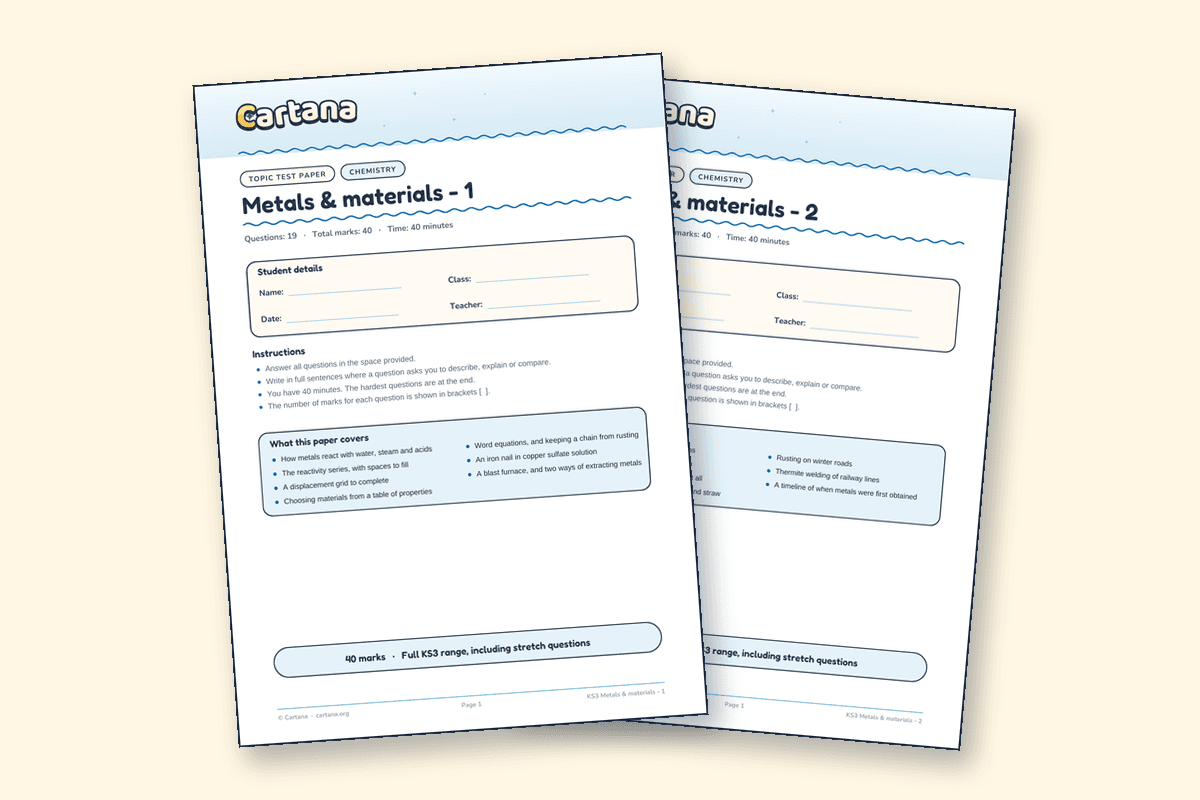
Two papers, one price
KS3 Metals & materials Test Papers with Mark Schemes (2 Papers)
Two different test papers on the same unit, each with its own mark scheme, for £1.99 together.
- 2 different papers
- 2 × 40 marks
- 40 minutes each
- 2 mark schemes, 26 pages
Also in the Chemistry Pack: 16 papers for £9.99, save 37%.
Did you know?
- Gold is so easy to hammer out that a single gram can be beaten into a sheet of about one square metre, thin enough for light to shine through.
- The Eiffel Tower is made of iron and has to be repainted about once every seven years to stop it rusting. Each repaint uses about 60 tonnes of paint.
- Some spider silk, a natural polymer, is stronger than steel for its weight: a thread of it can hold more before snapping than a steel wire of the same weight.
- Concrete is the most used material made by people. Most big concrete buildings and bridges are really a composite, with steel bars hidden inside.
More chemistry units
- Particles & states of matter 5 topics
- Atoms, elements & compounds 5 topics
- Separating mixtures 5 topics
- Chemical reactions 6 topics
- Acids & alkalis 5 topics
- The periodic table 5 topics
- Earth & atmosphere 7 topics
All of KS3 science · Every homework sheet · Test papers and packs
 Watch the trailer · 1:06
New from Cartana · Beta test 1–31 December
Revision that feels like an adventure
Cartana is our KS3 learning adventure: sail between islands, answer quick-fire questions and battle bosses. It starts with science, with maths on the way, and launches in 2027. This December a small group of testers gets to play it first.
In the Cartana adventure, every science unit is an island to explore. The island for metals & materials is being built.
- Play the game before its official release
- Help us build it with your feedback
- Earn exclusive in-game items in return