
KS3 Chemistry · Metals & materials
The reactivity series
- The order from potassium to gold, with carbon and hydrogen placed in it
- Working out the order from reactions with water and acids, and the temperature-rise test
- What carbon’s and hydrogen’s places tell you
- Using the series to predict, and why aluminium seems unreactive
- 4 min read
- 5 quick questions
- Free homework sheet
- Years 7 to 9
Revision notes
The reactivity series is a list of metals in order of how readily they react, from potassium at the top to gold at the bottom. Carbon and hydrogen are placed in it too, so it can be used to predict reactions.
What is the order of the reactivity series?
A reactive metal reacts quickly and vigorously; an unreactive metal reacts slowly or not at all. The reactivity series, most reactive first:
Potassium, sodium, calcium, magnesium, aluminium, (carbon), zinc, iron, tin, lead, (hydrogen), copper, silver, gold.
One way to remember it: “Please Stop Calling Me A Careless Zebra, Instead Try Learning How Copper Saves Gold”. Each word starts with the same letter as the element in that place.
How do you work out the order?
By comparing how the metals react with the same things: water, dilute acids and oxygen. The higher a metal is, the faster and more violently it reacts (see reactions of metals).
| Metal | Cold water | Dilute acid |
|---|---|---|
| Potassium, sodium | Violent | Far too violent to try |
| Calcium | Fizzes steadily | Very vigorous |
| Magnesium | Very slow | Fizzes fast |
| Zinc, iron | No reaction | Steady or slow fizzing |
| Tin, lead | No reaction | Very slow |
| Copper, silver, gold | No reaction | No reaction |
These reactions give out heat (they are exothermic), so the temperature rise is a way to put numbers on reactivity:
- Pour 25 cm3 of dilute hydrochloric acid into a polystyrene cup (it keeps the heat in) and measure its temperature.
- Add 0.5 g of a powdered metal, stir, and record the highest temperature reached.
- Repeat with fresh acid for each metal. To make it a fair test, change only the metal: keep the mass of metal and the volume and strength of acid the same.
What you see: magnesium warms the acid most, then zinc, then iron; copper not at all. What it shows: the order magnesium, zinc, iron, copper.
Where do carbon and hydrogen fit?
Carbon and hydrogen are non-metals, placed in the series to compare with the metals:
- Carbon sits between aluminium and zinc. Metals below carbon can be extracted from their oxides by heating them with carbon (see extracting metals).
- Hydrogen sits between lead and copper. Metals above hydrogen react with dilute acids to give hydrogen; copper, silver and gold, below it, do not.
How do you use the series to make predictions?
A metal’s place tells you how it will behave even if you have never seen it react: whether it reacts with water or acids, whether carbon can extract it, and whether it will displace another metal from its compounds.
Metal X does not react with cold water. In dilute acid it fizzes, but more slowly than zinc. Where does it go?
It reacts with acid, so it is above hydrogen.
It reacts more slowly than zinc, so it is below zinc.
So X goes between zinc and hydrogen, among iron, tin and lead. Carbon is above it, so X could be extracted by heating its oxide with carbon.
One metal seems to break the rules. Aluminium is high in the series, yet window frames and drinks cans made of it last for years. As soon as it meets the air it is covered by a thin, tough oxide layer (aluminium oxide), which keeps air and water away from the metal underneath.
Stretch The series can be extended. Lithium, not in the school list, reacts with cold water more gently than sodium, and is usually placed between sodium and calcium (as in most GCSE lists). The series can also be measured with electricity: two different metals dipped in salty water, or pushed into a lemon, make a simple cell, and the further apart the metals are in the series, the bigger the voltage.
Written to the KS3 national curriculum. Last changed 14 November 2026.
Key words
Say them, spell them, use them in an answer.
- reactivity series
- reactive
- unreactive
- exothermic
- fair test
- carbon
- hydrogen
- oxide layer
Common misconception
Often said“Aluminium can’t be a reactive metal. Drinks cans and window frames made of it never wear away.”
In factAluminium is high in the reactivity series, above zinc and iron. It looks unreactive because it reacts with the air at once to make a thin, tough layer of aluminium oxide, which stops air and water reaching the metal underneath.
Did you know?
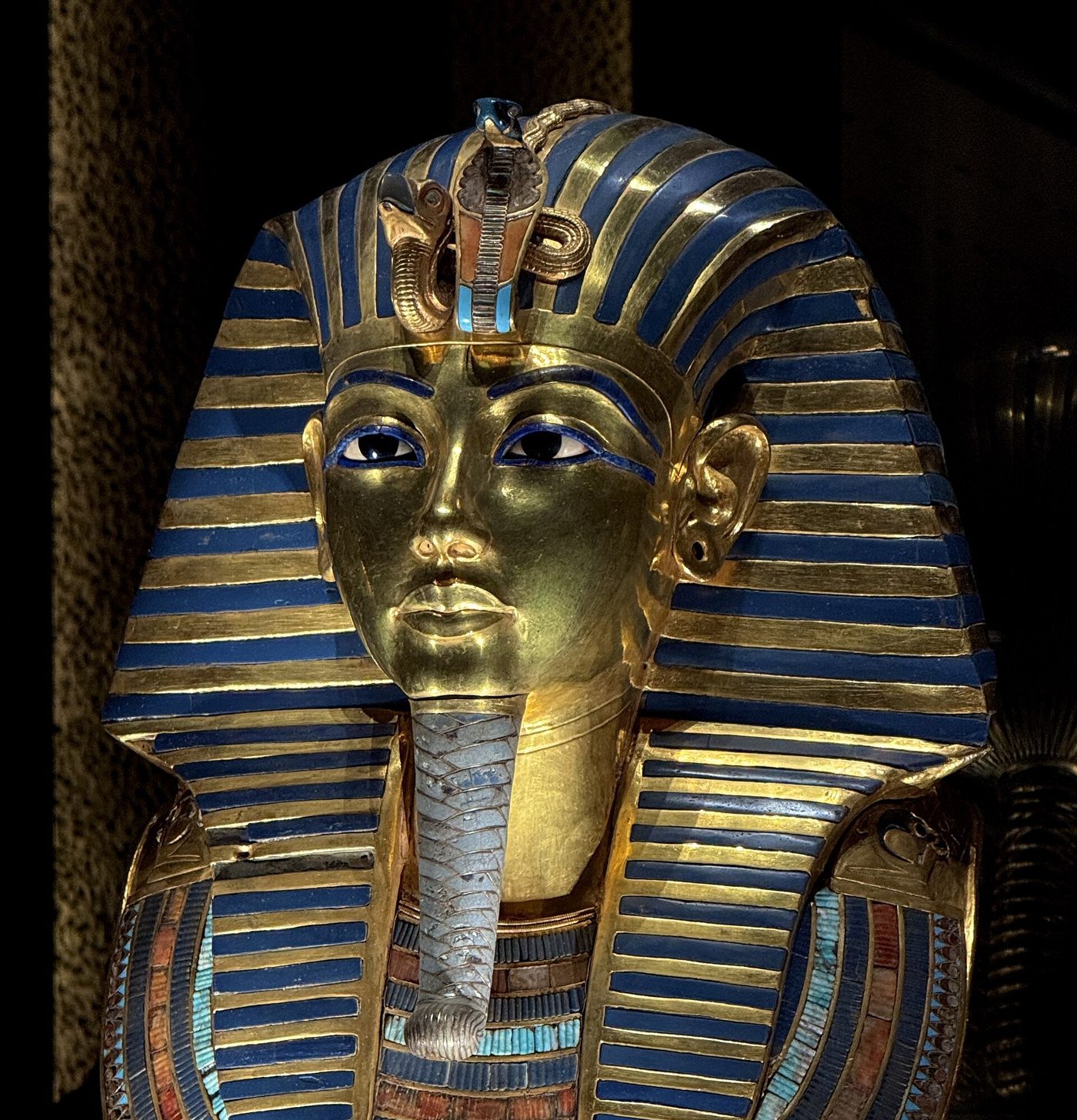
Tutankhamun’s mask
The gold mask of the Egyptian king Tutankhamun was made more than 3,300 years ago and its gold still shines. Gold is so unreactive that air and water do not tarnish it.
Photo: Dawid Wdowczyk, CC BY 4.0, via Wikimedia Commons
Try 5 questions
Quick questions on the reactivity series, marked as you go. Each one explains the answer.
Question 1 of 5
Which list is in order of reactivity, most reactive first?
Choose an answer. Each question explains itself.
The homework sheet
About twenty minutes. Everything on it is in the notes above; the answers are on the last page.
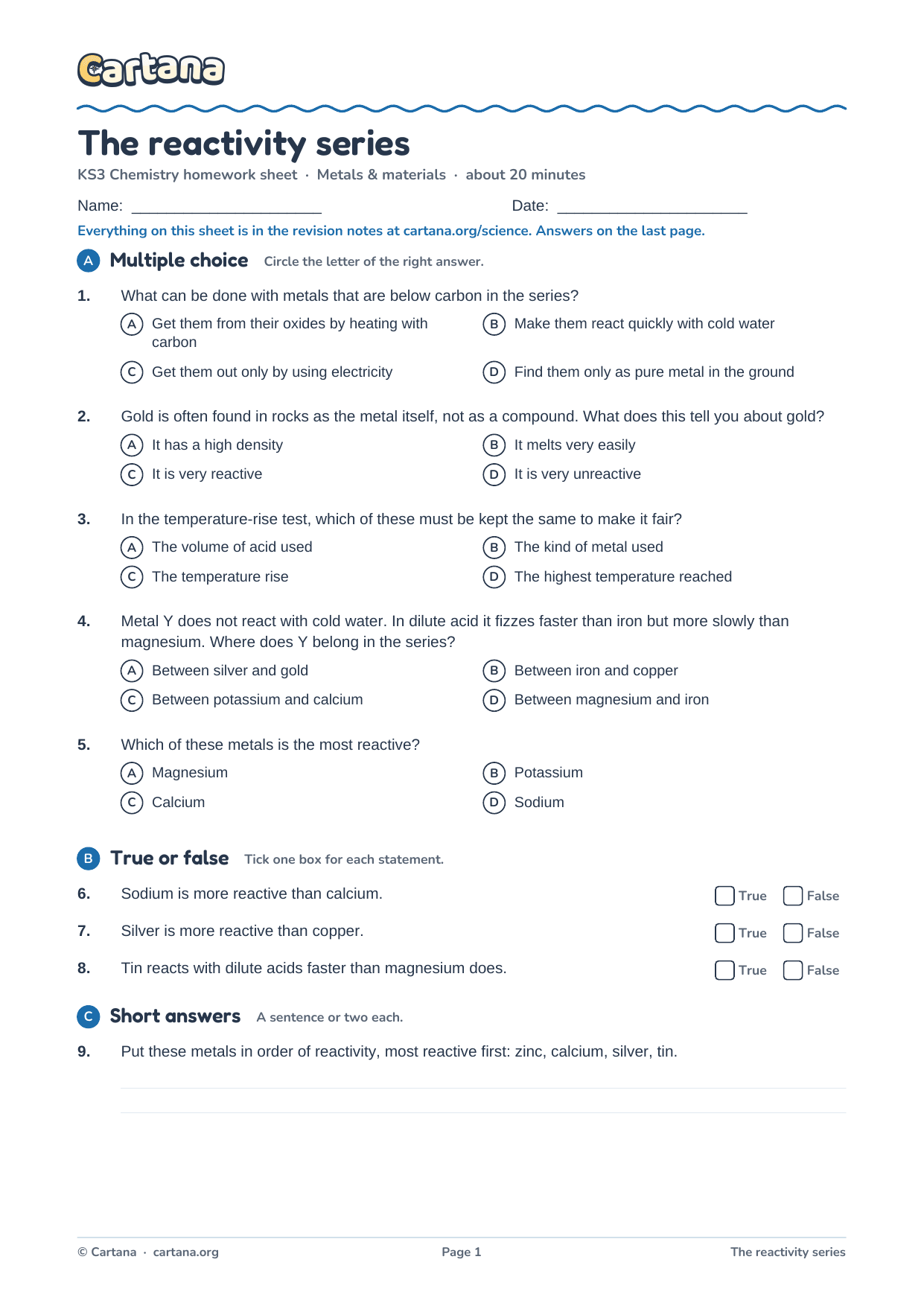
Free homework sheet
The reactivity series homework sheet
17 questions, about twenty minutes, with the answers on the last page: multiple choice, true or false, short answers, key words to define and one to explain in full.
KS3 Metals & materials
Revised the whole unit?
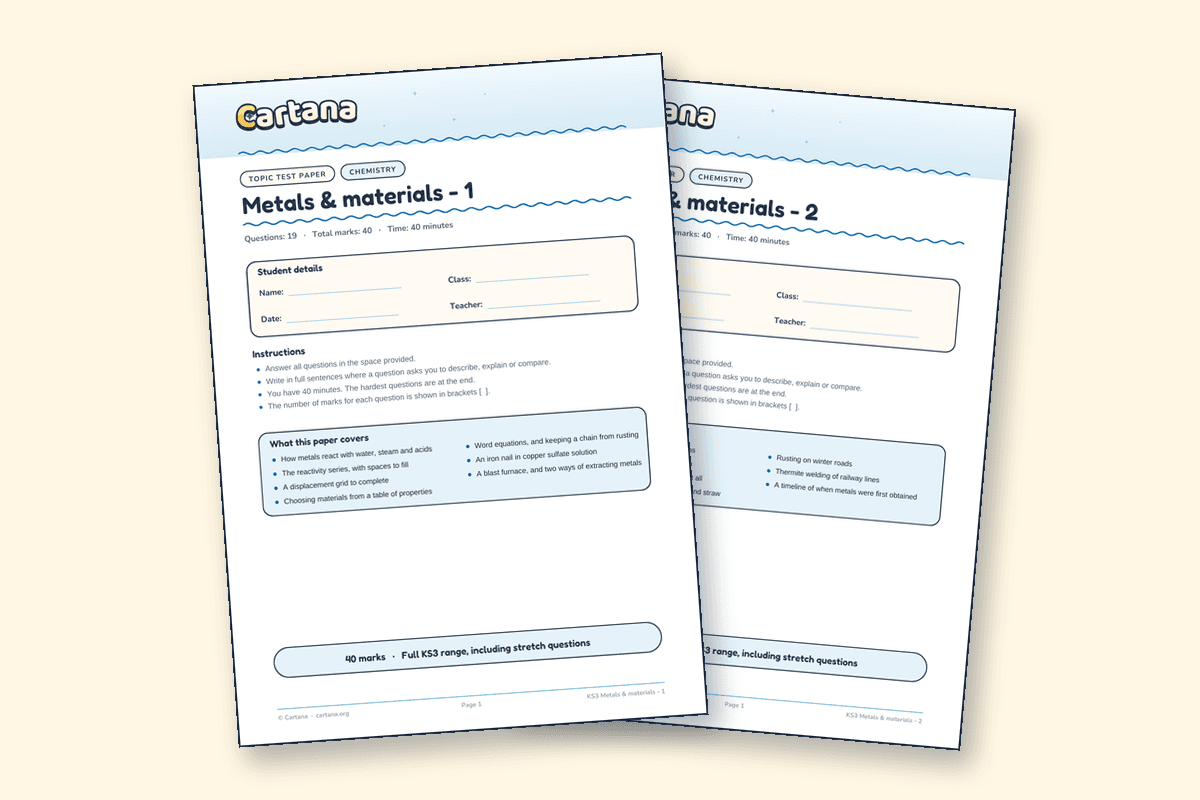
When every topic in metals & materials is done, two different papers test the whole unit, each with its own mark scheme.


 Watch the trailer · 1:06
New from Cartana · Beta test 1–31 December
Revision that feels like an adventure
Cartana is our KS3 learning adventure: sail between islands, answer quick-fire questions and battle bosses. It starts with science, with maths on the way, and launches in 2027. This December a small group of testers gets to play it first.
In the Cartana adventure, every science unit is an island to explore. The island for metals & materials is being built.
- Play the game before its official release
- Help us build it with your feedback
- Earn exclusive in-game items in return
More in this unit
Metals & materials
- 1Reactions of metalsHow metals react with oxygen, water and dilute acids, and why iron rusts
- 3Displacement reactionsNextA more reactive metal pushing a less reactive one out of its compound, from an iron nail in copper sulfate to the thermite reaction
- 4Extracting metalsOres, native metals, heating with carbon, the blast furnace in outline, electrolysis for reactive metals, and recycling
- 5Ceramics, polymers and compositesThe properties and uses of ceramics, polymers and composites, and how to choose a material for a job