
KS3 Chemistry · Acids & alkalis
Making salts
- What a salt is, and how to name one from its metal and its acid
- Acids with metal oxides (salt + water) and with carbonates (salt + water + carbon dioxide)
- Testing for carbon dioxide with limewater
- Making copper sulfate crystals, step by step
- 5 min read
- 5 quick questions
- Free homework sheet
- Years 7 to 9
Revision notes
Making salts means reacting an acid with a metal or a base (a metal oxide, hydroxide or carbonate) to make a salt: a compound named after the metal and the acid, such as copper sulfate. Most salts can then be got as crystals.
What is a salt, and how do you name one?
Table salt, sodium chloride, is only one of thousands of salts. Epsom salts are magnesium sulfate, and potassium nitrate is used in fertilisers. Most salts are named in two parts: first the metal, then a part that comes from the acid.
| Acid | Salt ending | Example |
|---|---|---|
| Hydrochloric acid | Chloride | Calcium chloride |
| Sulfuric acid | Sulfate | Copper sulfate |
| Nitric acid | Nitrate | Potassium nitrate |
There are four kinds of reaction that make a salt from an acid:
| Acid reacts with | Products |
|---|---|
| A metal | Salt + hydrogen (see acids and metals) |
| An alkali | Salt + water (see neutralisation) |
| A metal oxide | Salt + water |
| A metal carbonate | Salt + water + carbon dioxide |
What happens when an acid reacts with a metal oxide?
A metal oxide, a compound of a metal with oxygen such as copper oxide, is a base. Most metal oxides do not dissolve in water, but they still react with acids, making a salt and water:
Black copper oxide powder reacts with warm, colourless dilute sulfuric acid to make a blue solution of copper sulfate:
copper oxide + sulfuric acid → copper sulfate + water
No gas is made, so there is no fizzing, but the black powder disappears and the solution turns blue.
How do you make copper sulfate crystals?
- Wearing eye protection, pour about 25 cm3 of dilute sulfuric acid into a beaker and warm it gently. Do not let it boil.
- Add copper oxide one spatula at a time, stirring, until some black powder is left over and will not react. The copper oxide is now in excess: there is more than enough, so all the acid has been used up.
- Filter the mixture. The extra copper oxide stays on the filter paper as the residue. The blue copper sulfate solution that runs through is the filtrate.
- Heat the filtrate in an evaporating basin, a shallow dish, over a beaker of boiling water until about half of the water has gone and crystals start to appear at the edge. The boiling water heats it gently, so it does not spit. Do not heat it until it is dry, or you get a powder instead of crystals.
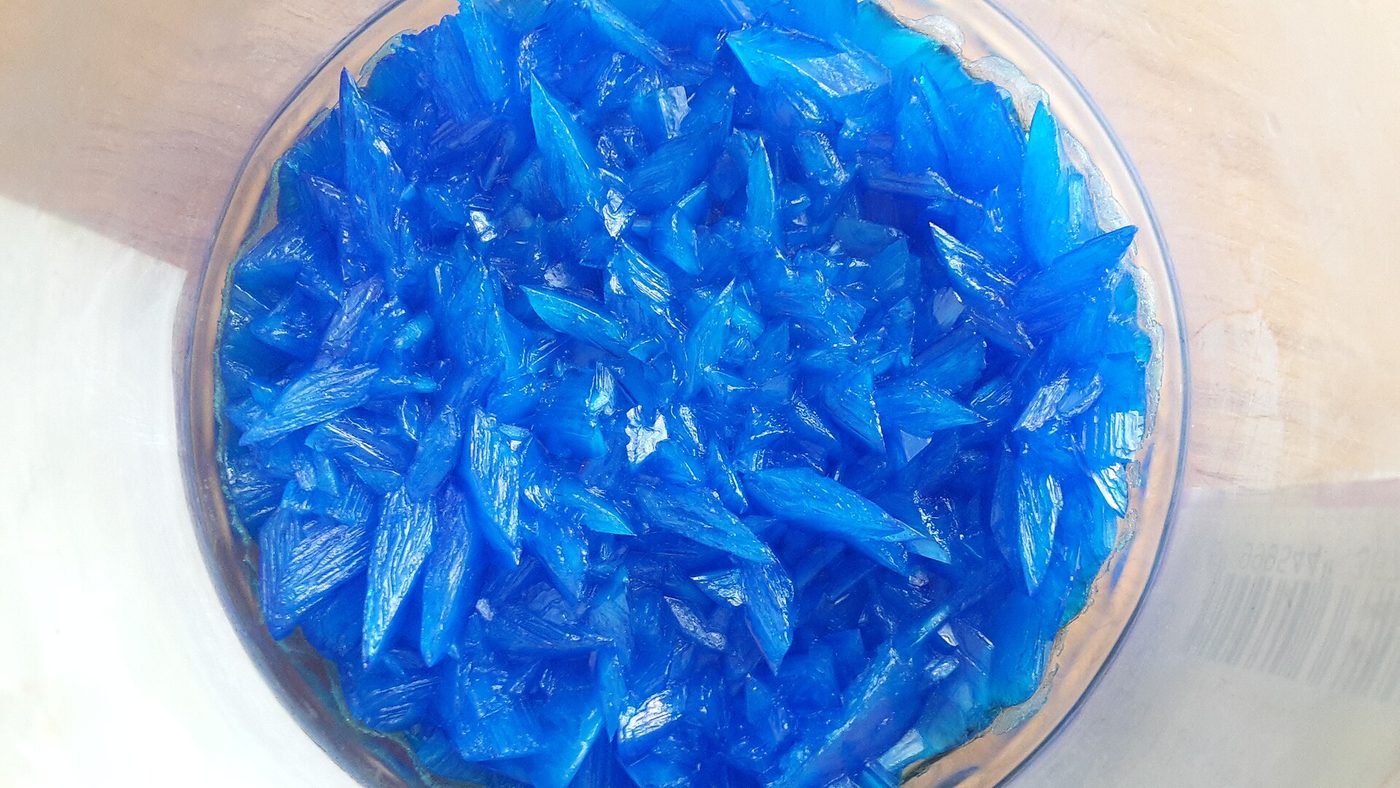
- Leave the basin in a warm place for a day or two. Blue crystals of copper sulfate grow as the rest of the water slowly evaporates.
Using copper oxide in excess makes sure no acid is left to spoil the crystals, and the extra solid is easy to filter off. Slow evaporation makes bigger crystals. Copper sulfate is harmful if swallowed, so wash your hands afterwards. (Filtering and crystallising are explained in filtration and crystallisation.)
What happens when an acid reacts with a carbonate?
A metal carbonate is a compound of a metal with carbon and oxygen, such as calcium carbonate (marble or limestone) or green copper carbonate. It is a base too. With an acid it fizzes, because one of the products is carbon dioxide gas:
calcium carbonate + hydrochloric acid → calcium chloride + water + carbon dioxide
copper carbonate + sulfuric acid → copper sulfate + water + carbon dioxide
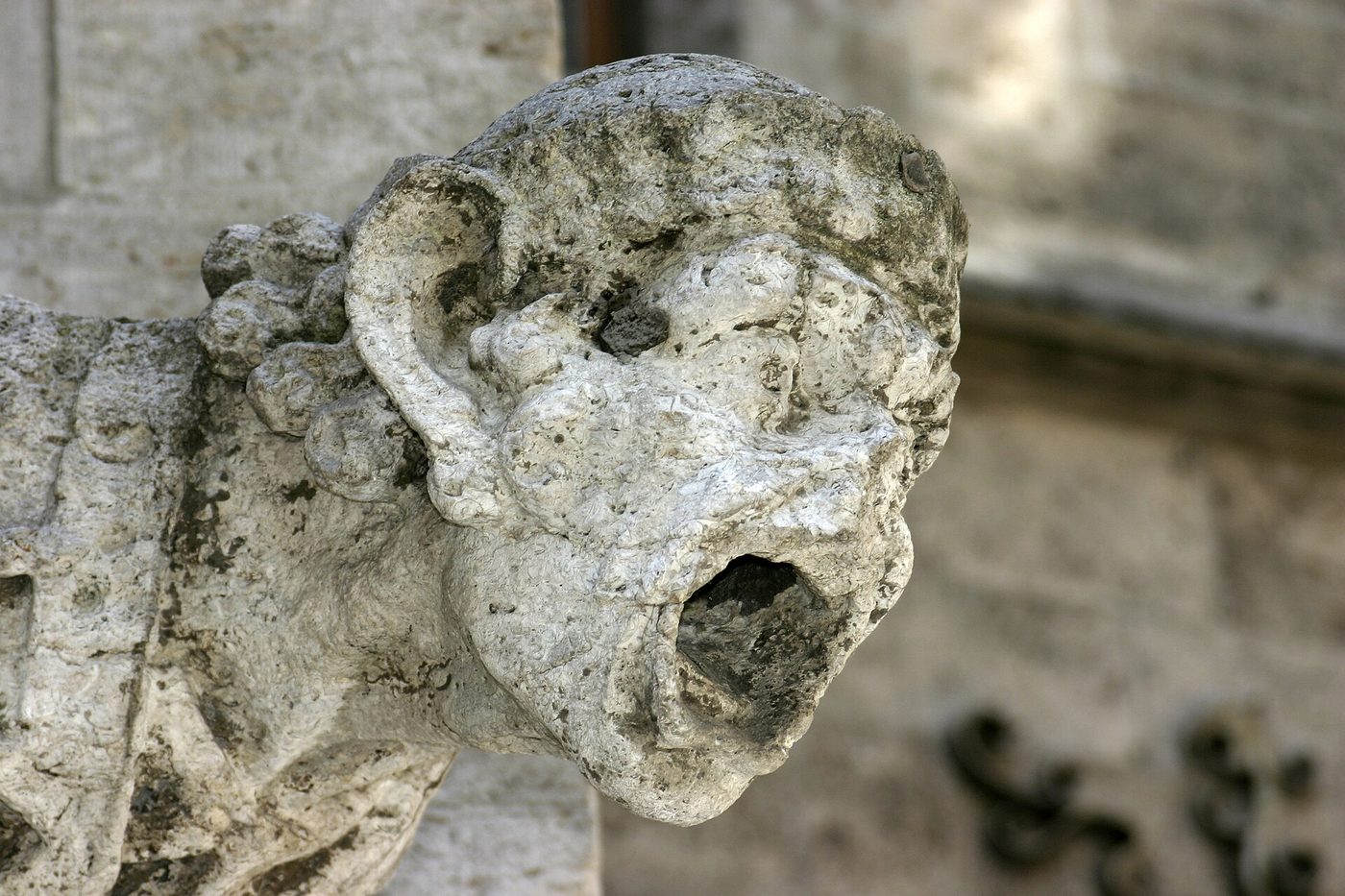
To show that the gas is carbon dioxide, bubble it through limewater, a solution of calcium hydroxide. Carbon dioxide turns limewater milky (see thermal decomposition). The same reaction slowly wears away limestone buildings in acid rain.
Stretch Copper sulfate crystals are blue because water is built into them, called water of crystallisation: their formula is CuSO4·5H2O. Heat them and the water is driven off, leaving a white powder, anhydrous copper sulfate (“anhydrous” means without water). Add a few drops of water and it turns blue again and gets hot, which is a test for water.
Written to the KS3 national curriculum. Last changed 14 November 2026.
Key words
Say them, spell them, use them in an answer.
- salt
- metal oxide
- metal carbonate
- in excess
- residue
- filtrate
- evaporating basin
- limewater
Common misconception
Often said“Salt just means the stuff you put on chips.”
In factThat is only one salt, sodium chloride. To a chemist a salt is any compound made when an acid reacts with a metal or a base, and there are thousands of them, from blue copper sulfate to the potassium nitrate in fertilisers. Many are not safe to eat.
Did you know?
Epsom salts
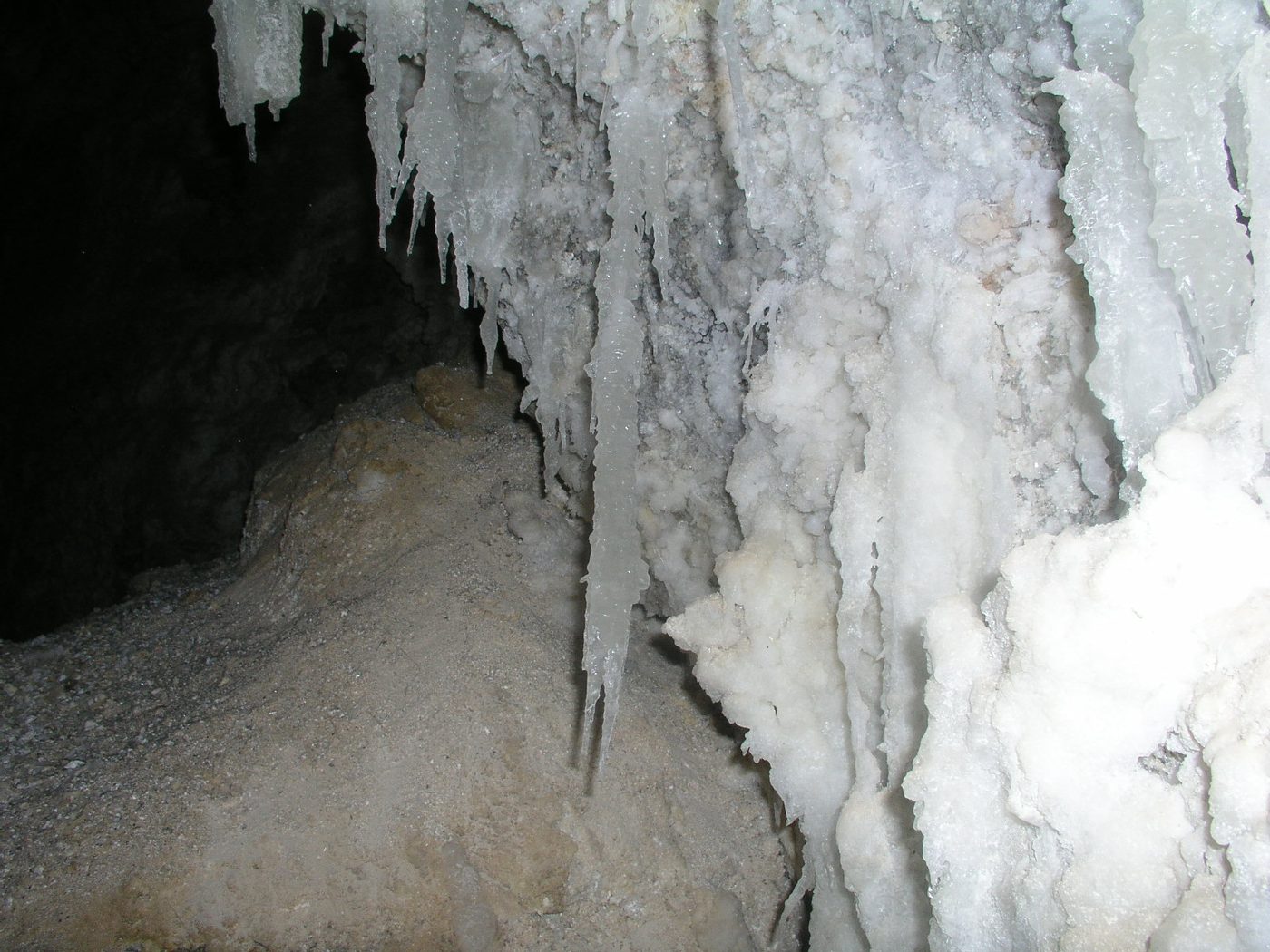
In 1618, the story goes, a farmer called Henry Wicker found that his cows would not drink from a spring on Epsom Common in Surrey. The water tasted bitter because of a salt dissolved in it, magnesium sulfate, which is still sold today as Epsom salts.
Photo: WTucker, CC BY-SA 3.0, via Wikimedia Commons
Try 5 questions
Quick questions on making salts, marked as you go. Each one explains the answer.
Question 1 of 5
Why is the copper sulfate solution left for a day or two after heating?
Choose an answer. Each question explains itself.
The homework sheet
About twenty minutes. Everything on it is in the notes above; the answers are on the last page.
Free homework sheet
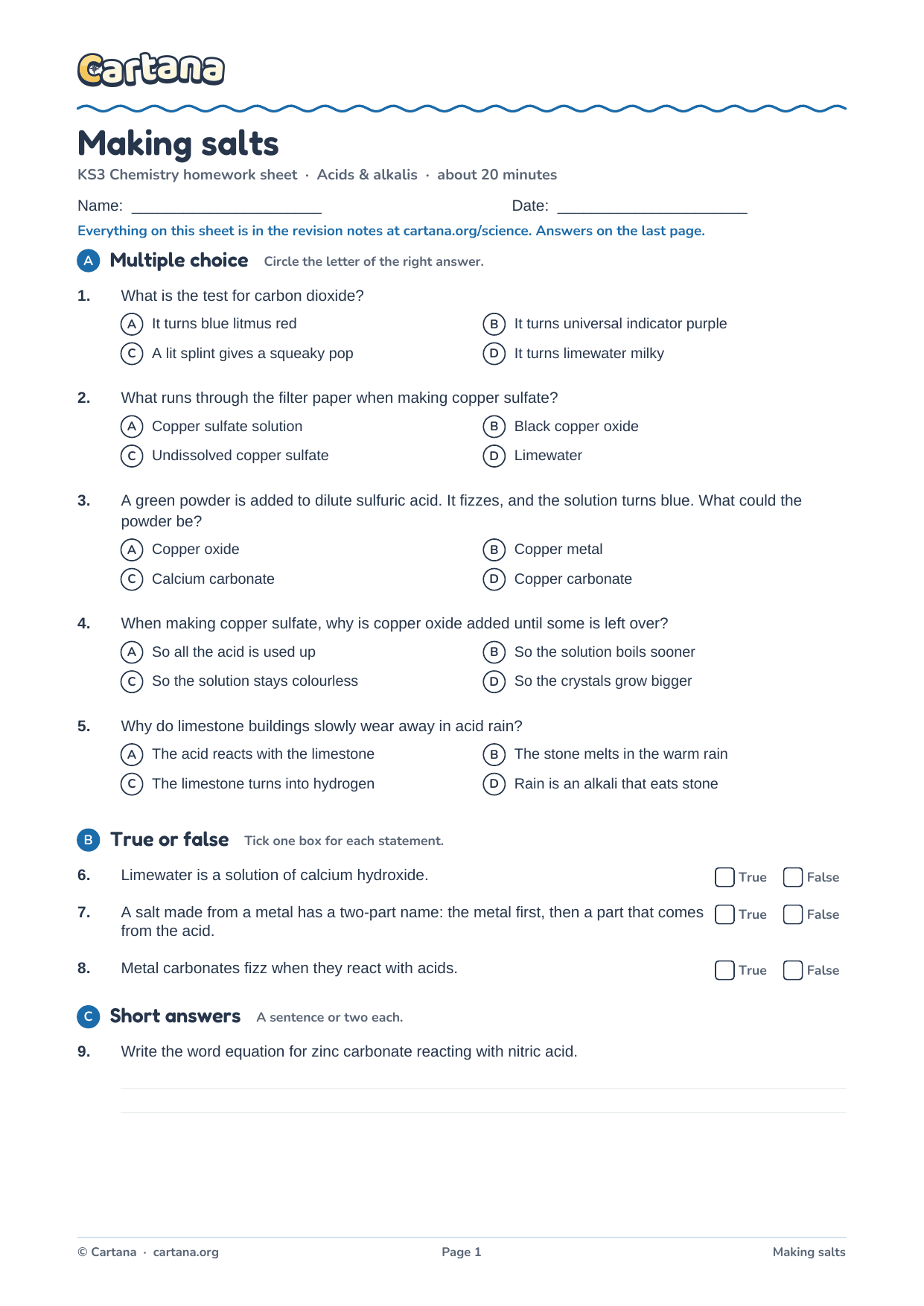
Making salts homework sheet
17 questions, about twenty minutes, with the answers on the last page: multiple choice, true or false, short answers, key words to define and one to explain in full.
KS3 Acids & alkalis
Revised the whole unit?
When every topic in acids & alkalis is done, two different papers test the whole unit, each with its own mark scheme.


 Watch the trailer · 1:06
New from Cartana · Beta test 1–31 December
Revision that feels like an adventure
Cartana is our KS3 learning adventure: sail between islands, answer quick-fire questions and battle bosses. It starts with science, with maths on the way, and launches in 2027. This December a small group of testers gets to play it first.
In the Cartana adventure, every science unit is an island to explore. The island for acids & alkalis is being built.
- Play the game before its official release
- Help us build it with your feedback
- Earn exclusive in-game items in return
More in this unit
Acids & alkalis
- 1Acids and alkalisEveryday and laboratory acids and alkalis, bases and alkalis, concentrated and dilute solutions, hazard symbols and working safely
- 2Indicators and pHThe pH scale from 0 to 14, litmus and universal indicator, pH meters, strong and weak acids and alkalis, and making a red cabbage indicator
- 3NeutralisationAcid + alkali → salt + water, following the pH as alkali is added to an acid, and uses of neutralisation for indigestion, soil, teeth and stings
- 4Acids and metalsMetal + acid → salt + hydrogen, the squeaky pop test, which metals react with dilute acids, and naming the salt from the acid