
KS3 Chemistry · Separating mixtures
Filtration and crystallisation
- How filtration separates an insoluble solid from a liquid: the residue and the filtrate
- Evaporating and crystallising to get a dissolved solid back from its solution
- The rock salt practical from start to finish: grind, dissolve, filter, evaporate
- The safety points: eye protection, and stopping before the basin is dry
- 4 min read
- 5 quick questions
- Free homework sheet
- Years 7 to 9
Revision notes
Filtration separates an insoluble solid from a liquid, such as sand from water. Evaporation and crystallisation get a dissolved solid back out of its solution, such as salt from salty water.
How does filtration work?
Filter paper is full of tiny holes. The particles of water, and the particles of anything dissolved in it, are small enough to pass through. Grains of an insoluble solid, such as sand, are far too big, so they stay on the paper.
- The solid left on the filter paper is the residue.
- The liquid that passes through is the filtrate.
Fold a circle of filter paper into a cone, sit it in a filter funnel standing in a conical flask, and pour the mixture in slowly, keeping the level below the top of the paper, so none of it runs down between the paper and the funnel unfiltered. A tea bag and a coffee filter work in the same way.
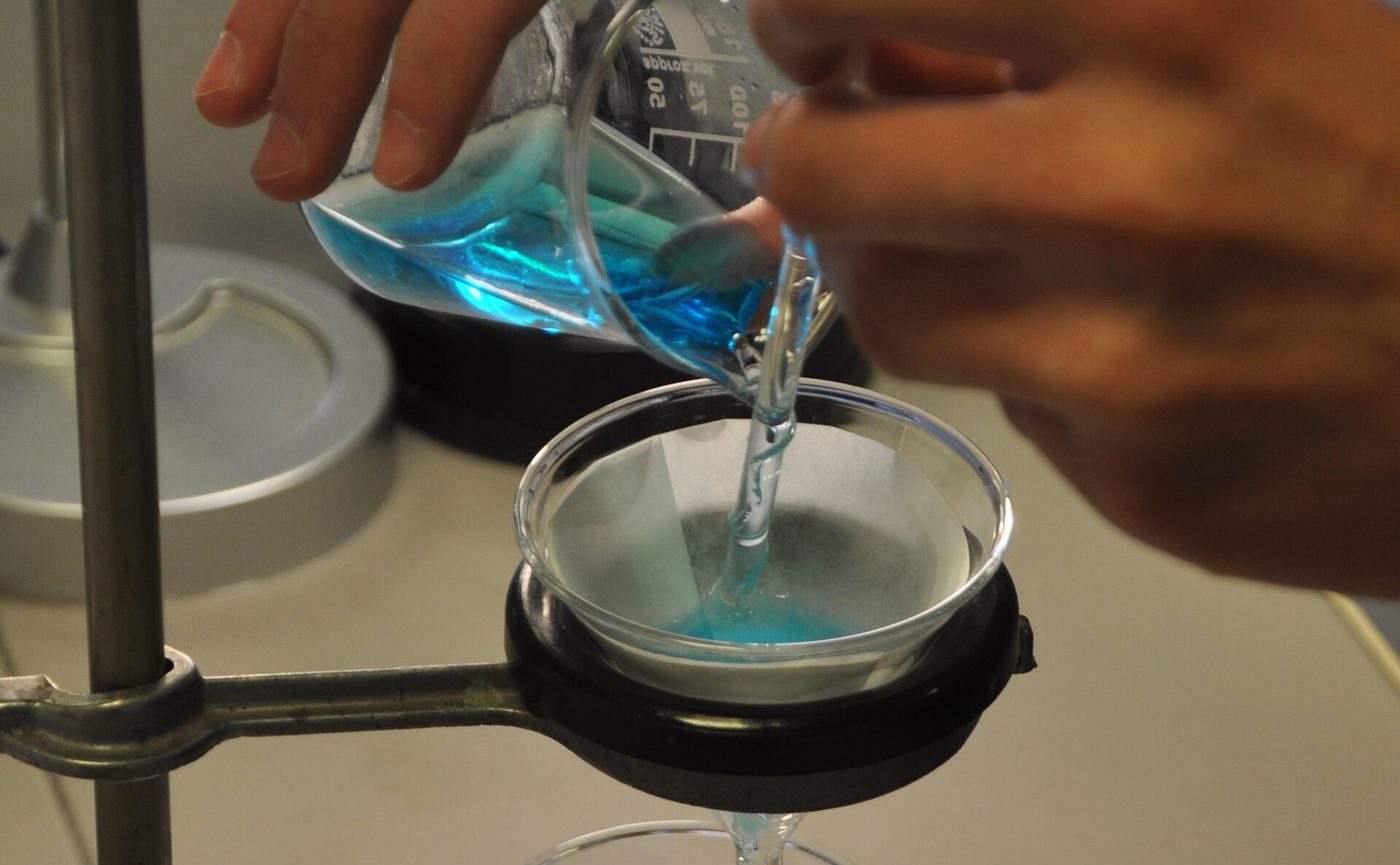
Filtering cannot take out a dissolved solid. Its particles go through the paper with the water, so salty water comes out of a filter just as salty as it went in.
How do you get a dissolved solid back?
Heat the solution in an evaporating basin. The water evaporates (turns into a gas at its surface) and the solid is left behind, because the solid does not evaporate.
For good crystals, do not boil it dry. Heat gently until crystals just start to form round the edge, then stop and leave the basin in a warm place for a day or two. As the solution cools and the rest of the water slowly evaporates, the solid comes out as crystals. Pat the crystals dry with filter paper.
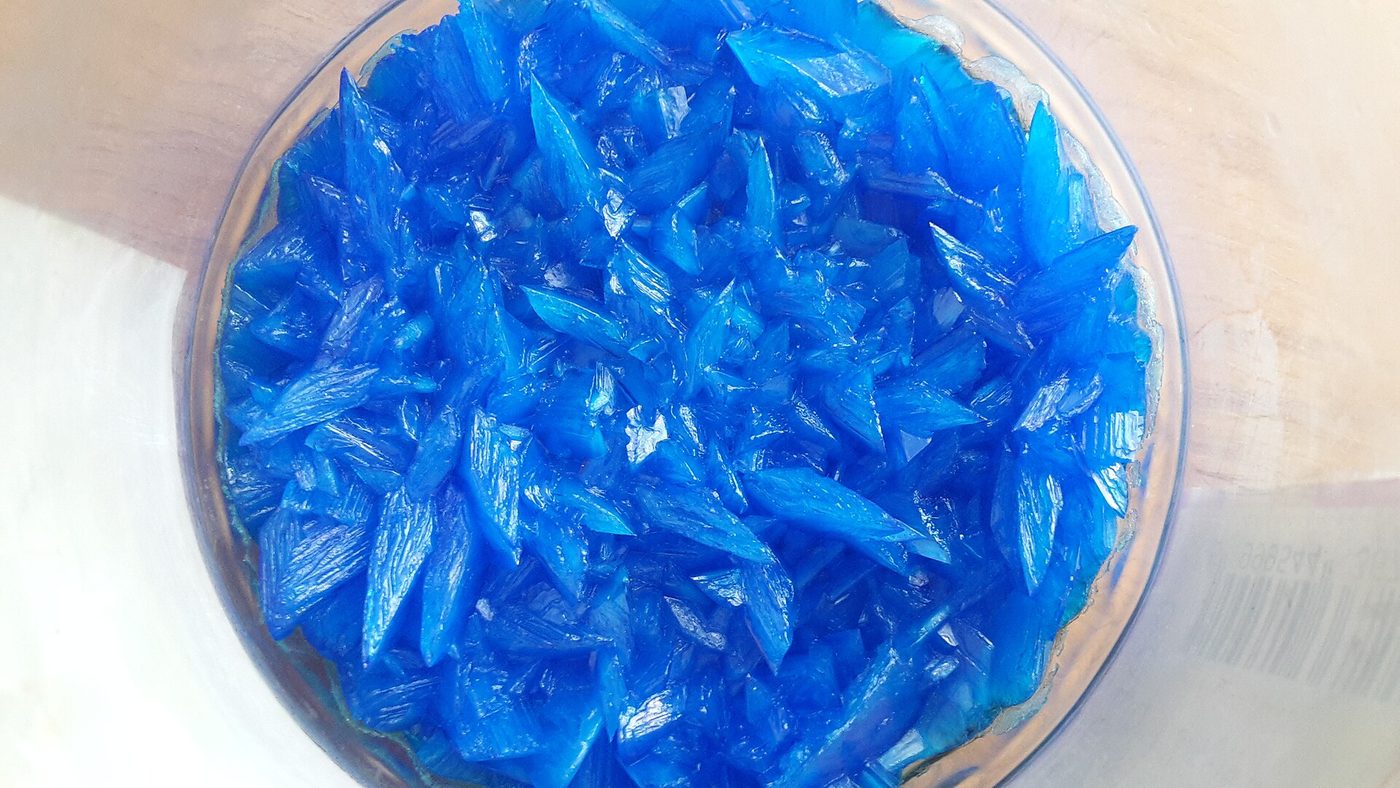
Safety. Wear eye protection. Stop heating before the basin is dry: as the last water goes, hot solid spits out of the basin. The basin, tripod and gauze stay hot for a long time, so leave them to cool or use tongs. Turn the Bunsen burner to the yellow safety flame when you are not heating.
How do you get salt from rock salt?
Rock salt is salt dug out of the ground, mixed with sand and clay. Much of the salt spread on Britain’s roads in winter is rock salt from a mine in Cheshire. Getting pure salt from it takes two separating methods, one after the other.
- Grind the rock salt with a pestle and mortar, so the salt dissolves faster.
- Stir it into warm water in a beaker. The salt dissolves; the sand does not.
- Filter the mixture. The sand stays on the paper as the residue; the filtrate is salt solution.
- Evaporate the filtrate in a basin until crystals start to form, then leave it to crystallise.
- Dry the salt crystals on filter paper.
What you see: a brown, gritty residue on the filter paper, a clear filtrate, and white cubic crystals in the basin. What it shows: the methods work because the substances differ. Salt is soluble and sand is insoluble, so filtering parts them; water evaporates and salt does not, so evaporating parts them. (Why salt dissolves: solutions and solubility.)
Stretch Crystallising gives purer crystals than boiling dry. As a crystal grows slowly, particles of the substance fit neatly into its regular pattern; particles of anything else do not fit, so they stay behind in the solution. Boil it dry and every impurity is left mixed into the solid. Slower cooling also gives bigger crystals.
Written to the KS3 national curriculum. Last changed 13 November 2026.
Key words
Say them, spell them, use them in an answer.
- filtration
- filter paper
- residue
- filtrate
- evaporation
- crystallisation
- evaporating basin
- crystals
- rock salt
- insoluble
Common misconception
Often said“To get the most salt back, boil the salt solution until it is completely dry.”
In factBoiling it dry makes hot salt spit out of the basin, which is dangerous, and leaves every impurity mixed into the salt. Heat only until crystals start to form, then leave the rest of the water to evaporate slowly: you get the same amount of salt, safely, as bigger and purer crystals.
Did you know?
Salar de Uyuni
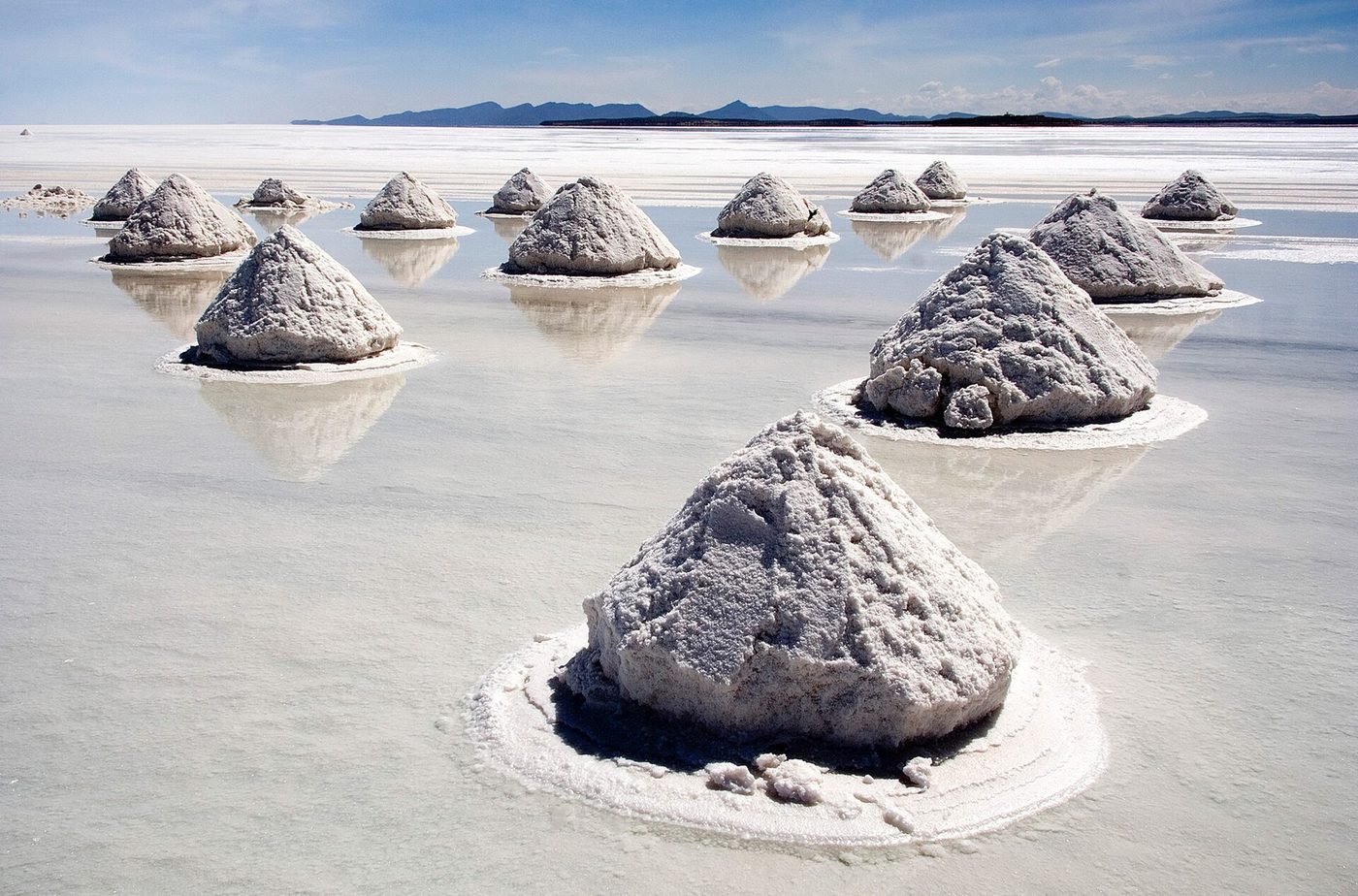
The Salar de Uyuni in Bolivia is the largest salt flat in the world: more than 10,000 km² of white salt crust, left behind when prehistoric lakes evaporated. Local workers still rake the salt into piles to dry in the sun.
Photo: Luca Galuzzi, CC BY-SA 2.5, via Wikimedia Commons
Try 5 questions
Quick questions on filtration and crystallisation, marked as you go. Each one explains the answer.
Question 1 of 5
Particles that are dissolved pass through filter paper.
Choose an answer. Each question explains itself.
The homework sheet
About twenty minutes. Everything on it is in the notes above; the answers are on the last page.
Free homework sheet
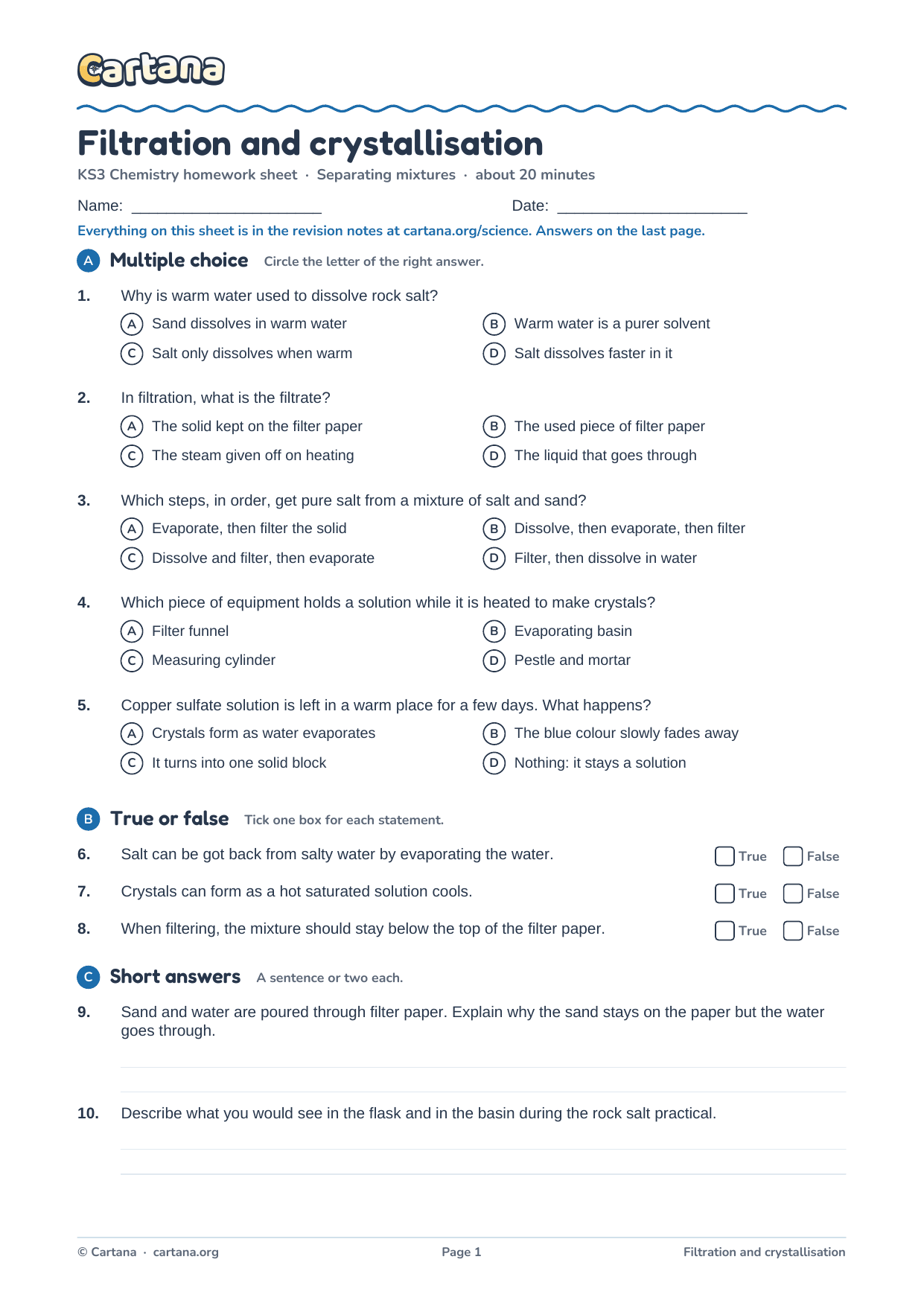
Filtration and crystallisation homework sheet
17 questions, about twenty minutes, with the answers on the last page: multiple choice, true or false, short answers, key words to define and one to explain in full.
KS3 Separating mixtures
Revised the whole unit?
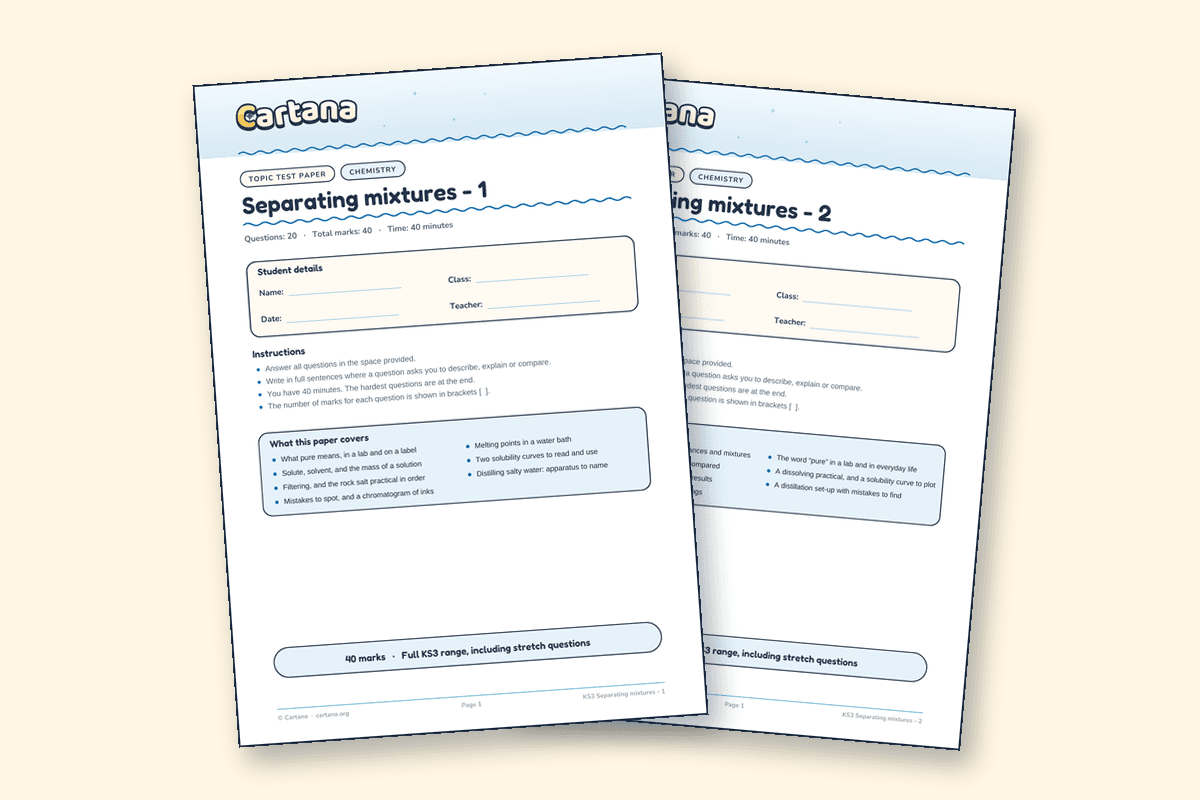
When every topic in separating mixtures is done, two different papers test the whole unit, each with its own mark scheme.


 Watch the trailer · 1:06
New from Cartana · Beta test 1–31 December
Revision that feels like an adventure
Cartana is our KS3 learning adventure: sail between islands, answer quick-fire questions and battle bosses. It starts with science, with maths on the way, and launches in 2027. This December a small group of testers gets to play it first.
In the Cartana adventure, every science unit is an island to explore. The island for separating mixtures is being built.
- Play the game before its official release
- Help us build it with your feedback
- Earn exclusive in-game items in return
More in this unit
Separating mixtures
- 1Pure and impure substancesWhat pure means in chemistry, mixtures, and testing purity by melting point
- 2Solutions and solubilitySolute, solvent and solution, dissolving, saturated solutions and solubility curves
- 4DistillationNextSimple distillation, the Liebig condenser, and fractional distillation
- 5ChromatographyPaper chromatography: the method, why substances separate, and reading a chromatogram