
KS3 Chemistry · Separating mixtures
Distillation
- How simple distillation gets the solvent back from a solution: boiling, then condensing
- The Liebig condenser, and why the cooling water goes in at the bottom
- Distilling salty water step by step, with the thermometer and safety points
- Uses of distillation, and fractional distillation in a Stretch box
- 4 min read
- 5 quick questions
- Free homework sheet
- Years 7 to 9
Revision notes
Distillation separates a liquid from a mixture by boiling it and then cooling the vapour so it condenses back into a liquid somewhere else. Simple distillation gets the solvent back from a solution, such as pure water from sea water.
What is distillation?
Evaporating salty water gets the salt back, but the water escapes into the air. To keep the water, you distil it. Distillation uses two changes of state, one after the other:
- Boiling: the water turns into steam. Salt boils only at about 1,465 °C, so it stays behind in the flask.
- Condensing: the steam is cooled and turns back into liquid water, which drips into a separate flask.
The pure liquid collected is the distillate.
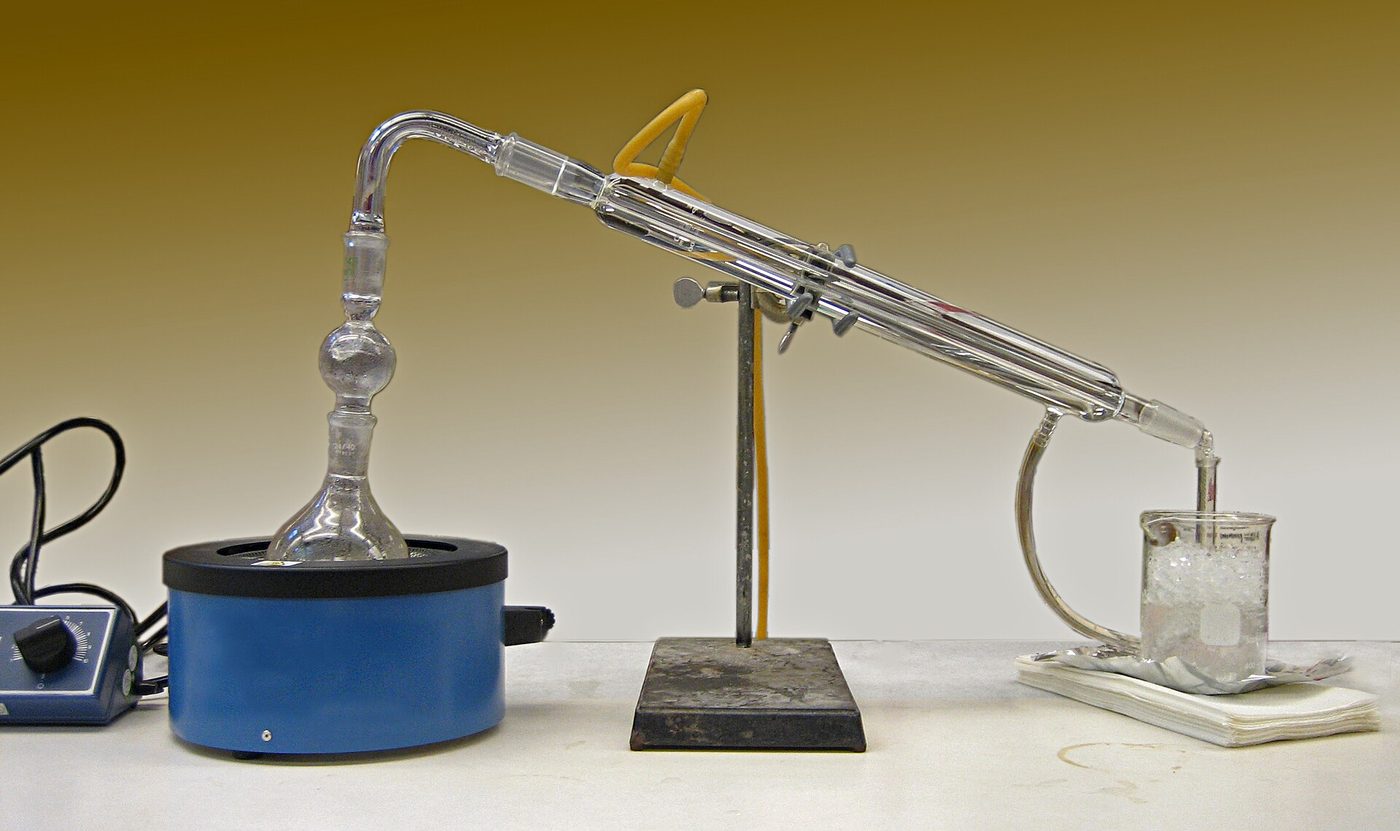
How does a Liebig condenser work?
A Liebig condenser is two glass tubes, one inside the other. The steam travels down the inner tube. Cold water flows through the outer tube, the jacket, and cools the inner tube, so the steam condenses into drops that run down into the collecting flask. The condenser slopes downwards so the liquid runs out.
The cold water goes in at the bottom and out at the top. That way the jacket stays full of water with no air pockets, and the coldest water meets the vapour just before it leaves, so it all condenses.
How do you distil salty water?
- Pour salty water into the flask, no more than half full, and add a few anti-bumping granules. They make it boil smoothly instead of in sudden violent bursts.
- Fit the thermometer so its bulb is level with the side arm. It then reads the temperature of the vapour going into the condenser, not of the liquid.
- Turn on the cold water, in at the bottom of the condenser, then heat the flask.
- Collect the distillate in a flask or beaker. Stop heating before the flask boils dry.
What you see: the thermometer rises to 100 °C and stays there while water drips from the condenser. The distillate is clear and does not taste salty; the salt is left in the flask. What it shows: the liquid boiling off is pure water, because pure water boils at exactly 100 °C.
Safety. Wear eye protection. Never heat a sealed apparatus: the end where the distillate comes out must be open to the air, or the pressure builds up. Clamp the flask and the condenser firmly.
Where is distillation used?
- Making drinking water from sea water in some hot, dry countries (desalination), and on ships.
- Making distilled water for laboratories, car batteries and steam irons, where dissolved substances would leave deposits.
- Making spirits such as whisky, and in perfume making.
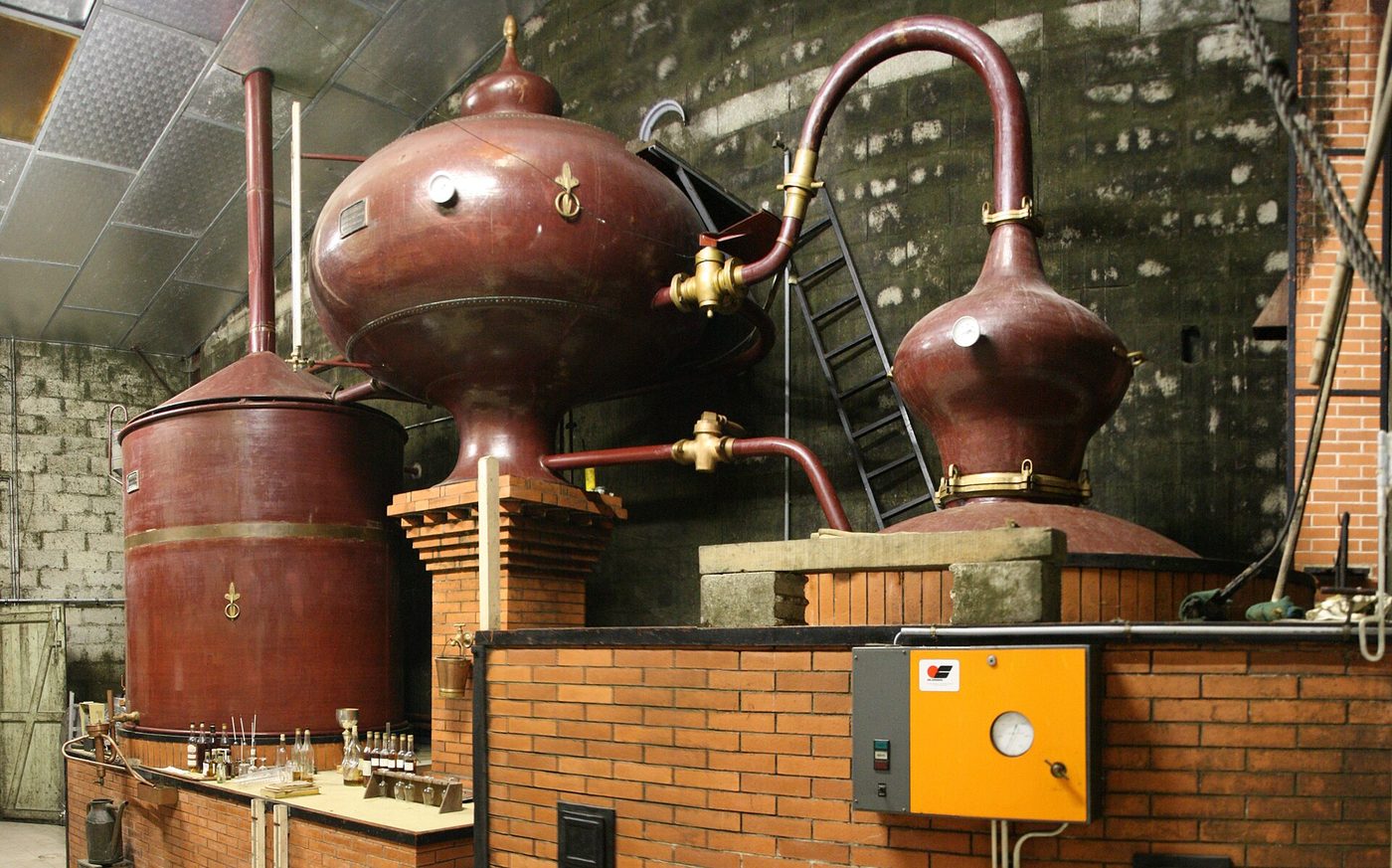
Stretch Fractional distillation separates liquids that are mixed together, such as ethanol (boiling point 78 °C) and water (100 °C). Simple distillation does not separate them well: both liquids evaporate, so the distillate is still a mixture. A tall fractionating column, packed with glass beads, sits between the flask and the condenser. The ethanol reaches the top first, so the thermometer stays near 78 °C while ethanol distils, then rises to 100 °C when the water starts to come over. Oil refineries separate crude oil in the same way, and air is separated into oxygen and nitrogen by cooling it to a liquid and distilling it.
Written to the KS3 national curriculum. Last changed 13 November 2026.
Key words
Say them, spell them, use them in an answer.
- distillation
- simple distillation
- condense
- distillate
- Liebig condenser
- anti-bumping granules
- boiling point
- desalination
Common misconception
Often said“When you distil salty water, the salt boils off with the water, so the distilled water is salty too.”
In factSalt does not boil until about 1,465 °C, so at 100 °C only the water turns into steam. The salt stays in the flask, and the water that condenses is pure. That is how drinking water can be made from sea water.
Did you know?
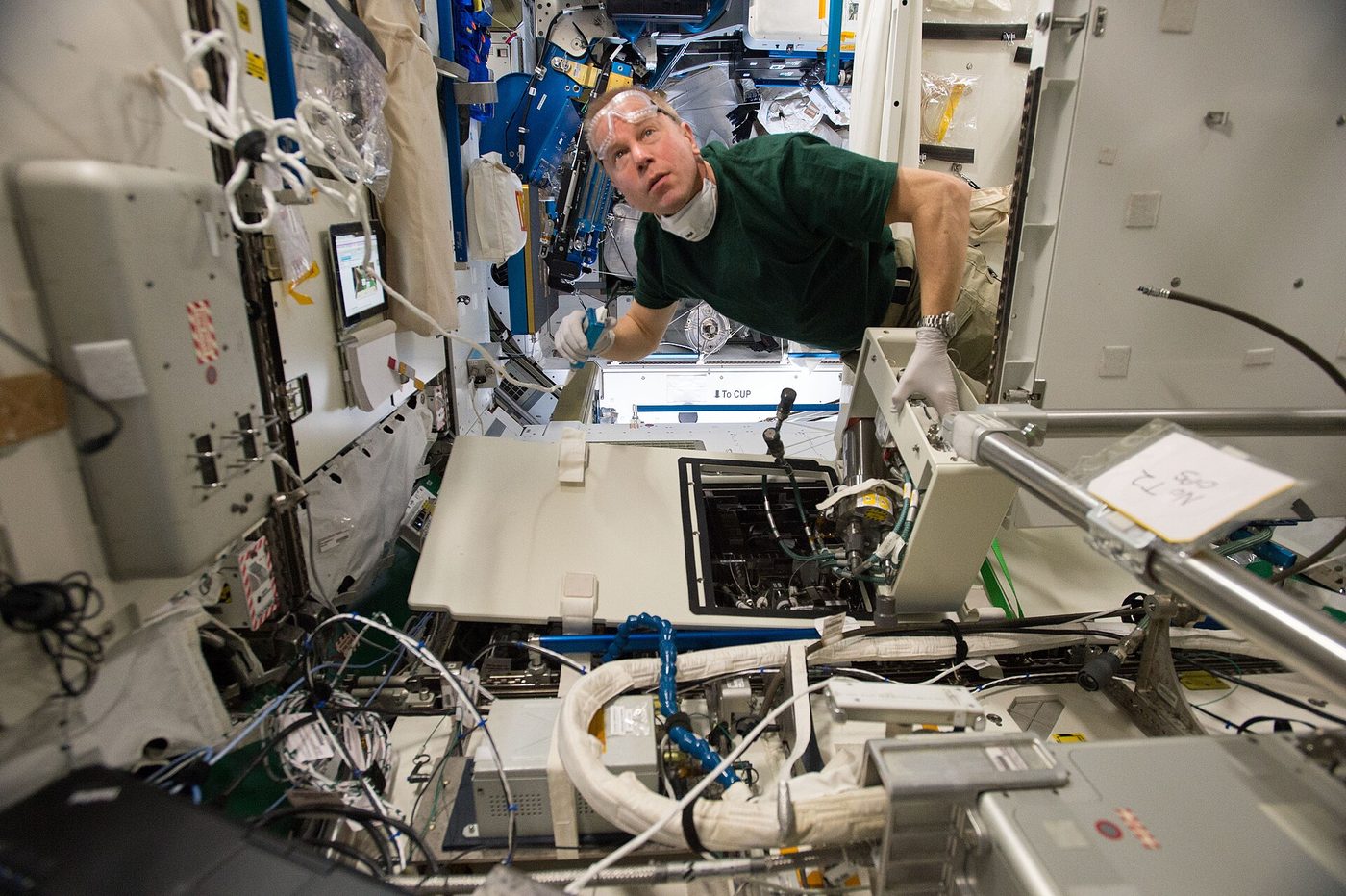
Water on the space station
On the International Space Station, astronauts’ urine is cleaned by distillation at low pressure and turned back into drinking water. With the water collected from their breath and sweat, the station now recycles about 98% of its water.
Photo: NASA, Public domain, via Wikimedia Commons
Try 5 questions
Quick questions on distillation, marked as you go. Each one explains the answer.
Question 1 of 5
The distillate from salty water tastes salty.
Choose an answer. Each question explains itself.
The homework sheet
About twenty minutes. Everything on it is in the notes above; the answers are on the last page.
Free homework sheet
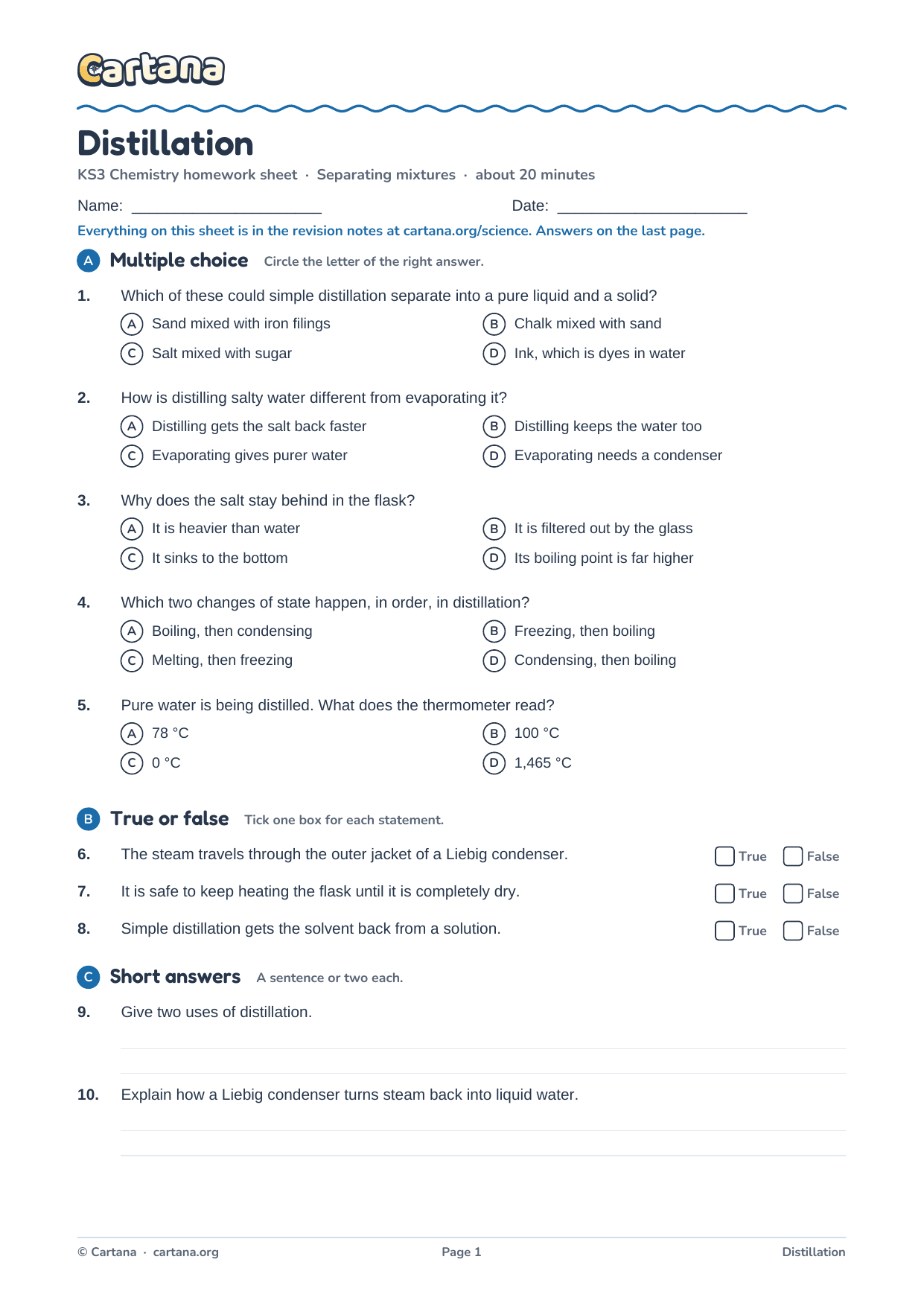
Distillation homework sheet
17 questions, about twenty minutes, with the answers on the last page: multiple choice, true or false, short answers, key words to define and one to explain in full.
KS3 Separating mixtures
Revised the whole unit?
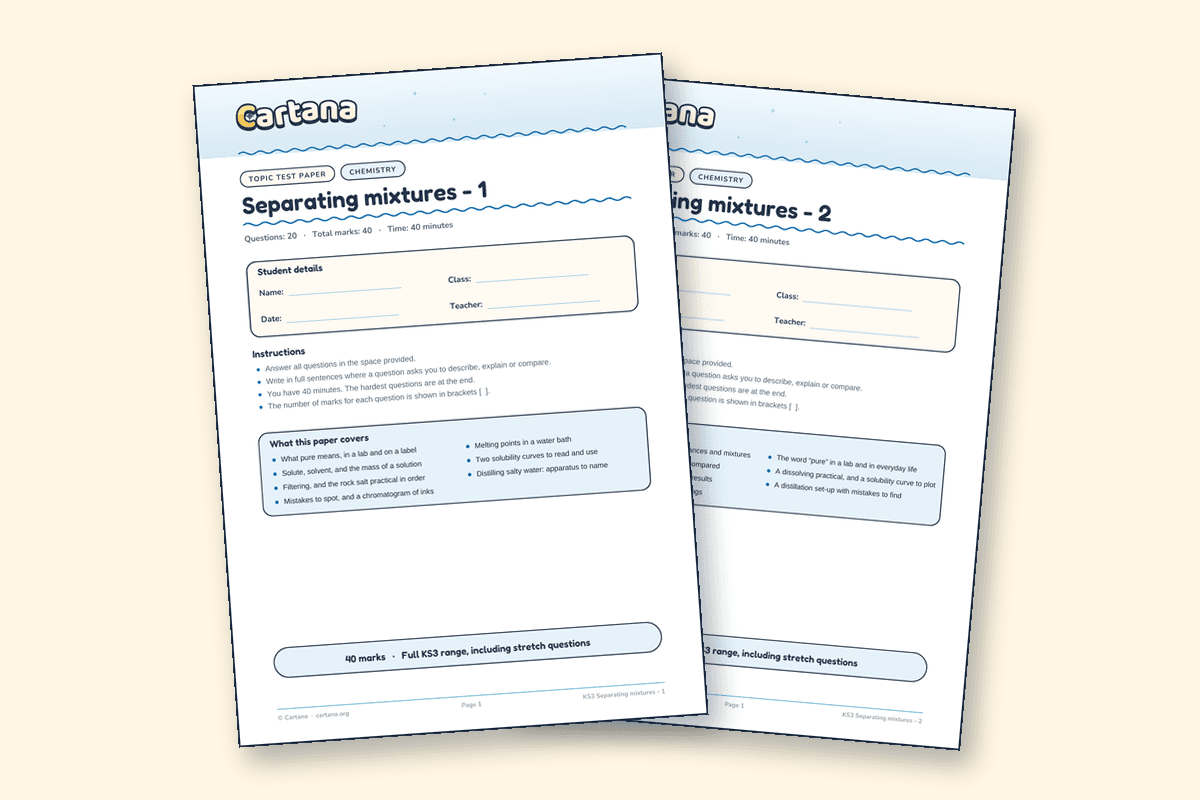
When every topic in separating mixtures is done, two different papers test the whole unit, each with its own mark scheme.


 Watch the trailer · 1:06
New from Cartana · Beta test 1–31 December
Revision that feels like an adventure
Cartana is our KS3 learning adventure: sail between islands, answer quick-fire questions and battle bosses. It starts with science, with maths on the way, and launches in 2027. This December a small group of testers gets to play it first.
In the Cartana adventure, every science unit is an island to explore. The island for separating mixtures is being built.
- Play the game before its official release
- Help us build it with your feedback
- Earn exclusive in-game items in return
More in this unit
Separating mixtures
- 1Pure and impure substancesWhat pure means in chemistry, mixtures, and testing purity by melting point
- 2Solutions and solubilitySolute, solvent and solution, dissolving, saturated solutions and solubility curves
- 3Filtration and crystallisationFiltering an insoluble solid, evaporating and crystallising a dissolved one, and the rock salt practical
- 5ChromatographyNextPaper chromatography: the method, why substances separate, and reading a chromatogram