
KS3 Chemistry · Particles & states of matter
Changes of state
- The changes of state: melting, freezing, boiling, evaporating, condensing, sublimation and deposition
- Melting and boiling points, and the difference between boiling and evaporating
- Energy and particles in a change of state, the heating curve and the cooling-curve practical
- Why mass is conserved when a substance melts, evaporates or dissolves
- 4 min read
- 5 quick questions
- Free homework sheet
- Years 7 to 9
Revision notes
A change of state is when a substance turns from solid to liquid, liquid to gas, or back again, as when ice melts or water boils. No new substance is made, the mass stays the same, and the change can be reversed.
What are the changes of state called?
- Melting: solid to liquid. Freezing is the reverse, liquid to solid.
- Boiling and evaporating: liquid to gas. Condensing is the reverse, gas to liquid, as when your breath mists a cold window.
- Sublimation: solid straight to gas, with no liquid in between. Solid carbon dioxide (dry ice) does this. The reverse, gas straight to solid, is called deposition: it is how frost forms.
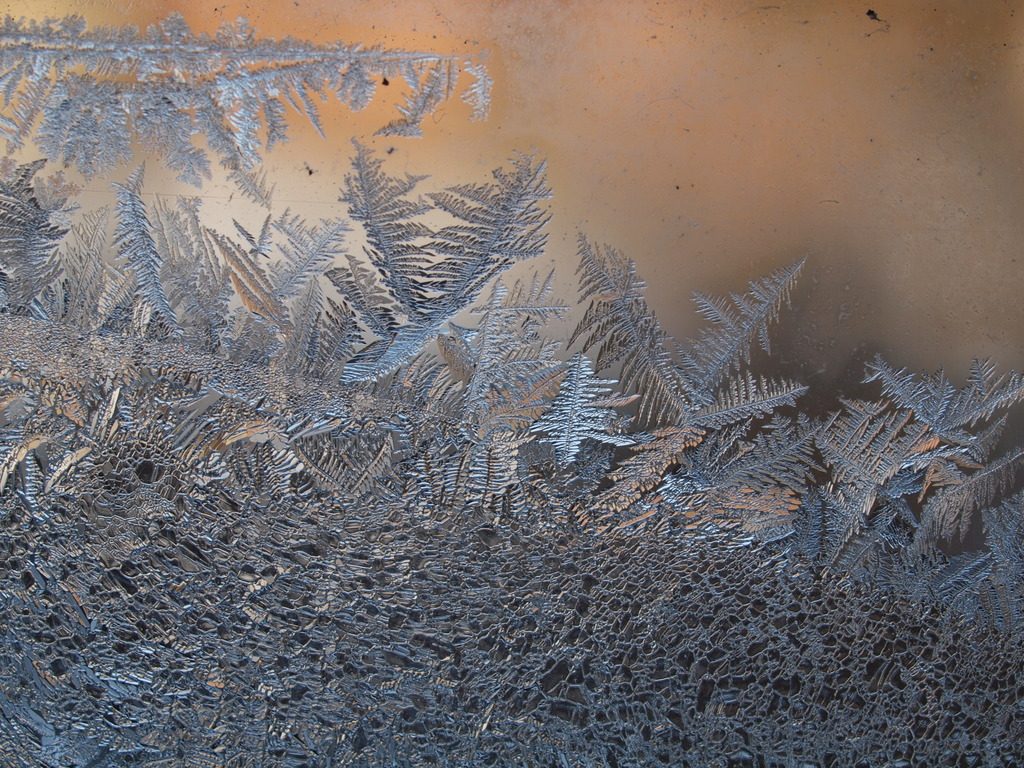
The melting point is the temperature at which a solid melts; the liquid freezes at the same temperature. The boiling point is the temperature at which a liquid boils. Below its melting point a substance is a solid, between the two it is a liquid, and above its boiling point it is a gas.
| Substance | Melts at (°C) | Boils at (°C) |
|---|---|---|
| Oxygen | −219 | −183 |
| Ethanol | −114 | 78 |
| Water | 0 | 100 |
| Iron | 1538 | 2862 |
So at 20 °C oxygen is a gas, ethanol and water are liquids, and iron is a solid.
What is the difference between boiling and evaporating?
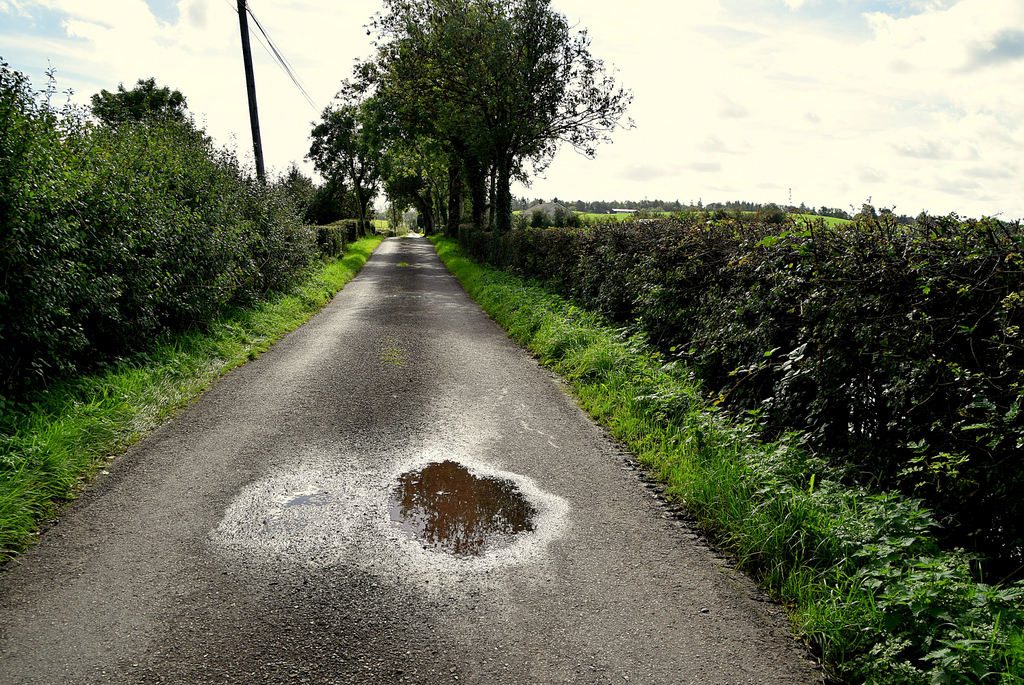
Happens at any temperature, but only at the surface of the liquid. The fastest particles escape into the air. Puddles dry this way, faster when it is warm or windy.
Happens only at the boiling point, all through the liquid. Bubbles of gas form inside the liquid and rise. The bubbles in boiling water are water vapour.
Evaporating cools what is left behind, because the fastest particles leave. That is why sweat cools you down.
What happens to the particles and their energy?
The energy stored in a material by its particles, in their movement and the forces between them, is its internal energy. Heating raises it. Within one state, the particles move faster and the temperature rises. At the melting point the energy goes into freeing the particles from their fixed places instead, so the temperature stays the same until it has all melted. The same happens at the boiling point, as the particles are pulled apart.
Melting, boiling and evaporating take energy in. Freezing and condensing give energy out: steam scalds worse than boiling water because it gives out extra energy as it condenses on your skin.
A classic practical: melt some stearic acid (a waxy solid) in a boiling tube in hot water, then let it cool with a thermometer in it, reading the temperature every 30 seconds. The temperature falls, stays steady while the liquid freezes, then falls again. The flat part of this cooling curve is the freezing point: energy given out as the particles settle into place stops the temperature falling.
Is mass conserved when a substance changes state?
Yes. The particles are only rearranged: none are made or destroyed, so the mass is conserved. This is the conservation of mass. 100 g of ice melts into 100 g of water. Dissolving conserves mass too: 100 g of water with 5 g of salt dissolved in it has a mass of 105 g. Changes of state are reversible: cool the water and it freezes back into ice. Dissolving is reversible too: evaporate the water from salt solution and the salt is left behind.
If water evaporates from an open beaker, the balance reading falls, but the mass has not vanished: the particles have gone into the air.
Stretch A boiling point depends on the air pressure. At the top of Mount Everest, where the pressure is low, water boils at about 70 °C. Inside a pressure cooker the higher pressure raises it to about 120 °C, so food cooks faster. See gas pressure.
Written to the KS3 national curriculum. Last changed 13 November 2026.
Key words
Say them, spell them, use them in an answer.
- change of state
- melting
- freezing
- boiling
- evaporating
- condensing
- sublimation
- deposition
- melting point
- boiling point
- internal energy
- conservation of mass
Common misconception
Often said“The bubbles in boiling water are bubbles of air.”
In factThey are water vapour: water turning into a gas inside the liquid. The tiny bubbles you see as cold water first warms up are dissolved air coming out, but the big bubbles at the boil are steam.
Did you know?
Dry ice
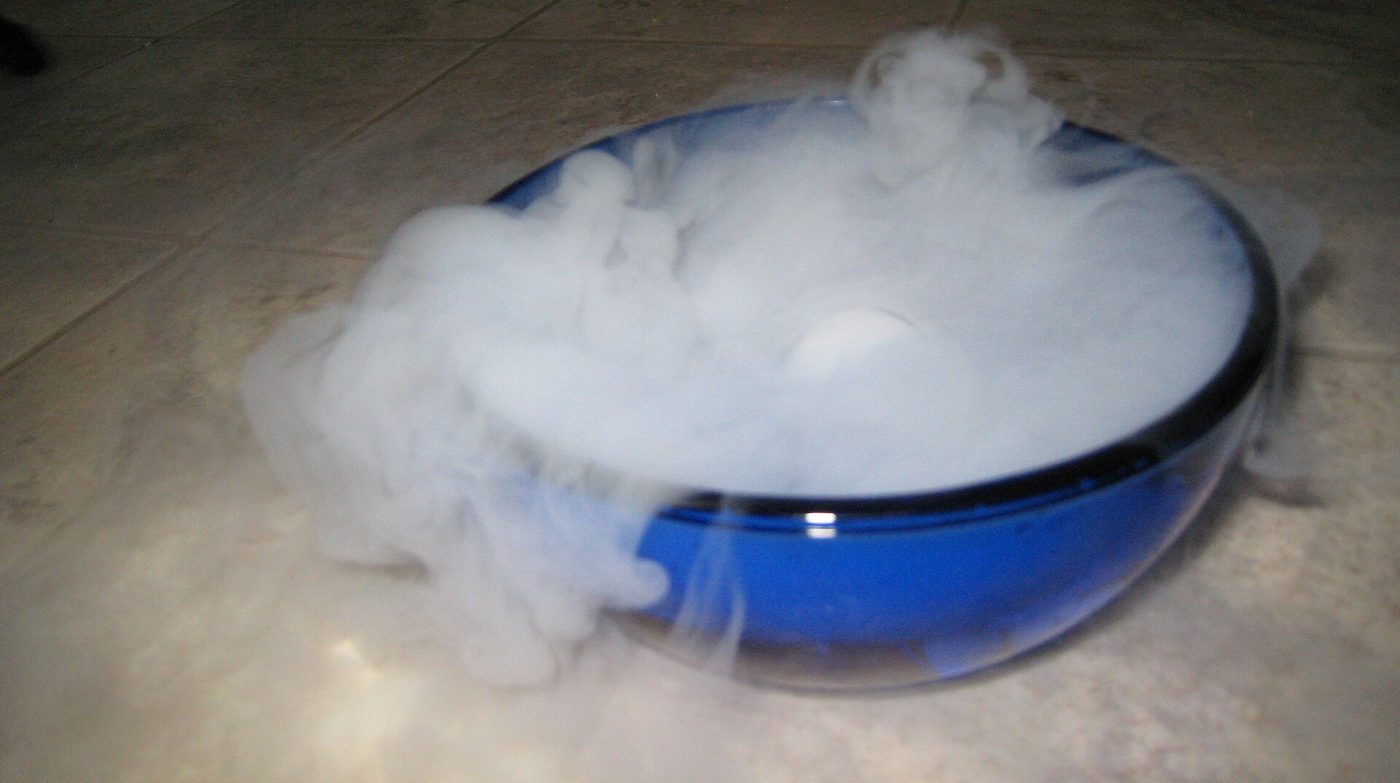
Solid carbon dioxide never melts at normal air pressure: it turns straight into a gas at −78.5 °C, which is why it is called dry ice. The white fog that pours off it is not carbon dioxide, which is invisible, but tiny drops of water condensed out of the air it chills.
Photo: Christopher from Salem, OR, USA, CC BY-SA 2.0, via Wikimedia Commons
Try 5 questions
Quick questions on changes of state, marked as you go. Each one explains the answer.
Question 1 of 5
Why does the temperature of melting ice stay at 0 °C until it has all melted?
Choose an answer. Each question explains itself.
The homework sheet
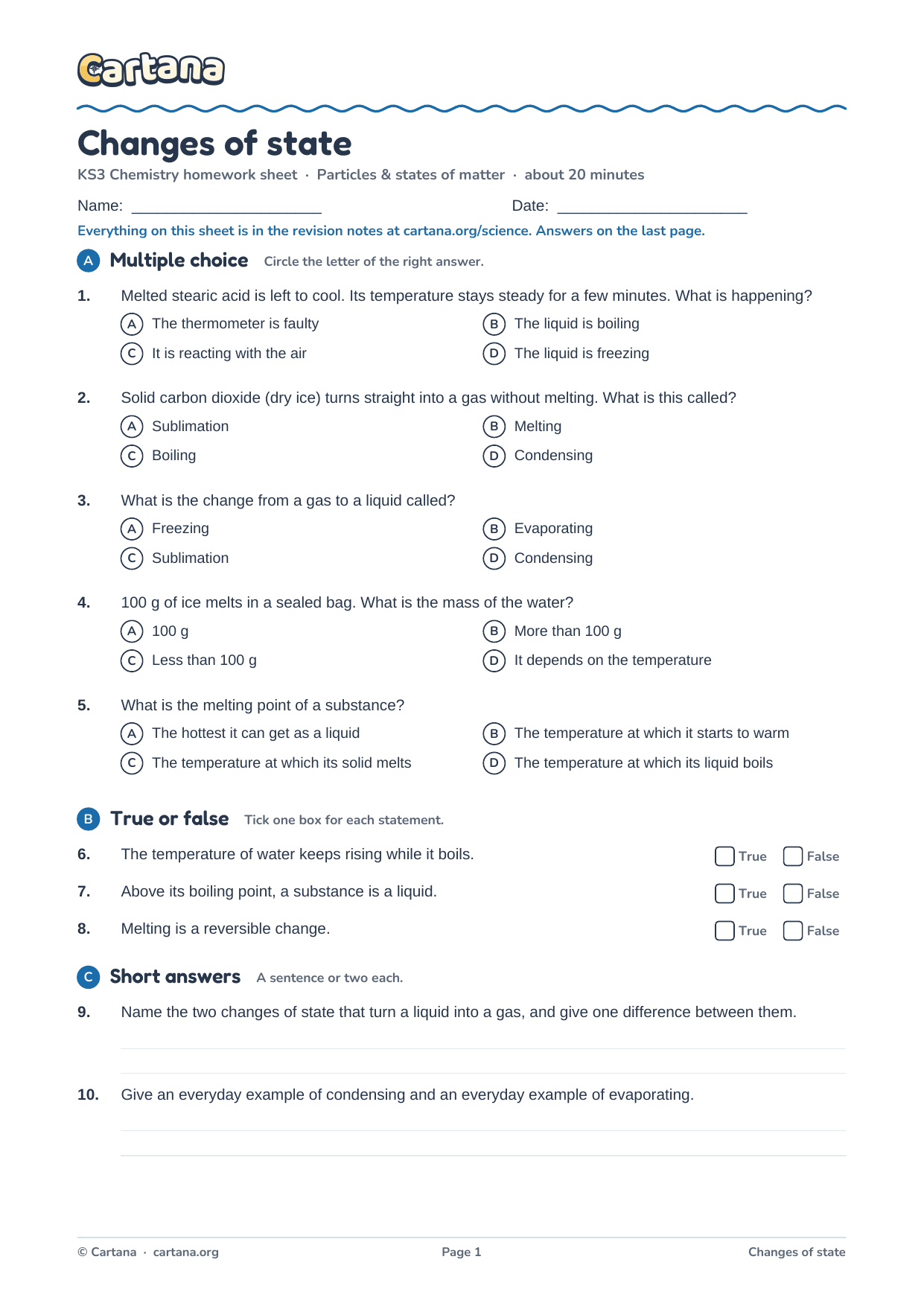
About twenty minutes. Everything on it is in the notes above; the answers are on the last page.
Free homework sheet
Changes of state homework sheet
17 questions, about twenty minutes, with the answers on the last page: multiple choice, true or false, short answers, key words to define and one to explain in full.
KS3 Particles & states of matter
Revised the whole unit?
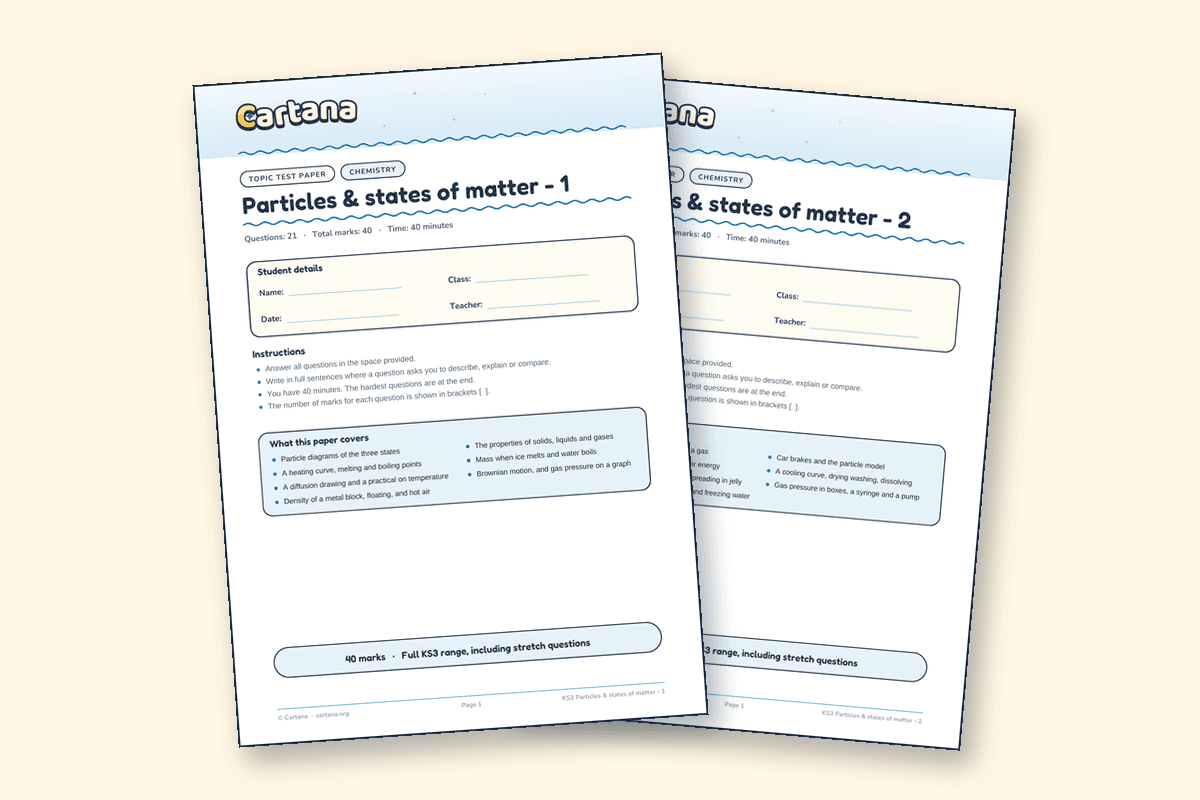
When every topic in particles & states of matter is done, two different papers test the whole unit, each with its own mark scheme.


 Watch the trailer · 1:06
New from Cartana · Beta test 1–31 December
Revision that feels like an adventure
Cartana is our KS3 learning adventure: sail between islands, answer quick-fire questions and battle bosses. It starts with science, with maths on the way, and launches in 2027. This December a small group of testers gets to play it first.
In the Cartana adventure, every science unit is an island to explore. The island for particles & states of matter is being built.
- Play the game before its official release
- Help us build it with your feedback
- Earn exclusive in-game items in return
More in this unit