
KS3 Chemistry · Particles & states of matter
Diffusion and Brownian motion
- What diffusion is: particles spreading from a high to a low concentration, on their own
- Diffusion in liquids and gases, and why it is faster in a gas and hardly happens in a solid
- What makes diffusion faster, and the hot and cold water test
- Brownian motion in a smoke cell, and why it is evidence for moving particles
- 4 min read
- 5 quick questions
- Free homework sheet
- Years 7 to 9
Revision notes
Diffusion is the spreading out of particles from where there are a lot of them (a high concentration) to where there are fewer (a low concentration). It happens on its own in liquids and gases, because their particles move about at random.
What is diffusion?
Open a bottle of perfume and it is soon smelt across the room, even with no draught to carry it. The concentration of a substance is how many of its particles there are in a given space. Next to the bottle the concentration of perfume particles is high; across the room it is low.
The particles of the air and the perfume move at random, bumping into each other all the time. Each is as likely to go one way as another, but where there are more particles, more move away. So overall, there is a net movement from the high concentration to the low concentration, until the particles are evenly mixed. They keep moving after that, but the mixture stays even.
Why is diffusion faster in a gas than in a liquid?
Gas particles move fast and are far apart, so they travel much further between collisions than the particles of a liquid. Liquid particles are touching, so each one is jostled back and forth by its neighbours all the time. In a solid, the particles stay in their places, so diffusion is far too slow to notice.
In a liquid: drop a purple crystal of potassium permanganate into a beaker of still water. The purple spreads slowly outwards, and after a few days the whole beaker is evenly coloured.
In a gas: a teacher, in a fume cupboard, puts a gas jar of brown bromine gas under a jar of air. After a quarter of an hour or so the brown colour has spread through both jars.
What makes diffusion faster?
- A higher temperature: the particles move faster.
- A bigger difference in concentration between the two places.
- Smaller, lighter particles, which move faster at the same temperature.
- A gas rather than a liquid.
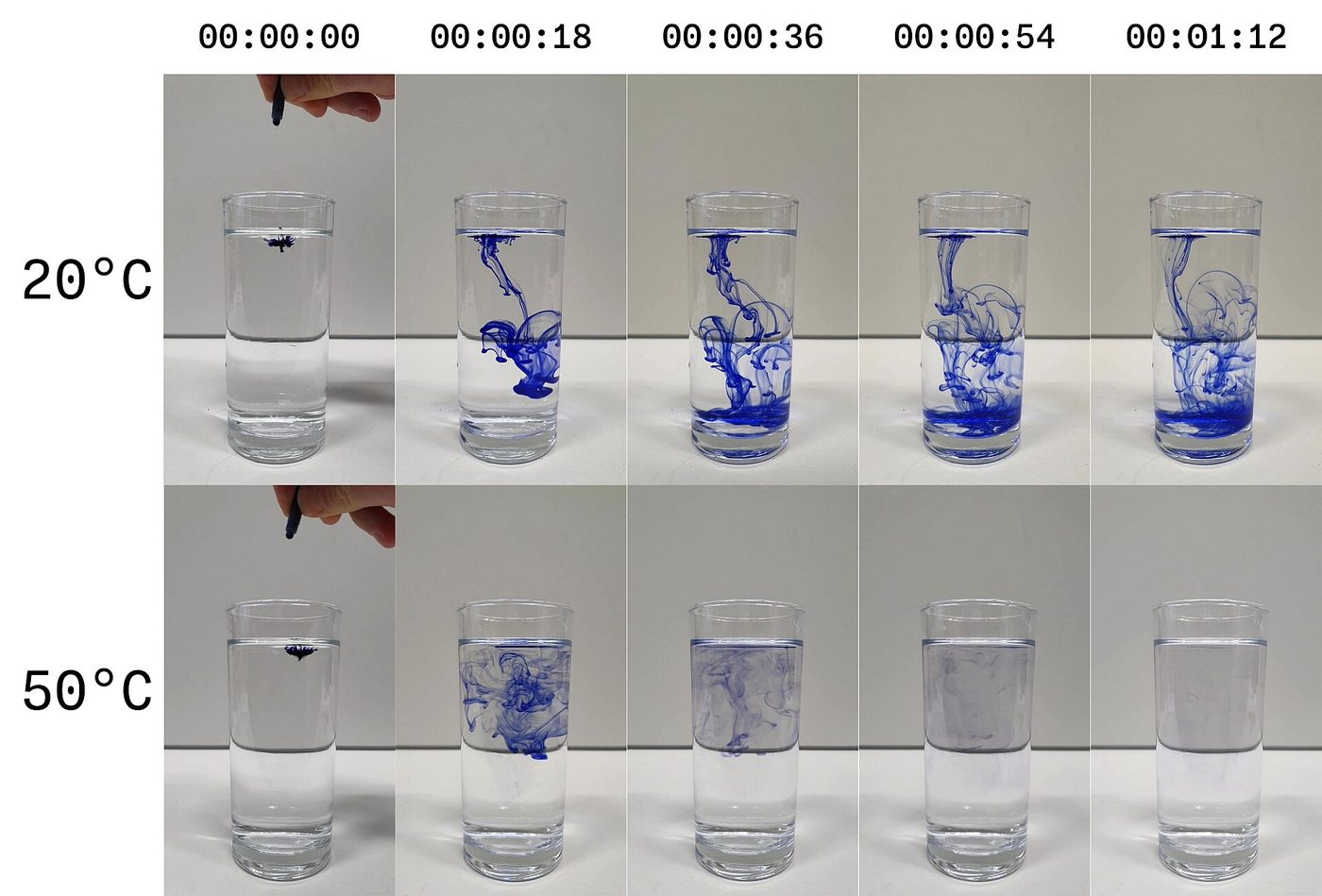
You can test the first one: drop food colouring into a glass of cold water and a glass of hot water at the same moment, without stirring. The colour spreads through the hot water faster. Living things depend on diffusion too (see cells at work).
What is Brownian motion?
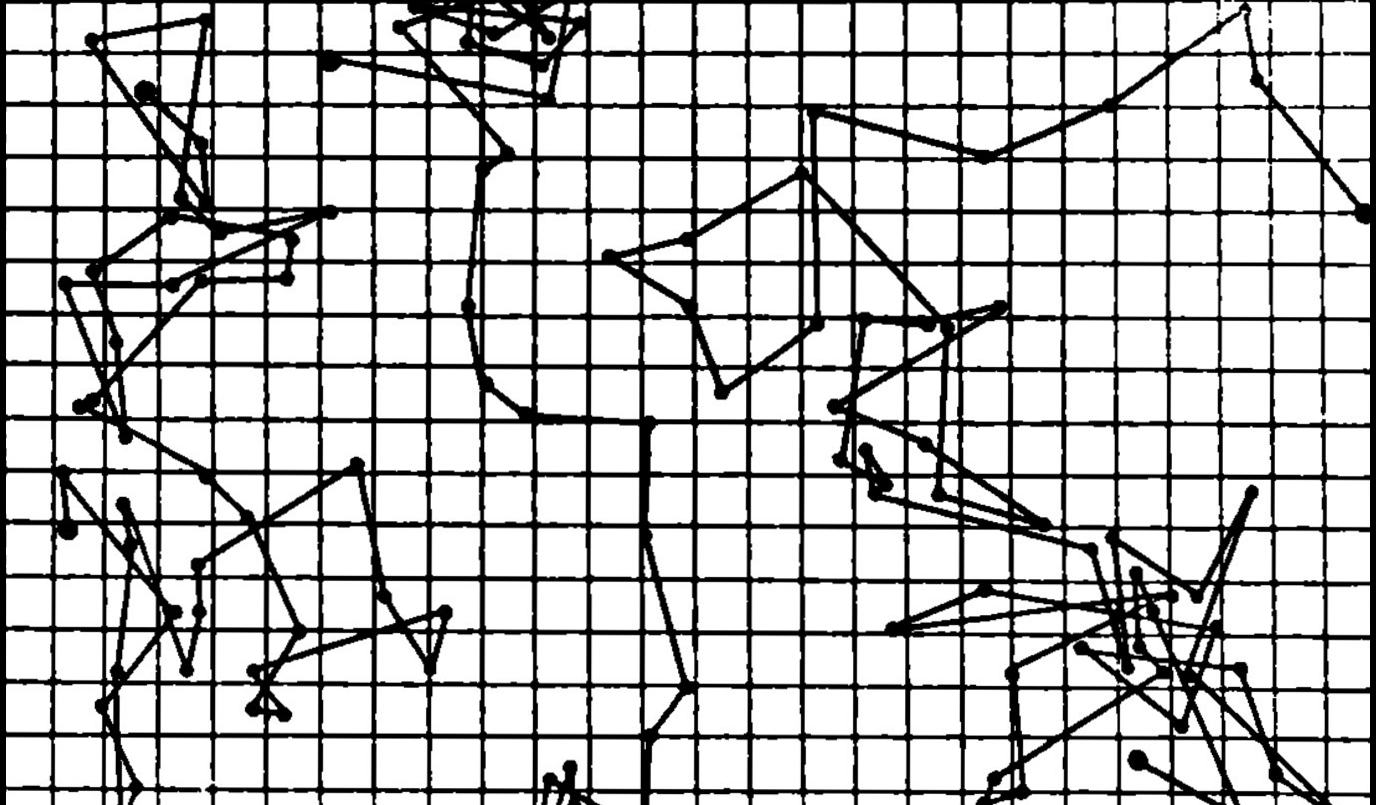
Put some smoke in a tiny glass box called a smoke cell, light it from the side and look through a microscope. The specks of smoke show up as points of light that jiggle about at random and never stop. This is Brownian motion.
Each speck is hit on every side by air particles far too small to see. At each moment a few more hit one side than the other, so the speck is pushed away from that side, then away from another. Brownian motion is evidence that air is made of tiny particles moving fast in all directions. The botanist Robert Brown first saw the jiggling in 1827, with tiny grains from inside pollen floating in water; in 1905 Albert Einstein explained it with moving particles.
Stretch Lighter particles diffuse faster. Put cotton wool soaked in ammonia solution in one end of a long glass tube and cotton wool soaked in hydrochloric acid in the other (a teacher does this in a fume cupboard). The gases diffuse towards each other and, where they meet, make a white ring of solid ammonium chloride. It forms nearer the hydrochloric acid end: ammonia particles are lighter, so they move faster and get further.
Written to the KS3 national curriculum. Last changed 13 November 2026.
Key words
Say them, spell them, use them in an answer.
- diffusion
- concentration
- net movement
- random
- temperature
- Brownian motion
- smoke cell
- evidence
- particle
Common misconception
Often said“Once the colour has spread out evenly, the particles stop moving.”
In factThey keep moving at random for as long as the substance is a liquid or a gas. The spreading stops only because as many particles now move one way as the other, so the mixture stays even.
Did you know?
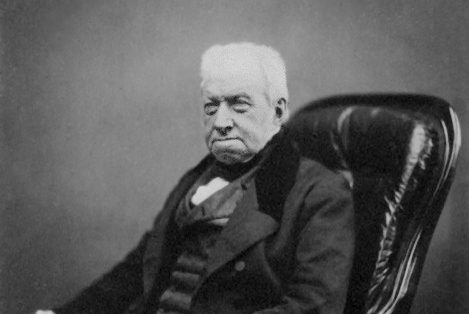
Robert Brown’s pollen
In 1827 the botanist Robert Brown watched tiny grains from inside pollen jiggling in water under his microscope. He wondered if they were alive, but specks of powdered rock and glass jiggled too. It was 1905 before Albert Einstein explained it: the grains were being knocked about by water molecules.
Photo: Maull & Polyblank, Public domain, via Wikimedia Commons
Try 5 questions
Quick questions on diffusion and Brownian motion, marked as you go. Each one explains the answer.
Question 1 of 5
In a smoke cell, why do the specks of smoke jiggle about?
Choose an answer. Each question explains itself.
The homework sheet
About twenty minutes. Everything on it is in the notes above; the answers are on the last page.
Free homework sheet
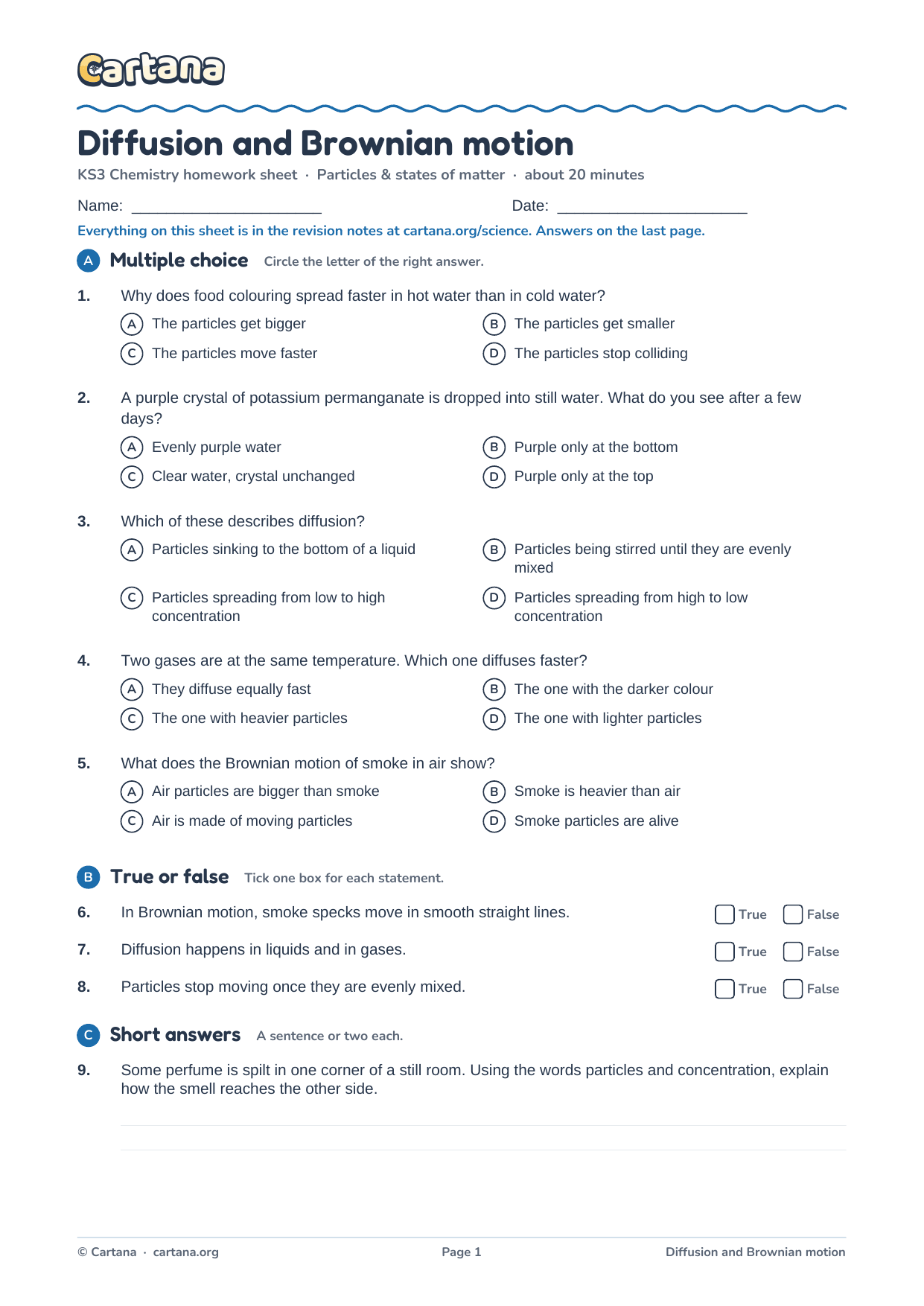
Diffusion and Brownian motion homework sheet
17 questions, about twenty minutes, with the answers on the last page: multiple choice, true or false, short answers, key words to define and one to explain in full.
KS3 Particles & states of matter
Revised the whole unit?
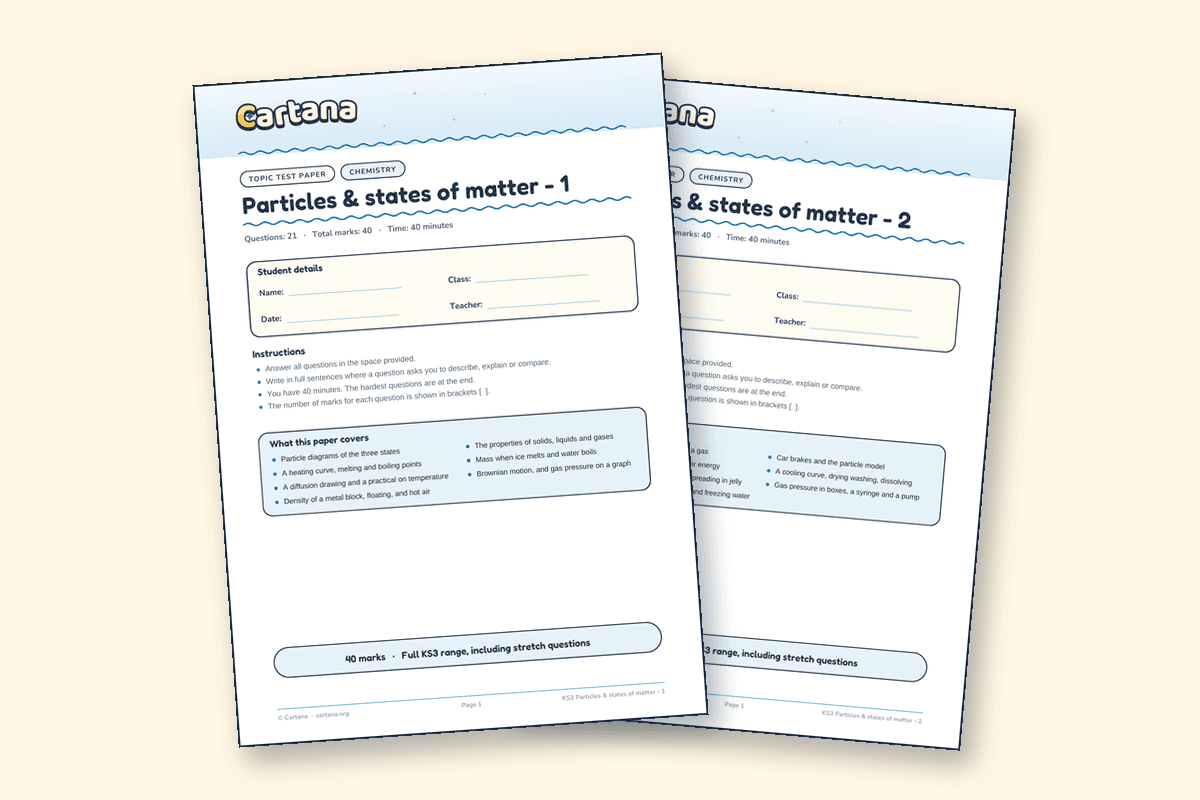
When every topic in particles & states of matter is done, two different papers test the whole unit, each with its own mark scheme.


 Watch the trailer · 1:06
New from Cartana · Beta test 1–31 December
Revision that feels like an adventure
Cartana is our KS3 learning adventure: sail between islands, answer quick-fire questions and battle bosses. It starts with science, with maths on the way, and launches in 2027. This December a small group of testers gets to play it first.
In the Cartana adventure, every science unit is an island to explore. The island for particles & states of matter is being built.
- Play the game before its official release
- Help us build it with your feedback
- Earn exclusive in-game items in return
More in this unit