
KS3 Physics · Light
Reflection
- The law of reflection, measured from the normal
- The ray-box practical, step by step
- Specular reflection from mirrors, diffuse reflection from rough surfaces
- What the image in a plane mirror is like
- 5 min read
- 5 quick questions
- Free homework sheet
- Years 7 to 9
Revision notes
Reflection is light bouncing off a surface. At a mirror, the angle of incidence always equals the angle of reflection, and both are measured from the normal: a line drawn at right angles to the mirror.
What is the law of reflection?
The ray going in to a mirror is the incident ray; the ray coming off it is the reflected ray. Where the incident ray hits, draw the normal: a line at right angles (90°) to the surface, shown dashed. The angle of incidence is the angle between the incident ray and the normal. The angle of reflection is the angle between the reflected ray and the normal.
Both angles are measured in degrees (°). This is the law of reflection.
A ray hits a mirror at 30° to the mirror’s surface. What is the angle of reflection?
The angle must be measured from the normal, which is at 90° to the mirror.
angle of incidence = 90° − 30° = 60°
angle of reflection = angle of incidence = 60°
How do you investigate reflection with a ray box?
A ray box is a lamp in a box with a narrow slit, so that it sends out a thin beam you can draw round.
- Draw a straight line on paper and stand a plane mirror on it.
- Use a protractor to draw the normal at 90° to the line, and lines at 20°, 30°, 40°, 50° and 60° to the normal.
- Shine the ray box along each line in turn, so it hits the mirror where the normal meets it.
- Mark the reflected ray with two crosses, remove the mirror, join the crosses and measure the angle of reflection from the normal.
Each angle of reflection comes out equal to its angle of incidence, give or take a degree or two (the ray has a width, and it is hard to line up exactly). Do it in a darkened room so the ray is easy to see, and let the ray box cool before you touch its bulb.
Why can you see yourself in a mirror but not in a wall?
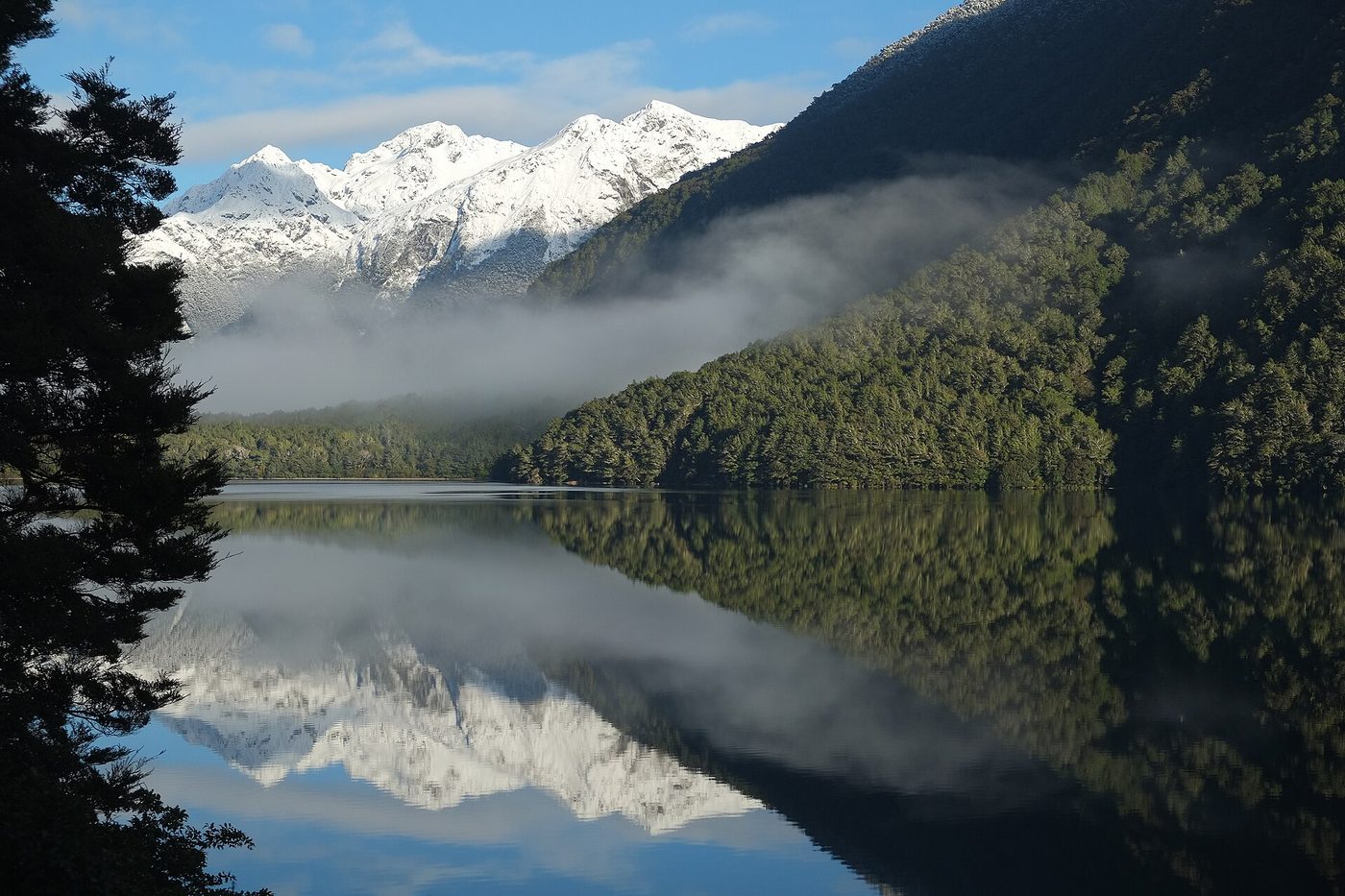
A mirror is very smooth. Parallel rays hitting it all meet the surface at the same angle, so they leave parallel to each other. This is specular reflection, and it gives a clear image. Calm water and polished metal do it too.
Paper, a wall or your skin is rough on a tiny scale. Each ray still obeys the law of reflection, but every bump faces a different way, so the rays scatter in all directions. This is diffuse reflection. It gives no image, but it is why you can see the page from anywhere in the room.
What is the image in a plane mirror like?
A flat mirror is a plane mirror. Light from an object reflects off it into your eye, and your brain follows the rays back in straight lines, so the object seems to be behind the glass. The image in a plane mirror is:
- the same size as the object, and the right way up
- as far behind the mirror as the object is in front of it
- laterally inverted: left and right are swapped, so writing reads backwards
- a virtual image: no light really reaches the place behind the mirror, so the image cannot be caught on a screen
That is why AMBULANCE is printed backwards on the front of an ambulance: in a driver’s mirror it reads the right way round. A periscope uses two plane mirrors at 45° to let you see over a wall.
Stretch How tall must a mirror be to show the whole of you? Light from your feet must reflect into your eyes. By the law of reflection it hits the mirror at a height halfway between your feet and your eyes. Light from the top of your head hits halfway between your head and your eyes. So the mirror needs to be only half your height, and it works however far away you stand.
Written to the KS3 national curriculum. Last changed 14 November 2026.
Key words
Say them, spell them, use them in an answer.
- incident ray
- reflected ray
- normal
- angle of incidence
- angle of reflection
- law of reflection
- ray box
- specular reflection
- diffuse reflection
- plane mirror
- laterally inverted
- virtual image
Common misconception
Often said“Only shiny things like mirrors reflect light.”
In factEverything you can see reflects some light: that is how you see it. A mirror is so smooth that it reflects light in an orderly way and gives an image. Rough surfaces, like paper, scatter the light in every direction (diffuse reflection), so they give no image.
Did you know?
Mirrors on the Moon
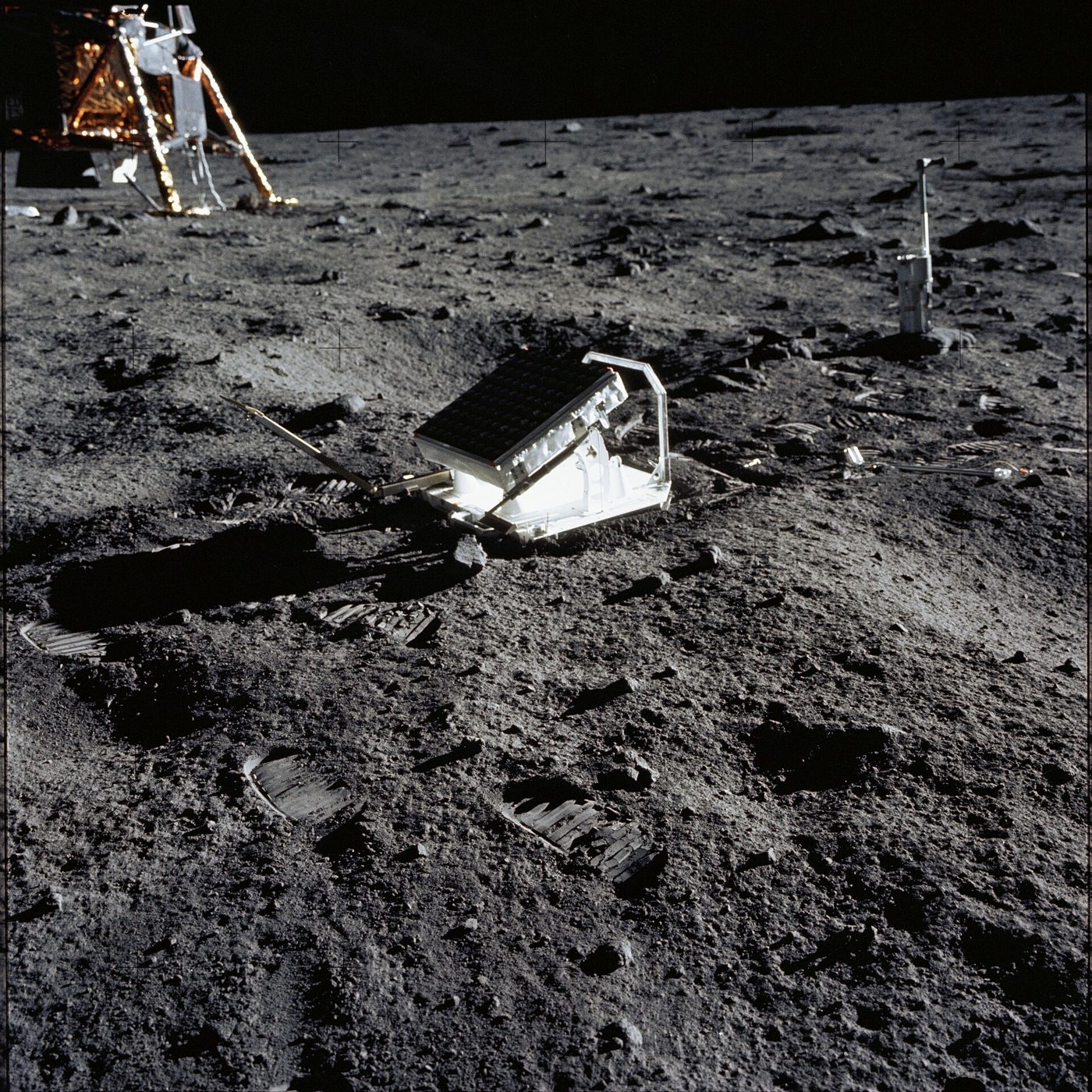
In July 1969 the Apollo 11 astronauts left a panel of 100 small reflectors on the Moon. Observatories still fire laser pulses at it and time the trip there and back, about 2.5 seconds, to measure the Moon’s distance to within a few millimetres.
Photo: NASA (Apollo 11 crew), Public domain, via Wikimedia Commons
Try 5 questions
Quick questions on reflection, marked as you go. Each one explains the answer.
Question 1 of 5
In the ray-box practical, why do you mark the reflected ray with two crosses?
Choose an answer. Each question explains itself.
The homework sheet
About twenty minutes. Everything on it is in the notes above; the answers are on the last page.
Free homework sheet
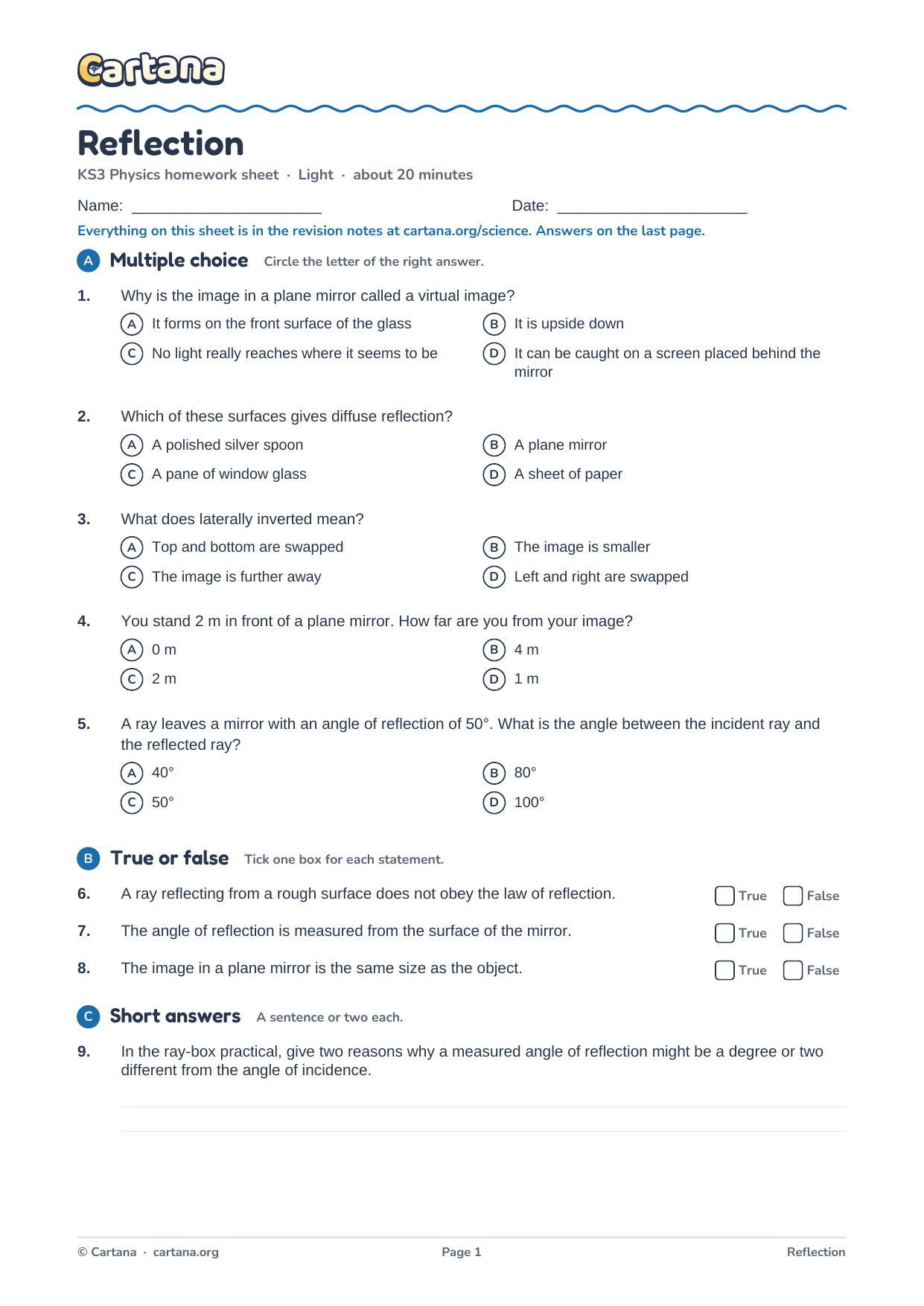
Reflection homework sheet
17 questions, about twenty minutes, with the answers on the last page: multiple choice, true or false, short answers, key words to define and one to explain in full.
KS3 Light
Revised the whole unit?
When every topic in light is done, two different papers test the whole unit, each with its own mark scheme.


 Watch the trailer · 1:06
New from Cartana · Beta test 1–31 December
Revision that feels like an adventure
Cartana is our KS3 learning adventure: sail between islands, answer quick-fire questions and battle bosses. It starts with science, with maths on the way, and launches in 2027. This December a small group of testers gets to play it first.
In the Cartana adventure, every science unit is an island to explore. The island for light is being built.
- Play the game before its official release
- Help us build it with your feedback
- Earn exclusive in-game items in return
More in this unit
Light
- 1How light travelsLight as a wave that needs no medium, its speed, rays and shadows, transparent, translucent and opaque materials, luminous and non-luminous objects, and light against sound
- 3RefractionNextLight changing speed and direction between materials, bending towards and away from the normal, the glass block practical, and a convex lens bringing rays to a focus
- 4The eye and the cameraThe parts of the eye and their jobs, the image on the retina, the pinhole camera, the camera and the eye compared, and light causing chemical and electrical changes
- 5ColourWhite light split by a prism, the spectrum and frequency, the primary colours of light, filters, and why objects look coloured in white and coloured light