
KS3 Physics · Light
The eye and the camera
- The parts of the eye and the job of each
- Why the image on the retina is upside down
- How a pinhole camera works and what changes its image
- How light makes chemical and electrical changes in the eye and in cameras
- 5 min read
- 5 quick questions
- Free homework sheet
- Years 7 to 9
Revision notes
The eye is the organ that detects light. Its cornea and lens focus light into an upside-down image on the retina, whose light-sensitive cells send electrical signals along the optic nerve to the brain.
What are the parts of the eye and what do they do?
| Part | What it does |
|---|---|
| Cornea | The clear, curved front window. It does most of the bending (refraction) of light. |
| Iris | The coloured ring of muscle. It changes the size of the pupil. |
| Pupil | The hole in the iris that lets light in. It looks black because light goes in and does not come back out. |
| Lens | Sits just behind the pupil and fine-tunes the focus. Muscles change its shape: fatter for near things, thinner for far ones. |
| Retina | The light-sensitive layer at the back, where the image forms. |
| Optic nerve | Carries electrical signals from the retina to the brain. |
In bright light the iris makes the pupil smaller, so less light gets in and the retina is protected. In dim light the pupil opens wider to let more in. You can watch this in a mirror: cover one eye for a few seconds, then uncover it and see its pupil shrink.
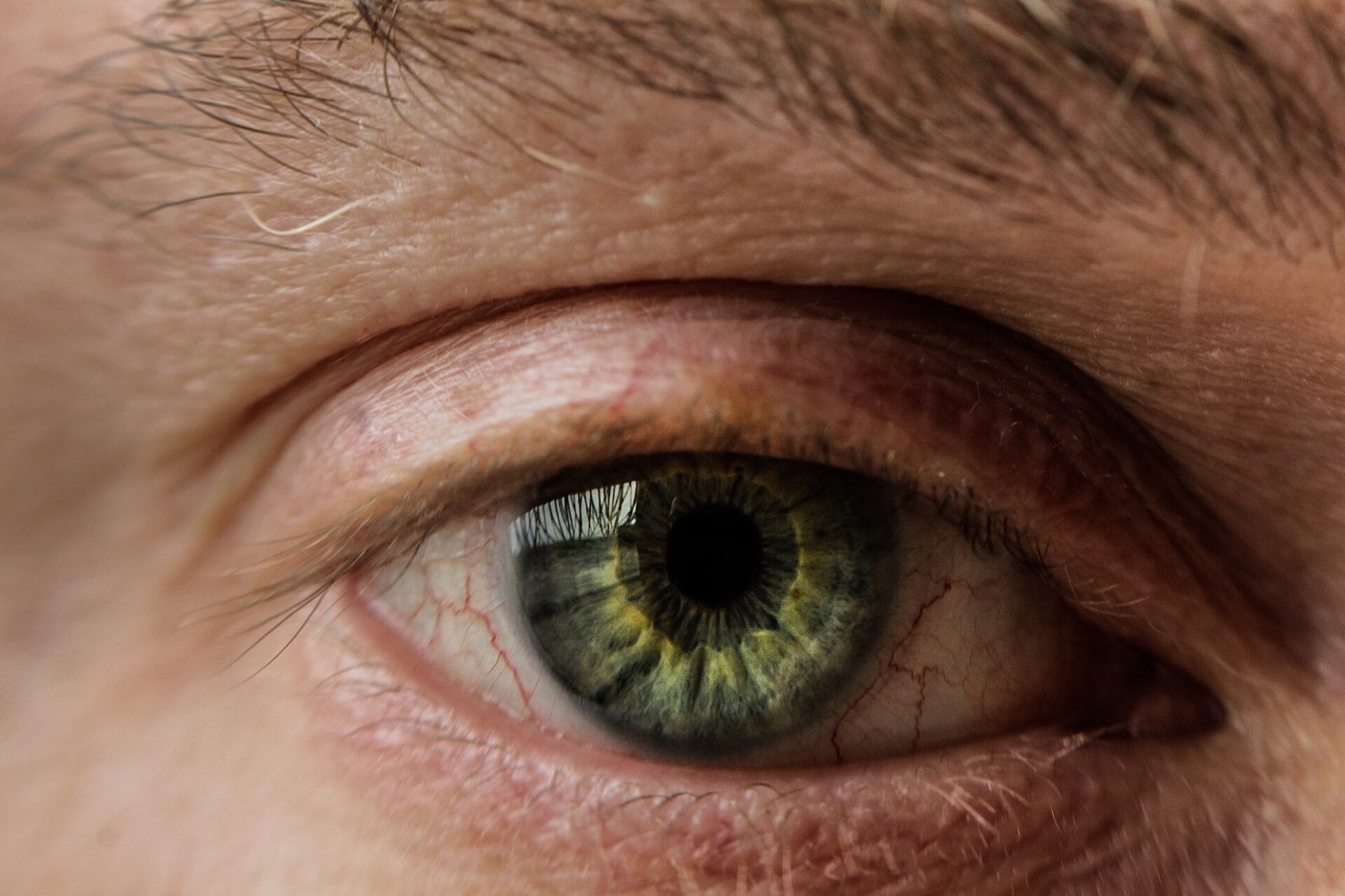
How does the eye make an image?
Light from each point of an object spreads out and enters the eye. The cornea and the lens refract it so that the light from each point meets again at one point on the retina. The image on the retina is upside down (inverted) and much smaller than the object. It is a real image: light really arrives there. The brain turns the picture the right way up.
How does a pinhole camera work?
A pinhole camera is a light-tight box with a tiny hole at the front and a translucent screen of tracing paper at the back. Point it at a bright object, such as a candle flame or a window, in a dim room, and look at the screen.
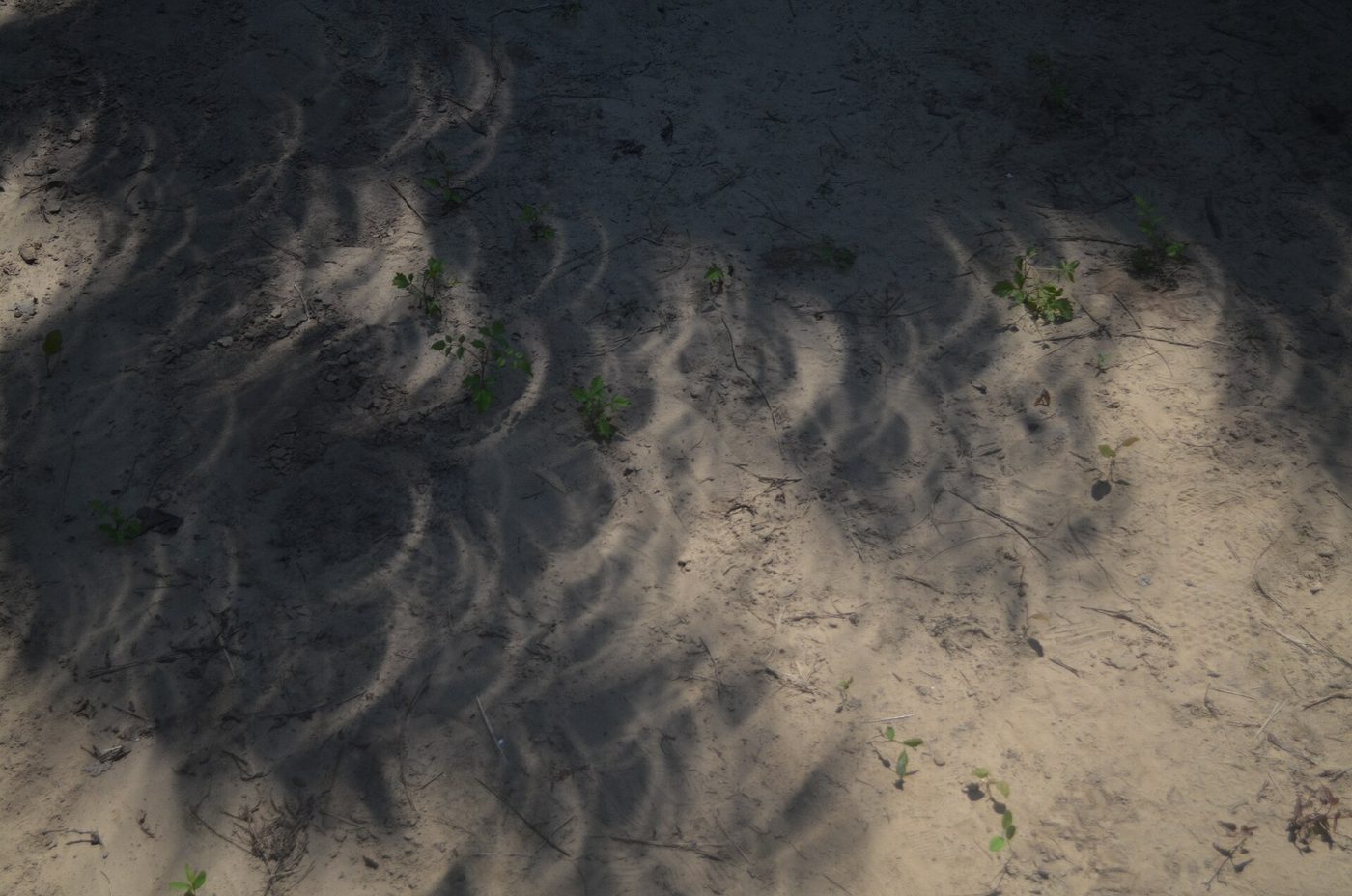
You see a small, dim, upside-down picture of the object on the screen. It shows that light travels in straight lines: light from the top of the object can only reach the screen by going straight through the hole and on downwards, so it lands at the bottom. Left and right swap over too.
- A bigger hole lets in more light, so the image is brighter but more blurred.
- A longer box (screen further from the hole) gives a bigger, dimmer image.
- Moving the camera closer to the object also makes the image bigger.
How are the eye and a camera alike?
A camera is built like an eye, with a lens instead of a pinhole so that it lets in plenty of light and still gives a sharp image.
| Job | Eye | Camera |
|---|---|---|
| Lets light in | Pupil | Aperture (the opening) |
| Controls the light | Iris | Diaphragm and shutter |
| Focuses | Lens changes shape | Lens moves |
| Detects light | Retina | Sensor or film |
In both, the image is upside down where it is detected.
How does light cause chemical and electrical changes?
Light carries energy from its source to whatever absorbs it, and the absorbed energy can make things happen. A photosensitive material is one that changes when light falls on it.
- In the retina, light-sensitive cells called rods (which work in dim light, in black and white) and cones (which see colour in brighter light) absorb light. A chemical in them changes, and the cells send electrical signals along the optic nerve.
- In a film camera, light causes a chemical change in the film, which darkens where light fell.
- In a digital camera, each tiny light-sensitive square of the sensor turns light into an electrical signal, building a picture of millions of dots.
Light drives other changes too: it powers the chemical reactions of photosynthesis in plants, and solar cells turn it into electricity.
Stretch Glasses correct eyes that focus in the wrong place. In a short-sighted eye, light from distant things meets in front of the retina, so far things look blurred; a concave lens spreads the rays a little first, moving the focus back onto the retina. In a long-sighted eye, light from near things would meet behind the retina; a convex lens bends the rays in a little first.
Written to the KS3 national curriculum. Last changed 14 November 2026.
Key words
Say them, spell them, use them in an answer.
- cornea
- iris
- pupil
- lens
- retina
- optic nerve
- real image
- pinhole camera
- photosensitive
- rods
- cones
Common misconception
Often said“The pupil is a black spot painted on the front of the eye.”
In factThe pupil is a hole in the iris that lets light into the eye. It looks black because light goes in and is absorbed inside the eye, so almost none comes back out to you.
Try 5 questions
Quick questions on the eye and the camera, marked as you go. Each one explains the answer.
Question 1 of 5
Which cells in the retina let you see colour?
Choose an answer. Each question explains itself.
The homework sheet
About twenty minutes. Everything on it is in the notes above; the answers are on the last page.
Free homework sheet
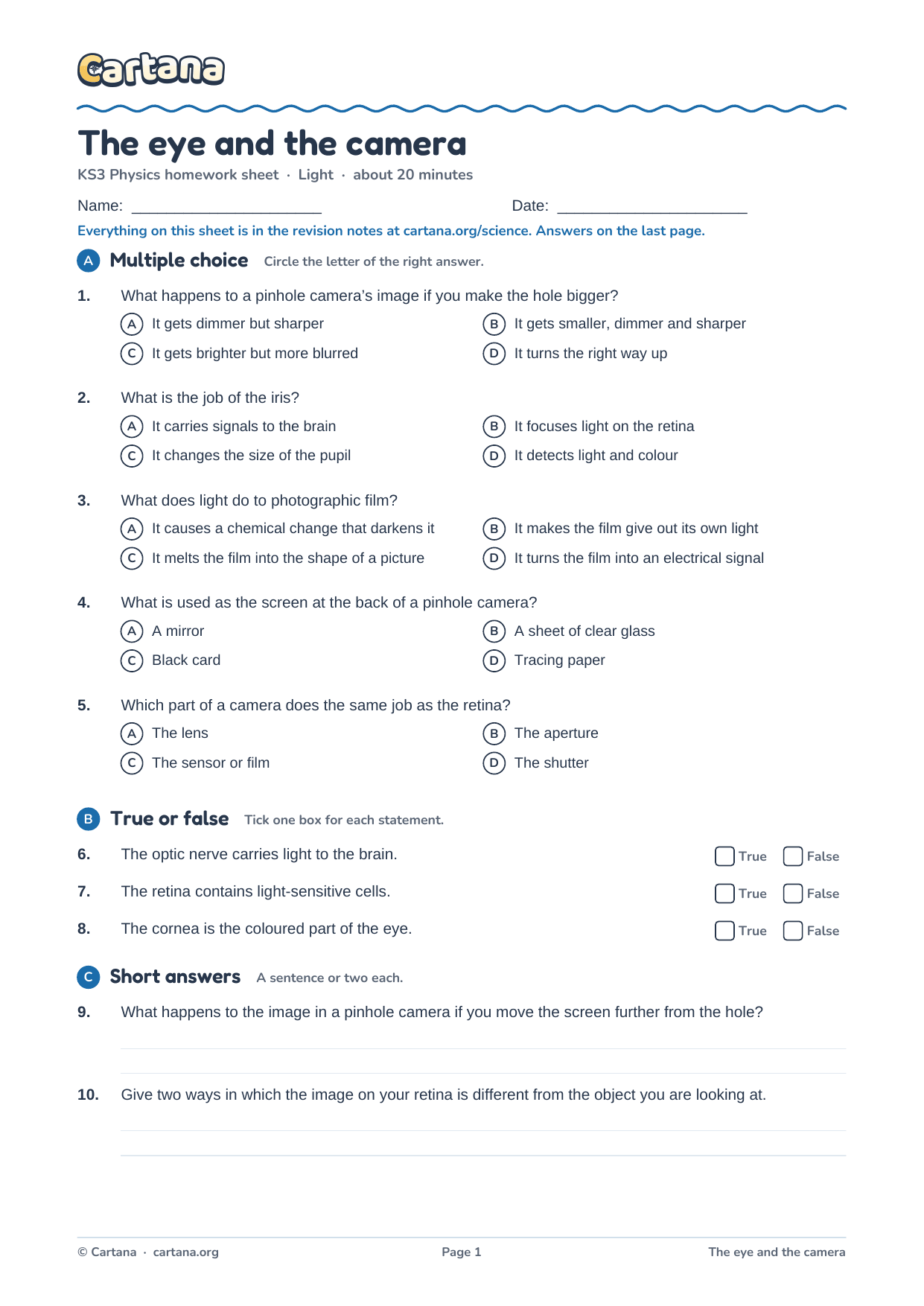
The eye and the camera homework sheet
17 questions, about twenty minutes, with the answers on the last page: multiple choice, true or false, short answers, key words to define and one to explain in full.
KS3 Light
Revised the whole unit?
When every topic in light is done, two different papers test the whole unit, each with its own mark scheme.


 Watch the trailer · 1:06
New from Cartana · Beta test 1–31 December
Revision that feels like an adventure
Cartana is our KS3 learning adventure: sail between islands, answer quick-fire questions and battle bosses. It starts with science, with maths on the way, and launches in 2027. This December a small group of testers gets to play it first.
In the Cartana adventure, every science unit is an island to explore. The island for light is being built.
- Play the game before its official release
- Help us build it with your feedback
- Earn exclusive in-game items in return
More in this unit
Light
- 1How light travelsLight as a wave that needs no medium, its speed, rays and shadows, transparent, translucent and opaque materials, luminous and non-luminous objects, and light against sound
- 2ReflectionThe law of reflection, the normal, specular and diffuse reflection, the image in a plane mirror and the ray-box practical
- 3RefractionLight changing speed and direction between materials, bending towards and away from the normal, the glass block practical, and a convex lens bringing rays to a focus
- 5ColourNextWhite light split by a prism, the spectrum and frequency, the primary colours of light, filters, and why objects look coloured in white and coloured light