
KS3 Chemistry · Earth & atmosphere
The atmosphere
- The gases in dry air and their percentages, and parts per million
- Water vapour, and where the oxygen in the air came from
- Showing that air is about one fifth oxygen, with a worked example
- Tests for oxygen, carbon dioxide, hydrogen and water
- 4 min read
- 5 quick questions
- Free homework sheet
- Years 7 to 9
Revision notes
The atmosphere is the layer of gases held round the Earth by gravity. Dry air is about 78% nitrogen, 21% oxygen, 0.9% argon and 0.04% carbon dioxide, with tiny amounts of other gases.
What gases are in the air?
Air is a mixture of gases: they are not chemically joined, and the numbers below are shares of the volume, rounded. Out of every 100 particles in dry air, about 78 are nitrogen molecules and 21 are oxygen molecules.
| Gas | Formula | Share of dry air |
|---|---|---|
| Nitrogen | N2 | 78% |
| Oxygen | O2 | 21% |
| Argon | Ar | 0.9% |
| Carbon dioxide | CO2 | About 0.04% |
| Others | Ne, He, CH4 … | Less than 0.01% in all |
- Nitrogen is very unreactive, so most of it just stays in the air.
- Oxygen is the gas that living things use in respiration and that fuels need to burn.
- Argon is a noble gas, so it hardly reacts at all (see group 0).
- Carbon dioxide is a tiny share, but plants need it for photosynthesis, and it traps heat. Very small amounts are often given in parts per million (ppm): 0.04% is 400 ppm. In 2025 it was about 427 ppm, and rising (see climate change).
Real air also holds water vapour. The amount changes from place to place and day to day, from almost none in very cold or dry air up to about 4% in warm, steamy places, so the table is for dry air.
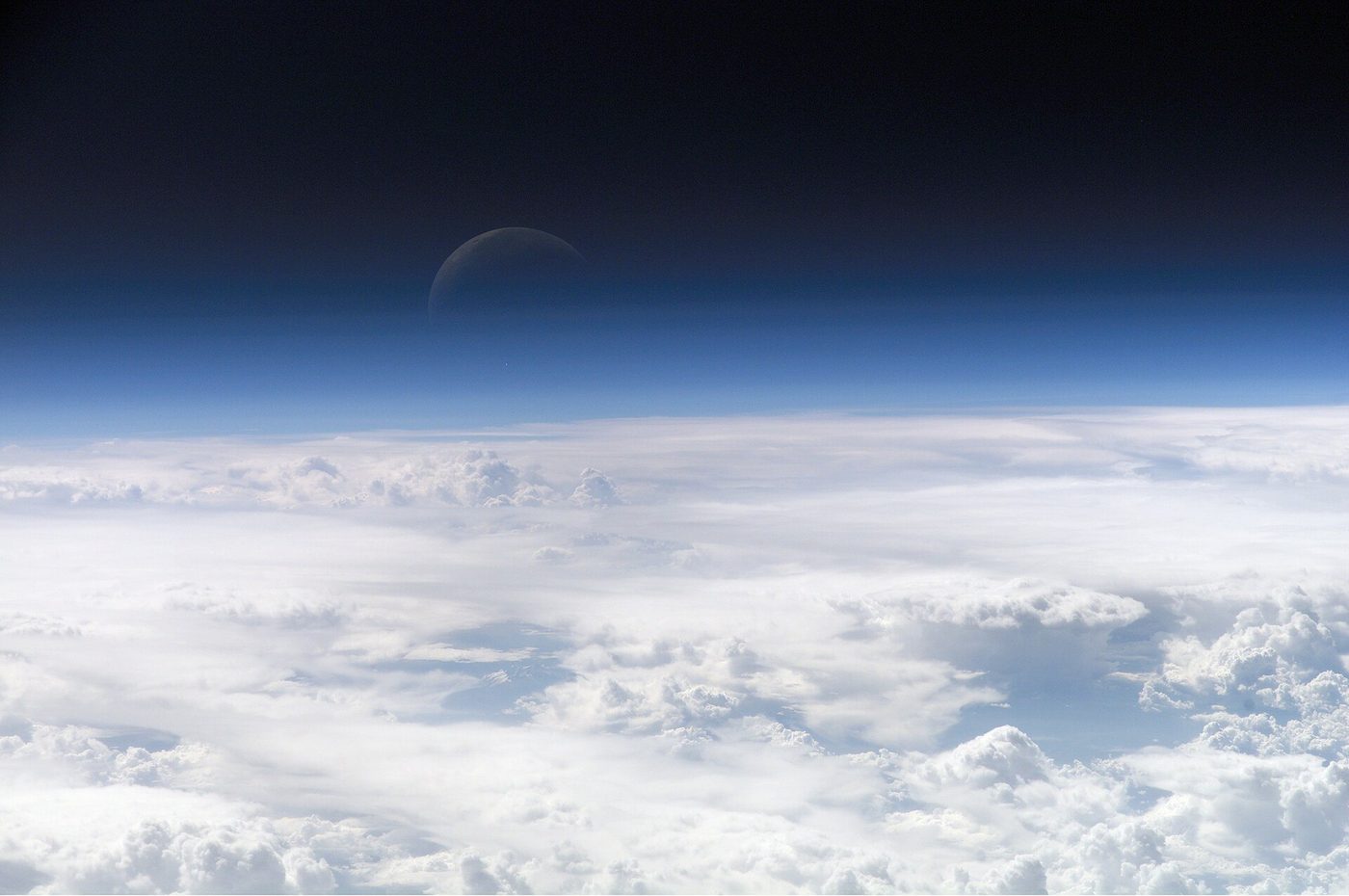
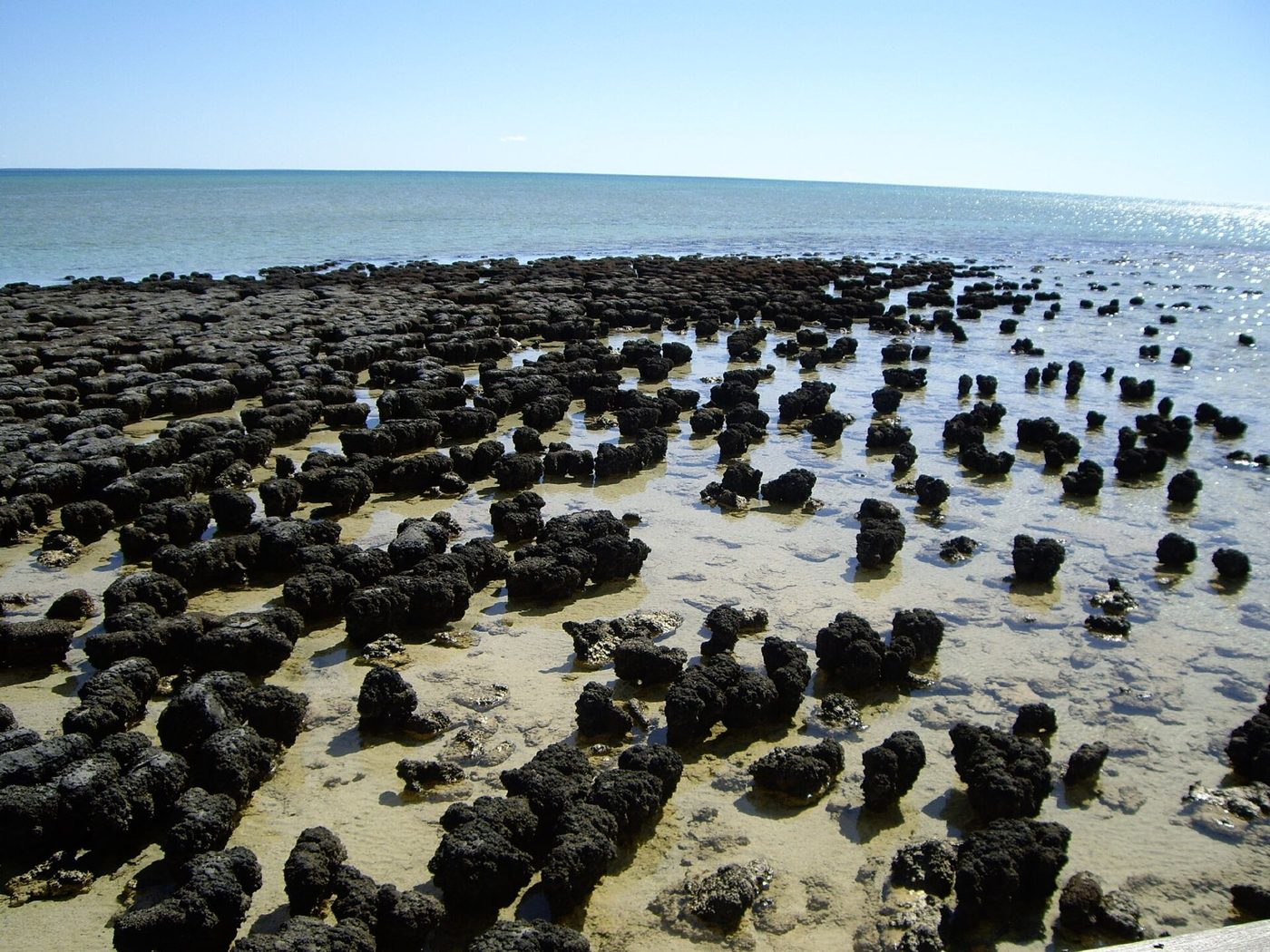
Where did the oxygen come from?
The Earth’s early atmosphere had almost no oxygen. Oxygen began to build up about 2.4 billion years ago. It was made by photosynthesis, first by tiny living things in the oceans and later by plants too.
How can you show that air is about one fifth oxygen?
- Push some damp iron wool into the closed end of a measuring cylinder.
- Stand the cylinder upside down in a trough of water, clamped, and read the volume of trapped air.
- Leave it for about a week, then read the volume again.
What you see: the iron wool goes rusty, and water rises up the cylinder, then stops. What it shows: rusting uses up the oxygen in the trapped air, and water moves up to fill its space. The rest of the air, mostly nitrogen, does not react.
At the start the cylinder holds 120 cm3 of air. A week later it holds 95 cm3. What percentage of the air was used up?
Volume used = 120 − 95 = 25 cm3
Percentage used = 25 ÷ 120 × 100 = 20.8%, about 21%
So about 21% of the air was oxygen.
How do you test for gases?
| Gas | Test | Result |
|---|---|---|
| Oxygen | Put a glowing splint into the gas | The splint relights |
| Carbon dioxide | Bubble the gas through limewater | The limewater turns milky |
| Hydrogen | Hold a lit splint at the mouth of the tube | A squeaky pop |
| Water vapour | Let it touch blue cobalt chloride paper | The paper turns pink |
A burning splint going out does not prove the gas is carbon dioxide: nitrogen puts out a flame too. Limewater is the test.
Stretch In 1892 Lord Rayleigh found that nitrogen taken from air was about half a percent denser than nitrogen made from chemicals. In 1894, with William Ramsay, he showed that the air sample held another, heavier gas that no one had noticed: argon, the first noble gas to be discovered.
Written to the KS3 national curriculum. Last changed 14 November 2026.
Key words
Say them, spell them, use them in an answer.
- atmosphere
- mixture
- nitrogen
- oxygen
- argon
- carbon dioxide
- parts per million
- water vapour
Common misconception
Often said“Air is mostly oxygen: that is why we can breathe it.”
In factAir is mostly nitrogen, about 78%. Only about 21% is oxygen, and that is plenty for breathing.
Did you know?
Argon
There is more than 20 times as much argon in the air as carbon dioxide. Argon is used to fill the gap between the panes of many double-glazed windows, because heat passes through it more slowly than through air.
Try 5 questions
Quick questions on the atmosphere, marked as you go. Each one explains the answer.
Question 1 of 5
Carbon dioxide is only a tiny share of the air. Why does it still matter?
Choose an answer. Each question explains itself.
The homework sheet
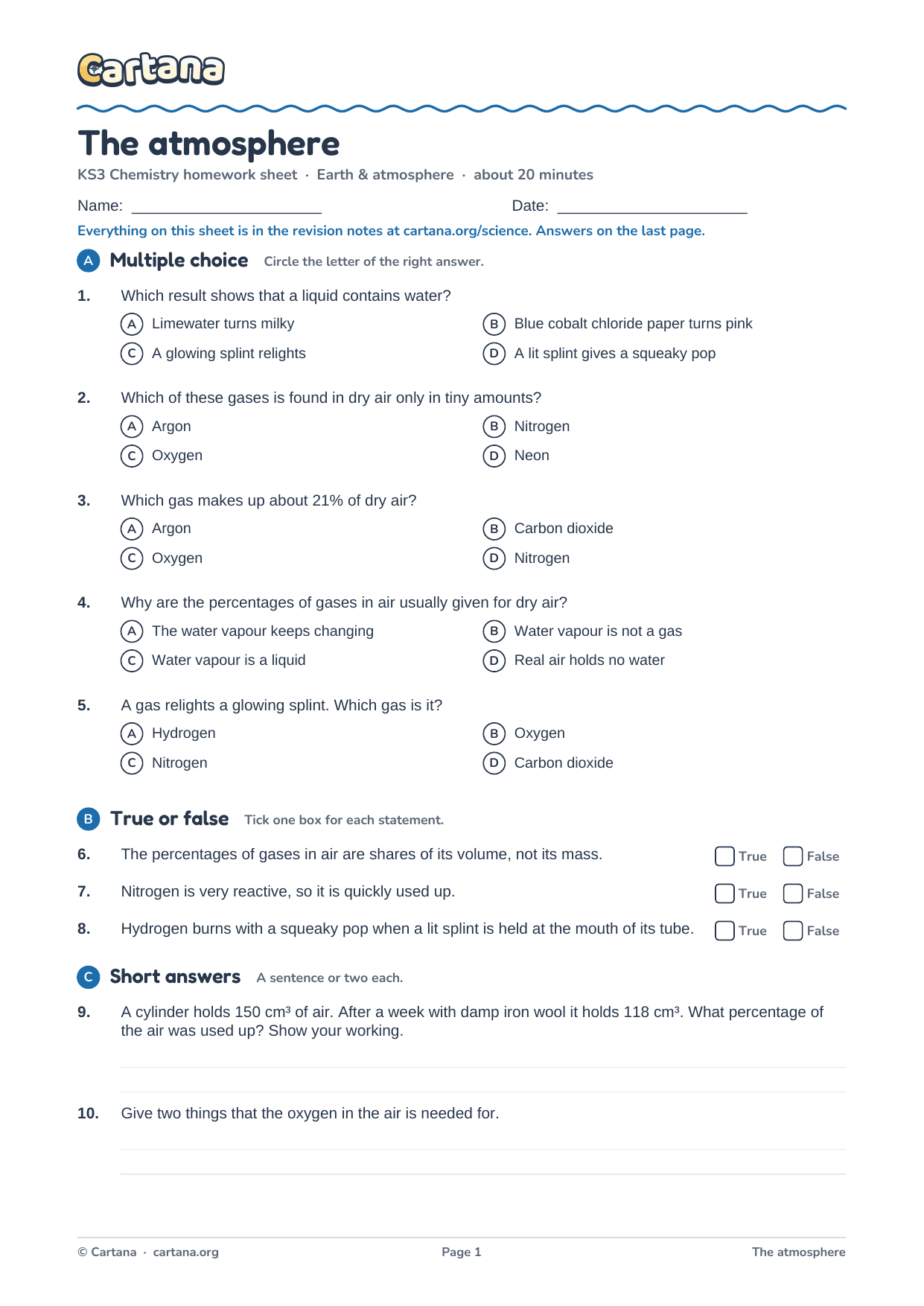
About twenty minutes. Everything on it is in the notes above; the answers are on the last page.
Free homework sheet
The atmosphere homework sheet
17 questions, about twenty minutes, with the answers on the last page: multiple choice, true or false, short answers, key words to define and one to explain in full.
KS3 Earth & atmosphere
Revised the whole unit?
When every topic in earth & atmosphere is done, two different papers test the whole unit, each with its own mark scheme.


 Watch the trailer · 1:06
New from Cartana · Beta test 1–31 December
Revision that feels like an adventure
Cartana is our KS3 learning adventure: sail between islands, answer quick-fire questions and battle bosses. It starts with science, with maths on the way, and launches in 2027. This December a small group of testers gets to play it first.
In the Cartana adventure, every science unit is an island to explore. The island for Earth & atmosphere is being built.
- Play the game before its official release
- Help us build it with your feedback
- Earn exclusive in-game items in return
More in this unit
Earth & atmosphere
- 1Structure of the EarthThe crust, mantle, outer core and inner core: what each is made of and like, and how earthquake waves show what is inside
- 2Types of rockHow igneous, sedimentary and metamorphic rocks form, what their grains, crystals, layers and fossils show, and how to tell them apart
- 3The rock cycleWeathering (physical, chemical and biological), erosion, transport, deposition, burial, uplift and melting, and following a rock round the cycle
- 5The carbon cycleNextThe stores of carbon and how carbon moves between them: photosynthesis, respiration, feeding, decay, combustion, dissolving and fossil fuels forming
- 6Climate changeThe greenhouse effect, carbon dioxide and methane from human activity, the measured evidence, the effects, and what reduces emissions
- 7Resources and recyclingWhy the Earth’s resources are limited, what getting them costs in energy and land, what recycling saves, and its limits