
KS3 Chemistry · Earth & atmosphere
Resources and recycling
- Why the Earth’s resources are limited: renewable and non-renewable
- What mining and quarrying cost in land, waste, energy and pollution
- What recycling aluminium, steel, glass and paper saves, with a worked example
- The limits of recycling, and reduce, reuse, recycle
- 4 min read
- 5 quick questions
- Free homework sheet
- Years 7 to 9
Revision notes
The Earth’s resources are the raw materials we take from it, such as metal ores, fossil fuels, sand and limestone. Most are limited, and recycling turns used materials into new products so that less has to be dug up.
Why are the Earth’s resources limited?
A non-renewable resource is one that formed over millions of years, or is fixed in the crust, so it is being used far faster than it can be replaced. Metal ores (rocks with enough metal in them to be worth extracting), fossil fuels and the minerals in rocks are all non-renewable. A renewable resource can be replaced within a human lifetime, such as wood from forests that are replanted, or cotton and wool.
The atoms in a used material are not destroyed. But once a metal is spread thinly, in rubbish tips or as rust, getting it back costs more than it is worth. Even common materials, such as the sand used for glass and concrete, are being dug up faster than nature makes them in many places.
What does it cost to get resources out of the ground?
- Land: mines and quarries (open pits where rock is dug out) scar the landscape and destroy habitats.
- Waste: an ore may hold only a few per cent of metal, or less, so a mountain of waste rock is left for every pile of metal.
- Energy: digging, crushing, transporting and extracting all use energy, mostly from fossil fuels, which adds carbon dioxide to the air. Getting aluminium out of its ore by electrolysis uses huge amounts of electricity (see extracting metals).
- Pollution: dust, noise, traffic and polluted water.
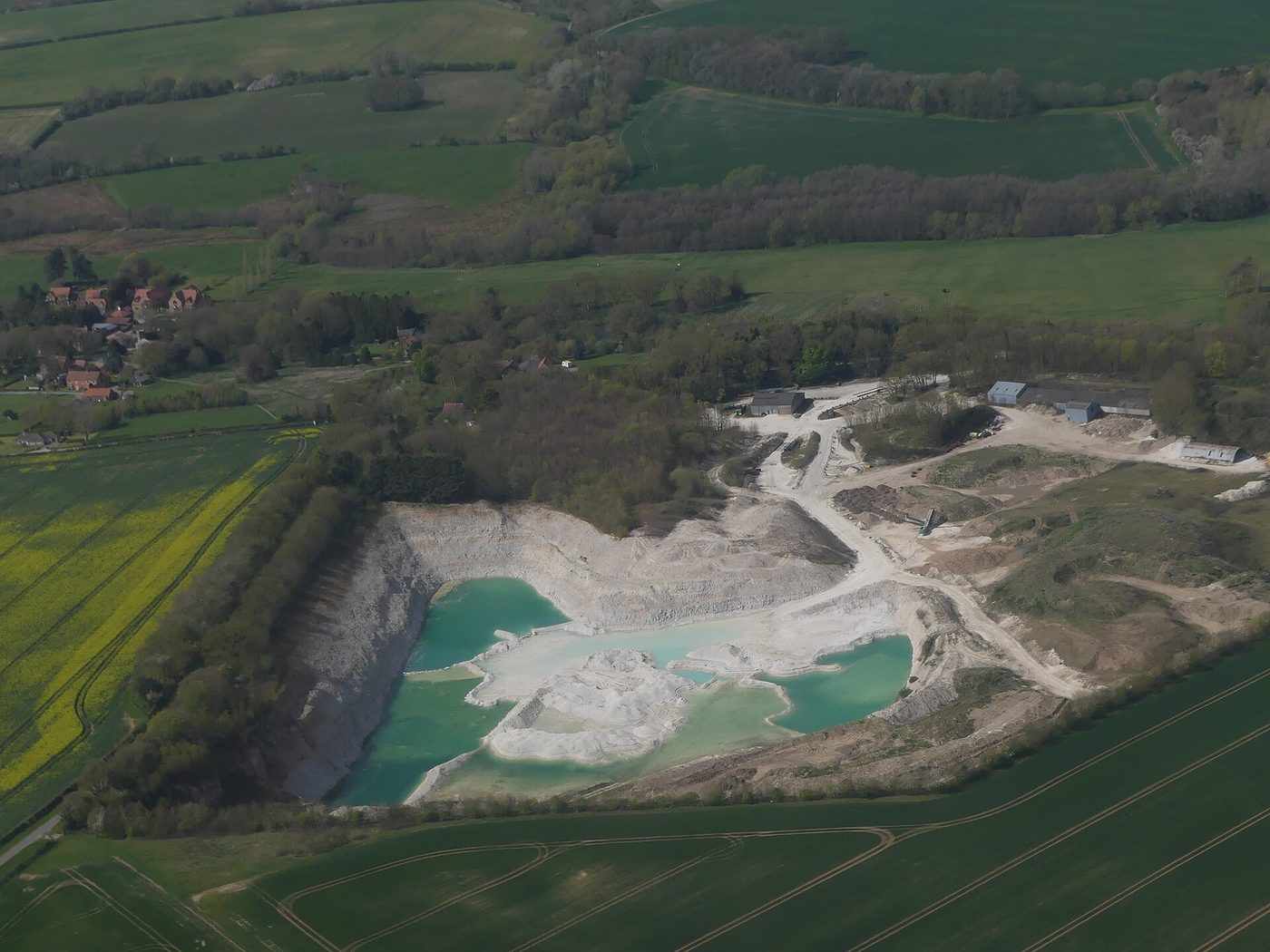
Mines and quarries also bring jobs and the materials everyone uses, so decisions about them weigh these costs against the benefits.
What does recycling save?
Recycling means collecting used materials and processing them so that they can be made into new products.
| Material | Made new from | What recycling saves |
|---|---|---|
| Aluminium | Bauxite, its ore, by electrolysis | About 95% of the energy: recycling uses only about 5% |
| Steel | Iron ore, coke and limestone | Ore, coal and energy; steel cans are easy to pick out with a magnet |
| Glass | Sand, sodium carbonate and limestone | Raw materials and energy: broken glass melts at a lower temperature than the raw materials |
| Paper | Wood from trees | Trees, water and energy |
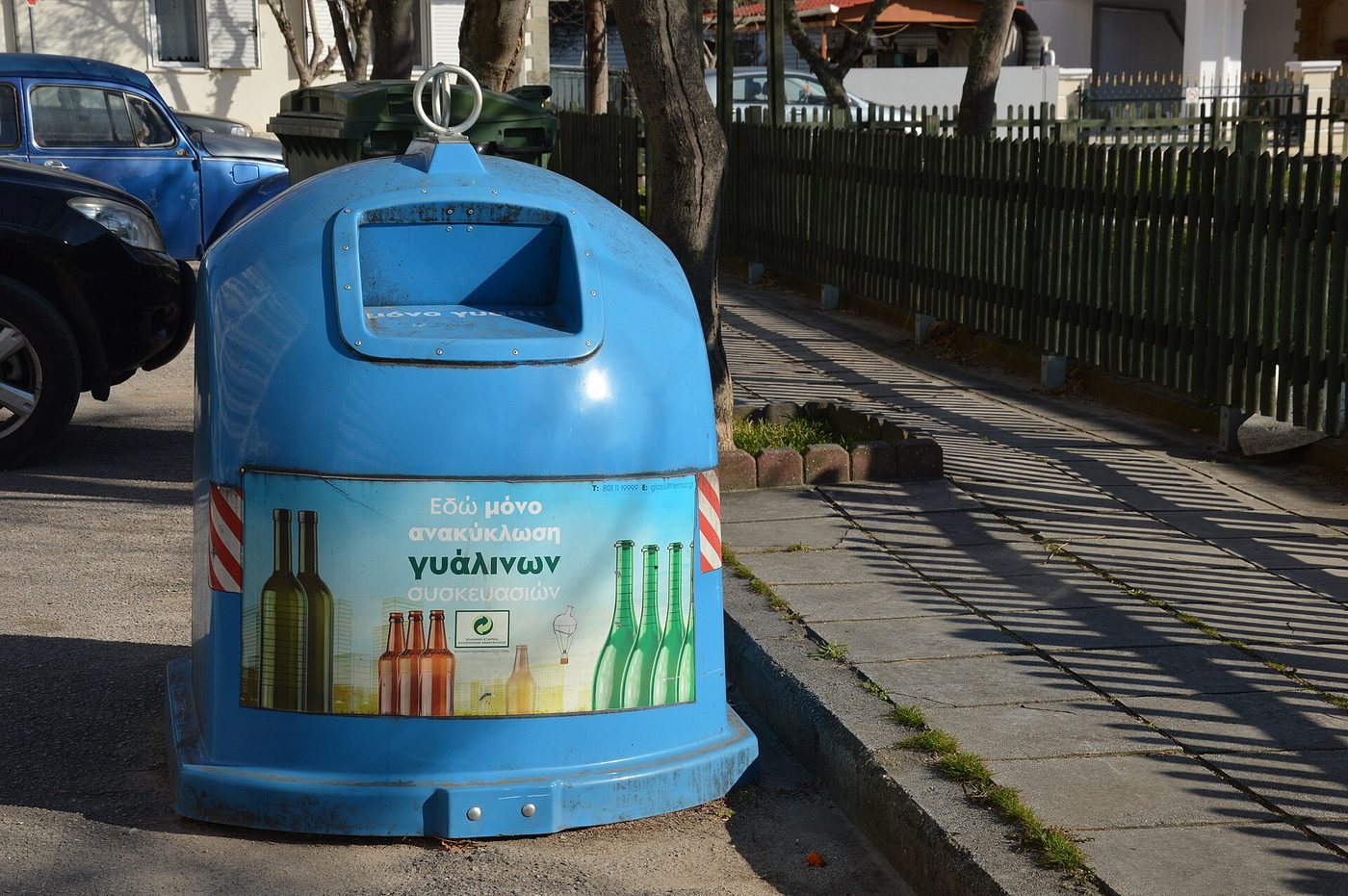
Aluminium and glass can be recycled again and again without getting worse. British Glass reports that every tonne of glass melted down again saves about 580 kg of carbon dioxide.
Making a batch of aluminium from ore uses 300 units of energy. Recycling uses 5% of that. How much energy does recycling save?
Energy for recycling = 5 ÷ 100 × 300 = 15 units
Energy saved = 300 − 15 = 285 units
Check: 285 ÷ 300 × 100 = 95%, as expected.
What are the limits of recycling?
- Collecting, sorting, cleaning and transporting used materials take energy and money.
- Materials must be sorted and clean: food left on cardboard, or the wrong plastic in the mix, can spoil a whole load.
- Some products, such as phones, hold many materials joined tightly together, which are hard to separate.
- Paper’s wood fibres get shorter each time it is recycled, so after about five to seven times they are too short to use (US Environmental Protection Agency), and new fibre has to be added.
That is why recycling comes third in “reduce, reuse, recycle”: using less in the first place, and reusing things, such as refilling a bottle, saves even more.
Stretch A life cycle assessment adds up the energy, raw materials and pollution for a product’s whole life: getting the raw materials, making it, using it and throwing it away or recycling it. It can give surprising answers: making a cotton shopping bag releases far more carbon dioxide than making a thin plastic one, so one UK Environment Agency study found the cotton bag only does better if it is used more than 100 times.
Written to the KS3 national curriculum. Last changed 14 November 2026.
Key words
Say them, spell them, use them in an answer.
- Earth’s resources
- non-renewable resource
- renewable resource
- ore
- quarry
- recycling
- bauxite
- reduce, reuse, recycle
Common misconception
Often said“Recycling uses no energy: the material just gets used again.”
In factCollecting, sorting, cleaning, transporting and melting down used materials all take energy. Recycling usually takes much less energy than making the material new, but it is not free. Using less and reusing things save even more.
Try 5 questions
Quick questions on resources and recycling, marked as you go. Each one explains the answer.
Question 1 of 5
About how much energy does recycling aluminium save, compared with making it from its ore?
Choose an answer. Each question explains itself.
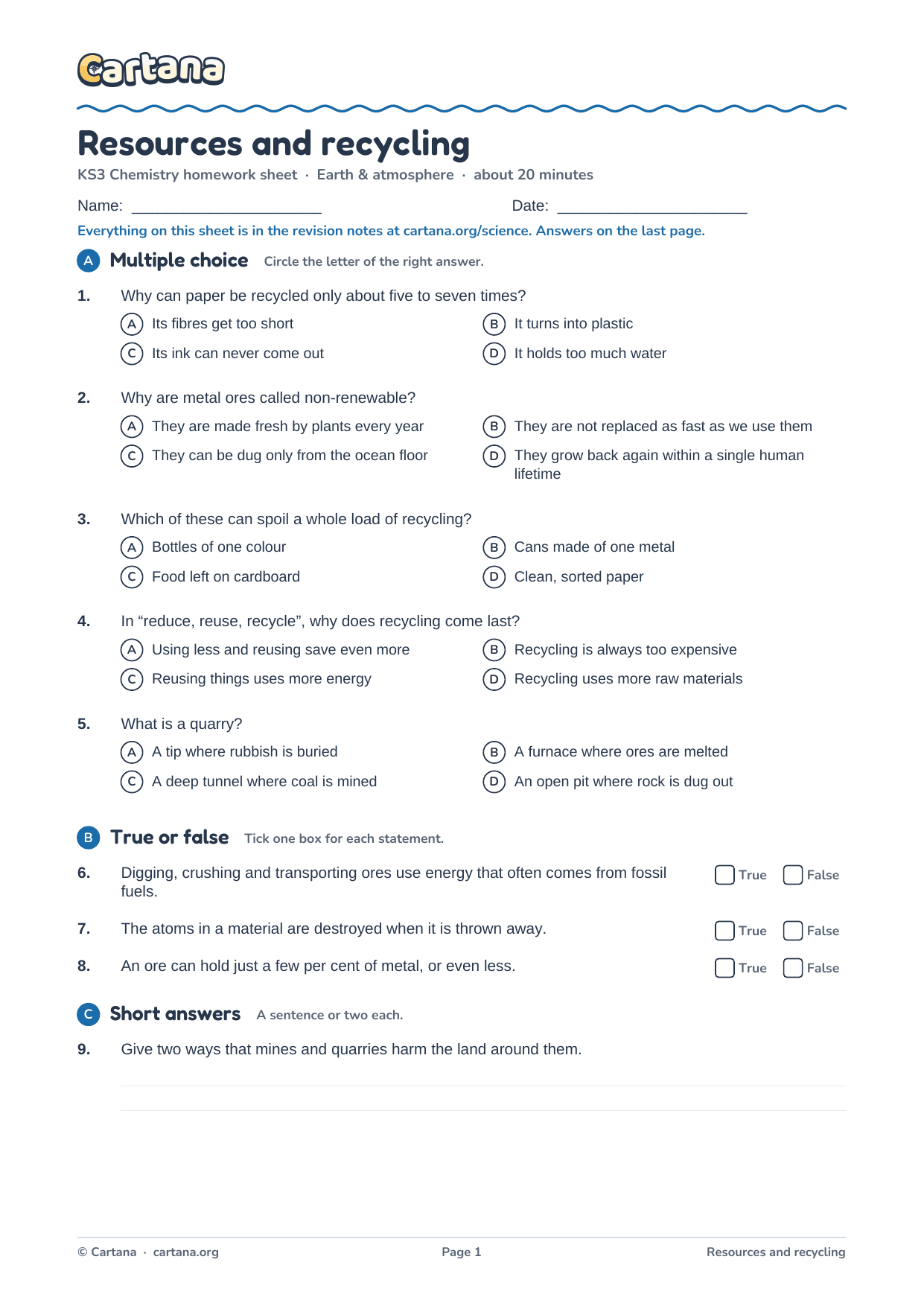
The homework sheet
About twenty minutes. Everything on it is in the notes above; the answers are on the last page.
Free homework sheet
Resources and recycling homework sheet
17 questions, about twenty minutes, with the answers on the last page: multiple choice, true or false, short answers, key words to define and one to explain in full.
KS3 Earth & atmosphere
Revised the whole unit?
When every topic in earth & atmosphere is done, two different papers test the whole unit, each with its own mark scheme.


 Watch the trailer · 1:06
New from Cartana · Beta test 1–31 December
Revision that feels like an adventure
Cartana is our KS3 learning adventure: sail between islands, answer quick-fire questions and battle bosses. It starts with science, with maths on the way, and launches in 2027. This December a small group of testers gets to play it first.
In the Cartana adventure, every science unit is an island to explore. The island for Earth & atmosphere is being built.
- Play the game before its official release
- Help us build it with your feedback
- Earn exclusive in-game items in return
More in this unit
Earth & atmosphere
- 1Structure of the EarthThe crust, mantle, outer core and inner core: what each is made of and like, and how earthquake waves show what is inside
- 2Types of rockHow igneous, sedimentary and metamorphic rocks form, what their grains, crystals, layers and fossils show, and how to tell them apart
- 3The rock cycleWeathering (physical, chemical and biological), erosion, transport, deposition, burial, uplift and melting, and following a rock round the cycle
- 4The atmosphereThe gases in dry air and their percentages, water vapour, where the oxygen came from, and the tests for gases
- 5The carbon cycleThe stores of carbon and how carbon moves between them: photosynthesis, respiration, feeding, decay, combustion, dissolving and fossil fuels forming
- 6Climate changeThe greenhouse effect, carbon dioxide and methane from human activity, the measured evidence, the effects, and what reduces emissions