
KS3 Physics · Energy
Work and machines
- Work done = force × distance, in joules
- Why no movement means no work
- Ramps, levers and pulleys trade force for distance
- Why no machine gives out more energy than goes in
- 5 min read
- 5 quick questions
- Free homework sheet
- Years 7 to 9
Revision notes
Work done is the energy transferred when a force moves an object: work done = force × distance moved in the direction of the force. It is measured in joules (J).
What is work done?
When a force makes something move, it transfers energy: the force does work. Kicking a ball transfers energy to its kinetic store, lifting a bag transfers energy to its gravitational store, and stretching a spring transfers energy to its elastic store.
Force in newtons (N) and distance in metres (m) give the work done in joules (J). One joule is the work done when a force of 1 N moves something 1 m.
You push a shopping trolley with a force of 50 N for 12 m. How much work do you do?
work done = force × distance
work done = 50 N × 12 m = 600 J
A bag weighs 40 N. How much work is done lifting it onto a shelf 1.5 m up?
To lift it steadily you need a force equal to its weight: 40 N.
work done = 40 N × 1.5 m = 60 J, now in the bag's gravitational store
No movement means no work. Holding a heavy bag still does no work on the bag, even though your arms get tired.
How do simple machines make jobs easier?
A simple machine, such as a ramp, a lever or a pulley, lets a small force do a job that needs a big one. The catch: the small force has to move a bigger distance. Force × distance stays the same, so the work done, the energy transferred, is unchanged.
- A ramp: pushing a box up a long, gentle slope takes less force than lifting it, over a longer distance (see the figure above).
- A lever: a small push far from the pivot gives a big force near it, as in a crowbar (see moments).
- A pulley: one fixed pulley only changes the direction of the force, so you can pull down to lift up. Add a pulley that moves with the load (a moving pulley), and two ropes hold it up: you need half the force, but pull twice as much rope.
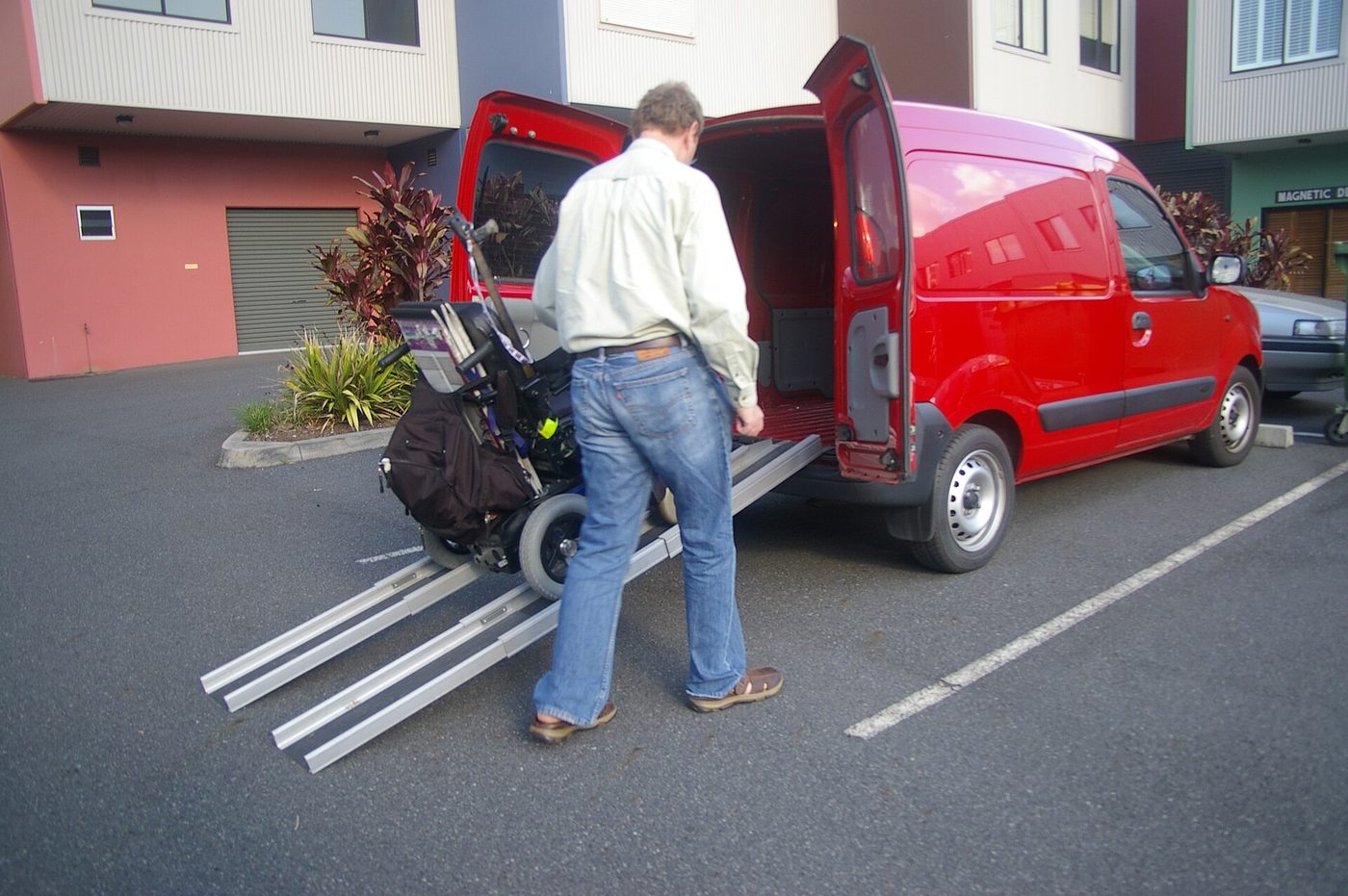
Some machines work the other way round, giving a smaller force over a bigger distance. In your arm, the biceps pulls a few centimetres close to the elbow, and your hand moves much further.
Can a machine give out more energy than you put in?
No. Energy is conserved, so the work a machine does can never be more than the work done on it. In a real machine, friction wastes some energy by heating, so you always put in a little more work than you get out (see conservation of energy).
You can test this with a ramp:
- Hang a toy trolley on a newton meter to find its weight, then work out the work done lifting it straight up to the top of the ramp: weight × height.
- Pull it steadily up the ramp with the newton meter, read the force and measure the ramp's length. Work done = force × length.
- Compare the two. The force up the ramp is smaller, but the work done is a little bigger, because of friction.
Stretch Engineers compare machines by their mechanical advantage: the force out ÷ the force in. The crowbar above has a mechanical advantage of 600 N ÷ 100 N = 6, and the pulley system 200 N ÷ 100 N = 2. A big mechanical advantage always means a big distance to move the force in.
Written to the KS3 national curriculum. Last changed 15 November 2026.
Key words
Say them, spell them, use them in an answer.
- work done
- joule
- simple machine
- ramp
- lever
- pulley
- fixed pulley
- moving pulley
Common misconception
Often said“If I push really hard on a wall, I'm doing a lot of work on it.”
In factWork is done on an object only when a force moves it. The wall does not move, so no work is done on it. Your muscles still transfer energy from their chemical store, but it all ends up heating your body.
Try 5 questions
Quick questions on work and machines, marked as you go. Each one explains the answer.
Question 1 of 5
How do you calculate work done?
Choose an answer. Each question explains itself.
The homework sheet
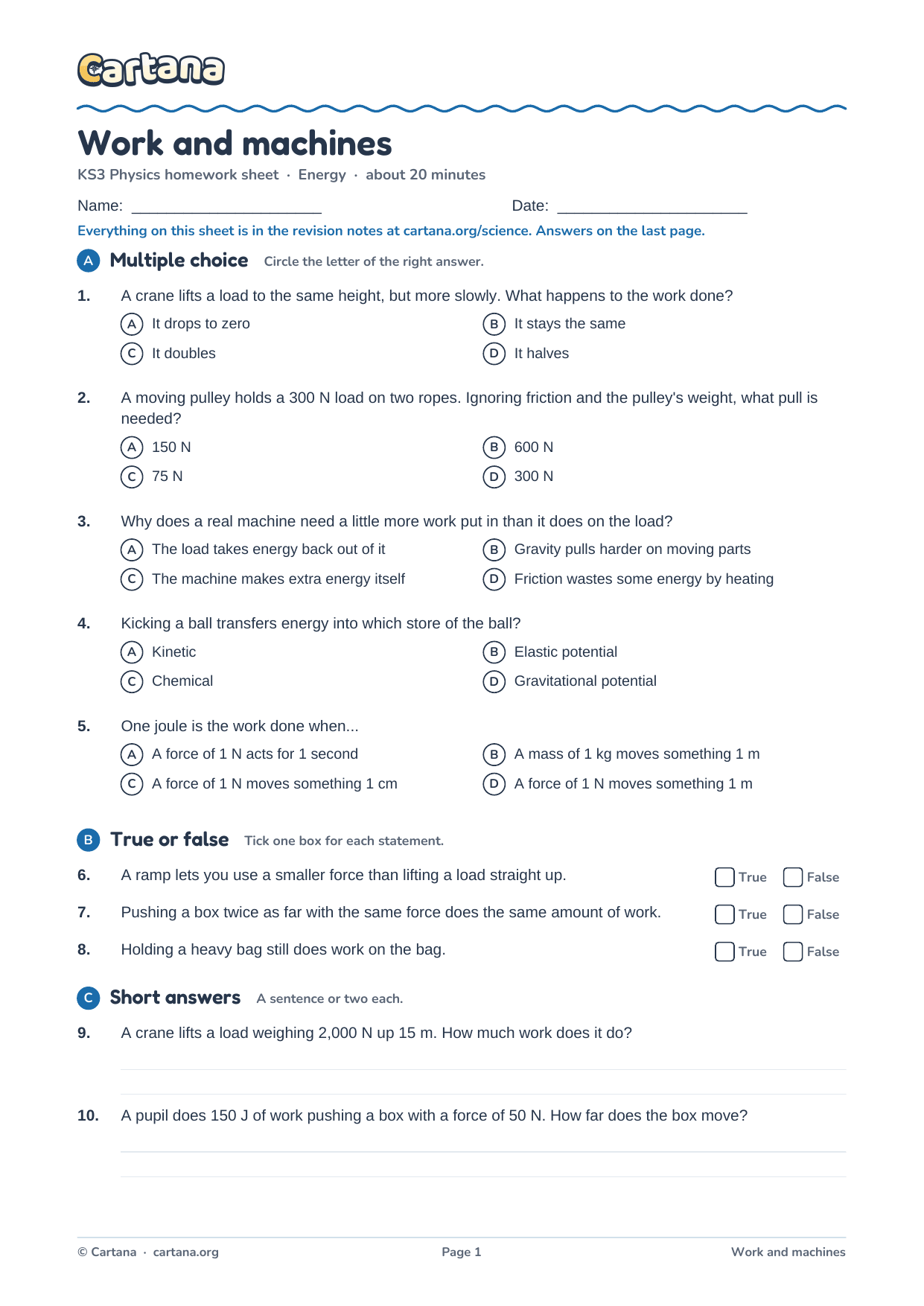
About twenty minutes. Everything on it is in the notes above; the answers are on the last page.
Free homework sheet
Work and machines homework sheet
17 questions, about twenty minutes, with the answers on the last page: multiple choice, true or false, short answers, key words to define and one to explain in full.
KS3 Energy
Revised the whole unit?
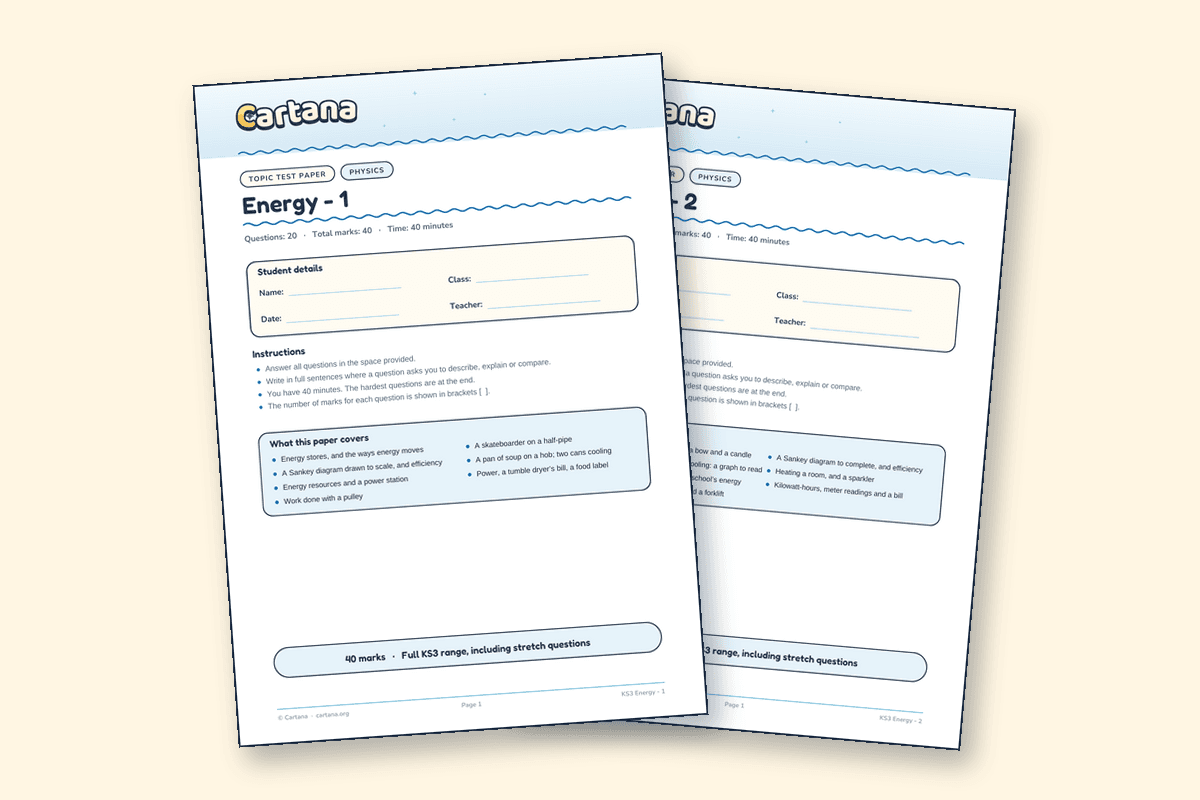
When every topic in energy is done, two different papers test the whole unit, each with its own mark scheme.


 Watch the trailer · 1:06
New from Cartana · Beta test 1–31 December
Revision that feels like an adventure
Cartana is our KS3 learning adventure: sail between islands, answer quick-fire questions and battle bosses. It starts with science, with maths on the way, and launches in 2027. This December a small group of testers gets to play it first.
In the Cartana adventure, every science unit is an island to explore. The island for energy is being built.
- Play the game before its official release
- Help us build it with your feedback
- Earn exclusive in-game items in return
More in this unit
Energy
- 1Energy stores and transfersThe energy stores, the four ways energy is transferred, and describing a change by its start and end
- 2Conservation of energyEnergy is never made or destroyed; useful and wasted energy, dissipation, Sankey diagrams and efficiency
- 3Heating and coolingTemperature and thermal energy, hot to cold until thermal equilibrium, conduction, convection, radiation and insulators
- 4Energy resourcesFossil fuels, nuclear fuel and renewables, how a power station works, the UK's electricity and comparing resources fairly
- 5Power and energy billsPower in watts and kilowatts, energy = power × time, the kilowatt-hour, working out a bill, and energy in food