
KS3 Physics · Energy
Heating and cooling
- Temperature and thermal energy are not the same thing
- Hot to cold until thermal equilibrium, and cooling curves
- Conduction, convection and radiation
- How insulators work, and the practical to compare them
- 4 min read
- 5 quick questions
- Free homework sheet
- Years 7 to 9
Revision notes
Heating is an energy transfer from a hotter object to a cooler one, caused by the difference in their temperatures. It goes on until both reach the same temperature, which is called thermal equilibrium.
What is the difference between temperature and thermal energy?
Temperature is how hot something is, measured in degrees Celsius (°C) with a thermometer. Thermal energy is the energy in an object's thermal store, from the movement of its particles. It is the part of the object's internal energy that rises with temperature. It depends on the temperature, but also on how much there is. A bath of water at 40 °C is cooler than a cup of tea at 80 °C, yet holds far more thermal energy, because it has hundreds of times more water.
Why does a hot drink cool down?
Energy is transferred by heating from a hotter object to a cooler one, never the other way on its own. A hot drink loses energy to the cooler room; its temperature falls while the room warms very slightly. When the two are at the same temperature they are in thermal equilibrium, and there is no more overall transfer. A cold drink warms up in a warm room for the same reason.
The bigger the temperature difference, the faster the energy is transferred. So a drink cools quickly at first and more and more slowly as it nears room temperature.
What are conduction, convection and radiation?
- Conduction happens mainly in solids. Particles at the hot end vibrate more, knock into their neighbours and pass energy along. The particles stay where they are: only the energy moves. Metals are the best conductors.
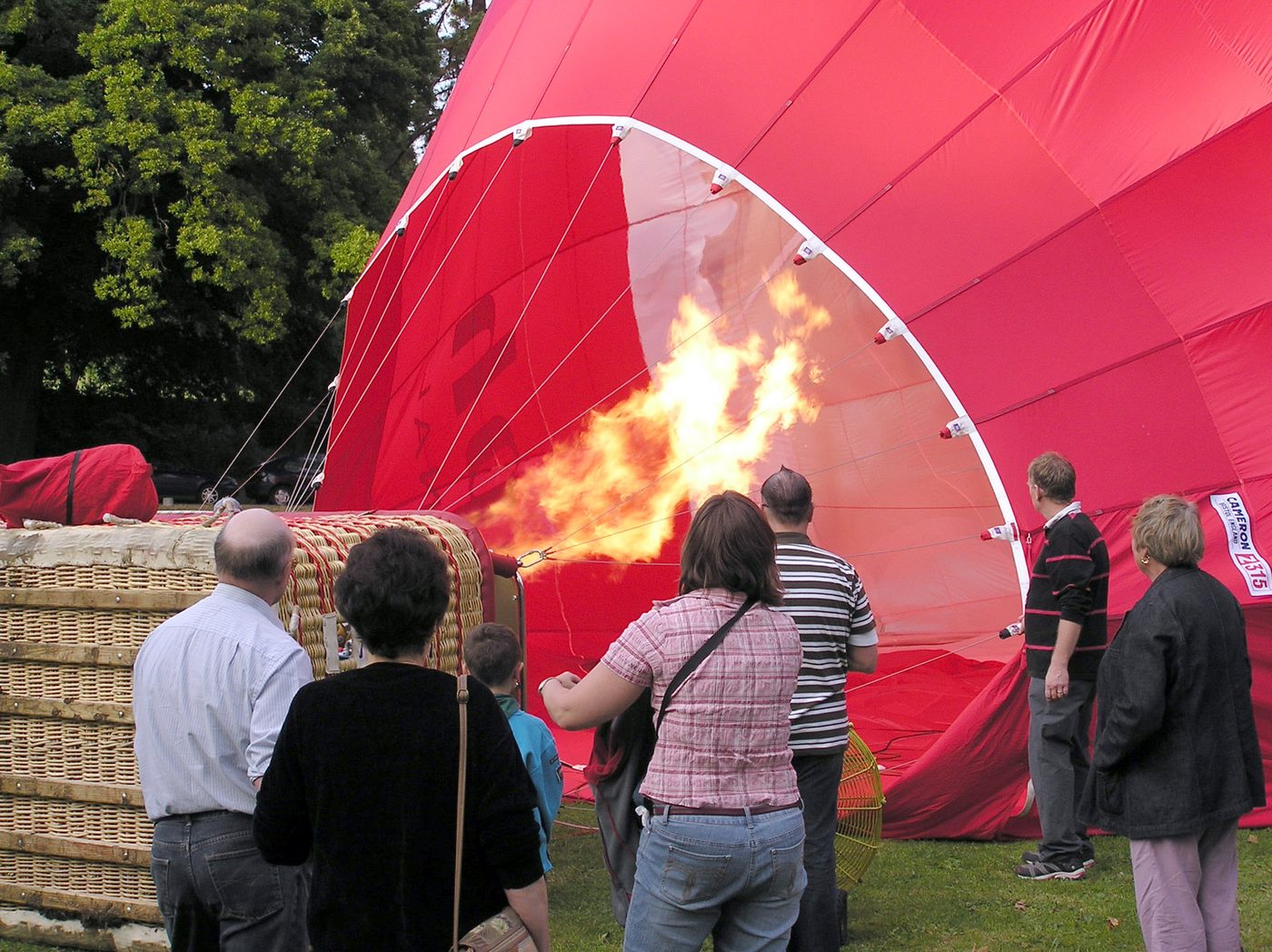
- Convection happens in liquids and gases. Warmed fluid expands (its particles move faster and spread out; they do not get bigger), so it becomes less dense and rises. Cooler, denser fluid sinks to take its place. This loop is a convection current.
- Radiation is energy carried by infrared waves. It needs no particles, so it crosses empty space: that is how the Sun warms the Earth. Everything gives out infrared, and hotter objects give out more. Dark, dull surfaces absorb and give out infrared best; light, shiny surfaces reflect it.
How do insulators keep things warm?
A thermal conductor lets energy pass through it quickly; a thermal insulator slows it down. Metals such as copper and aluminium are good conductors. Air, wool, plastic, wood and polystyrene are good insulators.
Most insulation works by trapping air. Air conducts very badly, and trapped air cannot move to set up convection currents. Loft insulation, a woolly jumper, a bird's fluffed-up feathers and the gap in double glazing all work this way. An insulator only slows the transfer: it keeps a cold drink cold as well as a hot one hot. A vacuum flask has two walls with a vacuum between them (no particles, so no conduction or convection) and shiny walls that reflect infrared.
A classic practical: which material insulates best?
- Pour the same volume of hot water, at the same starting temperature, into identical beakers.
- Wrap each beaker in a different material of the same thickness. Leave one bare to compare with.
- Read each temperature every 2 minutes for 20 minutes, and plot a cooling curve for each.
- The water that cools most slowly is wrapped in the best insulator. Keeping everything else the same makes it a fair test (see variables).
Stretch Why are metals such good conductors? As well as vibrating particles, a metal has electrons that are free to move through it. They carry energy from the hot end to the cold end much faster than vibrations can be passed along, which is why a metal spoon in hot tea soon feels hot.
Written to the KS3 national curriculum. Last changed 15 November 2026.
Key words
Say them, spell them, use them in an answer.
- heating
- temperature
- thermal energy
- thermal equilibrium
- conduction
- convection
- convection current
- infrared
- conductor
- insulator
Common misconception
Often said“Ice cubes cool a drink by giving it their cold.”
In factThere is no such thing as "cold" flowing. Energy flows by heating from the warmer drink to the colder ice, so the drink cools and the ice warms and melts, until they reach the same temperature.
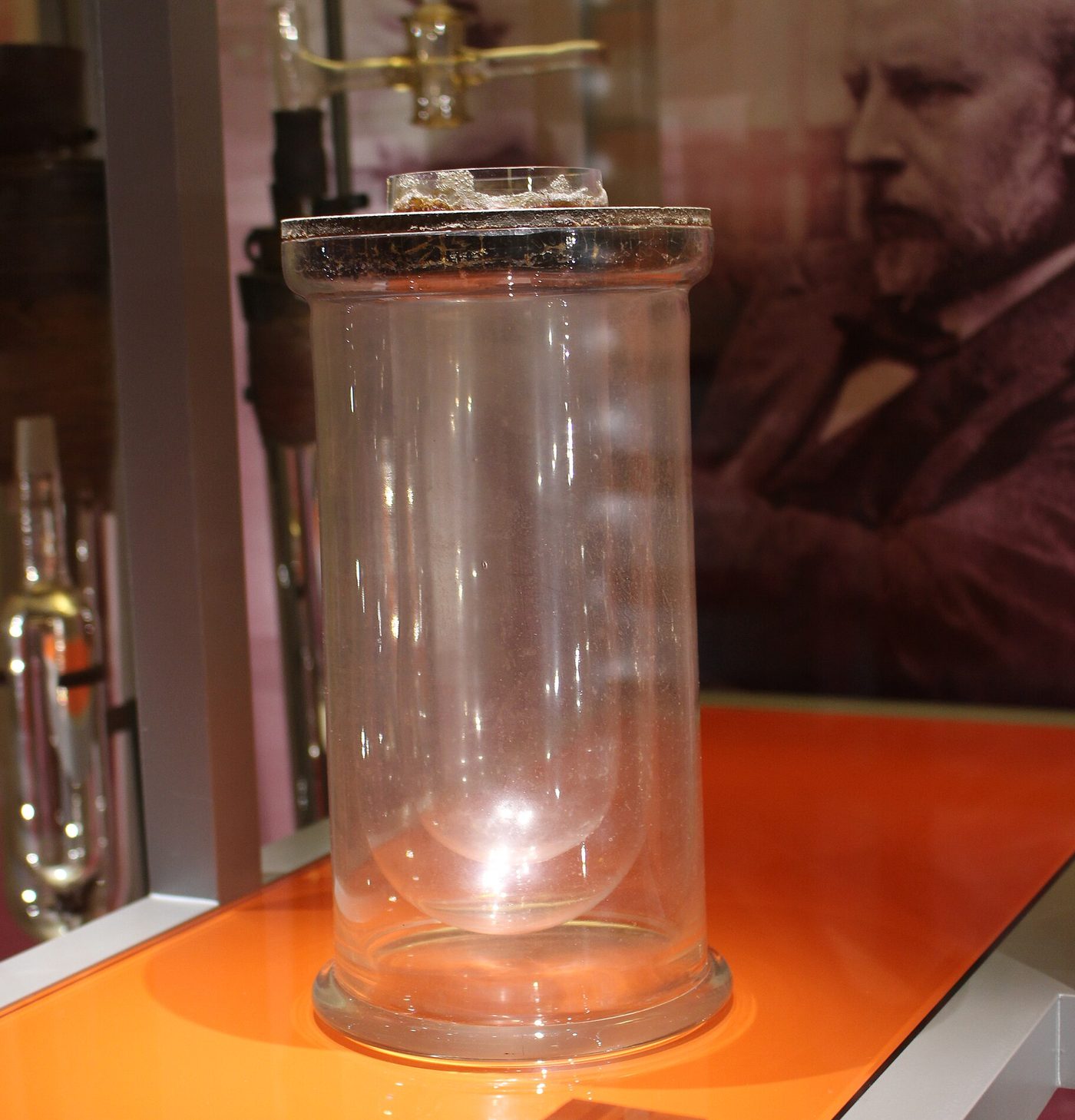
Did you know?
The vacuum flask
The vacuum flask was invented in 1892 by the Scottish scientist James Dewar to keep very cold liquefied gases cold. Only later was it sold for keeping tea and soup hot: an insulator slows energy transfer in both directions.
Photo: Vera de Kok, CC BY 4.0, via Wikimedia Commons
Try 5 questions
Quick questions on heating and cooling, marked as you go. Each one explains the answer.
Question 1 of 5
What is thermal equilibrium?
Choose an answer. Each question explains itself.
The homework sheet
About twenty minutes. Everything on it is in the notes above; the answers are on the last page.
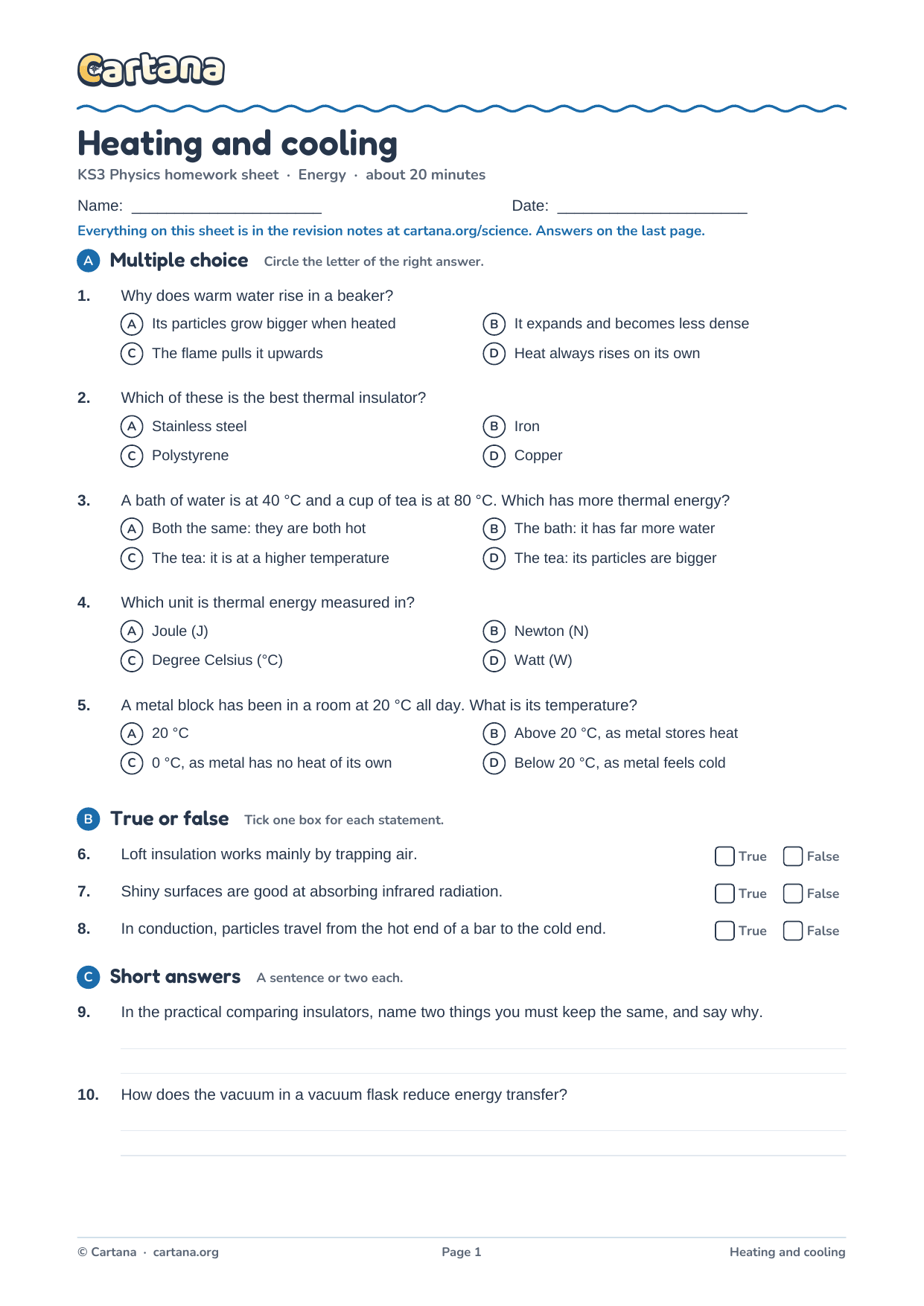
Free homework sheet
Heating and cooling homework sheet
17 questions, about twenty minutes, with the answers on the last page: multiple choice, true or false, short answers, key words to define and one to explain in full.
KS3 Energy
Revised the whole unit?
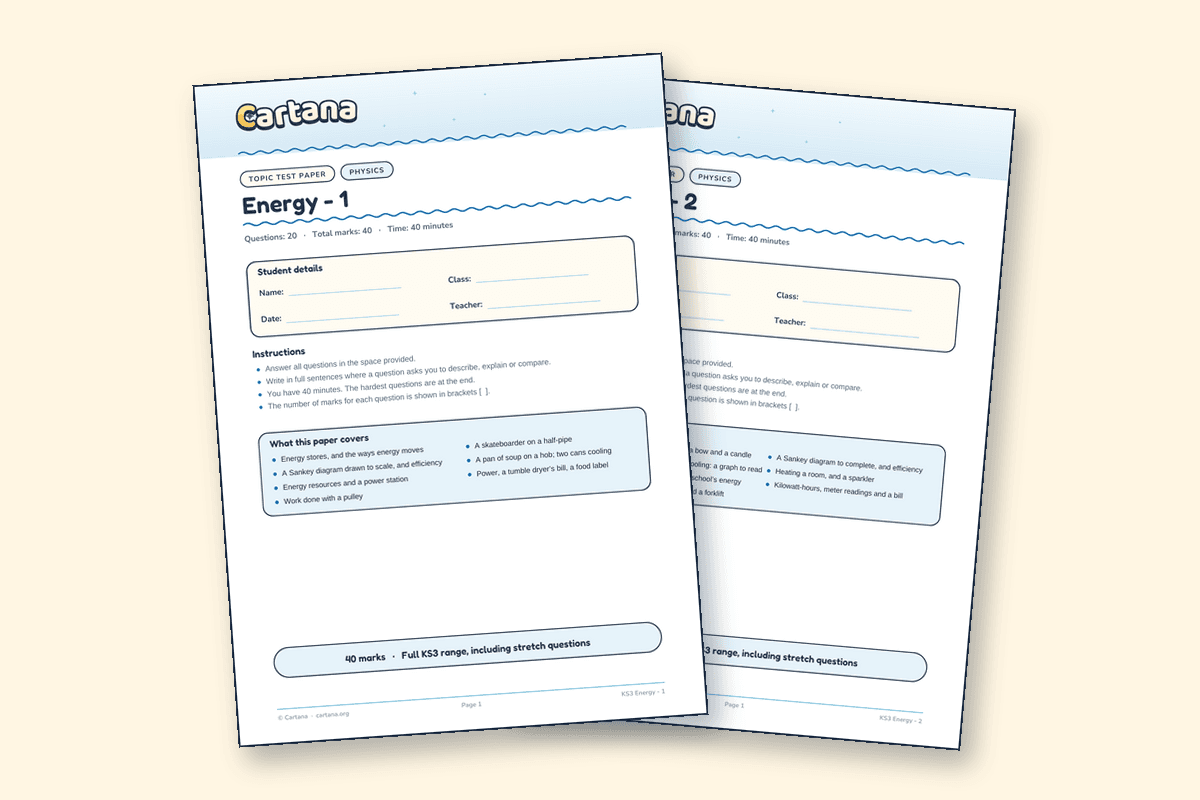
When every topic in energy is done, two different papers test the whole unit, each with its own mark scheme.


 Watch the trailer · 1:06
New from Cartana · Beta test 1–31 December
Revision that feels like an adventure
Cartana is our KS3 learning adventure: sail between islands, answer quick-fire questions and battle bosses. It starts with science, with maths on the way, and launches in 2027. This December a small group of testers gets to play it first.
In the Cartana adventure, every science unit is an island to explore. The island for energy is being built.
- Play the game before its official release
- Help us build it with your feedback
- Earn exclusive in-game items in return
More in this unit
Energy
- 1Energy stores and transfersThe energy stores, the four ways energy is transferred, and describing a change by its start and end
- 2Conservation of energyEnergy is never made or destroyed; useful and wasted energy, dissipation, Sankey diagrams and efficiency
- 4Energy resourcesNextFossil fuels, nuclear fuel and renewables, how a power station works, the UK's electricity and comparing resources fairly
- 5Power and energy billsPower in watts and kilowatts, energy = power × time, the kilowatt-hour, working out a bill, and energy in food
- 6Work and machinesWork done = force × distance; levers, ramps and pulleys trade force for distance; no machine gives out more energy than goes in